TL;DR
- A granite countertop warehouse sells natural stone slabs straight to homeowners and fabricators, often 20 to 40% below retail showroom prices.
- You walk the yard, tag the exact slabs you want, then a fabricator cuts and installs them.
- The trick is knowing how slab pricing works, which questions to ask, and how to avoid tagging a slab that won't match your kitchen.
What is a granite countertop warehouse and how does it work?
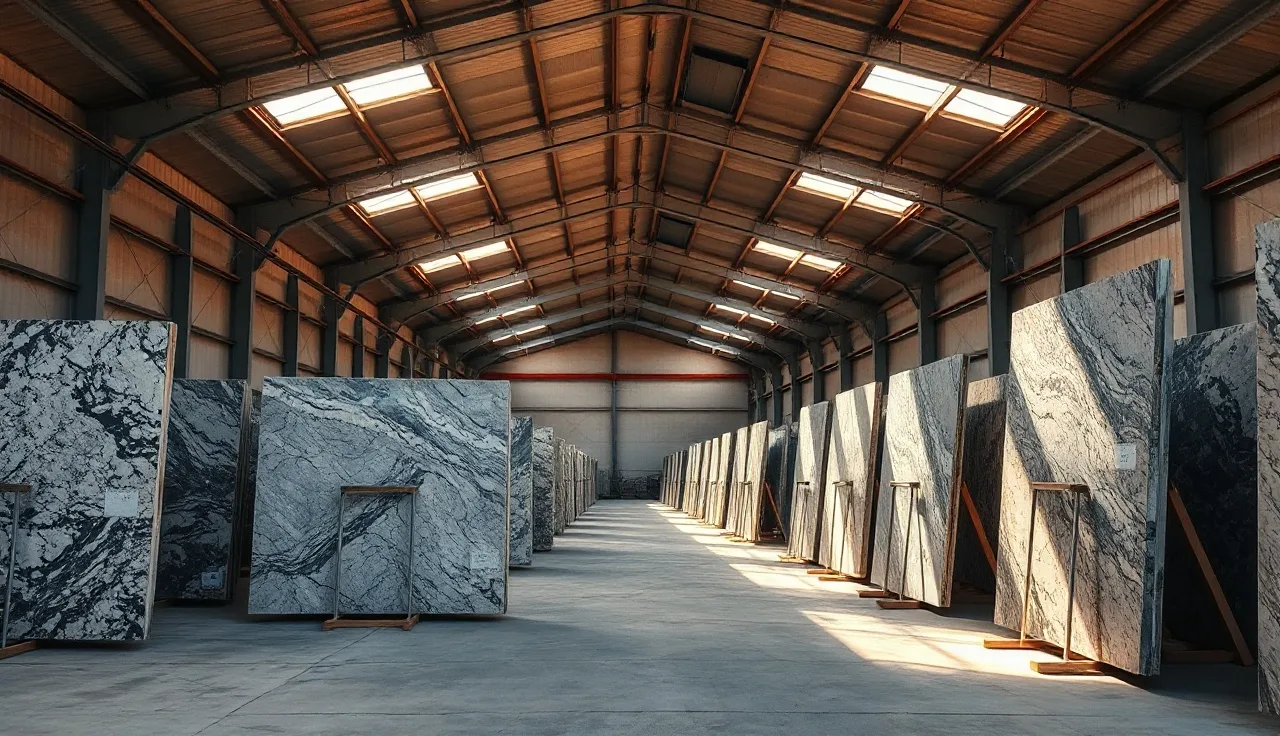
A granite countertop warehouse is a stone importer or distributor that keeps hundreds to thousands of slabs on site, usually in a large yard or a climate-controlled indoor space. A kitchen showroom hands you a small sample tile and asks you to imagine the rest. A warehouse lets you walk the actual slabs, standing upright in A-frame racks, and see exactly what you're buying.
The supply chain runs like this. Quarries in Brazil, Italy, India, China, and elsewhere cut raw granite into slabs, typically 9 to 10 feet long and 5 to 6 feet wide, with jumbo slabs running larger. Importers buy containers of these slabs, ship them to regional distribution warehouses, and sell to fabricators or straight to the public. That shorter path cuts out a middleman or two, which is why warehouse prices land well below a retail showroom's.
Most warehouses price granite by the square foot of finished countertop. Some still sell by the bundle, which is a group of slabs from the same quarry block kept together for color matching. When you buy direct, you'll usually still need a licensed fabricator to template, cut, and install the stone. The warehouse sells the material. Fabrication is a separate line item.
The visit itself earns its keep. Two slabs of the same granite color from different quarry blocks can look like two different stones. Picking yours in person kills off a big source of install-day surprises.
How much does granite from a warehouse actually cost compared to retail?
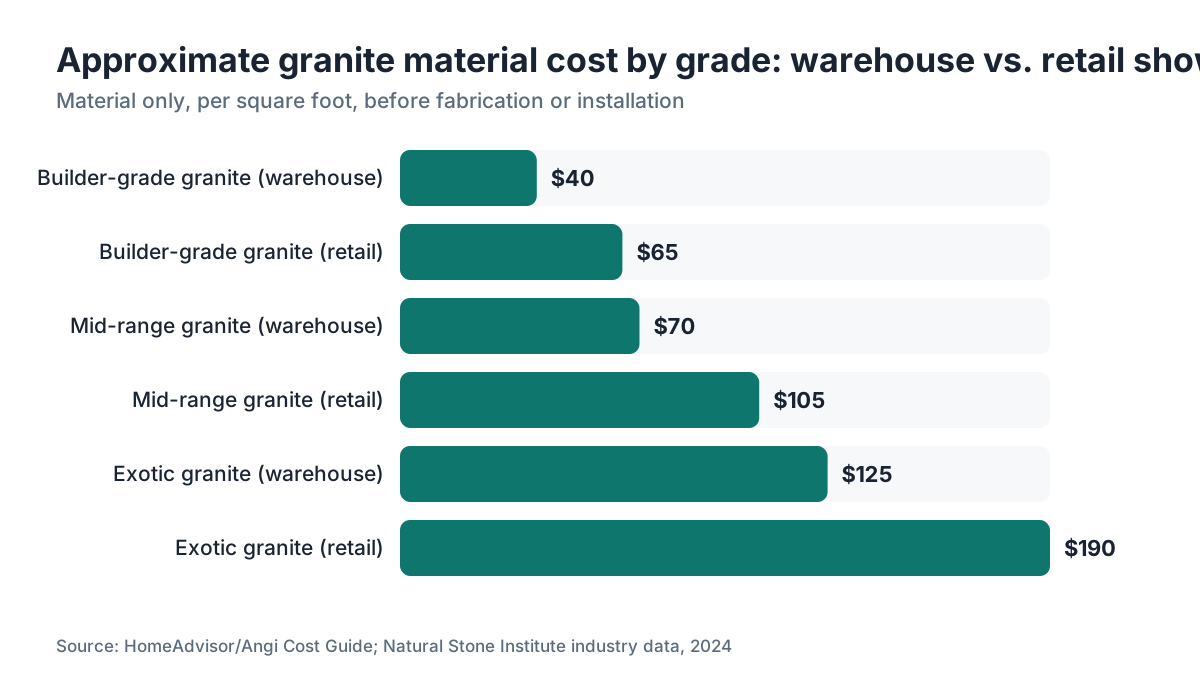
Warehouse granite runs $40 to $100 per square foot for material alone, with entry-level commercial grades starting near $30 and exotic colors pushing past $150. [1] Retail showrooms buy from the same distributors, then add markup and overhead, so the identical material commonly lands at $60 to $150 per square foot before any fabrication.
Total installed cost covers material plus fabrication plus installation, and it swings hard. Survey data from the National Kitchen and Bath Association puts a standard-kitchen countertop project between $2,800 and $8,000, with granite sitting in the middle of that band. [2] Buying material at warehouse prices can knock $500 to $2,000 off a typical project, but only if your fabricator will work with customer-supplied stone. Plenty won't, because they lose the margin they'd otherwise make on the slab.
Here's the comparison most people miss. A fabricator who buys from that same warehouse and resells you the slab at a markup can still beat a retail showroom package, because the fabricator's markup usually runs thinner than the showroom's. So shopping a warehouse on your own makes the most sense when you plan to buy material yourself and then collect competitive fabrication quotes separately.
The table below shows rough material-only ranges by stone type at the wholesale level, based on pricing published by major North American distributors.
| Stone type | Warehouse material cost ($/sq ft) | Retail showroom material cost ($/sq ft) |
|---|---|---|
| Builder-grade granite | $30 to $50 | $50 to $80 |
| Mid-range granite | $55 to $85 | $80 to $130 |
| Exotic granite | $90 to $160 | $130 to $250 |
| Quartzite | $65 to $120 | $100 to $180 |
| Marble | $60 to $130 | $100 to $200 |
These are broad ranges. Regional demand, import freight, and each warehouse's own pricing structure all move the numbers. Ask every warehouse for their current price sheet before you assume anything. [1]
What should you look for when walking a granite warehouse?
Bring your kitchen measurements, a tape measure, and photos of your cabinets and flooring. Warehouse yard lighting is harsh and direct, and that's a gift: it shows veining, pitting, and fissures far more plainly than the flattering light in a showroom.
Check the back of the slab, more than the polished face. Mesh backing, hairline cracks, and heavy filler epoxy all show from behind, and they tell you how sound the slab really is. A little epoxy fill in natural stone is normal and not a structural problem. A slab patched heavily across large areas is one to skip.
Look for consistent thickness. Standard slabs are 3 cm (about 1.2 inches) thick. Slabs of 2 cm exist but need a plywood substrate for support. Run your hand across a few slabs from the same lot. Noticeable thickness variation inside a single slab makes a fabricator's job of setting a level surface a lot harder.
Ask to see the bundle. Granite comes out of the quarry in blocks, then gets sliced into sequential slabs, and adjacent slabs bookmatch each other, mirroring the veining. If your kitchen needs more than one slab, you want them from the same bundle. Warehouses track bundles by lot or batch number. If nobody can tell you which bundle a slab came from, treat that as a warning.
Ask about the return and damage policy before you tag a thing. Most warehouse sales go final the moment a slab is cut, but the fine print varies a lot.
What is T&L Granite countertop warehouse and how does it compare?
T&L Granite is a regional granite and stone warehouse that has picked up a following among both homeowners and fabricators for stocking a broad slab selection at direct-import prices. Like most regional stone warehouses, T&L's model rests on walking inventory, competitive slab pricing, and working with the buyer's chosen fabricator, or sometimes offering fabrication in-house.
When you size up any warehouse, T&L included, run the same checklist. Ask how many slabs they stock (larger operations hold 500 to 3,000 or more), whether they track bundles, what the minimum purchase is, and whether they sell to homeowners directly or require you to arrive with a fabricator. Some warehouses are trade-only and sell strictly to licensed contractors or fabrication shops.
The honest answer is that the best warehouse for you is usually the one closest to your fabricator, because stone freight is not cheap. A warehouse 300 miles out might beat everyone on price per square foot, then $150 to $300 in freight erases the savings on a modest kitchen. [3] Local inventory you can walk, with a short delivery window, usually wins.
The buying process is the same everywhere. Walk the yard, tag your slabs, get a weight ticket or slab ID number, then have your fabricator confirm the quantity needed before the warehouse cuts or reserves anything.
How do granite slabs get priced, and what are the grading levels?
No industry standard governs granite grading, so the labels you'll see, like Level 1, Level 2, Level 3, or Entry, Mid, Premium, are made up by each warehouse. One warehouse's Level 2 is another's Level 3. That matters because shoppers compare by tier name and then get confused when the same look carries a different level at the next supplier.
Four things actually drive the price. Rarity of the color (how hard is it to source), visual complexity (unusual movement or veining costs more), country of origin and its freight, and current import market conditions. Brazilian granites have long priced below comparable Italian stones, partly because Brazil quarries in huge volume and its shipping lanes to North America are well worn. [4]
Thickness moves the price too. A 3 cm slab costs 20 to 30% more than a 2 cm slab of the same material, and it's the standard for residential countertops because it skips the substrate buildup.
Finish counts as well. Polished is the default and the most common. Honed (matte) and leathered (textured) finishes take extra processing and often add $5 to $15 per square foot to the material price.
When you get a quote, ask for it broken out: material per square foot, any processing fee (hone, leather, edge profile), and delivery or freight. One bundled number makes real comparison shopping impossible.
Can you buy granite directly from a warehouse as a homeowner?
Yes. Most stone warehouses sell to the public, though some run trade-only and require a contractor or fabricator account to buy. Call ahead before you make the drive.
For a homeowner buying direct, the catch is that you still need a fabricator to cut and install the stone. If your fabricator charges a premium for working with customer-supplied material, which is a common policy, the math may stop favoring the direct buy. Get your fabricator's position on this before you go slab shopping.
Going to the warehouse with your fabricator is often the smartest move. The fabricator knows the exact square footage, builds waste into the template layout, and reads slab quality with a trained eye. Many shops keep a standing relationship with one or two warehouses and can pull good pricing for a client without the homeowner negotiating a thing.
Some warehouses run a design service where a staffer helps you pair slabs against a cabinet and floor sample. That service comes and goes by location. To compare the full menu of countertop materials you might find at a warehouse, the granite countertops guide digs into granite's properties, and the kitchen countertops overview helps you weigh granite against other surfaces.
Want a fast cost read before you walk any warehouse? SlabWise's instant quote tool takes your measurements and returns a material-plus-fabrication estimate without you leaving your desk.
How do you calculate how many slabs you need for a kitchen?
Start with total countertop square footage. Measure the length of each run in inches, multiply by the depth (usually 25 inches for a standard counter), and convert to square feet. A typical U-shaped kitchen runs 40 to 60 square feet of surface.
Now add the waste factor. Granite gets cut from large slabs, and your fabricator has to work around slab dimensions, veining direction if you're matching pattern, sink cutouts, and corner angles. A standard waste factor is 15 to 20% for a straightforward kitchen, climbing to 25 to 30% for a complex layout with an island, diagonal cuts, or a tight veining match. [5]
A standard granite slab is roughly 9 feet by 5 feet, about 45 square feet of usable surface. For a 55-square-foot kitchen at 20% waste, you need around 66 square feet of slab, which means one full slab plus, often, a partial second slab from the same bundle for color continuity.
Your fabricator should hand you a cut sheet or layout drawing showing exactly how the slabs get used. If they don't, ask. Seeing the layout early catches trouble: a seam running straight through the cooking zone, or a piece that barely fits and leaves no room for error.
Here's a rough slab count guide by kitchen size.
| Kitchen size | Approx. countertop sq ft | Slabs needed (3cm, standard) |
|---|---|---|
| Small galley | 25 to 35 | 1 |
| Medium L-shape | 40 to 55 | 1 to 2 |
| Large U-shape with island | 60 to 85 | 2 to 3 |
| Large open kitchen | 90 to 120 | 3 to 4 |
What are the most popular granite colors and how do warehouse prices vary by origin?
The steadiest sellers in North American warehouses are Bianco Romano (white with gray veining, Brazil), Black Galaxy (black with gold flecks, India), Ubatuba (dark green-black, Brazil), Kashmir White (white-gray, India), and Tan Brown (dark red-brown, India). [4] These move in high volume and sit in stock at almost every large warehouse.
Origin shapes price in a few ways. Brazilian granites ride high quarry volume and established shipping lanes, which keeps costs down. Indian stones scatter across the range: some are cheap high-volume material, others are rare colors that carry a premium. Italian stones, like certain Ghiandone varieties, run expensive partly because Italian labor and extraction cost more.
Exotic granites break the geography rule. A rare blue granite from Norway or a gold-veined stone from Namibia can outprice nearly any Brazilian or Indian option, simply because so little of it exists.
One thing to keep in mind: granite color names are not standardized. The same stone carries different commercial names at different warehouses. Judge the actual slab, not the label. Two slabs both called "River White" from different importers may look close but read very differently depending on the block they came from.
For how granite stacks up against other natural stone on cost and upkeep, the marble countertops guide covers stone care, and for a different price bracket entirely, the laminate countertops article is worth a read.
How do fabricators use stone warehouses differently than homeowners?
Fabricators are the main customers at most granite warehouses. They buy in volume, often on trade accounts that give them net 30 terms, first look at new inventory, and sometimes reserved pricing on specific bundles.
A fabricator's visit looks nothing like a homeowner's. They usually template the job first, then buy material to match, rather than browse and then reverse-engineer the job. They know the exact square footage, the slab configuration that minimizes waste, and whether a slab's movement needs to run parallel or perpendicular to the cabinet run for a clean look.
For shop owners, the real question is how much inventory to hold versus buying per job. Stocking slabs ties up capital, eats floor space, and creates risk when a material falls out of fashion. Most small and mid-size shops keep only remnants on site and buy full slabs per project. Larger operations with display showrooms may stock 50 to 200 slabs as a sales tool.
Digital quoting and templating have reshaped how fabricators deal with warehouses. Shops running software like SlabWise can pull exact material quantities off a digital template and send that spec to the warehouse before committing to any slabs, which cuts over-purchase and waste on every job.
For the installation details that shape how fabricators handle slab delivery and placement, the countertop installation guide walks the full process.
What questions should you ask a granite warehouse before buying?
Before you commit to any slabs, get clear answers to these.
Are these slabs from one bundle? If your project needs more than one slab, bundle matching is non-negotiable for a consistent look. Ask for the lot or batch number of every slab you're eyeing, and confirm more slabs from that lot are available.
What's the actual thickness? Ask for a digital caliper reading at the thinnest point. Manufacturing tolerances on imported granite drift by a few millimeters, and that matters when a fabricator is leveling a seam.
Is there any filler or repair on this slab? Some filler is normal. A lot of it points to a damaged or low-grade stone. Ask them to show you the back.
What is the price per square foot, and does it include delivery to my fabricator? Get it in writing. Verbal warehouse quotes tend to get rounded down and optimistic.
Do you sell to homeowners directly, or do I need to bring a fabricator? Some warehouses prefer the fabricator route because it lets a pro verify quantity and handle logistics.
What's your return policy if the slab shows up damaged? Rare, but it happens. Know the answer before money changes hands.
What are current lead times on this material? Popular colors sell out or go on backorder. If you're on a renovation clock, ask whether the slab you're tagging can be held for 30 to 60 days.
The how to clean stone countertops guide is worth a look before you lock in a material, since granite maintenance shifts with finish type.
Are there any risks to buying granite at a warehouse that homeowners often miss?
The biggest risk is buying more slab than you need and having nowhere to use the rest. Warehouses rarely buy back leftover pieces, and most have no reliable secondary market for remnants. Overshooting by a single slab can leave hundreds of dollars of stone parked in your garage.
The second risk is buying slabs your fabricator then rejects on delivery. That happens when a slab comes in thinner than spec, hides cracks that vanished under warehouse lighting, or misses the color you thought you tagged. Bringing your fabricator to the warehouse wipes out almost all of this.
Radon comes up now and then in granite conversations. The U.S. Environmental Protection Agency has said that while granite can emit radon, the levels measured in typical granite countertops are very low and generally not a meaningful health concern next to other radon sources in the home, like the soil under a foundation. [6] If you're still uneasy, a licensed radon inspector can test your home's air.
Last one: some warehouses sell material labeled granite that is technically something else, like quartzite, gneiss, or schist. These look like granite and often behave like it, but some are softer or more porous. If the stone's true identity matters to you for maintenance, ask for the mineralogical identification, more than the commercial trade name. For a stone that constantly gets confused with granite, the how to clean quartzite countertops guide explains why quartzite needs its own routine.
How to find a reputable granite warehouse near you
Start with the Natural Stone Institute (formerly the Marble Institute of America), which keeps a member directory of stone suppliers and fabricators across North America. [7] Members sign on to a code of ethics and are far easier to vet than some warehouse you found through a paid ad.
Then ask your local kitchen and bath fabricators which warehouse they use. Fabricators walk these yards constantly and know which ones have real quality control, honest bundle tracking, and fair dealing. That referral beats any online review.
When you visit, watch for signs of a well-run yard. Slabs stored in A-frames rather than leaning flat (flat storage cracks stone over time), visible lot numbering on each slab, a clean layout with room to inspect, and staff who can answer origin and thickness questions without stalling.
Distance matters, as noted. A warehouse 30 minutes from your fabricator means lower freight and faster scheduling. One two states away means freight coordination, carrier insurance checks, and a longer window to settle any damage claim.
Online reviews help, but read them carefully. Look for patterns, not single complaints. A warehouse with 200 reviews averaging 4.2 stars tells you more than one with 12 reviews at a clean 5. Give extra weight to reviews from other fabricators, who deal with the warehouse on repeat and file complaints that are specific and credible.
Frequently asked questions
What is the difference between a granite warehouse and a granite showroom?
A warehouse is mainly a storage and distribution facility where you walk actual slabs and buy material, usually at lower per-square-foot prices. A showroom is a retail space built around design consultation, with samples and displays instead of full slab inventory. Showrooms add margin for overhead and design help. Warehouses pass more of the importer savings to you and offer less hand-holding.
Can I bring my own fabricator to a granite warehouse?
Yes, and you should. Most warehouses welcome fabricators coming in with clients. Your fabricator knows the exact slab quantity from your template, reads slab quality fast, and catches problems like inconsistent thickness or heavy filler that an untrained eye misses. Some warehouses prefer this setup because it cuts down on disputes about whether the material matched expectations after installation.
How do I know if the granite slab I picked will look the same after installation?
It won't look identical under different light. Warehouse lighting is usually fluorescent and directional, which shows the stone's structure clearly. Your kitchen has ambient and task lighting that shifts the color and veining. Best preview: photograph the slab with your phone, then view the photo in your kitchen's lighting. Also, polished granite reads slightly darker and more saturated after fabrication than a raw or dusty slab in the yard.
What does bundle matching mean at a granite warehouse?
Granite gets quarried in large blocks, then sawed into sequential slabs. Slabs from the same block share the same color, veining density, and pattern movement. A bundle is the set of slabs from one block, usually 3 to 8. For multi-slab kitchens, buying from the same bundle means seams flow visually instead of showing an obvious mismatch where two different blocks meet.
How much waste should I budget for when buying granite slabs?
Budget 15 to 20% waste for a straightforward kitchen and 20 to 30% for a complex layout with an island, angled corners, or a tight veining match. Waste comes from sink cutouts, edge trimming, and fitting rectangular slabs to an L or U shape. Your fabricator can give you a layout drawing showing exactly how each slab gets used, which pins down a more accurate waste number for your job.
Is granite from a warehouse lower quality than granite from a showroom?
Not inherently. Most showrooms buy from the same regional warehouses and distributors. The slab in a showroom display and the slab in a warehouse yard often rode in the same container. Quality varies by individual slab, not by sales channel. Warehouses sometimes carry a wider range that includes lower-grade material, so inspect carefully, but they also stock high-end exotics that showrooms skip because of slow turnover.
Does granite emit radon, and is it safe to buy for a kitchen?
Granite holds trace uranium that can produce radon gas, but the EPA has said levels from typical granite countertops are very low and not generally a meaningful health concern next to other indoor radon sources. [6] If you have specific worries, a certified radon professional can test your home's air independently of any countertop choice. The EPA's guidance on radon in homes is at epa.gov.
What edge profiles are available at a granite warehouse?
Warehouses sell unfinished slabs. Edge profiles get cut by your fabricator, not chosen at the warehouse. Common options include eased (a slight break on the top corner), beveled, bullnose (fully rounded), ogee (an S-curve), and waterfall. Edge profile pricing is part of fabrication cost, not material cost, and typically runs $10 to $30 per linear foot depending on complexity. Confirm profile pricing with your fabricator when you get a quote.
Can I get granite remnants at a warehouse cheaper than a full slab?
Yes. Most warehouses accumulate remnants from slab cuts and sell them at steep discounts, sometimes 50 to 70% below full slab pricing per square foot. Remnants work well for bathroom vanities, laundry room counters, small islands, or utility areas. The catch is you're limited to what's on hand. Call ahead, ask if they keep a remnant yard, and describe your square footage so they can tell you whether anything fits.
How long does it take to buy from a warehouse and get granite installed?
Buying the slab usually takes one visit of 1 to 3 hours. After that, your fabricator templates (typically 1 to 3 days after cabinet installation is done), then cuts and fabricates the stone (usually 3 to 7 business days), then schedules installation (half a day to a full day depending on scope). Total time from warehouse visit to installed countertop is typically 2 to 4 weeks, assuming your fabricator has current availability.
What is the best granite color for resale value?
Real estate data on specific granite colors is thin. The general read among kitchen designers is that neutral tones, whites, grays, and soft beiges, appeal to the widest buyer pool. Bold colors like deep blue or vivid red can win over the right buyer and put off everyone else. If resale is your main goal, a mid-range neutral granite from a reputable warehouse is a lower-risk pick than an exotic statement stone.
Do granite warehouse prices change with the market?
Yes. Granite is an internationally traded commodity, and warehouse pricing tracks shipping container costs, quarry output, currency exchange rates, and import duties. Container freight spiked hard during 2021 and 2022, pushing slab costs up 15 to 30% before easing. [3] Seasonal demand also nudges local pricing. If your timeline is flexible, visiting a warehouse in late fall or winter often yields better pricing and inventory than peak spring renovation season.
Can a granite warehouse do the fabrication and installation too?
Some do, some don't. Full-service stone operations that pair warehouse sales with in-house fabrication and installation exist, and they can be convenient because the material handoff stays internal, cutting logistics risk. The tradeoff is you lose the ability to competitively bid the fabrication separately. Buy material at a warehouse and hire an independent fabricator, and you can collect quotes from several shops, which sometimes saves more than the convenience of a one-stop shop.
Sources
- HomeAdvisor (Angi), Granite Countertop Cost Guide: Granite countertop material costs typically range from $40 to $100 per square foot at the wholesale/warehouse level, with retail showrooms pricing higher.
- National Kitchen and Bath Association, Industry Research: Average countertop project costs range from approximately $2,800 to $8,000 for a standard kitchen installation including material and labor.
- Bureau of Transportation Statistics, Freight Rates and Costs: Freight and delivery costs for stone slabs can range from $150 to $300 or more depending on distance, impacting total warehouse purchase economics.
- U.S. Geological Survey, National Minerals Information Center: Brazil and India are among the leading exporters of granite to the United States, contributing to their relatively lower landed cost compared to European sources.
- Natural Stone Institute, Fabricator Technical Resources: Standard waste factors for granite countertop fabrication run 15 to 20% for straightforward layouts, increasing to 25 to 30% for complex designs with heavy matching requirements.
- U.S. Environmental Protection Agency, Radon guidance: The EPA states that while granite can emit radon, levels from typical granite countertops are very low and generally not a significant health concern relative to other radon sources in the home.
- Natural Stone Institute, Member Directory: The Natural Stone Institute maintains a member directory of stone suppliers, fabricators, and distributors in North America who have agreed to a code of ethics.
- U.S. Census Bureau, American Housing Survey: Kitchen remodeling is consistently among the top home improvement projects by expenditure, with countertop replacement a primary driver of kitchen renovation spending.
- U.S. International Trade Commission: Import pricing for dimension stone including granite reflects container freight, tariff schedules, and country-of-origin factors that affect final warehouse pricing in the U.S.
- Occupational Safety and Health Administration, Silica in Construction: OSHA regulates silica dust exposure in stone fabrication environments, requiring engineering controls and monitoring when cutting natural stone including granite.
Last updated 2026-07-09