TL;DR
- Glacier stone is a trade name, not a rock.
- It gets slapped on quartzite, white marble, or engineered quartz that has icy blue-white veining.
- Fabrication uses standard hard-stone CNC and hand-polishing, but the thin translucent zones in quartzite need slower feed rates and careful seaming.
- Installed cost runs $60 to $200 per square foot depending on material and complexity.
What exactly is glacier stone, and is it one material or many?
Glacier stone is a sales label, not a geological species. Importers, distributors, and fabricators attach it to any slab with that pale, icy, blue-white or grey-white veining that looks like a frozen landscape. Walk enough stone yards and you will find the name on at least three different materials: quartzite (a metamorphic rock, mostly silicon dioxide), calacatta or statuario marble (calcium carbonate), and engineered quartz (ground stone bound with polymer resin). Some suppliers stretch it to cover a white onyx or a pale granite too.
That variety changes everything about fabrication, because each material has a different hardness, porosity, heat tolerance, and cutting behavior. Quartzite lands between 7 and 8 on the Mohs hardness scale, harder than most tooling likes [1]. Marble sits around 3 to 4. Engineered quartz is roughly 6 to 7, but it is homogeneous and therefore predictable. If a homeowner hands you a slab tagged "glacier stone" with no geology report and no quarry certificate, your first job is figuring out what it actually is.
Here is a fast field test. Scratch an inconspicuous edge with a steel blade. Marble scratches easily. Quartzite does not. Engineered quartz leaves a powdery line but no real scratch in the surface. This matters because the blade that cuts marble cleanly will burn out or chip a quartzite slab on the first pass. Identify the material before you cut anything.
How do you identify glacier stone material before fabrication starts?
Material verification belongs at receiving, before templating or cutting. Ask the distributor for a country-of-origin certificate and a full mineralogical description. Reputable Brazilian, Italian, and Norwegian quarries send these with every slab. The USGS publishes reference data on common metamorphic and igneous stone types that labs use as a baseline [2].
If the paperwork is missing, a drop of muriatic acid (10% hydrochloric) on a hidden edge sorts it out fast. Marble fizzes because the calcite reacts. Quartzite does nothing. Engineered quartz might show a faint surface reaction from the filler but no sustained fizzing. The acid fizz test is a standard field method taught in stone fabrication programs [10].
For homeowners, this is exactly why you buy from a yard that lets you inspect the actual slab, not a sample tile. The veining on a glacier-type slab shifts dramatically from one end to the other. A 4-inch sample tells you almost nothing about the finished countertop. Have the yard hold the specific slab you approve, mark it, and confirm the material type in writing before any deposit changes hands.
What does the fabrication process look like for glacier stone countertops?
Say the slab is quartzite, the most demanding of the glacier materials. Here is the sequence a competent shop follows.
Templating comes first. Digital templating with a laser or camera system kills the accumulated error you get from bending a hard template around cabinets. The template captures every sink cutout, cooktop opening, and faucet hole. On a slab with strong directional veining, the fabricator also marks the preferred grain orientation so the CNC operator can nest the pieces in a way that honors the visual flow.
Nesting is where material yield lives. A glacier stone slab from Brazil might run 126 inches by 63 inches, yielding somewhere between 50 and 60 usable square feet after edge waste and the bookmatch kerf. Software that optimizes part placement across the slab cuts waste by 15 to 20 percent compared to manual layout [3]. Shops running SlabWise, for example, track digital slab inventory and flag remnants big enough to sell, which matters on premium glacier quartzite where even a 10-square-foot offcut has real resale value.
Cutting quartzite needs diamond tooling rated for hard stone, water cooling the whole time, and feed rates roughly 30 to 40 percent slower than granite. The thin translucent zones common in glacier quartzite are areas where the crystal structure is less dense. A too-fast cut or an aggressive blade transition can start a micro-fracture that hides until the slab is installed and overhead light hits it wrong. Marble cuts faster but chips at the edges if the blade is dull or the feed wanders.
Edge profiling runs through CNC edge machines for straight sections, then gets hand-polished to match gloss level. A full bullnose or a waterfall edge on quartzite takes longer than the same profile on engineered quartz because you cannot push the tooling as hard. Budget roughly 20 to 30 percent more labor time for hard quartzite edge work than granite.
Seaming is the skill test. Glacier slabs with strong linear veining need pattern-matching at the seam. The fabricator cuts both pieces at the same angle (usually 90 degrees, sometimes a slight bevel), lines up the veins, then color-matches epoxy and joins them. A bad seam on white-and-grey stone shouts at you from across the room. A good one nearly disappears. Let the epoxy cure fully (typically 24 hours at room temperature) before any movement.
Installation wraps it up. Confirm cabinet level (generally within 1/8 inch across a 10-foot run), use silicone adhesive rather than rigid epoxy so the stone can move slightly with temperature, and support any span over 24 inches with plywood sub-decking or metal corbels. One more thing that never makes the glossy brochures: cutting engineered quartz throws crystalline silica dust, and OSHA's silica standard (29 CFR 1926.1153) caps exposure at a permissible limit of 50 micrograms per cubic meter as an 8-hour average, which means wet cutting or ventilation is not optional [8].
How much does glacier stone fabrication cost, and what drives the price?
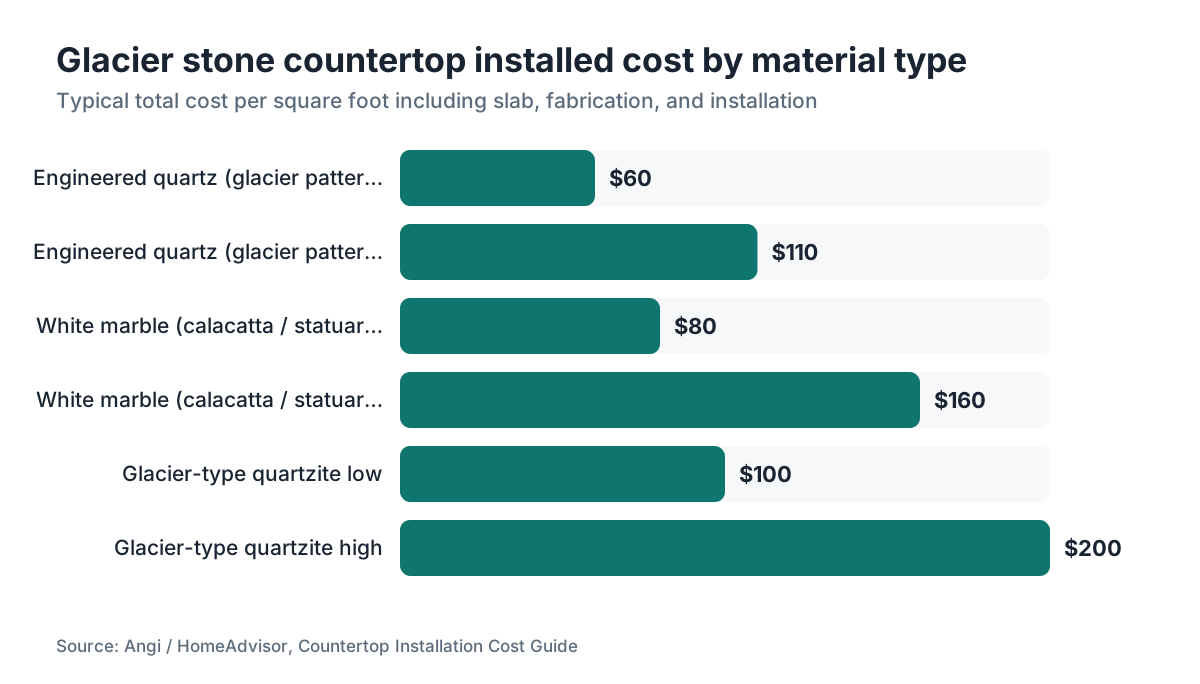
Glacier stone countertops run from about $60 per square foot at the low end (engineered quartz in a glacier pattern, basic edge, simple layout) to $200 per square foot or more for rare Brazilian quartzite with premium edges, complex cutouts, and a bookmatched install [4]. The table breaks it down by material.
| Material | Slab cost ($/sq ft) | Fab + install ($/sq ft) | Typical total ($/sq ft) |
|---|---|---|---|
| Engineered quartz (glacier pattern) | $25, $50 | $35, $60 | $60, $110 |
| White marble (calacatta, statuario) | $40, $90 | $40, $70 | $80, $160 |
| Quartzite (glacier-type) | $50, $120 | $50, $80 | $100, $200+ |
Those fab and install figures are shop-cost estimates from industry pricing guides. They do not include removing the existing countertop (typically $5 to $15 per linear foot), plumbing reconnection, or backsplash tile.
Beyond material, three things drive the price. Edge complexity comes first: a mitered waterfall edge adds $200 to $500 or more to a job. Cutouts come next, each sink or cooktop opening adding roughly $100 to $200 in labor. Seam count is the third. A kitchen with an island that needs a bookmatched seam costs more than one that dodges a seam entirely.
For fabricators, glacier quartzite carries higher material cost and higher tooling cost, because blades dull faster. Price it that way. A shop quoting glacier quartzite at the same labor rate as engineered quartz is either bleeding money or skimping on tooling.
How does glacier stone compare to granite, marble, and engineered quartz?
Homeowners mix up glacier-pattern quartzite and white marble constantly, and the visual likeness is genuinely close. The practical gaps are wide.
Marble is soft (Mohs 3 to 4), etches from acidic foods like lemon juice and vinegar, and stains readily because calcite is porous. It is easier and cheaper to fabricate. Quartzite is harder than granite, shrugs off acids (though it can stain if unsealed), and holds a polish longer. The price you pay is fabrication difficulty and tooling wear [1].
Engineered quartz (brands like Cambria sell glacier-inspired patterns; see cambria-countertops) is the most uniform of the three. Every cut behaves the same, seams are easier to manage, and it never needs sealing. The catch: it is not heat-tolerant (polymer binders can discolor above roughly 300 degrees Fahrenheit), and it lacks the depth and movement of real stone.
Granite in lighter colorways can fake the glacier look, though it rarely lands the same delicate linear veining. Our piece on granite countertops has the full comparison. For a household with heavy kitchen use and kids, engineered quartz is the honest recommendation. For someone who wants natural stone and will seal it annually and treat it with some care, quartzite is excellent.
Want the light, clean glacier look without the fabrication headache? Other kitchen countertops get you there for less. Laminate countertops now print photographic glacier patterns at high resolution, and Formica countertops offer similar looks at a fraction of the cost.
What sealing and care does glacier stone require after installation?
This is where knowing the actual material pays off, because marble and quartzite have different sealing needs.
Marble should be sealed at installation and re-sealed every 6 to 12 months depending on use. A penetrating siloxane or silicone sealer is the standard. Even sealed, marble etches from acid contact, because etching is a surface reaction, not a penetration problem. Sealer slows staining. It does nothing for etching. Anyone choosing marble for the glacier look needs to hear this before they buy.
Quartzite varies by porosity. Dense quartzite (Taj Mahal, White Macaubas) may need sealing only every 2 to 3 years. More porous varieties want annual treatment. Use the water drop test: leave a tablespoon of water on the surface for 10 minutes, and if a dark spot forms, the sealer is spent. The Marble Institute of America (now the Natural Stone Institute) recommends this test as a maintenance check [5].
Engineered quartz needs no sealing, ever. The polymer binders fill all the pore space during manufacturing.
Daily care is the same across every glacier material: pH-neutral cleaner or plain dish soap and water, no abrasive scrubbers, no bleach or ammonia products on natural stone. For material-by-material detail, see our guides on how to clean quartzite countertops, how to clean soapstone countertops, and how to clean stone countertops.
What are the most common fabrication mistakes with glacier stone?
Misidentifying the material is the costliest mistake. A shop that treats quartzite like marble will break blades, chip edges, and maybe crack the slab. Confirm the identity before the first cut.
Getting the seam color wrong is the second most common error. Glacier stone is pale, so the epoxy has to be color-matched precisely to white or light grey. Good fabricators mix a drop of grey colorant into a white epoxy base and test the cured color on a scrap before touching the real seam. Do not skip this step. A grey hairline on a white countertop will show up in every client photo you take.
Ignoring bookmatching requests is a close third. When a homeowner asks for a bookmatched island from glacier quartzite, you cut the two pieces sequentially from the same slab and flip one like opening a book before joining, so the veining mirrors across the seam. That means planning the slab layout before any cuts. Cut the pieces in the wrong order and the effect is gone.
Forgetting thermal movement on long spans bites later. Quartzite expands and contracts slightly with temperature. On an island over 8 feet long, gluing the stone rigidly to the cabinet with a continuous bead can cause stress cracks near cooktops or at seams over time. Use flexible silicone adhesive at intervals instead.
Rushing the polish ruins the look. Quartzite scratch-polishes in stages: typically 50-grit, then 100, 200, 400, 800, 1500, and finally a diamond paste or crystallization finish. Skip grits and you leave micro-scratches that show under raking light. On pale glacier stone the surface reads hazy instead of mirror-sharp. Take the time. The client will notice either way.
How do fabricators price and quote glacier stone jobs accurately?
Glacier stone has more pricing variables than plain granite work, and under-quoting it is a chronic shop problem.
Start with accurate square footage. Measure twice. Count every cutout and every linear foot of edge. Many shops set a base price per square foot that covers one standard edge profile and one sink cutout, then add line items for each upgrade. Edge upgrades, bookmatching, odd shapes, and long seams all deserve explicit upcharges, not a fudge buried in margin.
Factor tooling cost on its own. Glacier quartzite eats diamond blades and polishing pads faster than soft stone. Some shops track tooling cost per job and build it into the quote. Others use a higher hourly shop rate for hard-stone work. Either works, as long as your easy jobs are not subsidizing your hard ones.
Travel and install complexity stack up fast. A high-rise condo with no freight elevator, or a kitchen with a corner radius that needs on-site grinding, both cost real time. Quote them explicitly instead of hoping the install goes smoothly.
Fabrication software that ties slab inventory straight to the quote (so you know before quoting whether you have enough of a specific glacier slab, and what the remnant is worth) sharpens accuracy fast. That is the workflow tools like SlabWise are built around, and it pays off most on high-cost slabs, where a 10 percent material overrun on a $120-per-square-foot quartzite carves straight into your margin.
Is glacier stone a good choice for bathroom vanities and other surfaces?
Yes, with a few caveats. The glacier look suits bathrooms because the cool, pale palette fits the space, and vanity tops take less mechanical stress than kitchen counters. The trade-off is moisture.
On quartzite vanity tops, sealing matters most around the sink cutout, where water sits and wicks into the cut edge. Brush a penetrating sealer into that raw edge at installation. It is the most vulnerable point on any natural stone vanity.
Marble vanity tops are common and gorgeous, but they will etch if a guest sets a perfume bottle straight on the surface (many perfumes run mildly acidic). A honed or matte finish hides etching better than a polished one, because the contrast between etched and unetched areas is lower. That is a real functional choice, not only an aesthetic one.
Glacier stone also works for shower walls in large-format panels (12 by 24 inches or bigger) mounted with silicone joints instead of grout. Grout on pale stone in a shower is a maintenance headache. Minimal-grout or grout-free panel systems are the better answer.
Outside the kitchen and bath, quartzite is excellent for a fireplace surround because it takes heat well. Marble is fine too. Keep engineered quartz away from fireplace openings, where surface temperatures can spike well above 300 degrees Fahrenheit.
What should homeowners know before choosing glacier stone for their kitchen?
The most useful thing to grasp is that the glacier look spans a huge price and performance range. If you love the white-and-grey veined aesthetic, you have real options from $60 per square foot laminate to $200 per square foot bookmatched quartzite. The right pick depends on budget, lifestyle, and how much upkeep you will genuinely do.
Get the slab in person. Glacier slabs vary enormously within a single shipment. The slab you pick is the slab you get, and a photo or a small sample is not enough for a decision that will live in your kitchen for 20 years.
Ask exactly what the material is. If the yard cannot tell you whether it is quartzite, marble, or something else, find a yard that can. Material identity drives everything: how it cuts, whether it etches, how often you seal it, and whether it survives a hot pan.
Budget for the whole job, not the slab alone. Say the beautiful slab costs $80 per square foot. Add fabrication, edge profiling, a sink cutout, installation, and removal of the old countertop, and a typical kitchen (40 square feet of counter) lands at $5,000 to $10,000 or more depending on complexity [4].
Last, ask your fabricator how many glacier quartzite or white marble jobs they finished in the last year. This is not a material for a shop that cuts it twice a year. Color-matching, seaming, and polishing pale stone takes regular reps. A shop doing five glacier-type jobs a month will run circles around one doing two a year.
Frequently asked questions
Is glacier stone the same as quartzite?
Not exactly. Glacier stone is a marketing name used for any pale, icy-veined slab, which could be quartzite, white marble, or engineered quartz. Quartzite is a specific metamorphic rock composed mostly of silicon dioxide, and it is often the material behind the glacier label. Always ask the supplier to confirm the actual geology before buying.
Does glacier stone scratch easily?
It depends on the material. Glacier quartzite scores 7 to 8 on the Mohs hardness scale and resists scratching better than most kitchen objects. Glacier marble scores 3 to 4 and will scratch from metal utensils or abrasive cleaners. Engineered quartz falls in between. Identify your material first, then set care expectations accordingly.
Can you put hot pans on glacier stone countertops?
Quartzite and marble handle heat well as natural stones, though thermal shock from extreme temperature swings can stress any material. Engineered quartz is not heat-tolerant; the polymer resin can discolor or delaminate above roughly 300 degrees Fahrenheit. Use a trivet regardless of material to stay safe and keep the surface finish intact long-term.
How often do glacier stone countertops need to be sealed?
Marble typically needs sealing every 6 to 12 months. Dense quartzite may only need it every 2 to 3 years, while more porous quartzite needs annual sealing. Use the water drop test: leave water on the surface for 10 minutes, and if a dark spot forms, reseal. Engineered quartz needs no sealing at all.
What edge profiles work best on glacier stone countertops?
Any profile works, but complex profiles like ogee or full bullnose add significant labor time on hard quartzite. A simple eased edge or a mitered edge is easiest for the fabricator and reads clean on pale stone. Waterfall edges are popular with glacier quartzite on islands but add $200 to $500 or more to the job cost.
How visible are seams on glacier stone?
More visible than on darker stone if the vein matching is poor. Pale white-and-grey stone makes epoxy color mismatches obvious. A skilled fabricator does a test cure on a scrap piece before committing to the seam. Bookmatched seams, done right, can be nearly invisible. Ask to see examples of past white-stone seam work before hiring a shop.
How long does glacier stone countertop fabrication take from template to install?
A typical residential job runs 5 to 10 business days from templating to installation. Hard quartzite jobs may take a day or two longer because of slower cutting and polishing. Shops with high volume or a single CNC machine sometimes run 2 to 3 weeks. Confirm the lead time before signing a contract, especially if you are working around a renovation schedule.
Can glacier stone be repaired if it chips or cracks?
Small chips can be filled with color-matched epoxy and polished smooth by an experienced stone restoration tech. Cracks are harder. A surface crack can sometimes be stabilized with epoxy injection and re-polished, but a full structural crack through the slab usually means slab replacement. Prevention through proper installation support and avoiding impact near edges matters more than repair.
Is glacier stone safe for food contact?
Yes. Sealed quartzite and marble surfaces are safe for food preparation, and the USDA treats stone surfaces as cleanable food-contact materials when properly maintained. Engineered quartz is also food-safe. Use a pH-neutral soap and water for daily cleaning. Avoid leaving raw meat juices sitting on any stone surface for extended periods regardless of material type.
How do I find a fabricator experienced with glacier stone?
Ask specifically how many white or pale-stone quartzite or marble jobs the shop finished in the last 12 months. Request photos of installed seams on similar material. Check whether they use digital templating and CNC cutting, which cuts human error on complex layouts. A shop affiliated with the Natural Stone Institute has access to ongoing technical training.
What is the difference between glacier white quartzite and White Macaubas?
White Macaubas is a specific quartzite from the Macaubas formation in Minas Gerais, Brazil, with a relatively consistent pale-grey background and subtle wispy veining. Glacier white is a trade name applied loosely to many quartzite varieties with a similar look. White Macaubas is generally denser and more uniform than quartzites marketed as glacier white. Ask for the quarry source, more than the trade name.
Can glacier stone countertops be installed outdoors?
Quartzite handles outdoor use reasonably well because it resists acids and UV, though freeze-thaw cycling in cold climates can widen any existing micro-fractures over time. Marble is a poor choice outdoors because acid rain etches the surface and freeze-thaw cycles speed deterioration. Engineered quartz is not recommended outdoors because UV exposure degrades the polymer binders and causes yellowing or fading.
Does glacier stone add resale value to a home?
Natural stone countertops, including quartzite and marble, are consistently listed as a value-adding kitchen feature by real estate professionals. The National Association of Realtors has tracked kitchen remodels as among the higher-return renovation categories, though exact ROI varies by market. The aesthetic is broadly appealing to buyers, which helps with resale. No specific data isolates glacier stone as a category.
Sources
- National Park Service / USGS, Mohs Hardness Scale reference: Quartzite rates 7 to 8 on the Mohs hardness scale, marble rates 3 to 4, placing quartzite among the hardest common countertop stones.
- USGS, National Minerals Information Center: Stone (Crushed and Dimension): USGS publishes reference mineralogical classifications for dimension stone including quartzite and marble used by labs for identification.
- Natural Stone Institute, Technical Manual: Digital nesting and slab layout optimization can reduce material waste by 15 to 20 percent compared to manual layout on premium stone slabs.
- Angi, Countertop Installation Cost Guide: Installed natural stone countertop costs range from roughly $60 to $200 per square foot depending on material, edge complexity, and regional labor rates.
- Natural Stone Institute (formerly Marble Institute of America), Care and Maintenance Guidelines: The water drop absorption test is recommended as a field indicator of when natural stone surfaces require re-sealing.
- USDA Food Safety and Inspection Service, Safe Food Handling: The USDA classifies properly maintained cleanable surfaces as suitable for food preparation.
- National Association of Realtors, Remodeling Impact Report: NAR tracks kitchen remodels, including countertop upgrades, as among the renovation categories with stronger resale return, though exact ROI varies by market.
- OSHA, Crystalline Silica Rule for Construction (29 CFR 1926.1153): OSHA's crystalline silica standard sets a permissible exposure limit of 50 micrograms per cubic meter as an 8-hour time-weighted average and requires wet cutting, ventilation, or respiratory protection for engineered stone fabrication.
- Natural Stone Institute, Quartzite vs. Marble Identification Guidelines: The acid fizz test (10% hydrochloric acid applied to an edge) is an industry-standard field method for distinguishing quartzite (no reaction) from marble (vigorous fizz) at point of receiving.
Last updated 2026-07-09