TL;DR
- Over the next few years, sintered stone keeps gaining on quartz, thinner slabs (6mm and 12mm) go mainstream, matte and leathered finishes replace high-gloss, ultra-large slabs cut seams, and demand grows for low-silica materials as fabricators worry about their lungs.
- Distributor pricing and availability are already shifting.
- Sintered stone is the clearest growth story.
What are the biggest countertop trends right now?
The U.S. countertop market is worth roughly $14 billion a year, and the materials mix is shifting faster than it has in two decades [1]. Quartz still runs the most residential installation volume. But its share has been flat or slightly down since 2022 as sintered stone, porcelain slabs, and ultra-compact surfaces take bites out of the premium tier. Natural stone, especially quartzite and marble, holds firm in high-end renovations.
Several things are happening at once. Homeowners want surfaces that read like natural stone but behave like engineered material. Fabricators are under real pressure to cut less silica-heavy stone, both for their crews' lungs and because some states are moving toward regulation. And slabs keep getting bigger, which changes how shops nest and quote.
The short version: expect more sintered stone, thinner profiles, larger formats, matte and textured finishes, and quieter color palettes. The Carrara-white-quartz moment isn't over. It's plateauing.
Is sintered stone going to replace quartz countertops?
Sintered stone, sold under brands like Neolith, Lapitec, and Dekton, is made by pressing and heating natural minerals at extreme pressure to produce a non-porous, UV-stable slab. The finished product has essentially zero crystalline silica. Engineered quartz typically runs 90 to 95 percent crystalline silica by weight [2].
That silica gap matters right now. Australia banned engineered stone containing more than 1 percent crystalline silica effective July 1, 2024 [3]. The U.S. has no federal ban, but OSHA cut its permissible exposure limit for respirable crystalline silica to 50 micrograms per cubic meter as an 8-hour time-weighted average, down from 250 micrograms [4]. That rule already covers fabrication shops. Cal/OSHA has pushed for tighter limits still. The direction of travel is not subtle.
Sintered stone cuts differently. It needs diamond tooling rated for porcelain, slower feed rates, and careful water management to avoid thermal cracking. The learning curve is real. But the shops that got there early are quoting sintered stone at 15 to 30 percent above comparable quartz jobs, partly for material cost and partly because few competitors can cut it cleanly.
Will it replace quartz outright? Probably not this decade. Quartz is still cheaper to fabricate at scale, and the installed base of tooling is enormous. But sintered stone is taking the $80-and-up per square foot tier, and that tier is exactly where fabricator margin lives.
What are the new countertop materials homeowners should know about?
Beyond sintered stone, a handful of materials are crossing over from specialty to mainstream.
Porcelain slabs. Not the same thing as tile. Large-format porcelain slabs (think 63 by 126 inches) fired at high temperature hit Mohs hardness around 7, on par with granite [5]. They're close to maintenance-free and come thin enough to use as a waterfall panel without piling on weight. Installed cost at retail runs roughly $60 to $120 per square foot, depending on complexity.
Ultra-thin formats. 6mm porcelain and sintered stone sheets work as overlays on existing counters and on furniture. The fabricators who can handle the fragility during templating and transport are winning renovation work that used to go to tile or laminate.
Glass and recycled-content surfaces. Vetrazzo and similar recycled-glass slabs have been around for years. Interest in low-carbon materials is pulling them into more conversations. Genuinely niche, but a growing niche.
Dekton Slim and other 4mm formats. Cosentino built 4mm panels for vertical surfaces and furniture. Whether they migrate to horizontal countertop use at scale is an open question, but everything points thinner.
One warning for homeowners eyeing these for kitchen countertops: the newer materials often carry longer lead times and need specialty installation. Get a firm delivery date in writing before you sign anything.
Are silica regulations going to change what countertops fabricators can offer?
Yes, and faster than most of the industry expected. Australia's July 2024 ban on engineered stone above 1 percent silica is the clearest signal of where this goes [3]. Big quartz makers sell globally, so they're already building low-silica formulations. Silestone's HybriQ+ blends quartz with other minerals specifically to shrink the silica fraction, and Cosentino has said the technology was a response to regulatory pressure [11].
In the U.S., OSHA's silica rules for construction (29 CFR 1926.1153) and general industry (29 CFR 1910.1053) both set the 50 microgram limit and require engineering controls, medical surveillance for workers with significant exposure, and written exposure control plans [4]. Enforcement is uneven. But Cal/OSHA, Colorado, and a handful of other states have been active.
For a homeowner, the practical upshot is simple. Some quartz products from smaller or older manufacturers may get harder to source in states with tighter rules. Premium brands are adapting. Budget lines may not. If you're speccing granite countertops or marble countertops instead, the silica question barely applies, because the processing differs and the silica you'd be exposed to during routine cleaning is negligible.
For fabricators, the compliance cost is real. Shops that invested early in wet fabrication, vacuum extraction, and enclosed CNC environments are in far better shape than the ones still handing out dust masks. If you haven't measured your actual air quality, you're guessing about your own liability.
What finish and color trends are replacing the high-gloss white kitchen?
The high-gloss white quartz kitchen peaked somewhere around 2019 to 2021. What's replacing it isn't one thing.
Matte and leathered finishes are the most consistent signal across designer surveys and trade show floors, and the NKBA's 2024 design trends work lists them among the leading finishes displacing polished surfaces [12]. A leathered finish on granite or quartzite has a lightly textured, broken-gloss surface that hides fingerprints and reads more casual. It genuinely shows fewer marks in a busy kitchen. Matte sintered stone pushes further, almost chalky in some colorways. If you go leathered, know that the texture holds debris, so cleaning quartzite countertops takes a little more deliberate wiping.
Color is drifting warmer: greige, warm white, taupe veining on cream. The dramatic black-and-gold and deep blue-and-white slabs had a big moment, and that moment is settling into "classic dramatic" rather than "current." Terracotta and warm browns are showing up in backsplashes and starting to pull countertop choices toward an earthy, organic feel.
Wood tones are back too. Butcher block countertops are getting renewed interest in the mixed-material kitchen, where the island is stone and the perimeter is wood. That combination was everywhere in the 1990s, went away, and returned with better execution.
Thickness is interesting. The 3cm slab is still the workhorse. Mitered waterfall edges that fake a 6cm or 9cm slab are common on islands. At the same time, 2cm slabs are turning up on wall-mount pieces and furniture-style islands where visual lightness is the whole point.
How is slab sizing changing, and why does it matter for homeowners and fabricators?
Standard quartz and granite slabs used to run around 55 by 120 inches or 63 by 126 inches. Large format now means 63 by 144 inches and up. Some sintered stone makers ship 63 by 144 or 59 by 118 as their standard size.
For homeowners, bigger slabs mean fewer seams on big islands. A 48 by 96 inch island can sometimes come from one slab with no seam at all, depending on stone orientation. That reads better and cuts the long-term risk of a seam opening from thermal movement or cabinet settling.
For fabricators, large format brings real headaches. You need a bigger CNC bed or more manual handling. Transport wants longer trucks or specialized racks. The nesting math changes, because a big slab with a dramatic vein demands careful orientation and waste climbs fast if the job doesn't eat most of the slab. Software that handles large-format nesting accurately earns its keep here. SlabWise is built for exactly that kind of quoting and remnant tracking, which is why busy shops care about it once slabs stop being standard.
Breakage risk climbs with size too, especially for sintered stone and porcelain. A 144-inch slab that snaps in the shop or on the truck is an expensive day. Price large-format jobs with a higher breakage contingency, and confirm your supplier's warranty terms before you quote a firm number.
Will countertop prices go up or down over the next few years?
Prices aren't likely to fall in real terms. The costs driving countertop pricing are energy (kilns and water jets), transportation, and raw stone or mineral, and all three track global commodity markets.
Quartz pricing has been fairly stable in the U.S. since the Section 301 tariffs on Chinese quartz took effect in 2018 and were later increased [6]. Most quartz for the U.S. now comes from North America (Cambria, MSI, Arizona Tile domestic lines), Europe (Silestone, Dekton, Caesarstone's Israel-produced lines), or India. Those supply chains carry different cost structures, but none of them is cheaper than Chinese quartz was pre-tariff.
Natural stone pricing lives and dies on quarrying and shipping. Brazilian quartzite has gotten pricier as demand outran supply infrastructure. Indian granite, the backbone of budget stone, is stable but wrestles with quality consistency that's been documented in the trade press.
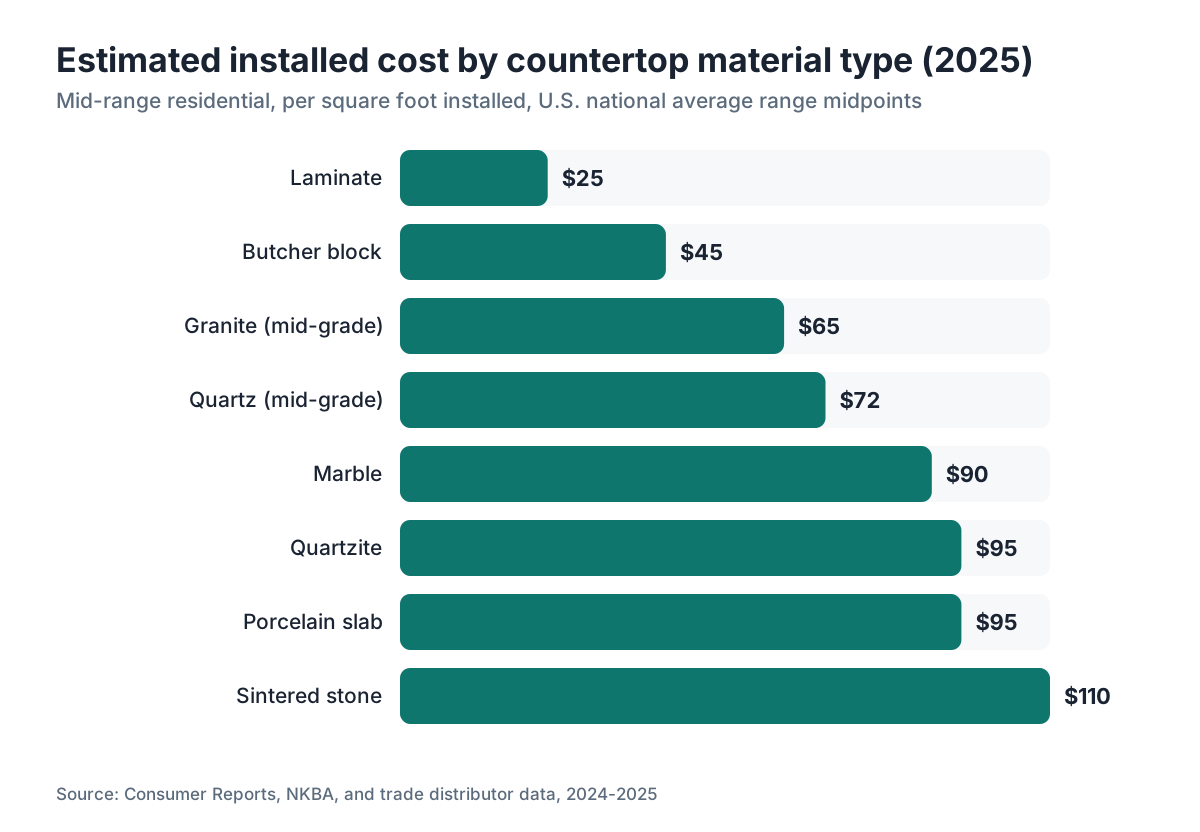
Here's the realistic map for 2025 to 2028: quartz holds in the $55 to $90 per square foot installed range for mid-grade, sintered stone and porcelain hold at $80 to $140-plus, natural granite runs $45 to $120 by grade and rarity, and budget options like laminate countertops or Formica countertops creep up with inflation but stay well under stone.
For fabricators, margins are tighter, and it isn't foreign competition doing it. Countertops are local work. Material and labor both went up. The shops doing well in 2025 run efficient quoting, tight remnant management, and a job mix across price tiers.
Are smart or tech-integrated countertops actually coming?
The smart countertop pitch has floated around for a decade. Wireless charging pads in quartz, integrated scales, touch-activated backlighting, antimicrobial copper. A few are real products. Almost none are mainstream.
Wireless charging has the only real traction. Several quartz and solid surface makers now offer slabs with embedded Qi charging zones, where the surface is milled thin over the pad location and a standard charger sits recessed below. It works. It isn't cheap, adding roughly $400 to $800 per charging location in materials and labor [7]. For most homeowners, a $30 under-cabinet wireless pad from a consumer electronics brand does the same job.
Antimicrobial surfaces got a lot of attention during the pandemic. Corian and a few other solid surface makers added EPA-registered antimicrobial agents to their formulations, and such claims require EPA registration to stand [8]. Corian countertops already carried the claim, and it became a selling point. Whether it drives purchases post-2023 is much less clear.
Truly integrated touchscreens or display surfaces aren't close to mainstream. They need power, they make heat, they're hard to seal against water, and they go obsolete faster than a kitchen renovation cycle. The trade-show demos look great. The durability and repairability in a real kitchen do not.
Honest read: tech integration in countertops stays a niche upgrade for the foreseeable future. The substrate is passive. The intelligence lives in appliances and devices, not the stone.
What do the sustainability and low-carbon trends mean for countertops?
Sustainability claims in this industry are real but inconsistent. There's no single third-party certification that works like LEED does for buildings, though Environmental Product Declarations (EPDs) are showing up more often from major manufacturers.
Natural stone has a low-carbon argument. Quarrying and cutting release much less CO2 than manufacturing an engineered product, assuming local or regional sourcing. A Brazilian quartzite slab shipped by sea to the East Coast carries a far bigger transport footprint than a Georgia granite slab trucked 500 miles. But total lifecycle carbon per square foot of natural stone still tends to run lower than manufactured quartz [9].
Quartz makers are responding. Cambria sources raw quartz from Minnesota and manufactures in the U.S., shortening the chain. Silestone's HybriQ formulation uses recycled material and less water in production. These are real differences, more than marketing.
Laminate countertops and Formica countertops have a low upfront carbon footprint but shorter lifespans, so any lifecycle math swings hard on how often you assume replacement.
If you care about this as a homeowner, ask the fabricator for the manufacturer's EPD, or look for products carrying third-party Declare labels. For fabricators, the customers asking about carbon skew heavily toward the $80k-and-up job tier. Having an answer ready is a sales tool more than an ethics stance.
Water use in fabrication is a growing concern too. Wet CNC cutting uses a lot of water, and shops in drought-prone states (Texas, Arizona, California) are seeing more scrutiny. Water recirculation systems are becoming standard in new shop builds.
How should fabricators prepare for these trends operationally?
The shops that win over the next five years already share a few traits you can see today.
First, tooling flexibility. A shop that cuts quartz, sintered stone, natural stone, and porcelain without stopping to reconfigure is faster and quotes more job types. That means diamond tooling rated for hard porcelain and knowing the feed rate differences by material cold.
Second, silica compliance as a baseline, not a scramble. OSHA enforcement is rising and the limits only get stricter. Bringing in an industrial hygienist to measure actual air quality during production isn't expensive, roughly $500 to $2,000 for a basic assessment, and it tells you whether you have a problem. Don't guess.
Third, quoting accuracy on large-format and unusual materials. When slabs are bigger, pricier, and more complex in vein pattern, a pricing error is a bigger dollar problem. Shops estimating by hand leak more margin on specialty jobs than shops using software that calculates real slab yield. This is the operational gap SlabWise was built to close for fabricators running quartz and stone.
Fourth, speed of response. The homeowner shopping window is shorter than it was five years ago. Someone who walks a showroom Saturday expects a quote Monday. Shops that produce an accurate, professional quote same-day win jobs the slow ones lose.
Fifth, get a real handle on remnant inventory. Large-format slabs leave larger remnants when jobs come in under the slab size. Those pieces have real value, especially in sintered stone and high-end quartzite. Tracking them and marketing them to the next customer is pure margin.
What trends are overhyped and probably not worth chasing?
A few things get a lot of press and may not pay off the way they promise.
Embedded countertop displays and smart screens, covered above. The service life of electronics and the service life of a countertop are mismatched by about fifteen years.
3D-printed countertops: real technology, nowhere near commercial scale for residential work. The material properties of printed concrete or polymer don't compete with sintered stone or natural stone at any price point you can actually hit today. Watch it in five years, not now.
Concrete countertops as a growth segment: concrete has a loyal following and produces beautiful results in skilled hands. But the maintenance (sealing every 1 to 3 years, plus real susceptibility to staining and cracking) and the weight (roughly 18 to 20 pounds per square foot for 1.5-inch concrete) cap mass-market appeal. It's a craft product, not a trend.
Extreme veining as a long-term investment: the ultra-dramatic book-matched slabs with enormous gold or blue veins photograph beautifully and date faster than subtler choices. If you plan to sell in 3 to 5 years, ask yourself whether the slab you love today reads as timeless or as "very 2024."
For fabricators specifically: chasing every new material without training and tooling burns cash. Pick one or two new categories to build competency in each year. Sintered stone and large-format porcelain are the right bets for most shops in 2025. Everything else can wait for clearer signals.
Frequently asked questions
What countertop material will be most popular in 2025?
Quartz remains the highest-volume residential countertop material in the U.S. as of 2025. Sintered stone is growing fastest in the premium tier. Natural quartzite and marble stay strong in high-end renovations. Budget projects are still dominated by laminate and lower-grade granite. No single material is about to flip the market overnight, but sintered stone is the clearest growth story.
Are quartzite countertops a good long-term investment?
Quartzite is a genuinely hard natural stone, typically Mohs 7, resistant to heat and scratching. It needs sealing every 1 to 3 years depending on porosity, and the best slabs (Brazilian White Macaubas, Sea Pearl, and similar) hold their appeal across design cycles because they read as natural stone, not engineered material. For resale, high-quality quartzite in a neutral palette is a solid choice.
Will engineered quartz be banned in the United States like it was in Australia?
Australia banned engineered stone with crystalline silica above 1 percent effective July 1, 2024. The U.S. has no similar federal ban as of mid-2025. OSHA has tightened silica exposure limits for fabrication workers. California, Colorado, and other states are weighing stricter rules. A federal ban isn't imminent, but regulatory pressure on high-silica products is real and building.
What is sintered stone and how does it differ from quartz?
Sintered stone is made by pressing and heating natural minerals at very high pressure and temperature, similar to how geological pressure forms rock. It has near-zero porosity, UV stability (it won't fade outdoors), and much lower crystalline silica content than engineered quartz. Brands include Dekton, Neolith, and Lapitec. It's harder to fabricate than quartz but increasingly preferred in premium applications.
How much do sintered stone countertops cost compared to quartz?
Installed sintered stone typically runs $80 to $140 per square foot for mid-range products, against $55 to $90 for mid-range quartz. The gap reflects higher material cost and more demanding fabrication. Complex edge profiles or book-matched layouts push both materials higher. Some shops add a fabrication premium of 15 to 30 percent over quartz simply because fewer competitors can produce clean sintered stone work.
Are thinner countertop slabs (6mm or 12mm) structurally safe?
For normal residential use, 12mm (roughly 1/2 inch) sintered stone or porcelain is structurally fine when supported across the full cabinet base without gaps. 6mm is generally limited to vertical applications, overlays on existing surfaces, or furniture. Spans over dishwashers, or spans without continuous cabinet support below, need 20mm (3/4 inch) or thicker, or a substrate. Get specifics from the manufacturer.
What countertop finishes are trending and which actually wear better?
Matte and leathered finishes are the clearest trend moving away from high-gloss polished surfaces. In daily use, matte and leathered surfaces show fewer fingerprints and water spots. The tradeoff is that textured surfaces are harder to clean thoroughly because debris settles in the texture. Polished surfaces still give the best stain resistance on porous natural stones, because polishing closes surface pores.
Should I worry about silica dust if I'm just a homeowner with quartz countertops?
No. The silica health risk hits fabrication workers who cut, grind, and sand quartz dry without proper controls, generating airborne crystalline silica dust at dangerous concentrations. Installed quartz countertops present no meaningful silica exposure during normal household use, including cleaning, cutting food on the surface, or routine maintenance. The OSHA and regulatory concern is specifically occupational exposure in fabrication shops.
What are the best countertop materials for outdoor kitchens?
Sintered stone (Dekton, Neolith) is the top choice for outdoor kitchens because it's UV-stable and won't fade in sunlight, unlike most quartz, which contains resins that yellow outdoors. Granite is also durable outdoors but needs sealing and can absorb stains from organic material. Avoid quartz, solid surface, and laminate in direct sun. Porcelain slabs are a strong second option.
How do large-format slabs affect countertop installation?
Large-format slabs reduce seams, which is the main appeal for homeowners. Installation is more complex because the slab is heavier, harder to maneuver, and less forgiving of cabinet levelness issues. Fabricators need larger equipment and more careful templating. As a homeowner, confirm your installer has done large-format work and get their breakage policy in writing before signing a contract.
Are recycled or sustainable countertop materials actually available?
Yes, though availability varies by region. Recycled glass countertops (Vetrazzo, IceStone) are real commercial products, typically $70 to $130 per square foot installed. Some quartz makers now publish Environmental Product Declarations and use recycled mineral content. Natural stone from regional quarries carries a lower transport footprint than imported material. Ask for EPD documents if sustainability matters to your decision.
Will countertop prices go down as new materials come to market?
Unlikely in real terms. Energy costs, material inputs, and fabrication labor all trend upward. New materials like sintered stone carry a premium now because demand exceeds fabrication capacity. Budget options, particularly laminate and lower-grade quartz, stay available and price-competitive with inflation adjustments, but the mid-to-premium tier isn't heading lower.
What should homeowners look for when getting a countertop quote for a new material?
Confirm the fabricator has actually installed that material before, more than cut a test piece. Ask about edge profile limits (some sintered stone can't be profiled as aggressively as quartz). Get the delivery timeline in writing. Confirm what happens if the slab breaks during fabrication or installation and who pays for the replacement. A clear, itemized quote showing slab square footage and waste percentage is the mark of a professional shop.
Sources
- IBIS World, Kitchen Cabinet & Countertop Manufacturing in the US, Industry Report: The U.S. countertop and cabinet manufacturing market is valued at roughly $14 billion annually
- OSHA, Crystalline Silica Exposure Health Hazard Information: Engineered quartz contains 90-95% crystalline silica by weight, creating occupational health hazards during fabrication
- OSHA, Respirable Crystalline Silica standards (29 CFR 1926.1153 and 29 CFR 1910.1053): OSHA set a permissible exposure limit of 50 micrograms per cubic meter as an 8-hour time-weighted average, down from 250, and requires engineering controls, medical surveillance, and written exposure control plans
- Ceramic Tile Education Foundation (CTEF), Porcelain Tile Certification Program: Large-format fired porcelain slabs reach Mohs hardness around 7, comparable to granite
- U.S. Trade Representative, Section 301 Tariffs on Products from China: Section 301 tariffs on Chinese quartz have been in effect since 2018 and were subsequently increased, shifting quartz sourcing away from China
- Consumer Reports, Kitchen Countertops Buying Guide: Wireless charging integration in countertops adds roughly $400-800 per charging location in materials and labor
- U.S. Environmental Protection Agency (EPA), Pesticide Registration: EPA-registered antimicrobial agents can be incorporated into solid surface materials including Corian, and such claims require EPA registration
- National Stone, Sand and Gravel Association (NSSGA), Sustainability and Environmental Data: Natural stone quarrying and cutting generally results in lower lifecycle CO2 per square foot than manufacturing engineered quartz, assuming comparable transport distances
- Cosentino Group, HybriQ Technology Product Information: Silestone HybriQ+ uses a hybrid mineral formulation to reduce crystalline silica fraction, developed in direct response to regulatory pressure
- National Kitchen and Bath Association (NKBA), Design Trends Report 2024: Matte and leathered finishes are among the leading finish trends in kitchen design surveys, displacing high-gloss polished surfaces
Last updated 2026-07-09