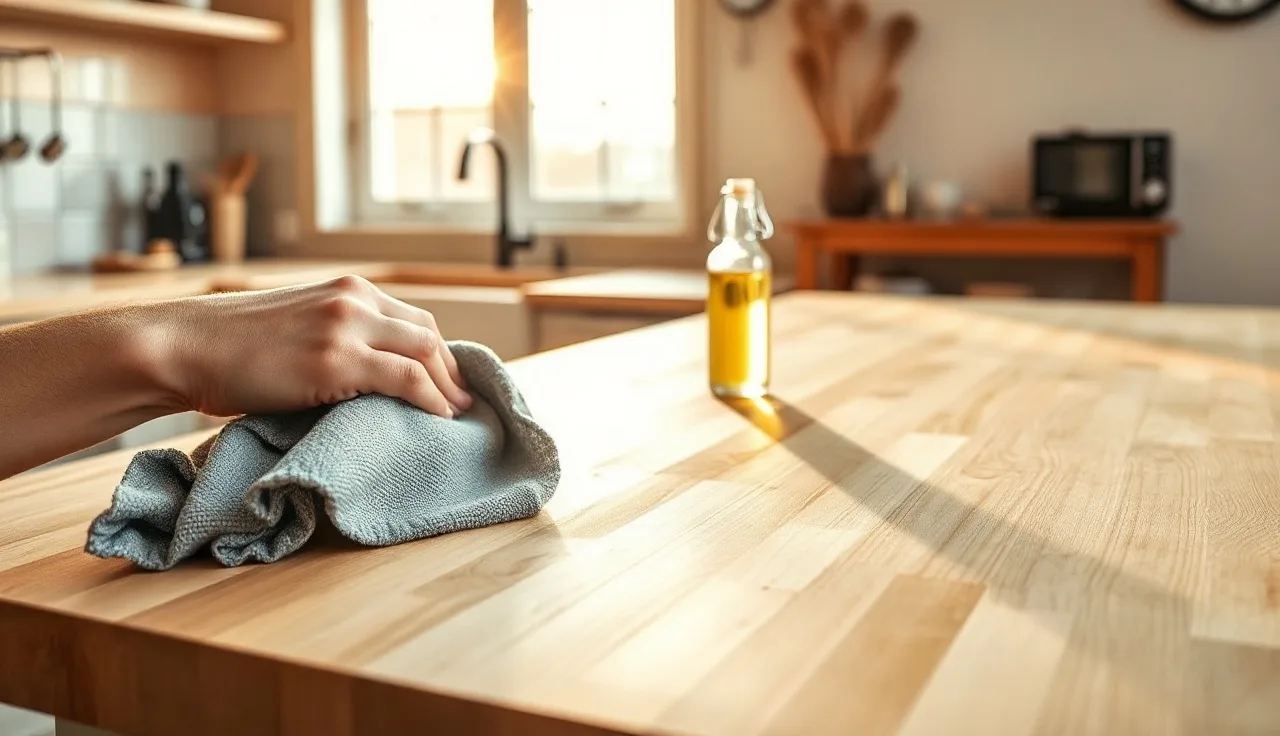
TL;DR
- Food-grade mineral oil is the safest, cheapest, and most recommended oil for butcher block countertops.
- Apply it liberally three to four times when the surface is new, then once or twice a year.
- Skip vegetable, olive, and coconut oils.
- They go rancid inside the wood.
- Pure tung oil, walnut oil, and beeswax blends work too, each with a catch.
Why does butcher block need oil at all?
Wood is porous. Leave an unfinished hardwood counter bone dry and it pulls water from wet produce, spills, and steam, swells unevenly, then cracks along the grain. Oil doesn't make the wood waterproof. It fills enough of those open pores to slow moisture in and out, which keeps the surface from drying out and splitting.
The other job oil does is deny bacteria an easy home. A 2003 study in the Journal of Food Protection found hardwood boards with worn, knife-scarred surfaces held fewer recoverable bacteria than new plastic boards after being contaminated with Listeria, Salmonella, and E. coli. Washing with soap and water brought counts to undetectable levels on wood far more reliably than on plastic. [1] People cite that study to claim wood is inherently safe, which is only half right. The real point is that well-kept, oiled wood doesn't give bacteria the crevices a deeply grooved surface does.
Skip oil and the wear speeds up. The wood dries, the surface checks and splinters, debris settles into those cracks, and you get a counter that looks bad and is genuinely harder to clean.
What makes an oil food safe for butcher block countertops?
An oil is food safe for a countertop when it touches food without releasing anything toxic, and when it doesn't feed bacterial growth inside the wood. Those are the two tests that matter.
The FDA decides which substances can contact food. Mineral oil derived from petroleum is listed as an acceptable food-contact substance under 21 CFR 178.3620, which covers mineral oils used in articles meant for food contact. [2] That one paragraph of the Code of Federal Regulations is the legal reason food-grade mineral oil sits on every fabricator's recommended list. The qualifier that matters is "food-grade" or "USP-grade" (United States Pharmacopeia), meaning it was refined to strip out aromatic hydrocarbons. Hardware-store lubricating mineral oil is a different product even if it looks identical in the bottle.
Past mineral oil, three things decide whether a finishing oil is safe: does it cure (polymerize) fully once dry, is the uncured form toxic, and does it turn rancid. A rancid oil won't poison you the way eating rancid butter might. It produces off-flavors, foul odors, and a surface where mold can take hold.
Which oils are actually food safe for butcher block?
Here are the options that survive scrutiny, safest first.
Food-grade mineral oil is the standard everyone else gets measured against. It's odorless, tasteless, non-drying (it doesn't polymerize or harden), cheap (usually $5 to $12 per quart at a pharmacy or grocery store), and inert. Because it never cures, you reapply now and then instead of building a permanent film. That's actually a feature. You can't ruin it in a single coat, and any excess just wipes off. [3]
Pure tung oil (not "tung oil finish," which is a product name that may hold very little real tung oil) is pressed from tung tree seeds and cures by oxidative polymerization into a hard film. Fully cured, it's food safe. The catch: uncured tung oil carries some chemical risk, and many products labeled "tung oil" pack in varnish, dryers, or solvents that aren't. [4] If you go this way, buy 100% pure tung oil from a supplier that states food safety outright, and give it the full cure, usually 15 to 30 days at room temperature.
Walnut oil is a real food-grade finishing oil that woodworkers have used for centuries. It's a drying oil that polymerizes, so it builds a little film that mineral oil can't. The obvious problem: walnut oil comes from tree nuts. Anyone in your house with a tree-nut allergy has a genuine issue with a walnut-oiled surface. If that's not a concern, food-grade walnut oil from the cooking aisle works, though it costs more and doesn't last as long as mineral oil.
Carnauba wax and beeswax blends aren't oils, but they sell right next to butcher block oils and meet FDA food-safety standards. They go on over a base coat of mineral oil and leave a slightly harder, more water-resistant surface. Beeswax-and-mineral-oil products (often sold as "board cream" or "butcher block conditioner") are common and work well as a maintenance topcoat.
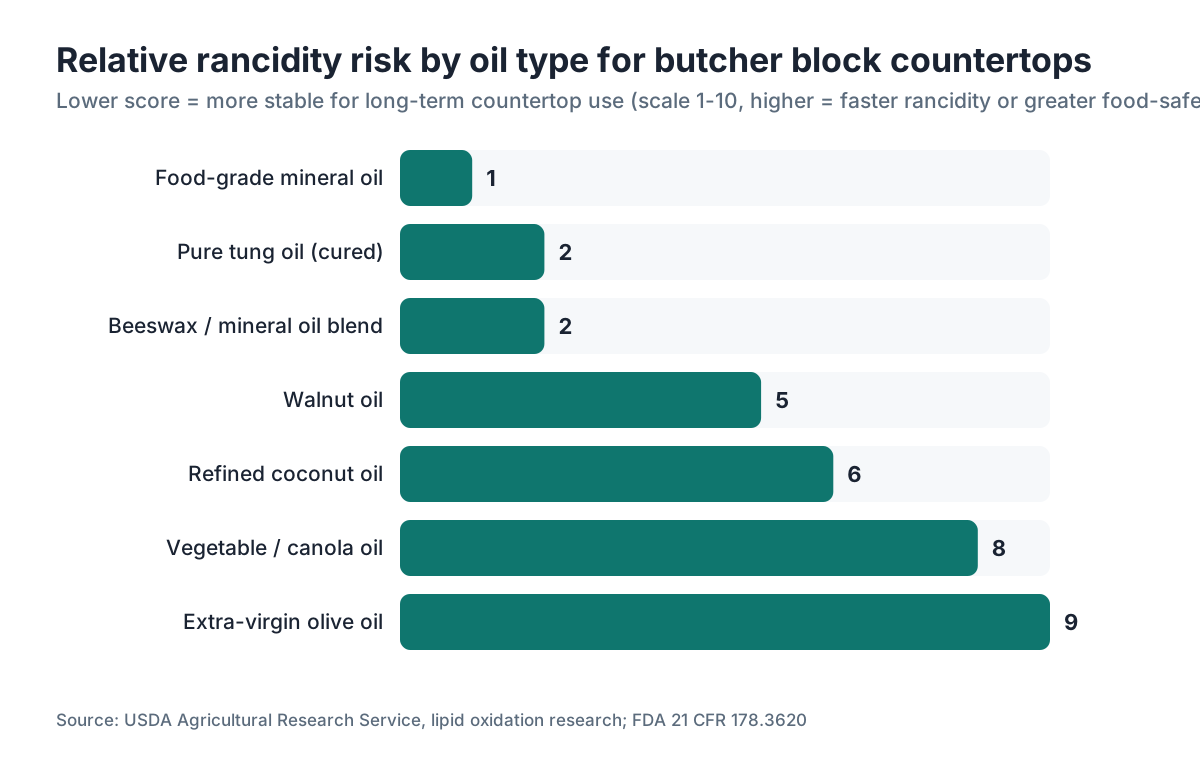
Coconut oil, olive oil, and every other cooking oil are a bad idea. All of them go rancid. The timeline shifts (refined coconut oil outlasts extra-virgin olive oil), but none stay stable on a surface that sits at room temperature for months or years. You'll know you got it wrong when the counter starts to smell musty or sour. Don't do it. [5]
Is mineral oil the best choice for most homeowners?
Yes. Mineral oil wins on nearly every count for the average kitchen: cheap, genuinely safe, sold everywhere, and forgiving because it never cures into a film you'd have to strip.
The one knock is that it doesn't build a durable surface film the way a cured tung or Danish oil finish does, so you reapply it now and then. I don't think that's a flaw. The wood breathes, over-application just wipes off, and you never have to sand back to bare wood to start over.
Here's the routine for a hard-working prep surface. Flood the top with mineral oil, let it soak 20 to 30 minutes, wipe the excess, and repeat three or four times in the first week. After that, one application a year usually holds a residential counter. A kitchen that sees a lot of water or heavy cutting may want it twice a year. [3]
For fabricators quoting a butcher block job, the maintenance talk pays off in fewer callbacks. Customers who understand the oiling schedule on day one rarely phone you six months later. That's the kind of detail most countertop installation guides skip.
How do you apply mineral oil to butcher block countertops?
Flood, soak, wipe, repeat. That's the whole method, but a few details decide whether it works.
Start with a clean, dry surface. Any moisture in the wood blocks oil from soaking in evenly. A brand-new counter may carry a light factory oil coat, but treat it as though it has none.
Pour a generous amount of food-grade mineral oil right onto the wood and spread it with a lint-free cloth or paper towels, working along the grain. Don't be stingy. You want it to puddle a little and soak in. Let it sit 20 to 30 minutes. If the wood drinks it dry in under five minutes, that's telling you it was parched. Wipe off the excess, then run the cycle again the same day.
On a new counter, do the flood-soak-wipe cycle three to four times over two to three days. Each pass absorbs less as the wood nears saturation. You'll see it happen. Dry wood turns almost wet-looking, then lightens as it dries. A properly saturated top holds a faint sheen without pooling.
After that first conditioning, reapply about once a year, or when the surface looks dull and feels rough. The test is quick: drip a few drops of water on the top. If it beads, you're fine. If it soaks in within a minute, oil it.
Oil the edges and the underside too. The underside is the part everybody forgets, and it's the part most likely to dry out and warp, because it gets no oil but plenty of shifting ambient moisture.
How often should you oil butcher block countertops?
It depends on how hard you use the surface and how dry your climate is, and no single manufacturer schedule fits every kitchen. That's the honest answer.
A reasonable starting framework:
- First week after installation: three to four applications.
- First six months: monthly, or whenever the water-bead test fails.
- After that: once or twice a year for a typical residential kitchen.
A Phoenix kitchen with very low humidity and heavy daily use may want oil every two to three months. A lightly used prep counter on a humid coast might go two years between touch-ups. Watch the surface, not the calendar.
Wood that starts to look grey or bleached is telling you it's been starved. You can bring back a dried-out counter: sand lightly with 150-grit along the grain, wipe off the dust, then run the intensive initial conditioning again. It isn't ruined. It just needs more work than a well-kept surface would. [6]
What about food-grade tung oil or Danish oil for butcher block?
Pure tung oil has real advantages over mineral oil. Because it polymerizes, it builds an actual surface film over several coats, so it resists water better and handles heavy cutting. Sand between coats, apply three or four with a few days of cure between each, and you get a harder, more durable finish than mineral oil gives you alone.
The trouble is the finishing industry has basically hijacked the word "tung oil." Plenty of products sold as tung oil finish, Danish oil, or teak oil hold very little tung oil and a lot of varnish, linseed oil (not food safe until fully cured), mineral spirits, or other additives. The labels often don't spell out the full formula. [4]
To use tung oil on a food-contact surface, verify two things. One, the product is 100% pure tung oil (check the safety data sheet, more than the label). Two, you allow the full cure before food touches it. Real tung oil reaches full cure in roughly 15 to 30 days depending on humidity and temperature. Use the counter before that window closes and you risk transferring uncured compounds to food.
For most homeowners, that uncertainty and the wait aren't worth it next to mineral oil plus a beeswax topcoat. For a restaurant-grade or very heavily used surface where durability actually matters, pure tung oil applied right is a legitimate step up.
Can you use vegetable oil, olive oil, or coconut oil on butcher block?
No. This is a case where common sense ("it's in my kitchen, it touches food, so it's fine on the counter") lands on the wrong answer.
Every cooking oil, coconut and olive and avocado and generic vegetable, is subject to oxidative rancidity. Expose an unsaturated fat to oxygen over time and the fatty-acid chains break down into aldehydes, ketones, and short-chain fatty acids, the compounds behind the sour, musty smell of old oil. Inside a counter that process runs slowly and out of sight until you're stuck with a surface that stinks and may grow surface mold. [5]
The most stable cooking oils (refined coconut oil has a fairly low polyunsaturated fat content) take longer to turn, but none hold up on a surface that keeps oil in the wood at room temperature indefinitely. That's a different situation from cooking with olive oil in a pan, where it gets eaten or dumped.
If someone has already put cooking oil on a butcher block, the fix is to sand the surface (80-grit, then 120, then 150 along the grain), clean it with a dilute white vinegar solution, let it dry fully for at least 24 hours, and start over with mineral oil.
Does oiling butcher block prevent bacteria and make it safe for raw meat?
This deserves more nuance than most countertop guides give it. Oil doesn't kill bacteria. What it does is keep the surface smooth enough that bacteria can't lodge in crevices.
The 2003 Journal of Food Protection research found bacteria that contaminated wood surfaces got pulled into the wood by capillary action, didn't multiply there, and eventually died off. [1] That only holds when the wood is well-kept, not deeply gouged, and cleaned between uses.
FDA and USDA guidance recommends separate cutting surfaces for raw meat and produce, whatever the counter is made of. [7] Even a properly oiled butcher block should get washed with hot soapy water after it touches raw poultry, beef, or fish. Some sources recommend a diluted bleach solution (one tablespoon of unscented bleach per gallon of water) for occasional sanitizing, but use it sparingly, since chlorine bleach dries out and lightens wood over time.
So oiled butcher block is safe for food prep when you clean it properly. It is not self-sanitizing. Treat it like any cutting surface. Don't let raw meat juices sit, and wash it well after use.
What products should you buy: brands and label terms to look for
You don't need a countertop-specific product to oil butcher block. Food-grade mineral oil sold at pharmacies or grocery stores as a laxative (Fleet or a store brand) is chemically the same as most butcher block oils and costs less per ounce. Packaging and marketing are the only real difference.
If you want a product built for the job, look for these on the label:
- "Food grade" or "USP grade" mineral oil.
- NSF International certification (NSF is the nonprofit that certifies food-contact safety for food service equipment and materials).
- No added fragrances, dyes, or other additives.
For a beeswax-and-mineral-oil conditioner (the second step many fabricators recommend after the initial mineral oil saturation), pick products that list only mineral oil and beeswax. Carnauba wax is fine too. Skip anything with synthetic fragrance or petroleum additives beyond the mineral oil itself.
Fabricators who want to hand customers a clean, accurate estimate for butcher block jobs, including the right finish and a maintenance schedule, can build those quotes without guesswork in shop software. SlabWise countertop fabrication software lets shops write material and finish specs straight into the quoting workflow, so the customer hears the same story from day one.
For how butcher block stacks up against stone and solid surface on care, the butcher block countertops guide covers it. Stone options like granite countertops and marble countertops follow their own sealing rules, and they're meaningfully different from oiling wood.
How does butcher block oiling compare to sealing other countertop materials?
Butcher block asks for more hands-on attention than most stone, and less technical skill than it sounds. The table below lays out the differences.
| Material | Sealing product | Frequency | Food-contact safe when sealed? |
|---|---|---|---|
| Butcher block | Food-grade mineral oil | 3-4x first week, 1-2x/year after | Yes, immediately |
| Granite | Impregnating stone sealer | Every 1-3 years | Yes, once cured (usually 24-48 hrs) |
| Marble | Impregnating stone sealer | Every 1-2 years | Yes, once cured |
| Quartzite | Impregnating stone sealer | Every 1-2 years | Yes, once cured |
| Soapstone | Mineral oil or teak oil | Every few months initially | Yes |
| Quartz (engineered) | Generally not required | N/A | Yes |
| Laminate | Not sealed | N/A | Yes |
Soapstone uses mineral oil for a different reason than butcher block. It deepens the stone's natural patina rather than protecting it. There's more on that in how to clean soapstone countertops.
Here's what surprises homeowners: quartzite and marble, both stone, often want more attentive sealing than granite because they're more porous. The how to clean quartzite countertops guide covers the sealer specifics.
For a kitchen planning overview that puts all these materials side by side, start with kitchen countertops.
What do fabricators need to know about butcher block oil when selling and installing?
If you sell butcher block, the oiling conversation happens at two points: the quote (what finish the customer gets from the factory or from you before delivery) and the installation handoff. Get both right and callbacks drop.
Most butcher block ships from the manufacturer with a light oil treatment. It's not enough for the long haul. Set expectations plainly. Tell the customer to run the initial conditioning in the first week, and hand them a one-page written instruction sheet. Customers who never hear this are the ones calling to ask why their counter is cracking six months later. That call is avoidable.
For templating, remember that butcher block moves with humidity. Unlike granite or quartz, a butcher block run can expand or contract a quarter inch or more across a wide span, depending on species and moisture. Leave expansion gaps at walls (1/8 inch to 1/4 inch per linear foot is conservative; confirm with the specific manufacturer) and don't caulk them with a rigid sealant. Use a flexible silicone bead that moves with the wood.
On the finish question, some customers want a fully sealed surface with a food-safe poly or lacquer instead of oil. That's a fair choice for a bar or perimeter counter that won't see direct cutting. For an active prep surface, oil is the better long-term call, because you renew it without stripping.
Shops that want to track finish specs per job and kill handoff confusion can use a quoting platform that carries material notes through to production. SlabWise's fabrication software handles that workflow for stone and specialty materials including butcher block.
By contrast, materials like Corian countertops and Formica countertops need no oiling at all, which changes the whole care conversation.
Frequently asked questions
What is the best food safe oil for butcher block countertops?
Food-grade mineral oil is the best all-around choice for most homeowners. It's inert, doesn't go rancid, costs under $12 a quart, and the FDA lists it as a food-contact substance under 21 CFR 178.3620. For a more durable finish, 100% pure tung oil is a good second option once fully cured, though it takes more care during application and needs 15 to 30 days before food contact.
Can I use regular mineral oil from the drugstore on butcher block?
Yes. Pharmacy mineral oil sold as a laxative (USP-grade) is food safe and chemically the same as products marketed for butcher block. It costs less per ounce than specialty woodworking oils. Confirm the label says USP or food-grade and has no added fragrances or additives. Hardware-store lubricating mineral oil is different and shouldn't touch a food-contact surface.
How often should I oil my butcher block countertop?
Apply mineral oil three to four times during the first week after installation, letting each coat soak 20 to 30 minutes before wiping the excess. After that, once or twice a year covers most kitchens. Use the water-bead test: if a few drops soak into the surface within a minute rather than beading up, it's time to reapply.
Is olive oil or coconut oil safe to use on a butcher block countertop?
No. Both go rancid inside the wood over time, producing off-flavors and musty odors. Rancidity is an oxidative process that happens regardless of the oil's quality. Coconut oil is more stable than olive oil because of its higher saturated fat content, but neither stays stable on a surface holding oil at room temperature indefinitely. Use food-grade mineral oil instead.
What is the difference between food-grade mineral oil and regular mineral oil?
Food-grade (USP-grade) mineral oil is refined to remove aromatic hydrocarbons, potentially carcinogenic compounds found in less-refined petroleum oils. Hardware-store lubricating oils labeled mineral oil may not have gone through that refining. The FDA approves food-grade mineral oil for food-contact use under 21 CFR 178.3620. Always buy USP or food-grade for a food-contact surface.
How long after oiling can I use my butcher block countertop?
With mineral oil, the counter is safe for food as soon as you've wiped off the excess and the surface is no longer wet, usually 20 to 30 minutes after the final wipe-down. Mineral oil doesn't cure; it just absorbs. With pure tung oil, wait for full polymerization, which takes 15 to 30 days at room temperature, before food touches the surface.
Can I use butcher block countertops for raw meat prep if I oil them?
Yes, with proper cleaning. Research in the Journal of Food Protection found bacteria pulled into wood by capillary action don't multiply and eventually die, but that doesn't remove the need to wash the surface with hot soapy water after contact with raw poultry, beef, or fish. Oiling keeps the surface smooth so bacteria have fewer places to hide, but it doesn't sanitize. The USDA also recommends separate cutting surfaces for raw meat.
What happens if I forget to oil my butcher block countertop?
The wood dries out, gets more likely to crack along the grain, and turns grey and bleached. Deep drying opens surface checks that trap food debris. You can recover a neglected counter by sanding with 150-grit along the grain, cleaning with a damp cloth, letting it dry completely (at least 24 hours), then running the full initial conditioning with several coats of mineral oil.
Is tung oil food safe for butcher block countertops?
100% pure tung oil is considered food safe once fully cured. The problem is that most products sold as tung oil contain varnish, solvents, or linseed oil that aren't. Check the safety data sheet, more than the label. Once you confirm it's pure, allow 15 to 30 days for full curing before food contact. Properly cured pure tung oil builds a more durable film than mineral oil.
Does mineral oil protect butcher block from water damage?
Mineral oil slows water absorption a lot by filling the wood's open pores, but it doesn't make butcher block waterproof. Standing water still penetrates over time, especially at end grain. Wipe up spills promptly and don't let the counter stay wet. For more water resistance, a beeswax-and-mineral-oil conditioner over the base oil coats adds a modest repelling layer.
Can I put a polyurethane finish on butcher block instead of oiling it?
Yes, with a trade-off. A food-safe poly or lacquer makes a harder, more water-resistant surface that needs no periodic oiling. The downside: once the finish chips or wears through in a high-use spot (and it will), you strip and refinish the whole surface instead of just adding oil. For active cutting areas, most fabricators still recommend oil. For a bar or decorative counter, a cured poly finish is reasonable.
How much mineral oil do I need for a butcher block countertop?
For a standard island run of roughly 25 square feet, plan on 12 to 16 ounces per application during initial conditioning, and three to four applications total in the first week. That's about one to two quarts for the full initial treatment. Annual maintenance uses far less, typically four to eight ounces for the same surface. A quart bottle from the drugstore covers most residential jobs.
Does walnut oil work on butcher block if someone in my house has a nut allergy?
No. Walnut oil is pressed from tree nuts, and the proteins that trigger tree-nut allergies can persist in the processed oil. Research on allergy transfer from oiled surfaces is limited, but the risk is real enough that it isn't worth it. Use food-grade mineral oil, which is completely hypoallergenic, if anyone in the household has a tree-nut allergy.
Can I use butcher block oil on an end-grain countertop?
Yes, and end-grain surfaces need more oil than face-grain or edge-grain because the exposed cell ends absorb it much faster. Expect to apply two to three more coats during initial conditioning than you would on face-grain. The water-bead test is especially useful here: end grain that still drinks water within seconds needs another coat. Don't skip the underside and edges on end-grain slabs.
Sources
- Journal of Food Protection, Cliver et al., 2003, 'Cutting Boards of Plastic and Wood Contaminated Experimentally with Bacteria': Hardwood boards with worn surfaces harbored fewer recoverable bacteria than new plastic boards after contamination with Listeria, Salmonella, and E. coli; bacteria drawn into wood by capillary action did not multiply and eventually died.
- U.S. FDA, Code of Federal Regulations Title 21, Section 178.3620, Mineral Oil: Food-grade mineral oil is listed as an acceptable food-contact substance under 21 CFR 178.3620 for use as a component of articles intended for food-contact use.
- University of Nebraska-Lincoln Extension, 'Cutting Board Safety': Food-grade mineral oil applied liberally and repeatedly is the standard recommendation for conditioning and maintaining wooden cutting surfaces and butcher block countertops.
- NC State University Extension, Wood Finishing, 'Tung Oil and Finishing Oil Products': Many products sold as 'tung oil finish' or 'danish oil' contain varnish, linseed oil, and solvents in addition to or instead of tung oil, and the full formulas are often not disclosed on product labels.
- USDA Agricultural Research Service, 'Lipid Oxidation and Rancidity in Vegetable Oils': Unsaturated fats in vegetable and cooking oils undergo oxidative rancidity when exposed to oxygen over time, producing aldehydes, ketones, and short-chain fatty acids responsible for off-flavors and musty odors.
- Oregon State University Extension Service, 'Caring for Wooden Cutting Boards and Butcher Block': A dried-out or neglected butcher block countertop can be recovered by light sanding along the grain followed by repeated mineral oil conditioning applications.
- USDA Food Safety and Inspection Service, 'Cutting Boards and Food Safety': USDA recommends keeping separate cutting surfaces for raw meat and produce regardless of countertop material, and washing all surfaces with hot soapy water after raw meat contact.
- NSF International, 'NSF Certification for Food Equipment and Materials': NSF International certifies food-contact safety for food service equipment and materials including food-grade oils and finishes used on food-contact surfaces.
- U.S. Pharmacopeia, 'USP Mineral Oil Monograph': USP-grade mineral oil meets pharmacopeial standards for purity including removal of aromatic hydrocarbons, distinguishing it from industrial or lubricating mineral oil grades.
- University of California Agriculture and Natural Resources, 'Wood as a Food Contact Surface': Properly maintained oiled wood surfaces resist bacterial accumulation and can be used safely for food preparation when cleaned with soap and water after use.
- FDA Center for Food Safety and Applied Nutrition, 'Food Contact Substances': The FDA maintains a list of food contact substances and their authorized uses; mineral oil is among the substances approved for direct food-contact applications.
- Wood Machinery Manufacturers of America (WMMA), 'Butcher Block Care and Maintenance Guide': Industry guidance recommends three to four mineral oil applications during the first week of butcher block installation, then one to two applications per year for routine maintenance.
Last updated 2026-07-09