TL;DR
- Discount quartz costs $40, $80 per square foot installed.
- Premium brands like Cambria run $80, $150.
- Real savings come from remnant slabs, builder-grade lines, closeout colors, and pulling three or four fabricator quotes.
- The traps are thin warranties, discontinued colors you can't reorder, and edge and cutout fees that quietly double an advertised price.
What does quartz actually cost, and what counts as a discount?
Discount quartz runs $40, $70 per square foot installed. Premium runs $90, $150. Both are the same material at the crystal level. The word "quartz" covers a huge price range because it's really a spread of brands, colors, and warranties bolted onto nearly identical engineered stone.
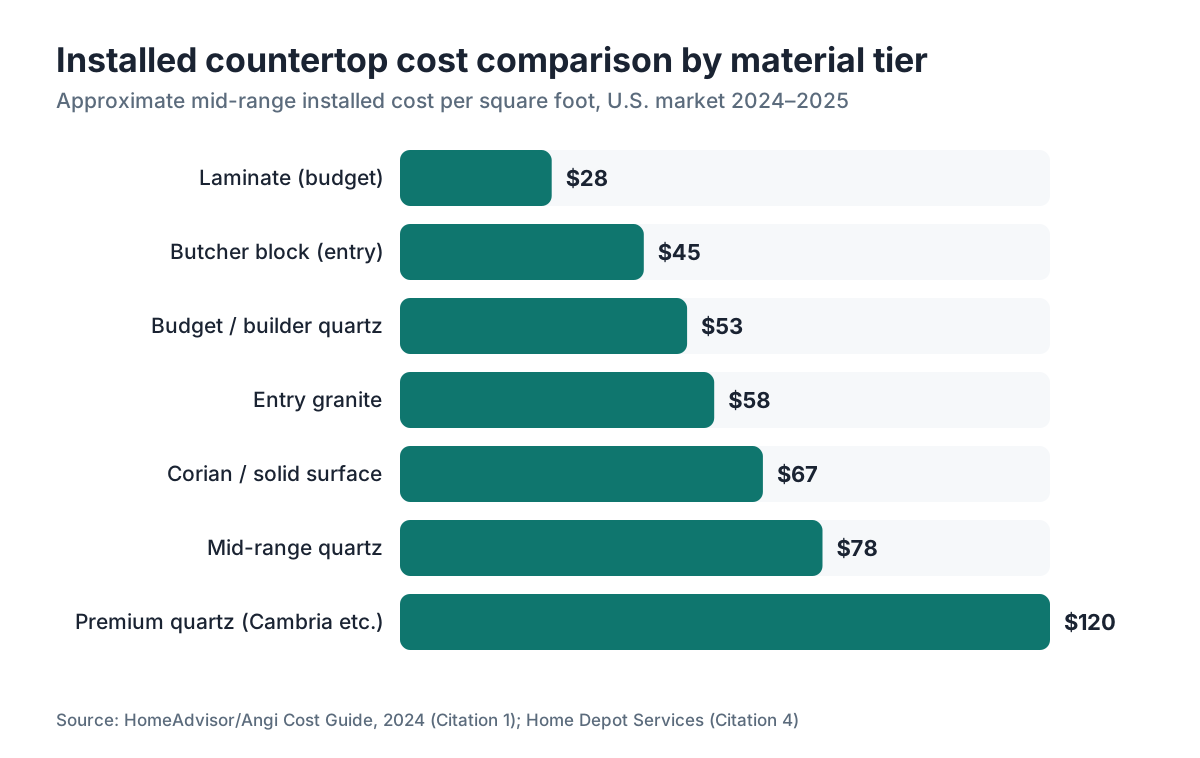
At the low end, builder-grade quartz from brands like MSI, Vicostone, or generic imports runs roughly $40, $60 per square foot installed in most U.S. markets. Mid-tier lines from Silestone, Caesarstone, and Viatera land at $60, $90 installed. Premium and designer lines, including Cambria's top collections, reach $120, $150 or more installed. [1]
So "discount quartz" usually means that $40, $70 installed band. It's real quartz, roughly 90 to 94% ground quartz crystals bound with polymer resin, the same basic composition as a $120 slab. [2] The difference is mostly color complexity, brand cache, thickness options, warranty terms, and sometimes (not always) how consistent the veining looks.
The installed price is the only number that matters. A slab priced at $28 per square foot can land at $75 installed once you add fabrication labor, edge profiles, sink cutouts, and delivery. Ask for an all-in quote or you're comparing fantasies.
For comparison, laminate countertops run $15, $40 installed, and granite countertops overlap heavily with quartz at $50, $120 installed depending on the stone. Neither is automatically better. This is a budget and preference call, not a quality ranking.
Where do legitimate discount quartz deals actually come from?
Real below-market quartz comes from four places: remnants, builder-grade lines, closeout colors, and volume-buying fabricators. Knowing which one you're looking at tells you whether the savings are worth the tradeoff.
Remnant slabs. When a fabricator cuts a countertop, the leftover piece is a remnant. Eighteen square feet of a $90 slab might sell for $200 total because the shop wants the rack space back. For powder rooms, laundry counters, and small kitchens, remnants are the best deal in the business. The catch: limited selection, no guarantee of a match if you need more later, and they sell fast.
Builder-grade and value lines. Most major manufacturers produce entry-level collections priced for production builders. MSI's Q Premium Natural Quartz line, Pental's entry tier, and similar products are real quartz at compressed margins. They're often thinner (2 cm instead of 3 cm) and have simpler patterns, but hardness and scratch resistance are essentially identical to the flagship colors. [3]
Closeout and discontinued colors. Quartz colors get discontinued constantly. A fabricator sitting on 40 square feet of a dead Caesarstone color needs it gone, and you can often buy it at 30 to 50% off list. The tradeoff is simple: you can't add more later.
Warehouse clubs and big-box retailers. Costco, Home Depot, and Lowe's all sell installed quartz. Material pricing is often competitive, but fabrication is contracted out, which can mean longer lead times and less flexibility on edge profiles. For a tight budget and a standard kitchen layout, these programs can work. [4]
Volume also cuts price. A shop that moves 500 slabs a month from one distributor can quote a number a one-off buyer will never see elsewhere. Pulling quotes from three or four local fabricators is still the single most reliable way to find a real deal on installed quartz.
What's the price per square foot breakdown by tier?
Budget quartz installs at $40, $65 per square foot. Mid-range runs $60, $95. Premium starts at $90 and climbs past $150. The table below shows approximate installed ranges for 2024 to 2025 U.S. markets. These are midpoints, and actual numbers move with region, shop overhead, and material costs. [1][4]
| Tier | Example brands | Material only ($/sq ft) | Installed ($/sq ft) |
|---|---|---|---|
| Budget / builder-grade | MSI Q Premium, Pental entry, generic imports | $18, $30 | $40, $65 |
| Mid-range | Silestone, Caesarstone, Viatera | $30, $50 | $60, $95 |
| Premium | Cambria, high-end Silestone, Dekton | $50, $80+ | $90, $150+ |
What the table hides: edge profiles add $10, $25 per linear foot for anything past a basic eased edge. Sink cutouts run $75, $200 depending on type. Cooktop cutouts are similar. These add-ons can turn a cheap quote into an average one once the whole job is priced.
To cross-shop materials honestly, look at kitchen countertops for a side-by-side across every surface type.
Is cheap quartz lower quality, or is the performance the same?
The performance is basically the same. Scratch resistance, non-porosity, and chemical resistance come from the manufacturing process and quartz content, not the price tag. A budget slab with 93% quartz content is as hard (around 7 on the Mohs scale) and as non-porous as a premium one. [2]
What you actually give up at the low end:
Color and pattern consistency. Premium manufacturers use better printing and layering to fake marble veining. Budget slabs repeat patterns more visibly and look flatter. If you want something that reads like Calacatta from across the room, you'll spend more.
Slab thickness. Many budget lines are 2 cm rather than 3 cm. That's fine with proper cabinet support, but it limits edge profile options and looks thinner at the overhang.
Warranty length and coverage. Cambria offers a lifetime transferable warranty. [5] Generic imports may offer 1 to 5 years, and some discount material sold through middlemen carries no manufacturer warranty at all, which leaves you with only whatever the fabricator backs.
UV stability. Some lower-cost formulations yellow faster under direct sun. If the counter sits under a skylight or a south-facing window, ask about this specifically.
None of this makes budget quartz a bad buy. For a rental, a basement bar, or a kid-heavy kitchen where you want a hard surface you can wipe down and forget, builder-grade quartz is tough to beat at the price.
What are the hidden fees that inflate the final price?
The gap between the advertised number and the final invoice lives in six line items: fabrication, edges, cutouts, seams, removal, and template fees. An advertised $35 per square foot can become $75 all-in by the time all six land on the bill. Here's where each one hides.
Fabrication and installation. Some quotes split material from labor. When a retailer advertises "$35/sq ft quartz," that's often material only. Fabrication adds $25, $45 per square foot depending on complexity.
Edge profiles. A basic eased or flat-polish edge is usually included. Ogee, waterfall, beveled, mitered, all cost extra. A waterfall edge on an island can add $500, $1,500 to a job.
Cutouts. Each sink, cooktop, or outlet cutout is a separate charge. A standard undermount sink cutout runs $100, $175. A farm sink can run $200 and up.
Seams. Wider kitchens need seams. Some shops charge per seam (typically $100, $250 each), others include one and bill for the rest.
Removal and disposal. Pulling out the old countertops often runs $150, $300 or more, and it's not always in the base quote.
Template fees. Some shops charge $75, $150 for the template visit. Ask upfront.
A fabricator running quoting software that itemizes every line (like SlabWise) produces a clearer breakdown than someone emailing you one lump number. Ask any shop to show the quote broken out by component before you sign.
Run the math on an average 50-square-foot kitchen and the gap between a well-structured discount quote and a premium quote can shrink from $2,000 on paper to about $600 in practice, once you account for identical edge and cutout charges on both.
How do you find reputable discount quartz fabricators near you?
Get three written itemized quotes from local or regional fabrication shops. That's the whole method. The big-box shortcut is easier but gives you less control, and a good local shop will often match the price while walking your actual kitchen.
Start with the Natural Stone Institute member directory, which lists fabricators by state. [6] Membership isn't a quality guarantee, but it means the shop pays dues and holds itself to basic trade standards.
Ask each fabricator:
- What's the total installed price including fabrication, delivery, edges (eased standard), and one undermount sink cutout?
- Is the material 3 cm or 2 cm?
- Who manufactures the slab, and what warranty does it carry?
- Do you have a remnant yard I can walk?
Read their Google reviews, but weight the ones that name specific jobs and turnaround times over generic praise. Photos of finished work tell you more than star counts.
Walk away from any shop that won't put an itemized quote in writing. A verbal "around $55 a foot" with no paper is how disputes start.
For the install itself, the countertop installation guide covers what to expect on job day and how to check the work before the crew leaves.
Are discount quartz countertops from big-box stores worth it?
For a simple rectangular kitchen, often yes. Home Depot and Lowe's both run installed quartz programs, and in 2024 both offered entry-level installed promotions in the $50, $75 per square foot range for standard configurations. [4] For a complex layout, a local shop usually wins.
The case for big-box: clear pricing, financing options, and a large company on the hook if something goes wrong. The case against: the actual fabrication is subcontracted to local shops that vary in quality, turnaround can run 3 to 6 weeks versus 1 to 2 weeks at a responsive local shop, and color selection is narrower.
Costco's countertop program runs through local fabricators in its network and has a decent reputation on pricing, though coverage swings a lot by market.
Straightforward rectangular kitchen, no unusual cutouts or overhangs? The big-box route can genuinely save money. Complex layout, apron-front sink, or an unusual edge request? A local fabricator who walks your job and talks through options will likely do better work at a comparable price.
The honest answer: neither route wins every time. It comes down to which specific subcontractor covers your area for the big-box program, and that's hard to learn before you commit.
How does discount quartz compare to other budget countertop options?
Budget quartz beats laminate on durability, ties Corian and granite on price, and beats butcher block on maintenance. Here's the honest rundown against each affordable material.
Laminate. Laminate countertops (including Formica countertops) still cost less at $15, $40 installed. Modern laminate looks far better than it did twenty years ago, but it's not heat-resistant and can't be repaired once an edge chips. Budget quartz wins on durability and resale perception.
Corian and solid surface. Corian countertops run $45, $90 installed and are fully repairable, seams nearly disappear, and edges route into almost any profile. They scratch more easily than quartz but sand out. Comparable price at the overlap, different tradeoffs.
Butcher block. Butcher block countertops start around $30, $60 installed for standard hardwood. They need oiling and take water damage near sinks if unsealed. Budget quartz wins on zero maintenance. Butcher block wins on warmth and repairability.
Granite. Entry-level granite countertops compete head-on with discount quartz. A basic granite color from a stone yard can land at $45, $65 installed. Granite needs sealing (roughly once a year) and is porous, which quartz is not. But granite carries natural variation many people prefer.
For durability per dollar with minimal upkeep, budget quartz still wins the comparison. The gap between entry-level quartz and entry-level granite, though, is smaller than the marketing wants you to believe.
What should you watch out for with discount quartz warranties?
The warranty gap between budget and premium quartz is real, and it matters more than most buyers expect. A lifetime manufacturer warranty and a 1-year distributor warranty on a $6,000 countertop are not the same product, even if the slab looks identical.
Cambria's warranty covers "manufacturing defects for the life of the installation." [5] Silestone offers a 25-year limited warranty on its brand products when installed by an authorized dealer. [7] Both are manufacturer-backed, transferable to new owners in most cases, and stand behind companies likely to exist in ten years.
Generic quartz imported through smaller distributors might carry a 1-year warranty from the distributor, not the manufacturer, and some carry none. If the distributor folds, the warranty folds with it.
The fabricator's labor warranty is separate. Most reputable shops warrant their install work (seams, undermount sink integrity, level setting) for one year. Some go longer. Ask.
For a rental or a house you're selling in two years, warranty length barely matters. For your forever kitchen, the spread between one year and lifetime is the whole game.
Can you find discount quartz for a DIY install?
You can buy the slab, but you probably can't fabricate it. Quartz is brutal to cut and finish without a CNC saw, water-cooled diamond blades, and edge polishing gear. A 3 cm slab weighs roughly 18 to 20 pounds per square foot, and a full kitchen slab can hit 400 to 600 pounds. [8] That's a two-person, mechanical-lift job before you make a single cut.
Prefabricated quartz is the real DIY path. Some fabricators sell precut, pre-edged pieces in standard sizes (usually 25.5 inches deep, in 2-foot increments) ready to drop in. These run roughly $30, $50 per linear foot for basic designs and work for a simple galley kitchen or laundry room. Home Depot and Lowe's carry them in limited sizes.
Anything with an L-shape, an island, or an undermount sink needs professional templating and fabrication. Seam placement alone takes experience to get right visually, and a bad seam on quartz can't be fixed without replacing the slab.
If you go prefab, measure twice. Most prefab pieces don't handle full-depth corners without a seam, and that seam will show.
How to get a fair quote on discount quartz countertops
Measure accurately, set your priorities, then pull three itemized quotes and compare them line by line. That's the process. It's not complicated, but most buyers skip it and overpay.
First, measure. Square footage is length times depth in feet. For an L-shaped kitchen, measure each run separately and add them. Add 10 to 15% for waste and seam adjustments. Get this number wrong before you shop and every quote you collect will be wrong too.
Second, decide your priorities before you talk to anyone. Do you need a specific color? A particular edge? Are you fine with 2 cm? Knowing your own requirements is the best defense against an upsell.
Third, contact at least three fabricators or retailers and ask for a fully itemized quote: material, fabrication, edges (specify which), sink cutout (specify undermount or drop-in), delivery, and installation. Compare the lines, not the totals.
Fabricator quoting software has gotten good enough that better shops produce itemized PDF quotes in minutes. Hand you a number on a sticky note? That tells you how they run the rest of the business.
SlabWise is a quoting and shop operations tool fabricators use to price jobs and manage production. Shops running this kind of software tend to produce clearer quotes because the itemization is built into the workflow. If you're a fabricator whose quotes still live in spreadsheets, the demo takes fifteen minutes.
Last, ask the one question that catches the surprises: "Is there anything in my project that would add cost that we haven't discussed yet?" A good fabricator flags the apron-front sink surcharge or the extra seam before you sign, not after.
What questions should you ask before buying discount quartz?
Before any money moves, get clear answers to these. Any experienced fabricator has heard all of them and will answer straight. If a salesperson gets defensive at question 1, that's your answer.
- Who manufactured the slab, and what warranty does the manufacturer provide in writing?
- What is the quartz content percentage? (Should be 90%+)
- Is this 2 cm or 3 cm material?
- Has this color been discontinued, or is it a current SKU?
- What's the total installed price including all cutouts and my chosen edge profile?
- What's your lead time from deposit to installation?
- Do you provide a written contract and itemized quote?
- What happens if a slab arrives with a defect or gets damaged during installation?
These aren't adversarial questions. They're the ones that separate a shop that runs a tight operation from one that improvises.
Frequently asked questions
What is the cheapest quartz countertop you can buy installed?
The bottom of the installed market in most U.S. regions runs $40, $55 per square foot for a basic builder-grade color with a standard eased edge and a single sink cutout. Big-box promotions sometimes dip lower for simple rectangular layouts. Remnant slabs from a local fabricator can occasionally beat that, especially for small bathrooms or laundry rooms.
Is discount quartz as durable as premium quartz?
For everyday kitchen use, yes. Scratch resistance and non-porosity come from quartz content and manufacturing process, not price tier. Budget quartz with 90%+ quartz content performs comparably to a $120/sq ft slab on hardness, stain resistance, and daily wear. What you give up is pattern complexity, warranty length, and sometimes UV stability near direct sunlight.
What is the difference between 2 cm and 3 cm quartz?
2 cm is roughly 3/4 inch thick; 3 cm is about 1.25 inches. Most budget and builder-grade lines come in 2 cm. Both work fine with proper cabinet support. 3 cm looks more substantial at overhangs and gives more edge profile options. 2 cm countertops sometimes get a built-up edge from the fabricator to look thicker, which adds cost.
Can I save money by buying quartz remnants?
Yes, remnants are one of the best legitimate ways to save. Fabricators price them to clear inventory rather than for full margin. You can often find remnants of mid-tier and premium brands below the price of generic new material. The limits are size (usually under 25 sq ft), no ability to reorder, and whatever colors happen to be on the rack that week.
Are quartz countertops from Home Depot or Lowe's good quality?
The material is real; both chains sell name-brand or manufacturer-grade quartz. The variable is fabrication, handled by contracted local shops that differ by region. Reviews of the same program range from excellent to frustrating depending on which subcontractor covers your zip code. For simple, standard-layout kitchens the programs are reasonable. Complex jobs or tight timelines favor a vetted local shop.
How do I know if a quartz deal is too good to be true?
Red flags: no manufacturer name on the slab, no written warranty, a quote with no itemization, and pricing below $35/sq ft installed that isn't a remnant or a specific promotion. At very low prices, the risk is usually an unknown import with no manufacturer warranty, a 2 cm slab passed off as 3 cm, or hidden fees that surface after templating.
What hidden fees should I expect when buying quartz countertops?
The common surprises are edge profile upgrades ($10, $25/linear ft), sink cutouts ($100, $200 each), cooktop cutouts ($75, $175), seam charges ($100, $250 per seam), removal of old countertops ($150, $300), and template fees ($75, $150). Ask for a fully itemized quote before signing. A base material price of $45/sq ft can easily become $75/sq ft all-in after these.
Is quartz worth it compared to laminate if I'm on a budget?
It depends on how long you'll keep the kitchen and how hard you use it. Laminate is $15, $40 installed, low-maintenance, and much better-looking than a decade ago. Budget quartz at $40, $65 installed is harder to scratch, won't chip at edges from impact the same way, and reads as higher quality at resale. For a rental or flip, laminate is often the smarter spend. For a home you'll keep, quartz earns the premium.
Do discount quartz countertops hurt home resale value?
There's no credible data showing buyers separate budget from premium quartz on appraisals. The National Association of Realtors tracks countertop type at the category level (quartz versus laminate versus tile), not by brand or tier. In practice, buyers see quartz and read quality regardless of whether the slab cost $40 or $100 per foot. A clean, well-fabricated budget quartz counter won't hurt your resale.
How long does discount quartz last?
Quartz countertops, budget lines included, routinely last 20 to 30 years with normal use. The failure modes are usually chips at edges from heavy impacts, discoloration near heat sources (quartz is not heat-proof), or seam separation from poor installation. Those risks are essentially the same across price tiers. A well-installed 2 cm budget slab will outlast most kitchen renovations.
What are the best discount quartz brands?
MSI's Q Premium Natural Quartz line, Pental's entry-tier slabs, and Viatera's standard collections get consistent good feedback from fabricators for price-to-quality. None are obscure imports; they're distributed nationally and carry manufacturer warranties. Silestone and Caesarstone each have entry-level colors that fall into discount pricing while keeping the brand's full warranty.
Can I negotiate the price on quartz countertops?
Yes, especially with local fabricators. Material margin varies, but fabrication labor and overhead are mostly fixed. You'll get more room on remnant pricing, closeout colors, or package deals if you're doing multiple rooms. Getting competing quotes and sharing them with your preferred shop is the most effective move. Big-box stores flex less on price but often run seasonal promotions.
What thickness of quartz is best for kitchen countertops?
3 cm (about 1.25 inches) is the standard for kitchen countertops. It's self-supporting across most spans without added plywood, handles edge profiling better, and looks proportional on standard 34.5-inch cabinets. 2 cm works fine with a plywood sub-base and is common in budget lines. If you buy budget quartz in 2 cm, ask whether the fabricator will build up the edge to a 3 cm look and what that adds.
Sources
- HomeAdvisor (Angi), Quartz Countertop Cost Guide: Installed quartz countertop pricing ranges from approximately $50 to $150+ per square foot depending on brand and complexity
- U.S. Geological Survey, Quartz Mineral Resources: Engineered stone (quartz surface) is composed of 90 to 94% ground quartz crystals bound with polymer resin, giving it approximately 7 Mohs hardness
- MSI Surfaces, Q Premium Natural Quartz product specifications: MSI's builder-grade Q Premium Natural Quartz line is distributed nationally as an entry-level engineered stone option for production builders
- Home Depot, Countertop Installation Services pricing page: Home Depot offers installed quartz countertop programs with entry-level pricing in the $50, $75 per square foot range for standard configurations
- Cambria, Lifetime Warranty documentation: Cambria states its warranty covers manufacturing defects for the life of the installation
- Natural Stone Institute, Member Fabricator Directory: The Natural Stone Institute maintains a directory of member stone fabricators searchable by state for the U.S. market
- Silestone by Cosentino, Warranty terms page: Silestone offers a 25-year limited warranty on Silestone brand quartz products installed by authorized dealers
- Occupational Safety and Health Administration (OSHA), Respirable Crystalline Silica standard and material handling guidance: A full 3 cm quartz slab weighs approximately 18 to 20 lbs per square foot, requiring mechanical handling equipment for safe movement
- National Association of Realtors, Remodeling Impact Report: NAR's remodeling impact research tracks countertop category (quartz vs. laminate vs. tile) for resale perception but does not differentiate by brand or price tier within a category
- Lowe's, Countertop Installation Services: Lowe's offers contractor-installed quartz countertop programs with pricing competitive with Home Depot for standard layout kitchens
Last updated 2026-07-09