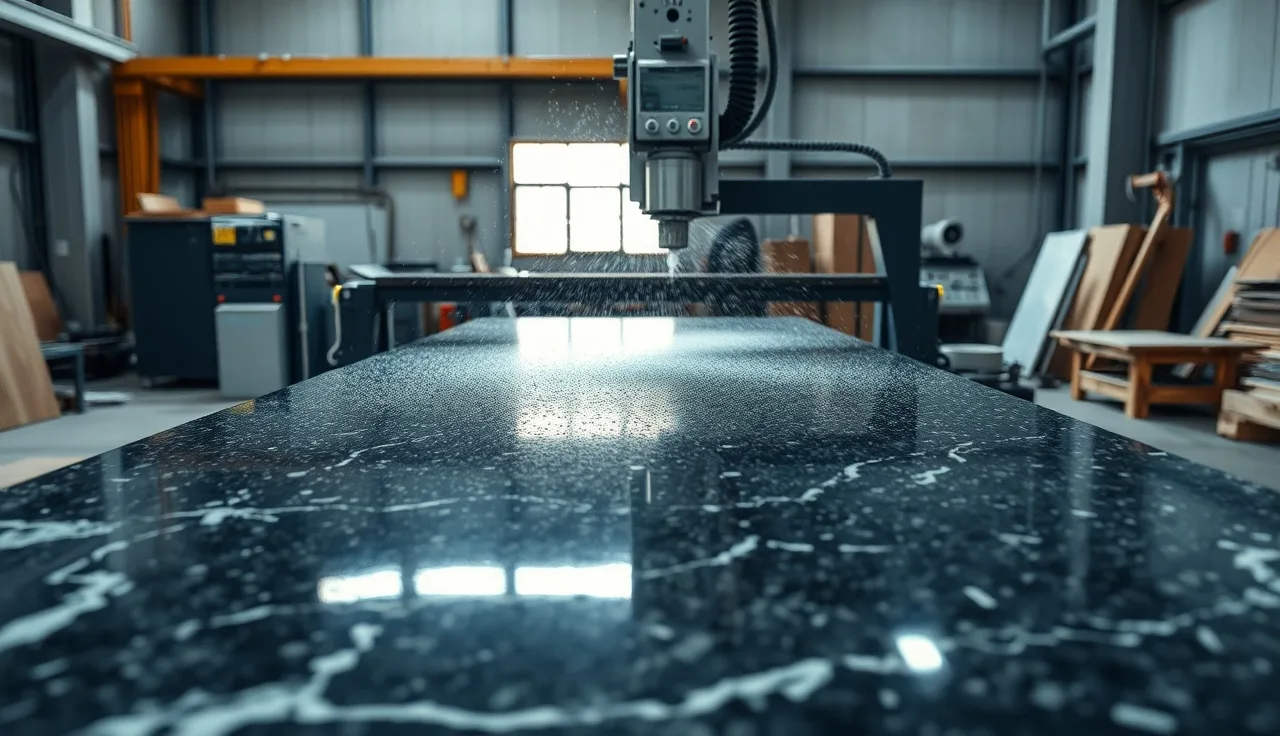
TL;DR
- Digital stone fabrication replaces hand-measuring and manual cutting with laser templating, CNC waterjet or bridge saw cutting, and nesting software.
- Shops that adopt the full digital workflow typically reduce material waste by 8 to 15%, cut labor hours on complex jobs, and produce tighter tolerances than hand-cut stone.
- Setup costs run from roughly $50,000 for a basic CNC saw to over $400,000 for a 5-axis waterjet.
What is digital stone fabrication?
Digital stone fabrication moves every step of a countertop job through software instead of tape measures and hand-guided saws. A fabricator scans the jobsite with a laser measuring device, imports that geometry into CAD/CAM software, arranges parts on a slab image to cut waste, then sends cut files straight to a CNC machine. The stone never sees a chalk line or a hand-drawn template.
The phrase covers a chain of linked technologies: digital templating (laser or photogrammetry), digital layout and nesting, and CNC cutting (waterjet, bridge saw, or router). Break any link and you have a hybrid workflow, not a truly digital one. Most shops adopt these tools one step at a time over several years. They start with digital templating because it has the fastest payback and the lowest entry cost.
For homeowners, the payoff is a countertop that fits the first time, with consistent edge profiles and tighter seams than hand-fabricated stone usually hits. For fabricators, the payoff is predictable labor, measurable material savings, and job files you can re-run if a slab breaks during install. Those re-run files are worth real money when you're cutting $200-per-square-foot marble [1].
How does laser templating work, and how accurate is it?
Laser templating uses a device on a tripod or handheld arm that fires a laser at reference points placed around the countertop opening. The device records angles and distances, builds a 2D or 3D polygon of the space, and exports a DXF or proprietary file straight to the shop's CAD software. The measure for an average kitchen takes 15 to 30 minutes on-site, versus 45 to 90 minutes for a cardboard or luan template.
The two dominant laser templating platforms in North American shops are Proliner (Prodim) and LT-2D3D. Proliner claims a measuring accuracy of ±0.5 mm under normal conditions [2]. In practice, accuracy depends on how carefully the operator places reference points and whether the finished floor elevation is stable. If a floor is still unlevel after installation, the slab fit is set by the cabinets, not the laser. Accuracy at the machine is not the same as a perfect fit at the site.
Photogrammetry-based systems, which use overlapping photos to reconstruct a 3D model, are gaining ground for irregular surfaces like curved islands or stone walls. They add post-processing time but handle curves and elevation changes better than single-plane laser systems.
For a homeowner, the question is simple: does your fabricator template digitally? Ask. A shop that still hand-templates can do excellent work, but digital templating cuts the odds of a mis-measure that stalls you eight weeks waiting on a rare slab.
What is CNC cutting for stone, and what machines are involved?
CNC stands for Computer Numerical Control. A CNC machine reads the cut file exported from layout software and moves a cutting head across a slab without a human guiding it in real time. The operator sets up the slab, confirms registration, and the machine runs.
Three machine types dominate:
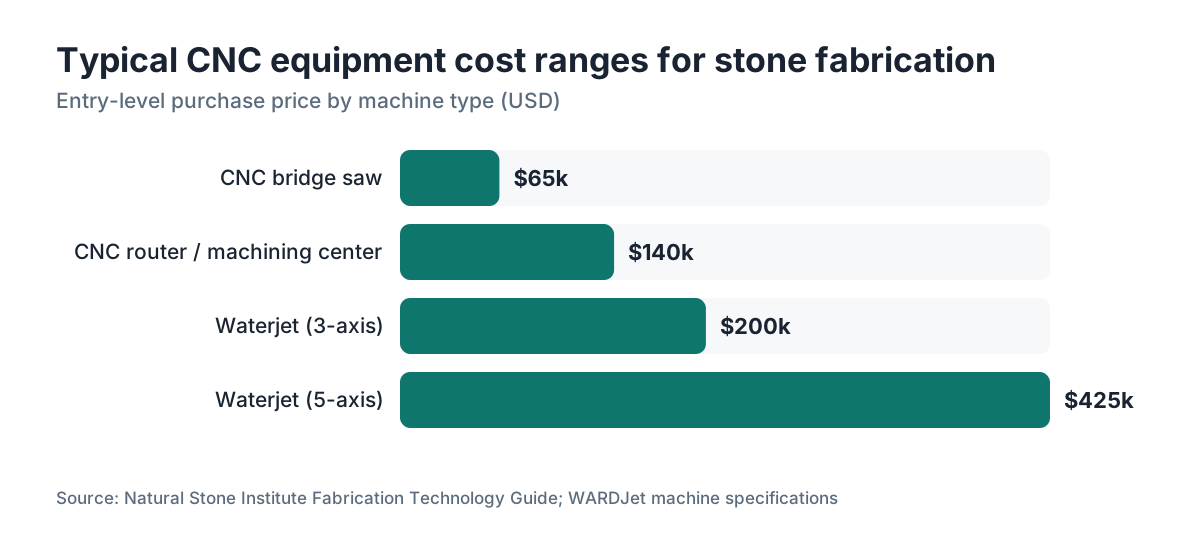
CNC bridge saw. A wet-cut diamond blade on a programmable gantry. These tilt the blade to cut miters and bevels automatically. Entry-level models start around $50,000 to $80,000 [3]. They cut straight lines and 45-degree miters well, but complex curved cutouts need a separate router or waterjet pass.
CNC router/machining center. Uses rotating diamond tooling to profile edges, drill sink cutouts, and shape curves. Often paired with the bridge saw in a two-machine workflow. A dedicated stone router runs $80,000 to $200,000 depending on table size and spindle count [3].
CNC waterjet. A high-pressure stream of water mixed with abrasive garnet cuts any shape, including tight internal radii and detailed patterns. No heat, no blade deflection, and tolerances under 0.25 mm are achievable. Waterjet machines for stone start around $150,000, and a 5-axis (tilting head) model that cuts compound bevels runs $350,000 to $500,000 or more [4]. Operating costs matter too: garnet abrasive runs roughly $0.25 to $0.45 per pound, and a busy shop burns through hundreds of pounds a day.
| Machine type | Typical entry cost | Cuts curves? | Edge profiling? |
|---|---|---|---|
| CNC bridge saw | $50,000 to $80,000 | Limited | Miter only |
| CNC router | $80,000 to $200,000 | Yes | Yes |
| Waterjet (3-axis) | $150,000 to $250,000 | Yes | Straight only |
| Waterjet (5-axis) | $350,000 to $500,000+ | Yes | Full bevel |
Most mid-size shops run a bridge saw for straight cuts and a CNC router for edge profiles. Waterjet shows up in shops doing high volumes of specialty work: medallions, inlays, custom furniture tops, or materials like porcelain that a blade can chip.
What is nesting software, and how much material does it actually save?
Nesting software takes the cut parts for one or more jobs and arranges them on the virtual slab image to shrink the wasted stone between pieces. It's the same idea used in garment cutting and CNC sheet metal work, applied to natural and engineered stone slabs.
The economics are plain. A standard 3-cm granite slab is roughly 50 to 65 square feet and costs $20 to $80 per square foot wholesale, depending on color and origin [1]. If bad layout wastes 12% of a $40-per-square-foot slab, that's about $25 to $30 of material gone per slab. Spread that across hundreds of slabs a year and the losses turn into real money, with no single visible mistake to point at.
Studies of CNC nesting in wood and sheet goods consistently show material savings of 8 to 15% versus manual layout [5]. Stone fabrication trainers report similar ranges, though peer-reviewed studies specific to stone are thin. The range is honest. A shop cutting simple rectangular kitchens lands at the low end. A shop doing complex inlays or mixed job batches can hit the high end.
Good nesting software also respects grain direction on marble and the pattern match on a book-matched slab, constraints that matter a lot for materials like marble countertops or Cambria countertops. Pattern-matched nesting is a harder problem to solve algorithmically, and not all software handles it equally well.
Nesting is also where a lot of quoting data lives. A shop that nests before quoting knows the exact slab yield before it commits to a price, which kills the guesswork behind underbids on tight jobs. Tools like SlabWise are built around this idea, connecting the nesting layout directly to the job quote so material cost reflects real cut efficiency instead of a rule-of-thumb overage percentage.
How does the digital workflow change quoting accuracy?
Traditional quoting relies on a salesperson measuring the space (or trusting homeowner measurements, which are often wrong) and adding a percentage overage to cover waste. That overage might be 15 to 20% for a complex job with lots of cutouts, and it's a guess.
In a digital workflow, the fabricator imports the digital template, nests the actual parts on a slab, and generates a material cost that reflects the real yield. The gap between a guess-based overage and a layout-based material cost can easily run $200 to $500 on a mid-size kitchen, and it compounds when slabs are expensive. Homeowners get a more accurate quote upfront and fewer surprise overages. Fabricators get fewer jobs that bleed money because the guess came in low.
The digital quote also carries the cut file, so the salesperson and the shop work from the same geometry. Miscommunication between measure, sales, and production is one of the most common sources of costly mistakes in fabrication shops. Locking the quote to the template file wipes out a whole category of those errors.
If you're getting countertop quotes, the practical check is to ask whether the price is based on a measured template or an estimate. A fabricator quoting from digital template data and actual slab layout is more likely to hold that price than one guessing off room dimensions you gave over the phone.
What does digital fabrication cost for a homeowner's countertop project?
Homeowners don't pay line items for CNC time or nesting software. You pay for finished countertops, and digital fabrication is baked into the fabricator's overhead and pricing. Digital shops often carry higher base prices per square foot than a small two-man shop with a handheld grinder, because they have debt service on expensive machines.
A rough 2024 to 2025 range for installed kitchen countertops from a digitally-equipped shop:
- Entry-level granite countertops: $45 to $75 per square foot installed
- Mid-range granite or quartz: $70 to $120 per square foot installed
- Premium marble or quartzite: $120 to $250 per square foot installed [1]
These are national ranges. Regional variation is large. A shop in rural Ohio runs on different overhead than one in San Francisco.
What digital fabrication buys you is tighter tolerances, consistent edge profiles, and lower re-do risk. The National Kitchen and Bath Association notes that countertop replacement from measurement error is one of the more expensive callbacks a remodeling contractor faces [6]. A digital shop's cost of a mis-cut is lower because the machine re-runs the file, so the material is usually the only loss. A hand-cut shop that mis-cuts a $400 piece of quartzite has also lost the labor to get there.
Choosing between shops? Ask whether they template digitally and whether they cut with CNC equipment. Most reputable shops doing volume work in 2025 have at least digital templating. Full CNC cutting is more common at larger shops running 20 or more jobs per week.
What materials work best with CNC and waterjet cutting?
CNC bridge saws and routers handle granite, engineered quartz, marble, quartzite, and soapstone without special accommodation. These are the bread-and-butter materials of most shops.
Porcelain panels and ultra-compact surfaces (Dekton, Lapitec) need more care. They're harder than granite on Mohs scale comparisons and more prone to edge chipping during machining. Waterjet is the preferred method for these because there's no blade contact. Blade speed and feed rates on a CNC saw also have to be dialed down for ultra-compact surfaces, which adds machine time per job.
Soft stones like soapstone and limestone are actually easier to cut but need sharper tooling, because dull tools drag and tear the surface. If you're keeping up with how to clean soapstone countertops at home, none of this touches you, but it's worth knowing your fabricator's experience with your chosen material.
Natural quartzite sits in a tricky middle spot. Some quartzite (geologically true quartzite, not the marketed "quartzite" that's often marble) is brutally hard, wears blades fast, and needs waterjet or aggressive diamond tooling. Fabricators who buy slab material without testing it first sometimes discover hardness surprises at the machine.
For engineered materials like laminate countertops or Corian countertops, the digital workflow exists but the machinery differs. Laminate uses router tooling on a flatbed CNC. Solid surface like Corian uses carbide bits and throws dust instead of slurry. The templating and nesting concepts carry over. The cutting physics do not.
How does digital fabrication reduce waste and what does that mean for sustainability?
Stone waste in fabrication comes in two forms: offcuts (usable remnants left over from a job) and slurry (the water, stone dust, and abrasive mix produced by wet cutting). Digital fabrication addresses the first directly and has no direct effect on the second.
Nesting optimization keeps more of each slab in the finished product and leaves larger, more usable remnants instead of a pile of small fragments. Big remnants can be priced and sold for bar tops, bathroom vanities, or small accent pieces. Small fragments usually go to landfill or aggregate. The EPA classifies construction and demolition debris, which includes stone waste from fabrication, under its broader solid waste framework, and shops in many states must document disposal of stone slurry as a business waste stream [7].
Slurry management is a separate operational issue. Wet cutting generates a calcium-rich slurry that cannot go straight to municipal storm drains under the Clean Water Act's National Pollutant Discharge Elimination System (NPDES) permit requirements [8]. Most shops run a recirculating water system with a settling tank. Digital versus hand cutting doesn't change the volume of slurry produced. Cut footage and blade or tool type matter more.
From a homeowner's side, a fabricator who nests jobs carefully is more likely to have usable remnants on hand for a future small project, like a replacement shelf or a laundry room vanity. Ask whether the shop keeps a remnant inventory. Many do, and remnants from premium materials can get you expensive stone at 30 to 50% of full slab price.
What should fabricators look for when buying CNC equipment or templating tools?
The most common mistake small shops make when buying CNC equipment is buying for the jobs they want instead of the jobs they have. A 5-axis waterjet is impressive, but if 80% of your revenue is standard granite kitchen tops, a well-configured bridge saw and router combination pays back faster and costs less to run.
Things that actually matter in the buying decision:
Table size. Most residential slabs are 55 to 65 inches wide and 100 to 130 inches long [1]. A machine with a 65-inch x 130-inch table handles standard residential slabs comfortably. Go smaller and you limit your material options. Go much larger and you add shop footprint and capital cost without matching benefit for residential work.
Software integration. The CNC machine is only as useful as the software driving it. Ask whether the machine natively reads DXF files from your templating system, or whether you need a middleware translator. Every format conversion step adds a place for errors to creep in.
Service and parts availability. A machine down for three weeks waiting on a part from Europe is a serious problem. Ask the manufacturer for their service response time commitment and the location of their nearest certified technician. Domestic machine brands sometimes have a real edge here, even when the import machine specs look comparable.
Training time. Even experienced stone cutters need 2 to 6 months to get fluent with a CNC workflow [3]. Budget for training time and lower throughput during the learning curve. Shops that rush this phase often blame the machine for errors that are really operator setup problems.
For templating tools, a Proliner or equivalent laser system runs $15,000 to $25,000, with a payback period most shops measure in under 18 months once they count the labor saved and the callbacks eliminated [2]. That's usually the first digital investment a shop should make, before any CNC equipment.
Shops that want to connect templating, nesting, and quoting in one workflow can request a demo from SlabWise to see how those three functions link in practice.
How do digital tools change the countertop installation process?
A digitally fabricated countertop doesn't install differently from a hand-fabricated one in physical terms. The same adhesive, epoxy seams, and mechanical fasteners apply. What changes is the predictability of fit.
Because the digital template captures the actual geometry of the cabinets, a CNC-cut piece should drop into place with minimal field trimming. Installers working with digital shops report less time on angle grinders at the jobsite and more time on seams and cleanup. That's real labor savings that partly offsets the higher per-piece cost at the shop.
Seam placement decisions, which affect both function and appearance, are made in the layout software before cutting. The installer has a diagram of where seams are supposed to land, and the cut pieces are designed to meet there. With hand-cut stone, seam placement sometimes gets adjusted in the field based on what the installer is working with that day.
The countertop installation process is also where digital fabrication shows its limits. If cabinet installation was sloppy and the cabinets aren't where the template said they were, even a perfectly cut CNC piece won't fit right. Digital fabrication pushes more of the quality burden onto the upstream trades. The laser template is only as accurate as what it measured, and it measured what was there at template time, not what the homeowner assumed would be there.
Is digital stone fabrication worth it for small shops and rural markets?
The honest answer: it depends on volume and job mix. The payback math looks different for a 10-job-per-week shop than a 50-job-per-week shop.
Digital templating has a strong case at almost any volume. The cost of a single callback from a measurement error usually beats the monthly lease payment on a Proliner. Even a shop doing 5 to 8 jobs a week will likely see positive ROI from digital templating within 18 to 24 months.
Full CNC cutting is a harder case for low-volume shops. The capital cost, maintenance, and training overhead favor shops that spread those costs across many jobs. A shop doing under 8 to 10 jobs a week may be better off outsourcing CNC cutting to a regional fabrication wholesaler and focusing on sales, templating, and installation. That hybrid model is common and works well.
Rural markets add a wrinkle: transportation time and cost to the job raise the price of a callback, which makes accuracy worth more. A fabricator who drives 90 minutes each way to a job cannot eat mis-cuts the way an urban shop can. That actually raises the ROI of digital templating for rural operations, even at lower volume.
Nobody has good national data on adoption rates by shop size. The closest proxy is the NKBA's industry tracking, which suggests digital templating is now the majority practice among shops with more than 5 employees, while smaller shops stay mixed [6].
Frequently asked questions
What is digital templating for countertops?
Digital templating uses a laser measuring device to capture the exact geometry of a countertop space and export that data as a CAD file. It replaces cardboard or luan templates. The laser records dozens of reference points, builds an accurate 2D polygon of the space, and sends it straight to the shop's layout software. Accuracy runs about ±0.5 mm under normal conditions, compared to ±3 to 5 mm for careful hand templating.
How accurate is CNC cutting for stone countertops?
CNC bridge saws and routers hold tolerances of ±0.5 to 1.0 mm for straight cuts and edge profiles under normal shop conditions. CNC waterjet can hit tolerances under 0.25 mm. In practice, the fit of a finished countertop depends on the accuracy of the original template as much as the cutting machine, so digital templating and CNC cutting have to work together to realize that accuracy in the installed piece.
How much does a CNC stone cutting machine cost?
Entry-level CNC bridge saws for stone start around $50,000 to $80,000. CNC routers for edge profiling and curved cutouts run $80,000 to $200,000. Waterjet machines range from $150,000 for a basic 3-axis unit to over $400,000 for a 5-axis model that cuts compound bevels. Operating costs, mainly garnet abrasive for waterjet, add $0.25 to $0.45 per pound used.
Does digital fabrication reduce countertop waste?
Yes. Nesting software optimizes how parts sit on a slab before cutting, which reduces wasted stone between pieces. Studies of CNC nesting in sheet goods show material savings of 8 to 15% versus manual layout. Stone-specific peer-reviewed data is limited, but industry trainers report similar ranges. The biggest gains come on complex jobs with many parts or expensive slabs where waste is costly.
What is waterjet cutting and when is it used for stone?
Waterjet cutting fires a high-pressure stream of water mixed with garnet abrasive to cut stone without blade contact or heat. It handles tight internal radii, detailed patterns, and hard materials like porcelain or ultra-compact surfaces that blade cutting can chip. It's slower and more expensive per linear foot than a CNC saw, so most shops reserve it for curved cuts, inlays, and materials that blade cutting damages.
Can homeowners tell if a fabricator uses digital vs. hand fabrication?
Yes, with some inspection. Digitally fabricated edges are consistent in profile depth and shape across the whole perimeter. Seam gaps are tighter and more uniform. Sink cutouts are smooth and precisely located. Hand-fabricated work can be excellent, but small inconsistencies in edge profile, slight seam gaps, or minor overhang variations are more common. Asking directly whether the shop templates digitally and cuts with CNC is the most reliable check.
What software do stone fabricators use for nesting and layout?
Common platforms for stone nesting and layout include Slabsmith (photorealistic slab layout), Alphacam and Mastercam (CNC toolpath generation), and quoting-plus-nesting tools like SlabWise that combine job layout with pricing. Some CNC machine manufacturers bundle proprietary software. The key capability to look for is whether the software reads digital template files directly and exports verified cut files to the specific CNC machine in the shop.
Does digital fabrication work for all stone types, including quartzite and porcelain?
Templating and nesting software works for any material. The cutting method varies. Granite, marble, and engineered quartz machine well on standard CNC bridge saws and routers. Porcelain panels and ultra-compact surfaces (Dekton, for example) are prone to edge chipping with blade cutting and work better on waterjet. True geological quartzite is very hard and speeds up blade wear; waterjet or aggressive diamond tooling handles it better than a standard setup.
How long does the digital fabrication process take from template to installed countertop?
Templating takes 15 to 30 minutes on-site for a standard kitchen. Layout and programming take 30 to 90 minutes in the shop. CNC cutting time depends on part complexity: a standard kitchen set of straight-cut granite pieces might run 45 to 90 minutes of machine time. Total lead time from template to installation is typically 5 to 10 business days at a well-run digital shop, versus 7 to 14 days at a hand-cut shop, though material availability is usually the longer constraint.
What are the environmental rules around stone fabrication waste and slurry?
Stone cutting slurry cannot be discharged straight to storm drains under the Clean Water Act's NPDES permit requirements. Most shops use recirculating water systems with settling tanks. Solid stone waste and dry slurry are typically classified as construction and demolition debris under EPA solid waste rules. Specific disposal requirements vary by state. Digital fabrication doesn't reduce slurry volume but does cut solid offcut waste through better nesting.
Is it worth paying more for a digitally-equipped fabricator?
Usually yes for mid-to-high cost materials. The main value is reduced callback risk: a mis-cut piece of $150-per-square-foot marble is a significant loss that a digital shop is much less likely to produce. For budget granite jobs where the material cost is low and a simple rectangle is all you need, the price premium may not pay off. Ask the fabricator specifically about their templating and cutting process before deciding.
How does digital fabrication affect countertop seams?
Digital fabrication lets seam placement get planned in software before cutting, with both pieces cut precisely to meet. This produces tighter seams, typically under 1 mm, compared to the 1 to 3 mm common with hand cutting. Seams in hard materials like granite get filled with color-matched epoxy regardless of fabrication method. The seam location is set at layout, so homeowners can see and approve placement on-screen before cutting starts.
Can a small fabrication shop afford digital equipment?
Digital templating is affordable at almost any shop size: a Proliner or equivalent laser system costs $15,000 to $25,000 and typically pays back within 18 months through reduced callbacks and labor savings. Full CNC cutting needs more volume to justify the capital. Small shops doing fewer than 8 to 10 jobs a week often outsource cutting to a regional wholesaler and keep their own digital templating and installation, which is a financially sound hybrid model.
Sources
- HomeAdvisor (Angi), Countertop Installation Cost Guide: Granite slab wholesale costs and installed countertop price ranges by material type
- Marble Institute of America (now Natural Stone Institute), Fabrication Technology Guide: CNC bridge saw and router cost ranges and estimated operator training time of 2 to 6 months
- WARDJet, Stone Waterjet Machine Pricing and Specifications: Waterjet machine pricing from $150,000 for 3-axis to over $400,000 for 5-axis stone cutting systems
- Forest Products Laboratory, USDA, CNC Nesting Optimization in Wood Products Manufacturing: CNC nesting software reduces material waste by 8 to 15% compared to manual layout in sheet goods manufacturing
- National Kitchen and Bath Association, NKBA Industry Research: Digital templating adoption rates among shops with more than 5 employees; countertop callbacks from measurement error as a cost category
- U.S. Environmental Protection Agency, Construction and Demolition Debris: Stone fabrication waste and dry slurry classified as construction and demolition debris under EPA solid waste framework
- U.S. Environmental Protection Agency, NPDES Permit Program: Stone cutting slurry cannot be discharged to storm drains; NPDES permit requirements apply to fabrication shop wastewater
- OSHA, Occupational Exposure to Respirable Crystalline Silica Final Rule (29 CFR 1910.1053): Fabrication shops that cut silica-containing stone must comply with the OSHA silica standard; wet cutting and engineering controls are primary compliance methods
- Natural Stone Institute, Dimension Stone Design Manual: Standard residential slab dimensions of 55 to 65 inches wide and 100 to 130 inches long for granite and marble
Last updated 2026-07-09