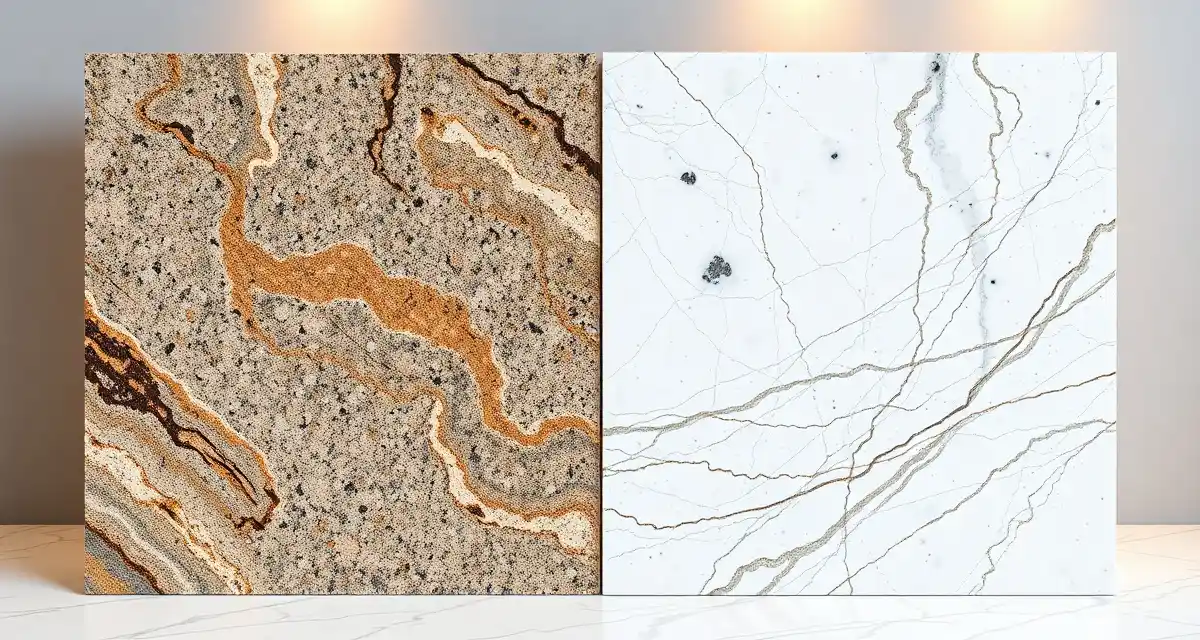
Granite vs Quartzite Countertops: 2026 Comparison
Granite and quartzite are both natural stones, both quarried from the earth, and both excellent choices for kitchen and bathroom countertops. But they differ in hardness, price, appearance, and maintenance needs. This guide breaks down the key differences so you can make a confident decision --- whether you are a homeowner choosing a material or a fabricator advising a customer.
TL;DR
- Quartzite is harder than granite (7 on the Mohs scale vs. 6-7 for granite), making it more scratch-resistant
- Granite is more affordable --- typically $40-$100/sq ft installed vs. $80-$200/sq ft for quartzite
- Both need sealing, but granite generally needs it less frequently than quartzite
- Quartzite offers a marble-like look with better durability --- it is the top choice for homeowners who want veining without marble's maintenance
- Granite has more color variety across all price ranges, while quartzite skews toward whites, creams, and soft earth tones
- Both handle heat well --- you can place hot pans on either without damage
- For outdoor kitchens, both work well since they are UV-stable natural stones
What Is Granite?
Granite is an igneous rock formed from cooled magma deep within the earth. It is composed primarily of quartz, feldspar, and mica, which gives it its characteristic speckled or granular appearance. Granite has been used for countertops in American kitchens since the 1980s and remains one of the most popular natural stone choices.
Calculate your material waste savings
See exactly how much slab material and money you could save with optimized cutting layouts.
Try the free Waste CalculatorGranite comes in hundreds of colors and patterns, from solid blacks to complex multi-colored slabs. Each piece is unique, which is part of its appeal.
What Is Quartzite?
Quartzite is a metamorphic rock formed when sandstone is subjected to extreme heat and pressure over millions of years. The sand grains recrystallize into an interlocking mosaic of quartz crystals, making quartzite extremely hard and durable.
Quartzite is often confused with quartz (engineered stone), but they are completely different materials. Quartzite is 100% natural. Quartz countertops are manufactured from ground quartz bound with polymer resin.
Quartzite typically features soft veining similar to marble, which is why it has become so popular among homeowners who love the marble look but want something tougher.
Side-by-Side Comparison
| Feature | Granite | Quartzite |
|---|---|---|
| Type | Igneous (natural stone) | Metamorphic (natural stone) |
| Hardness (Mohs) | 6-7 | 7 |
| Installed Cost (per sq ft) | $40-$100 | $80-$200 |
| Sealing Required | Every 1-3 years | Every 6-24 months |
| Heat Resistance | Excellent | Excellent |
| Scratch Resistance | High | Very High |
| Stain Resistance | Moderate (when sealed) | Moderate (when sealed) |
| UV Resistance | Yes | Yes |
| Outdoor Use | Yes | Yes |
| Color Range | Very wide | Moderate (mostly whites, creams, tans) |
| Appearance | Speckled, granular | Veined, marble-like |
| Maintenance | Low-Medium | Low-Medium |
| Lifespan | 50+ years | 50+ years |
Cost Comparison
Granite Pricing
Granite countertops typically cost $40-$100 per square foot installed, depending on the grade:
- Level 1 (builder grade): $40-$55/sq ft --- basic colors, thinner slabs, imported from India or China
- Level 2 (mid-range): $55-$75/sq ft --- more unique patterns, better consistency
- Level 3+ (premium): $75-$100+/sq ft --- exotic colors, rare patterns, thicker slabs
A typical kitchen with 40 square feet of countertop costs $1,600-$4,000 with granite.
Quartzite Pricing
Quartzite costs $80-$200 per square foot installed:
- Standard quartzite: $80-$120/sq ft --- common varieties like White Macaubas or Super White
- Premium quartzite: $120-$200/sq ft --- popular choices like Taj Mahal, Calacatta, or Sea Pearl
That same 40-square-foot kitchen costs $3,200-$8,000 with quartzite.
Why the Price Difference?
Quartzite costs more because:
- It is harder to quarry and process
- Fewer quarries produce quality countertop-grade quartzite
- The marble-like aesthetic commands premium pricing
- Fabrication requires more time and tool wear due to hardness
- Transport costs are higher from primary sources (Brazil is the largest supplier)
Durability and Hardness
Scratch Resistance
Quartzite is one of the hardest natural stones used for countertops. At 7 on the Mohs hardness scale, it is harder than a steel knife blade (5.5), meaning you cannot scratch quartzite with a kitchen knife. Granite comes in at 6-7, which is still very hard but slightly softer than quartzite.
In practical terms, both materials handle daily kitchen use without scratching. The difference only matters in extreme scenarios.
Heat Resistance
Both granite and quartzite handle heat extremely well. You can place a hot pan directly on either surface without damage. This is a major advantage over quartz (engineered stone), which can scorch at temperatures above 300F.
Chip Resistance
Both materials can chip if struck hard on an edge or corner. Quartzite's higher hardness makes it slightly more chip-resistant, but the difference is minimal. Proper edge profiles and careful handling during installation matter more than material choice here.
Impact Resistance
Granite has a slight edge in impact resistance because its crystalline structure absorbs shock slightly better than quartzite's interlocking grain structure. Neither material is brittle, though --- both hold up well in normal kitchen conditions.
Appearance and Aesthetics
Granite's Look
Granite has a speckled, granular appearance with flecks of different minerals throughout. Depending on the variety, it can be:
- Relatively uniform (like Absolute Black or Uba Tuba)
- Heavily patterned with multiple colors (like Delicatus or Bordeaux)
- Lightly veined (some granites have flowing patterns, though less pronounced than quartzite)
Granite's color range is vast --- black, white, gray, blue, green, red, gold, brown, and everything in between.
Quartzite's Look
Quartzite is prized for its marble-like veining. Popular varieties include:
- Taj Mahal --- warm white with soft gold veining
- Super White --- bright white with gray veining
- Sea Pearl --- grayish white with flowing movement
- Fantasy Brown --- warm tones with dramatic movement (technically a marble/dolomite hybrid, often sold as quartzite)
- Calacatta quartzite --- white with bold veining
The veined, flowing look of quartzite is its main selling point. If you want the marble aesthetic with natural stone durability, quartzite is the material to look at.
Maintenance Comparison
Sealing
Both granite and quartzite are porous natural stones that need periodic sealing to prevent staining.
Granite sealing schedule:
- Light colors: every 6-12 months
- Mid-range colors: every 1-2 years
- Dark/dense varieties: every 2-3 years
Quartzite sealing schedule:
- Most varieties: every 6-12 months
- Dense varieties (like Taj Mahal): every 12-24 months
To test if your countertop needs sealing, place a few drops of water on the surface. If the water absorbs and darkens the stone within 5 minutes, it is time to reseal.
Daily Cleaning
Both materials clean the same way: warm water, mild dish soap, and a soft cloth. Avoid acidic cleaners (vinegar, citrus-based products) on either material, as acids can degrade the sealant and potentially dull the surface over time.
Stain Risk
When properly sealed, both granite and quartzite resist stains well. Without sealant, both can absorb liquids --- coffee, wine, and cooking oil are the most common offenders. Quartzite's porosity varies by variety, so some slabs absorb more readily than others.
Fabrication Perspective
If you run a fabrication shop, here is what you need to know about working with each material:
Granite Fabrication
- Well-understood by virtually every shop in the country
- Standard diamond tooling works well
- Moderate blade wear
- Predictable cutting and polishing
- Wide availability from distributors
- Good profit margins across all price levels
Quartzite Fabrication
- Harder on tooling --- expect faster blade wear than granite
- Requires sharp, high-quality diamond blades
- Takes longer to cut and polish
- Some varieties have internal fractures that need careful handling
- Higher material cost means higher job values
- Requires more skill to seam and edge properly
For shops looking to optimize material usage on both granite and quartzite projects, slab nesting software like SlabWise can reduce waste by 10-15% --- which matters even more on $150/sq ft quartzite than it does on $50/sq ft granite.
Best Uses for Each Material
Choose Granite When:
- Budget matters --- granite offers the best natural stone value
- You want wide color selection --- no other natural stone comes in as many colors
- The project is a rental or investment property --- granite's durability-to-cost ratio is hard to beat
- You need a reliable, proven material --- granite has decades of track record in American kitchens
- The design calls for darker or more colorful surfaces --- granite excels in blacks, blues, greens, and multi-colored options
Choose Quartzite When:
- You want the marble look with better durability --- this is quartzite's sweet spot
- Scratch resistance is a top priority --- quartzite is harder than granite
- The kitchen will see heavy, long-term use --- quartzite holds up exceptionally well over decades
- Budget allows for a premium material --- quartzite is a long-term investment
- The design calls for light, veined surfaces --- quartzite's aesthetic is distinct and beautiful
Outdoor Kitchen Suitability
Both granite and quartzite work well for outdoor kitchens. As natural stones, they are UV-stable (no fading or discoloration from sunlight), heat-resistant, and can handle weather exposure. Seal outdoor surfaces more frequently --- every 6-12 months --- since rain and weather break down sealant faster.
Resale Value
Both materials add value to a home. Granite is seen as a standard premium countertop material and is well-recognized by home buyers. Quartzite, while less well-known among average buyers, appeals strongly to design-conscious purchasers and can command a premium in higher-end markets.
For resale purposes, neutral colors in either material perform best. White and gray tones in quartzite, and earth tones in granite, have the broadest appeal.
Is quartzite better than granite?
Neither is universally better. Quartzite is harder and offers a marble-like look that many buyers prefer. Granite is more affordable and comes in a wider range of colors. The best choice depends on your budget, aesthetic preferences, and how you use your kitchen.
Can you put hot pans on quartzite?
Yes. Quartzite handles heat extremely well. You can place hot cookware directly on the surface without damage. This is one of quartzite's advantages over engineered quartz, which can scorch from heat.
Does quartzite stain easily?
When properly sealed, quartzite resists stains well. Without sealant, it can absorb liquids and stain. The porosity varies by variety, so some quartzites are more absorbent than others. Regular sealing (every 6-12 months) prevents most staining issues.
Is quartzite the same as quartz?
No. Quartzite is a natural metamorphic rock quarried from the earth. Quartz countertops are engineered (manufactured) products made from ground quartz mixed with polymer resin. They look different, perform differently, and are priced differently.
How long does granite last?
Granite countertops can last 50 years or more with proper care. Many granite installations from the 1990s still look excellent today. The material itself does not degrade --- the main maintenance need is periodic resealing.
Which is easier to maintain, granite or quartzite?
They are roughly equal in maintenance. Both need periodic sealing, and both clean with soap and water. Granite may need sealing slightly less often (especially dark varieties), but the daily care routine is identical for both.
Does quartzite crack easily?
Quartzite does not crack under normal kitchen use. Its hardness actually makes it very resistant to cracking. However, some quartzite slabs have natural fissures (thin lines in the stone) that are cosmetic features, not structural weaknesses. A knowledgeable fabricator will inspect slabs and reinforce any areas that need it.
Can you use quartzite outdoors?
Yes. Quartzite is UV-stable and weather-resistant, making it an excellent choice for outdoor kitchens. Seal it every 6-12 months when used outdoors.
What is the most popular quartzite color?
Taj Mahal quartzite (warm white with soft gold veining) is consistently one of the most popular quartzite varieties. Super White and Sea Pearl are also top sellers. The trend in 2026 favors warm-toned quartzites over cooler options.
Is granite cheaper than quartzite?
Yes, significantly. Granite typically costs $40-$100 per square foot installed, while quartzite runs $80-$200 per square foot installed. For a typical kitchen, granite can save $1,500-$4,000+ compared to quartzite.
Get an Accurate Estimate
Choosing between granite and quartzite comes down to balancing your budget, aesthetic preferences, and long-term plans. Both are excellent natural stone options that will last for decades.
Need a quick countertop estimate? Use our countertop cost calculator to compare material costs for your specific kitchen layout. Fabricators can also start a free 14-day SlabWise trial to quote granite and quartzite jobs faster and reduce slab waste.
Try These Free Tools
- Cost Calculator -- Compare material costs instantly across different countertop options.
- Compare Materials -- Side-by-side material comparison with pricing, durability, and maintenance.
- Kitchen Visualizer -- Let customers preview countertop materials in their actual kitchen.
Sources & Further Reading
-
Natural Stone Institute - Technology and Software Solutions for Stone Fabricators
-
International Surface Fabricators Association - Fabrication Software and Digital Tools
-
National Kitchen & Bath Association - Technology Integration in Countertop Design
-
Marble Institute of America - Digital Fabrication and Software Standards