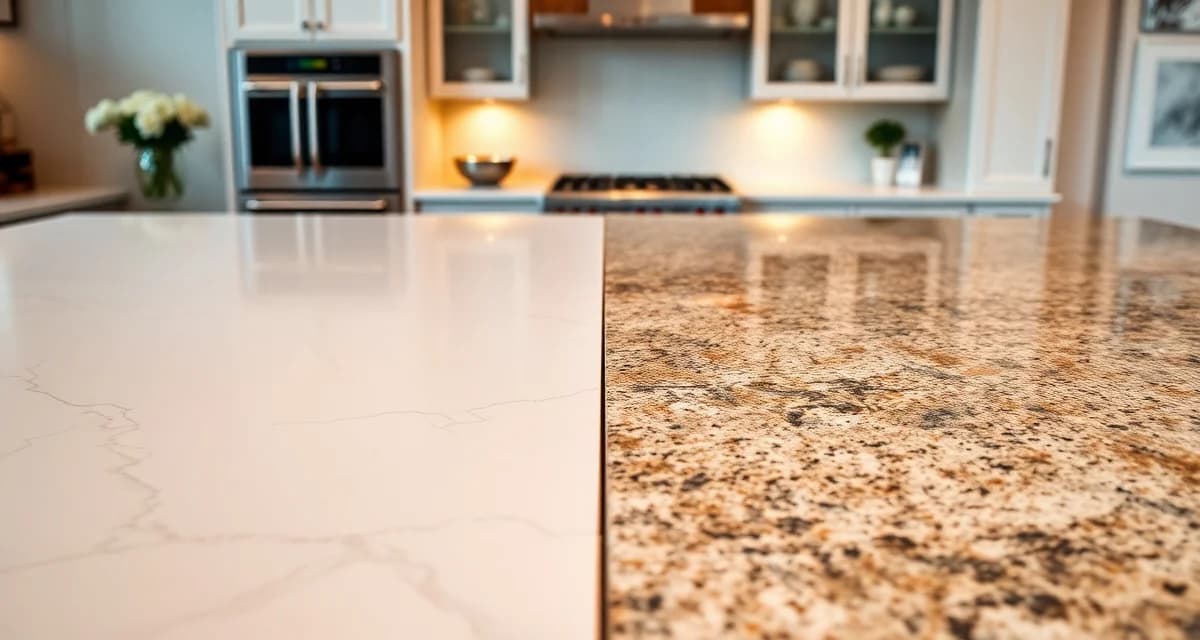
Cambria vs Granite Countertops: 2026 Comparison
Cambria is the top-selling premium quartz brand in North America. Granite is the most popular natural stone countertop. They compete directly in the $75-$150/sq ft range, making this one of the most common comparisons homeowners face. Here is how a premium engineered surface stacks up against genuine natural stone.
TL;DR
- Cambria never needs sealing; granite needs sealing every 1-3 years
- Granite handles heat better - hot pans are no problem; Cambria's resin scorches above 300F
- Granite is natural and unique; Cambria patterns are manufactured but highly realistic
- Cambria costs more on average: $80-$150/sq ft vs. $40-$100/sq ft for granite
- Cambria offers more consistent color slab-to-slab; granite varies by slab
- Granite works outdoors (UV-stable); Cambria does not
- Both are scratch-resistant and last 25+ years with proper care
Side-by-Side Comparison
| Feature | Cambria | Granite |
|---|---|---|
| Type | Engineered quartz (American-made) | Natural igneous stone |
| Installed Cost (per sq ft) | $80-$150 | $40-$100 |
| Sealing | Never | Every 1-3 years |
| Heat Resistance | Low (resin scorches) | Excellent |
| Scratch Resistance | High | High (6-7 Mohs) |
| Stain Resistance | Very High | Moderate (sealed) |
| UV/Outdoor Use | No | Yes |
| Pattern Consistency | Very consistent | Varies by slab |
| Pattern Uniqueness | Manufactured (repeats) | Naturally unique |
| Lifespan | 25-30+ years | 50+ years |
Cost Comparison
Granite's price range starts well below Cambria's:
Calculate your material waste savings
See exactly how much slab material and money you could save with optimized cutting layouts.
Try the free Waste Calculator- Budget granite (Level 1): $40-$55/sq ft - no Cambria equivalent at this price
- Mid-range granite (Level 2): $55-$75/sq ft - overlaps with Cambria's entry pricing
- Premium granite (Level 3+): $75-$100+/sq ft - directly competes with Cambria
The mid-range zone ($75-$100/sq ft) is where the real head-to-head competition happens. At this price, you are choosing between a premium natural stone slab and a premium engineered surface.
The Heat Question
This is granite's biggest practical advantage over Cambria (and all quartz). Granite formed from cooled magma handles kitchen temperatures without any concern. You can pull a 500F pan from the oven and set it directly on granite. Cambria's resin binder scorches at temperatures above 300F.
If you cook frequently and hate the idea of reaching for a trivet every time, granite wins this category decisively.
The Maintenance Question
This is Cambria's biggest advantage. Cambria is non-porous - liquids stay on the surface and never absorb. No sealing is needed, ever. Daily cleaning with soap and water is the entire routine.
Granite is porous and needs periodic sealing to prevent stain absorption. Light-colored granites may need sealing annually; dark, dense varieties can go 2-3 years. While sealing takes only 15-30 minutes, it is a recurring task that Cambria eliminates.
Natural vs. Manufactured Beauty
Granite offers genuine natural uniqueness. Each slab formed over millions of years with mineral variations that no two slabs share exactly. The speckled, crystalline appearance is distinctly natural.
Cambria's patterns are manufactured using engineering and design expertise. Their marble and stone looks are highly realistic, and Cambria's 200+ collection offers tremendous variety. But a Cambria slab is a reproduction of natural beauty, not the natural thing itself.
For homeowners who value authenticity, granite wins. For those who prioritize consistency (knowing the installed countertop will look exactly like the showroom sample), Cambria wins.
Project Cost Comparison
Cambria is the most expensive quartz brand. Granite's range starts much lower but can overlap with Cambria at the premium end:
| Kitchen Size | Cambria Installed | Granite Installed | Difference |
|---|---|---|---|
| Small (25 sq ft) | $2,000-$3,750 | $1,000-$2,500 | $1,000-$1,250 |
| Medium (40 sq ft) | $3,200-$6,000 | $1,600-$4,000 | $1,600-$2,000 |
| Large (60 sq ft) | $4,800-$9,000 | $2,400-$6,000 | $2,400-$3,000 |
The savings with granite are significant, especially for larger kitchens. A 60-square-foot kitchen with mid-range granite saves enough over Cambria to pay for upgraded appliances or backsplash tile.
Maintenance Cost Over Time
Granite needs sealing every 1-3 years. Hiring a professional costs $100-$300 per visit. DIY sealing products run $15-$40 per application. Over 20 years, granite's maintenance costs add $300-$3,000 that Cambria owners never spend.
That said, granite sealing takes 15-30 minutes and most homeowners handle it themselves. It's not a major burden, just something you have to remember to do.
Kitchen Performance
Both materials handle normal kitchen life well. The critical difference comes down to heat:
Hot pans: Granite is naturally heat-proof. A 500F cast iron skillet can go directly on granite without damage. Cambria's resin binder scorches above 300F, leaving white marks that can't be removed. If you cook with high heat and don't always reach for a trivet, granite gives you more margin for error.
Stains and spills: Cambria wins here decisively. It's non-porous out of the box. Granite is porous and relies on sealant for stain protection. If the sealant wears off and red wine or oil sits on the surface, granite can stain permanently.
Scratches and chips: Both resist scratching from normal use. Heavy impacts can chip either material. The difference: granite's chips tend to be more noticeable on polished surfaces, while Cambria's uniform color makes small chips slightly less obvious.
Fabrication Notes
Both materials require professional fabrication with diamond tooling and wet cutting. A few differences matter at the shop level:
- Cambria's engineered composition means predictable cutting speeds across all colors. Granite varies widely, with some colors cutting 30-40% slower than others.
- Cambria slabs match precisely between pieces. Granite requires careful slab selection and layout planning to minimize visual mismatches across seams.
- Cambria's authorized fabricator program offers marketing support and lead referrals. Granite has no equivalent program since it's a natural material, not a branded product.
Best Uses
Choose Cambria When:
- Zero maintenance is a firm requirement
- Pattern consistency across the project matters
- You want the widest design selection in quartz (200+ patterns)
- The kitchen will have minimal direct heat exposure
- Transferable lifetime warranty adds resale value
Choose Granite When:
- Heat resistance is important for your cooking style
- Natural stone authenticity matters to you
- Budget is $40-$75/sq ft (where Cambria has no options)
- Outdoor installation is part of the project
- You prefer the uniqueness of a one-of-a-kind natural slab
FAQ
Is Cambria better than granite?
Neither is universally better. Cambria is lower maintenance and more stain-resistant. Granite is more heat-resistant, naturally unique, and available at lower price points. The best choice depends on your cooking habits, maintenance tolerance, and design preferences.
Does granite add more home value than Cambria?
Both are recognized premium materials that add resale value. In the premium segment ($75-$100+/sq ft), buyers tend to view Cambria and granite equally. At the budget end, granite's natural stone status may carry slightly more prestige per dollar spent.
Can Cambria crack?
Cambria can crack from heavy impact or extreme stress (like unsupported overhangs), but this is rare under normal conditions. It is slightly more impact-resistant than granite due to the resin binder providing some flexibility.
Is granite maintenance really that much work?
No. Sealing granite takes 15-30 minutes every 1-3 years. Daily care is identical to Cambria: wipe with soap and water. The maintenance difference is real but manageable for most homeowners.
Which looks more like marble?
Cambria offers several highly convincing marble-look patterns (Brittanicca, Torquay, Ella). Some white granites have flowing patterns, but granite generally does not mimic marble as convincingly as Cambria does.
Can I use Cambria outdoors?
No. Cambria (and all quartz) should not be used outdoors. UV exposure causes yellowing and degradation. Granite is UV-stable and works well in outdoor kitchens.
Which is harder, Cambria or granite?
Both are comparably hard (both in the 6-7 Mohs range). Day-to-day scratch resistance is similar for both materials.
Does Cambria come in granite looks?
Cambria focuses primarily on marble, stone, and contemporary patterns rather than granite reproductions. If you want the granite look, you are better off choosing actual granite.
Make the Right Call
Cambria and granite are both excellent countertop materials competing in the premium segment. Your decision should be driven by cooking habits (heat matters), maintenance tolerance (sealing matters), and aesthetic preference (natural vs. engineered).
Compare costs using our countertop cost calculator. Fabricators can try SlabWise free for 14 days to manage quoting and nesting across quartz and natural stone.
Try These Free Tools
- Cost Calculator -- Compare material costs instantly across different countertop options.
- Compare Materials -- Side-by-side material comparison with pricing, durability, and maintenance.
- Kitchen Visualizer -- Let customers preview countertop materials in their actual kitchen.
Sources & Further Reading
-
Natural Stone Institute - Technology and Software Solutions for Stone Fabricators
-
International Surface Fabricators Association - Fabrication Software and Digital Tools
-
National Kitchen & Bath Association - Technology Integration in Countertop Design
-
Marble Institute of America - Digital Fabrication and Software Standards