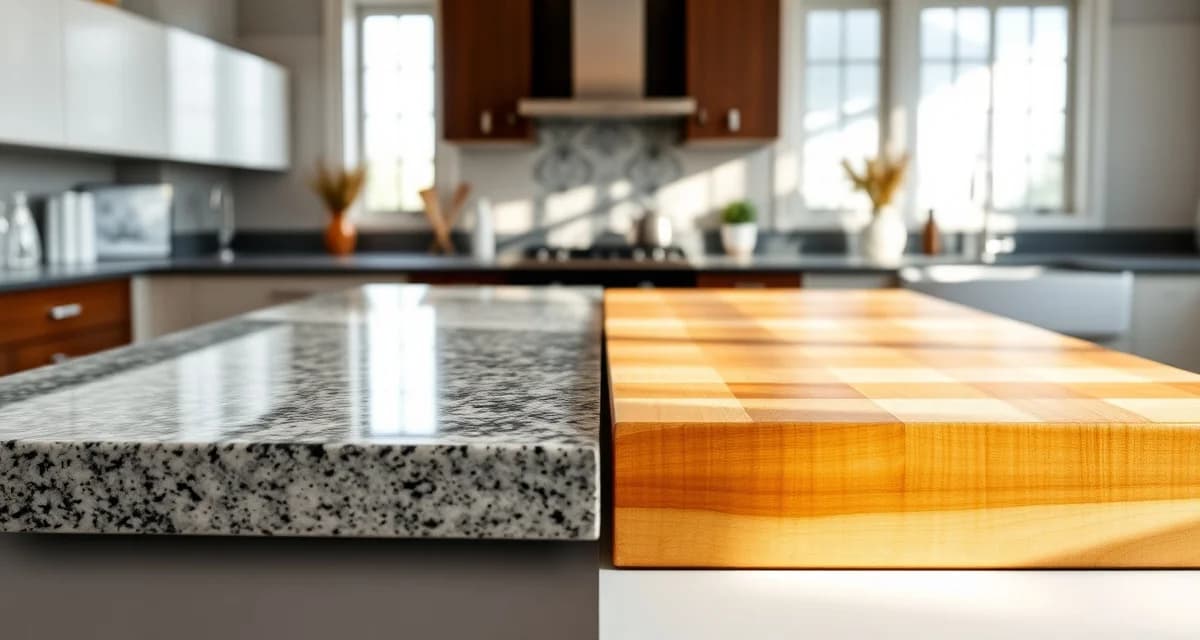
Granite vs Butcher Block Countertops: 2026 Comparison
Granite and butcher block represent two fundamentally different approaches to kitchen countertops. Granite is cold, hard, and virtually indestructible. Butcher block is warm, natural, and a genuine food-prep surface. Many kitchens use both - granite on the perimeter and butcher block on the island. Here is how they compare across the factors that matter most.
TL;DR
- Granite is far more durable - harder, heat-resistant, stain-resistant, and longer-lasting
- Butcher block adds warmth and character that no stone can replicate
- Butcher block requires regular oiling (every 2-4 weeks) and is high-maintenance
- Granite costs more: $40-$100/sq ft vs. $30-$70/sq ft for butcher block
- Butcher block is the only countertop you can cut directly on and sand/refinish when damaged
- Granite does not harbor bacteria when sealed; butcher block requires proper care to stay sanitary
- Mixing both materials in one kitchen is one of the most popular design trends in 2026
Side-by-Side Comparison
| Feature | Granite | Butcher Block |
|---|---|---|
| Type | Natural igneous stone | Hardwood (maple, walnut, oak, etc.) |
| Installed Cost (per sq ft) | $40-$100 | $30-$70 |
| Sealing/Oiling | Seal every 1-3 years | Oil every 2-4 weeks |
| Heat Resistance | Excellent | Poor (burns and scorches) |
| Scratch Resistance | High | Low (but repairable) |
| Stain Resistance | Moderate (sealed) | Low (absorbs liquids) |
| Water Resistance | High (sealed) | Low (swells from water) |
| Repairability | Difficult | Excellent (sand and refinish) |
| Food Prep Surface | No (use cutting board) | Yes (designed for cutting) |
| Warmth/Character | Cool, stone feel | Warm, natural wood feel |
| Maintenance Level | Low | High |
| Lifespan | 50+ years | 20-40 years |
Cost Comparison
Granite
- Level 1: $40-$55/sq ft installed
- Level 2: $55-$75/sq ft installed
- Level 3+: $75-$100+/sq ft installed
Butcher Block
- Standard hardwood (maple, oak): $30-$50/sq ft installed
- Premium hardwood (walnut, cherry, teak): $50-$70/sq ft installed
- Custom thickness or end-grain: $60-$80+/sq ft installed
For a 40-square-foot kitchen:
Calculate your material waste savings
See exactly how much slab material and money you could save with optimized cutting layouts.
Try the free Waste Calculator- Granite: $1,600-$4,000
- Butcher block: $1,200-$2,800
Butcher block is often cheaper than granite, especially in standard hardwoods. However, premium walnut butcher block can cost as much as mid-range granite.
Durability: Very Different Materials
Hardness
Granite (6-7 Mohs) is dramatically harder than wood. Kitchen knives, pots, pans, and dishes cannot scratch granite. All of these items will mark butcher block over time.
But here is the key difference: butcher block is designed to be scratched. It is a working surface meant to show use. Scratches, knife marks, and patina are part of the appeal. And when the wear becomes too much, you can sand the surface down and start fresh.
Heat Resistance
Granite handles heat without issue. You can set a hot pan directly on granite without worry.
Butcher block burns. A hot pan will scorch the wood, leaving a dark mark. Hot items near the edge can even cause warping. Always use trivets on butcher block.
Water and Moisture
Granite (when sealed) is effectively waterproof. Water sits on the surface and evaporates.
Butcher block absorbs water. Standing water can cause swelling, warping, splitting, and mold growth. The area around the sink is the highest-risk zone. Some homeowners avoid using butcher block near sinks entirely; others maintain it carefully with frequent oiling and immediate spill cleanup.
Staining
Sealed granite resists stains from coffee, wine, oil, and other common kitchen substances. Butcher block absorbs everything. Red wine, beet juice, turmeric, and cooking oils will stain untreated wood. Regular mineral oil application helps, but staining is part of life with butcher block.
Maintenance
Granite Maintenance (Low)
- Seal every 1-3 years (15-30 minutes)
- Clean daily with soap and water
- Avoid acidic cleaners
- Annual time investment: ~30 minutes
Butcher Block Maintenance (High)
- Apply food-grade mineral oil every 2-4 weeks
- Sand minor damage with fine-grit sandpaper as needed
- Keep water away from seams and edges
- Clean with mild soap; disinfect periodically with diluted vinegar
- Full refinishing (sanding + resealing) every 3-5 years
- Annual time investment: 3-6+ hours
If you enjoy caring for your home and treating surfaces as craft projects, butcher block maintenance can be satisfying. If you want to wipe and forget, granite is the clear choice.
The Hygiene Question
Granite, when properly sealed, is non-porous and does not harbor bacteria on its surface. It is easy to sanitize with standard kitchen cleaners.
Butcher block's hygiene profile is more nuanced. Wood is naturally antimicrobial - studies have shown that bacteria placed on wood surfaces die off faster than on plastic. However, deep cuts in the wood surface can trap bacteria. Proper care includes:
- Scraping the surface clean after use
- Periodic disinfecting with diluted white vinegar
- Regular oiling to maintain the protective barrier
- Replacing the cutting surface if deep grooves develop
For food safety, most experts recommend keeping separate cutting areas for raw meat and using the butcher block primarily for vegetable prep and bread cutting.
Design and Aesthetics
When Granite Works Best
- Traditional, transitional, and modern kitchen styles
- Kitchens where the countertop should feel permanent and substantial
- Rooms where cool tones and stone textures anchor the design
- Formal kitchens and bathrooms
When Butcher Block Works Best
- Farmhouse, rustic, and cottage-style kitchens
- Warm, inviting spaces that balance cool elements
- Kitchen islands where a warm accent contrasts stone perimeter counters
- Kitchens that prioritize a lived-in, homey feel
- Baking stations where a wood surface is preferred for dough
The Mixed-Material Trend
One of the strongest kitchen design trends in 2026 is mixing countertop materials. The most popular combination: granite or quartz on the perimeter counters, butcher block on the island. This gives you the durability of stone where you need it most (near the sink, stove, and dishwasher) and the warmth of wood as a visual centerpiece.
Repairability: Butcher Block Wins
Butcher block's greatest practical advantage is complete repairability. When the surface shows too much wear:
- Sand with 80-grit sandpaper to remove scratches and stains
- Progress to 120-grit, then 220-grit for a smooth finish
- Wipe clean and let dry
- Apply food-grade mineral oil (3-4 coats over 24 hours)
- Finish with a beeswax/mineral oil blend for extra protection
The result: a surface that looks brand new. This process can be repeated many times over the countertop's lifespan.
Granite cannot be refinished at home. Chips can be filled with color-matched epoxy, and a professional can re-polish dulled granite, but the process is expensive and not comparable to the simple DIY renewal that butcher block allows.
Best Uses
Choose Granite When:
- Durability and longevity are top priorities
- You want low maintenance - minimal time spent on upkeep
- Water resistance matters - areas near sinks and dishwashers
- Resale value is important - granite is universally recognized as premium
- You cook with high heat and want to set things down without worry
Choose Butcher Block When:
- Warmth and character are the design goal
- You want a true food-prep surface for cutting and kneading
- Repairability matters - you want to sand and refresh the surface over time
- The installation is a kitchen island or dedicated prep station
- Budget is tight and standard hardwood fits the price range
Can you use butcher block as a full kitchen countertop?
Yes, but it requires commitment to maintenance. Full butcher block kitchens work well for homeowners who enjoy the upkeep routine. Areas around sinks need extra attention to prevent water damage. Many homeowners prefer butcher block on the island only.
How long does butcher block last?
With proper oiling and periodic refinishing, butcher block countertops last 20-40 years. End-grain butcher block (where the grain faces up) tends to last longer and shows less wear than edge-grain or flat-grain construction.
Is butcher block sanitary?
Wood has natural antimicrobial properties, and studies show bacteria die faster on wood than on plastic. However, deep cuts can harbor bacteria. Regular cleaning, disinfecting, and oiling keep butcher block sanitary for food prep. Avoid using untreated wood for raw meat prep.
Can you put a hot pan on butcher block?
No. Hot pans will scorch and burn wood surfaces. Always use trivets and hot pads on butcher block. Even brief contact with a hot pot can leave a permanent mark (though it can be sanded out).
Does butcher block increase home value?
Butcher block on its own is not a premium resale feature the way granite or quartz is. However, butcher block used as an accent (like a kitchen island) in combination with stone perimeter counters is viewed positively by many buyers.
What type of wood is best for butcher block?
Hard maple is the most popular and practical choice - it is hard, tight-grained, light-colored, and relatively affordable. Walnut is popular for its dark, rich color. Cherry, oak, and teak are also used. Avoid softwoods (pine, fir) for countertop applications.
How often do you oil butcher block?
New butcher block should be oiled daily for the first week, then weekly for the first month, then every 2-4 weeks ongoing. In dry climates, you may need to oil more frequently. The wood will look dry and lighter in color when it needs oil.
Can butcher block go near the sink?
It can, but this is the highest-risk area for water damage. If you install butcher block near a sink, apply extra coats of mineral oil, wipe up water immediately, and maintain the finish diligently. Some homeowners use a marine-grade finish (like Waterlox) for extra protection near water.
Is granite better than butcher block?
Granite is more durable, more stain-resistant, more heat-resistant, and lower maintenance. Butcher block is warmer, more repairable, and functions as a cutting surface. Neither is universally better - they serve different purposes and appeal to different priorities.
Can you mix granite and butcher block in one kitchen?
Absolutely. This is one of the most popular kitchen design trends in 2026. Granite (or quartz) on the perimeter with butcher block on the island combines the best of both materials.
Find Your Perfect Combination
Granite and butcher block are not competitors as much as they are complements. The best kitchens often use both where each material's strengths matter most.
Get a cost estimate for your kitchen layout using our countertop cost calculator. Fabricators can try SlabWise free for 14 days to speed up quoting and optimize every slab.
Try These Free Tools
- Cost Calculator -- Compare material costs instantly across different countertop options.
- Compare Materials -- Side-by-side material comparison with pricing, durability, and maintenance.
- Kitchen Visualizer -- Let customers preview countertop materials in their actual kitchen.
Sources & Further Reading
-
Natural Stone Institute - Technology and Software Solutions for Stone Fabricators
-
International Surface Fabricators Association - Fabrication Software and Digital Tools
-
National Kitchen & Bath Association - Technology Integration in Countertop Design
-
Marble Institute of America - Digital Fabrication and Software Standards