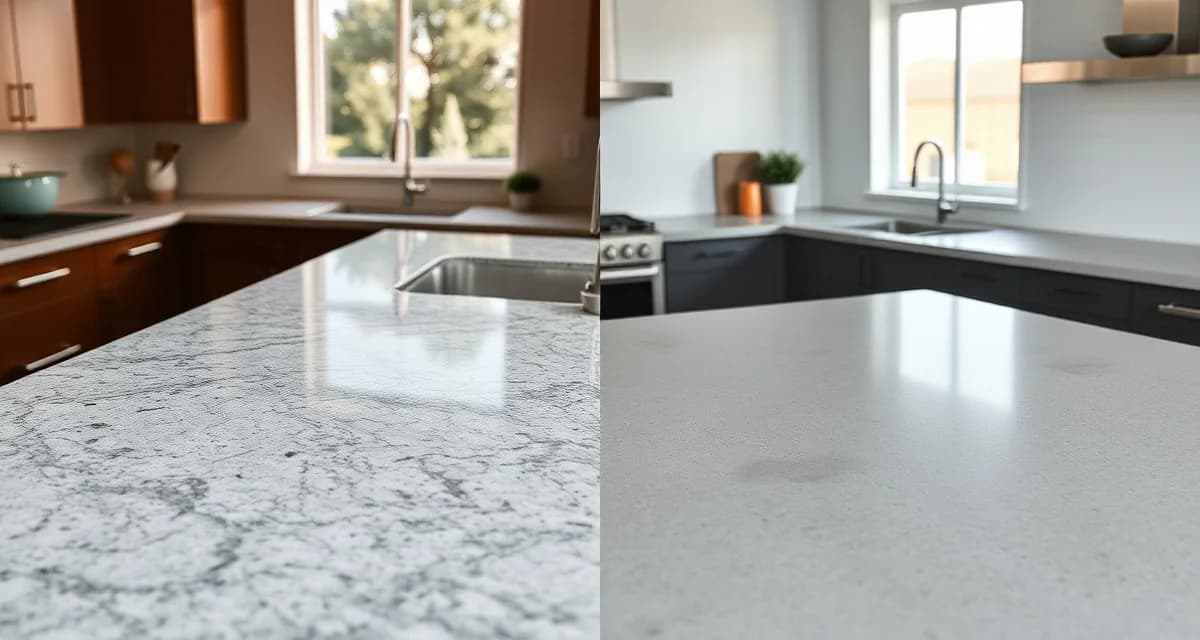
Granite vs Concrete Countertops: 2026 Comparison
Granite and concrete countertops appeal to very different design sensibilities. Granite is the proven natural stone standard. Concrete is the custom, artisan option that gives kitchens an industrial or modern feel. Both are durable, but they require different levels of care and come at different price points.
TL;DR
- Granite is lower maintenance - seal every 1-3 years vs. concrete's monthly waxing and annual sealing
- Concrete is fully customizable - any shape, color, texture, or embedded feature you can imagine
- Granite costs less in most cases: $40-$100/sq ft vs. $65-$150/sq ft for custom concrete
- Concrete cracks - hairline cracks are considered normal and expected over time
- Granite is harder and more scratch-resistant than concrete
- Concrete weighs more and may require cabinet reinforcement
- Both handle heat well, though concrete can discolor from extreme heat
- Concrete is a niche product - finding an experienced concrete fabricator is harder than finding a granite shop
Side-by-Side Comparison
| Feature | Granite | Concrete |
|---|---|---|
| Type | Natural igneous stone | Cement-based composite |
| Installed Cost (per sq ft) | $40-$100 | $65-$150 |
| Sealing Required | Every 1-3 years | Wax monthly, seal annually |
| Heat Resistance | Excellent | Good (can discolor) |
| Scratch Resistance | High (6-7 Mohs) | Moderate (3-4 Mohs) |
| Stain Resistance | Moderate (sealed) | Low-Moderate (sealed) |
| Customization | Limited to available slabs | Unlimited (any shape/color) |
| Cracking | Very rare | Expected (hairline cracks) |
| Weight | ~18-20 lbs/sq ft (3cm) | ~20-25 lbs/sq ft |
| Edge Profiles | Wide variety | Unlimited custom options |
| Integrated Features | Not possible | Drain boards, trivets, sink molds |
| Lifespan | 50+ years | 20-50 years |
Cost Comparison
Granite
- Level 1: $40-$55/sq ft installed
- Level 2: $55-$75/sq ft installed
- Level 3+: $75-$100+/sq ft installed
Concrete
- Basic concrete countertop: $65-$85/sq ft installed
- Mid-range (colored, textured): $85-$120/sq ft installed
- Custom (embedded features, complex shapes): $120-$150+/sq ft installed
For a 40-square-foot kitchen:
Calculate your material waste savings
See exactly how much slab material and money you could save with optimized cutting layouts.
Try the free Waste Calculator- Granite: $1,600-$4,000
- Concrete: $2,600-$6,000
Concrete's higher cost reflects its labor-intensive fabrication. Each countertop is custom-built - poured into molds, cured, ground, polished, and sealed by hand. This is artisan work, and it is priced accordingly.
The Cracking Reality
The most important thing to know about concrete countertops: they will crack. Hairline cracks in concrete are not a defect - they are an inherent characteristic of the material. Concrete shrinks as it cures, and changes in temperature and humidity cause expansion and contraction over time.
Most concrete countertop fabricators address this upfront and consider hairline cracking part of the material's character, similar to how marble owners accept etching. If hairline cracks would bother you, concrete may not be the right choice.
Granite, by contrast, almost never develops cracks under normal use. Its crystalline structure is far more stable than cured concrete.
Customization: Concrete's Biggest Advantage
Concrete's ability to be molded into virtually any shape sets it apart from every other countertop material:
- Custom colors - pigments can produce any color imaginable
- Embedded objects - glass, stones, shells, metal, fiber optics, or other materials can be set into the surface
- Integrated features - drain boards, trivets, soap dishes, and cutting board slots can be cast directly into the countertop
- Unusual shapes - curves, angles, and complex geometries are all possible
- Texture control - from glass-smooth to aggregate-exposed to rustic hand-troweled
- Integral sinks - the sink can be poured as part of the countertop
Granite is limited to what nature provides. You pick a slab from a yard and work with its existing color and pattern. Edge profiles offer some customization, but the surface itself is what it is.
Durability
Hardness and Scratch Resistance
Granite (6-7 Mohs) is significantly harder than concrete (3-4 Mohs). Kitchen knives will not scratch granite. They can scratch concrete. Concrete countertops require cutting boards to avoid surface damage.
Stain Resistance
Both materials are porous and need sealing. Granite's denser structure and established sealing products give it better stain resistance in practice. Concrete is particularly vulnerable to acidic foods and beverages (citrus, vinegar, wine) which can etch the surface through the sealer.
Heat Resistance
Both handle heat from normal kitchen use. Granite is essentially immune to kitchen temperatures. Concrete handles heat well but can discolor from extremely hot items. Using trivets is more important for concrete than granite.
Maintenance Comparison
Granite Maintenance
- Seal every 1-3 years (15-30 minute process)
- Clean daily with soap and water
- Avoid acidic cleaners on the surface
- Total annual maintenance time: about 30 minutes
Concrete Maintenance
- Apply food-grade wax every 1-4 weeks
- Reseal with penetrating sealer every 6-12 months
- Clean with pH-neutral soap only
- Avoid all acidic substances on the surface
- Sand and reseal if etching occurs
- Total annual maintenance time: several hours
This maintenance gap is significant. Homeowners who enjoy fussing over their surfaces and treating them like a craft project may enjoy concrete care. Those who want a set-it-and-forget-it surface should choose granite.
Weight and Structural Considerations
Concrete countertops are heavy - typically 20-25 pounds per square foot, compared to 18-20 pounds for 3cm granite. For standard base cabinets, this is usually fine. For overhangs, islands, and non-standard installations, additional structural support (steel reinforcement, beefier cabinets) may be required.
Always discuss weight requirements with your fabricator and cabinet installer before committing to concrete.
Finding a Fabricator
Granite fabricators are everywhere. The U.S. has 8,000-10,000 fabrication shops, and virtually all of them work with granite. Getting competitive quotes is straightforward.
Concrete countertop fabricators are much rarer. This is a specialized trade that combines concrete work, artistry, and countertop installation skills. Finding an experienced concrete fabricator in your area may require research, and prices vary widely between shops.
Best Uses
Choose Granite When:
- Low maintenance is important - granite needs far less attention than concrete
- Budget matters - entry-level granite is much cheaper
- You want proven durability - granite's 50+ year track record speaks for itself
- Scratch resistance matters - granite handles daily kitchen use without marking
- You want wide fabricator availability and competitive pricing
Choose Concrete When:
- Custom design is the priority - you want a unique, one-of-a-kind surface
- Industrial or modern aesthetic fits your kitchen design
- Integrated features (drain boards, embedded objects) are desired
- Color matching to a specific design palette matters
- You enjoy hands-on maintenance and treating the surface as a living material
Are concrete countertops durable?
Concrete countertops are reasonably durable for daily kitchen use, but they require more care than granite. They are softer, more porous, and prone to hairline cracking. With proper sealing and waxing, concrete surfaces hold up well for 20-50 years.
Do concrete countertops always crack?
Hairline cracks are extremely common and considered a normal characteristic of concrete countertops. Fiber reinforcement and proper curing reduce cracking but do not eliminate it. If cracks would bother you, consider a different material.
How much do concrete countertops cost?
Custom concrete countertops typically cost $65-$150 per square foot installed, depending on complexity. Basic poured concrete starts around $65/sq ft; complex custom work with embedded features, unusual shapes, or integral sinks can exceed $150/sq ft.
Can you put hot pans on concrete countertops?
Concrete handles moderate heat, but extremely hot items can discolor the surface or damage the sealer. Using trivets is recommended. Granite is more forgiving with heat.
Do concrete countertops stain?
Concrete is porous and can stain if the sealer is compromised. Acidic substances (lemon juice, wine, vinegar) are particularly problematic. Keeping the sealer and wax coat maintained is essential for stain prevention.
How heavy are concrete countertops?
Concrete countertops weigh approximately 20-25 pounds per square foot. Standard cabinets usually support this weight, but overhangs and islands may need additional structural reinforcement.
Can you make a concrete countertop yourself?
DIY concrete countertops are possible and popular with hands-on homeowners. Kits and online tutorials make the basic process accessible. However, professional-quality results - consistent color, smooth finish, proper reinforcement, and good sealing - are difficult to achieve without experience.
How do you clean concrete countertops?
Use a pH-neutral soap and warm water for daily cleaning. Avoid acidic or abrasive cleaners. Dry the surface after cleaning. Reapply food-grade wax every 1-4 weeks to maintain the protective layer.
Is granite outdated?
No. Granite remains one of the most popular and widely installed countertop materials in the U.S. It is a proven, attractive material that works across a wide range of kitchen styles and budgets.
Which has better resale value?
Granite has better resale value because it is universally recognized as a premium countertop material. Concrete countertops appeal to a smaller audience. While they can be a selling point in modern or industrial-style homes, some buyers view concrete as unusual or high-maintenance.
Choose What Fits Your Kitchen
Granite and concrete serve different purposes in kitchen design. Granite is the reliable, low-maintenance natural stone that works in almost any setting. Concrete is the custom, artisan choice for homeowners who want something truly unique and are willing to invest time in its care.
Get a quick cost estimate using our countertop cost calculator. Fabricators can try SlabWise free for 14 days to simplify quoting and reduce slab waste on every project.
Try These Free Tools
- Cost Calculator -- Compare material costs instantly across different countertop options.
- Compare Materials -- Side-by-side material comparison with pricing, durability, and maintenance.
- Kitchen Visualizer -- Let customers preview countertop materials in their actual kitchen.
Sources & Further Reading
-
Natural Stone Institute - Technology and Software Solutions for Stone Fabricators
-
International Surface Fabricators Association - Fabrication Software and Digital Tools
-
National Kitchen & Bath Association - Technology Integration in Countertop Design
-
Marble Institute of America - Digital Fabrication and Software Standards