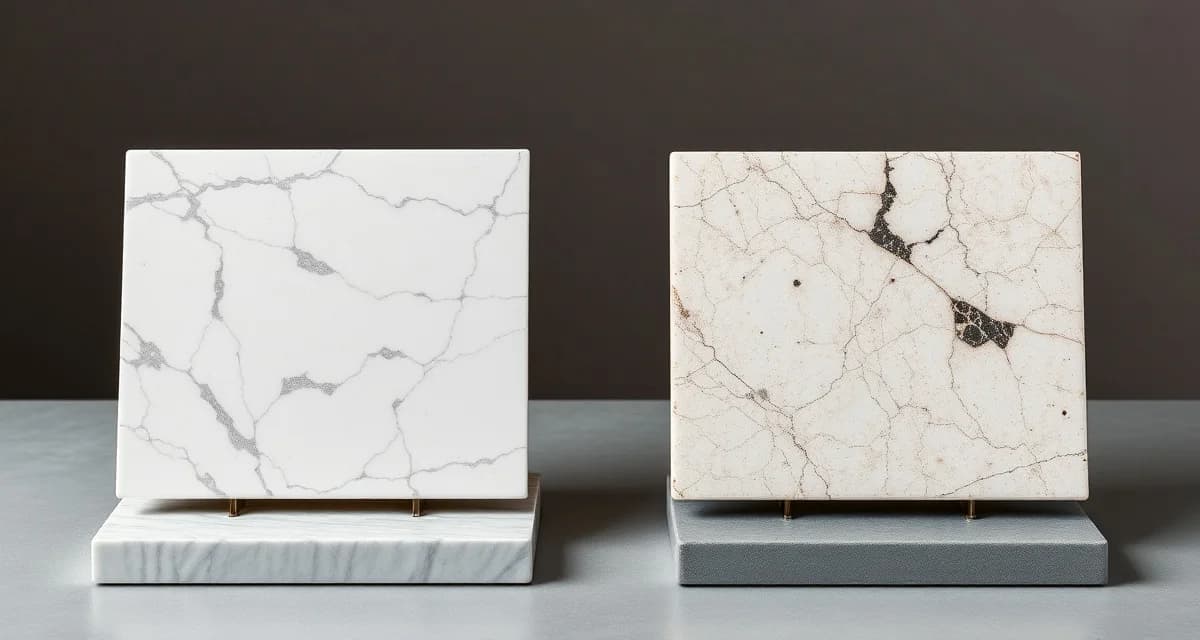
Quartz vs Quartzite Countertops: 2026 Comparison
Quartz and quartzite are two of the most confused countertop materials because of their similar names, but they are fundamentally different products. Quartz is a man-made engineered stone composed of 93% crushed quartz crystals bound with polymer resin. Quartzite is a natural metamorphic rock formed when sandstone is subjected to extreme heat and pressure deep within the earth. Quartz costs $50-$150 per square foot installed, while quartzite ranges from $70-$200 per square foot.
TL;DR
- Quartz is manufactured; quartzite is natural stone quarried from the earth
- Quartzite is harder than quartz---7+ Mohs vs 7 Mohs---and more heat resistant
- Quartz requires zero maintenance; quartzite needs sealing every 1-2 years
- Quartzite costs 20-40% more than comparable quartz on average
- Quartz has consistent patterns; quartzite has unique natural movement per slab
- Quartzite is UV-stable for outdoor use; quartz is not
- Demand for quartzite has grown 12% year over year as a premium alternative to marble
Side-by-Side Comparison
| Feature | Quartz | Quartzite |
|---|---|---|
| Origin | Factory manufactured | Quarried natural stone |
| Composition | 93% quartz + 7% resin | 100% natural metamorphic rock |
| Installed Cost | $50-$150/sq ft | $70-$200/sq ft |
| Avg Kitchen Cost (40 sq ft) | $3,200-$6,000 | $4,000-$8,000 |
| Hardness (Mohs) | 7 | 7-8 |
| Heat Resistance | Moderate (resin can burn at 300-400F) | Excellent (natural stone, no resin) |
| Stain Resistance | Excellent (non-porous) | Good (requires sealing) |
| Scratch Resistance | Very Good | Excellent |
| Maintenance | Soap and water only | Seal every 1-2 years |
| UV Resistance | Poor (yellows in sunlight) | Excellent |
| Pattern Consistency | High (engineered, repeatable) | Low (each slab is unique) |
| Color Range | Very wide (manufactured) | Limited (natural colors only) |
| Lifespan | 25-50+ years | 50-100+ years |
| Outdoor Use | No | Yes |
| Best For | Low-maintenance interiors | Premium kitchens, outdoor, heat zones |
Cost Comparison
Material Cost to Fabricators
| Quartzite Variety | Slab Cost/Sq Ft | Equivalent Quartz Slab Cost |
|---|---|---|
| Super White | $28-$48 | $22-$35 (white quartz) |
| Taj Mahal | $38-$60 | $30-$45 (warm-toned quartz) |
| White Macaubas | $32-$52 | $25-$40 (veined white quartz) |
| Calacatta Quartzite | $45-$75 | $35-$55 (Calacatta-look quartz) |
| Cristallo | $50-$80 | $40-$60 (premium quartz) |
| Mont Blanc | $32-$50 | $25-$38 (white quartz) |
Full Project Cost: 40 Sq Ft Kitchen
| Cost Component | Mid-Grade Quartz | Mid-Grade Quartzite |
|---|---|---|
| Material (50 sq ft w/ waste) | $1,750 | $2,500 |
| Fabrication | $480 | $600 |
| Edge Work (22 lin ft, beveled) | $352 | $440 |
| Sink Cutout | $250 | $300 |
| Installation | $600 | $650 |
| Sealing | $0 | $150 |
| Total Installed | $3,432 | $4,640 |
Quartzite runs roughly $1,200 more for a comparable kitchen---a 35% premium over quartz. The premium reflects higher raw material costs, longer fabrication time, and the uniqueness of natural stone.
Calculate your material waste savings
See exactly how much slab material and money you could save with optimized cutting layouts.
Try the free Waste CalculatorDurability Comparison
Hardness and Scratch Resistance
Quartzite is one of the hardest countertop materials available, rating 7-8 on the Mohs scale. It is harder than granite (6-6.5), harder than most quartz products (7), and significantly harder than marble (3-4). In a kitchen, quartzite resists scratches from knives, abrasive cleaners, and general daily wear better than nearly any other countertop material.
Quartz also performs well at 7 Mohs, but the resin binder creates micro-areas that are softer than the quartz crystals themselves. Heavy use over many years can create slightly more surface wear on quartz than on quartzite.
Heat Resistance
This is quartzite's most significant practical advantage. As a 100% natural stone with no resin or polymer binders, quartzite handles heat without risk of damage. Hot pots, baking sheets, and curling irons placed directly on quartzite will not cause discoloration, cracking, or marks.
Quartz contains resin binders that begin to degrade at 300-400 degrees Fahrenheit. Direct contact with hot cookware can leave permanent white marks, discoloration, or cracks in the resin. Trivets are mandatory with quartz.
Stain and Etch Resistance
Quartz is non-porous and wins this category decisively. No liquid can penetrate the surface---wine, oil, coffee, and acids all wipe away without concern.
Quartzite is naturally porous (though significantly less so than marble or granite). It requires sealing to prevent stain absorption. Properly sealed quartzite resists most household stains well, but the sealer must be maintained every 1-2 years.
Unlike marble, quartzite does not etch from acids. Its mineral composition (primarily quartz) makes it resistant to the chemical reactions that damage marble surfaces. This is a major advantage for homeowners who want a natural stone that can handle lemon juice and tomato sauce.
Appearance
Quartz Aesthetics
Quartz is manufactured, so patterns and colors are designed rather than discovered. This gives manufacturers control over:
- Vein placement and thickness
- Background color consistency
- Overall pattern density
- Surface texture (polished, matte, concrete-look)
The range of available looks is enormous---from solid whites to bold marble-inspired veining to concrete and terrazzo effects. However, quartz patterns are produced in batches, so slabs from the same production run look very similar. On large kitchen runs, pattern repetition at seams can be noticeable.
Quartzite Aesthetics
Quartzite offers some of the most dramatic and beautiful natural stone patterns available. The metamorphic process creates flowing veins, translucent crystals, and color movements that cannot be replicated by any manufacturer.
Popular quartzite aesthetics in 2026:
- Taj Mahal: Warm gold and cream tones with soft veining---resembles a warm marble
- Super White: Bright white with grey veining---often mistaken for marble
- White Macaubas: Grey and white with dramatic linear movement
- Cristallo: Near-transparent with subtle veining---a premium designer material
- Mont Blanc: Cool white with grey and gold accents
The natural color palette for quartzite is more limited than quartz. You will find whites, greys, golds, and some green or pink varieties, but not the blues, blacks, or bold manufactured colors available in quartz.
Fabrication Differences
For fabricators, quartzite presents distinct challenges compared to quartz:
Fabrication Time and Cost
| Factor | Quartz | Quartzite |
|---|---|---|
| Cutting speed | Standard | 15-25% slower |
| Diamond tooling wear | Normal | 20-30% faster wear |
| Edge profiling | Standard | Longer (harder stone) |
| Polishing passes | Standard (3-4) | More (4-6 for high polish) |
| Breakage risk | Low (1-2%) | Moderate (3-5%) |
| Seam work | Standard adhesive | Color-matched epoxy, more blending |
Why Quartzite Fabrication Costs More
Quartzite's extreme hardness means CNC machines and bridge saws run at slower feed rates, extending fabrication time. Diamond blades and bits wear faster, increasing consumable costs. The natural variation in quartzite also requires more careful slab layout to avoid fissures, pits, or weak spots that could cause breakage during cutting.
Fabricators should price quartzite jobs with a 15-25% fabrication premium over comparable quartz jobs to account for the additional time and tooling costs.
Maintenance Requirements
Quartzite Maintenance Schedule
| Task | Frequency | Cost | Time |
|---|---|---|---|
| Daily cleaning | Daily | $0 (soap and water) | 2 min |
| Sealant check (water test) | Every 6 months | $0 | 2 min |
| Professional sealing | Every 1-2 years | $100-$200 | 30 min |
| Deep cleaning | As needed | $15-$30 (stone cleaner) | 15 min |
| Professional polishing | Every 5-10 years (optional) | $200-$500 | 2-3 hrs |
Quartz Maintenance Schedule
| Task | Frequency | Cost | Time |
|---|---|---|---|
| Daily cleaning | Daily | $0 (soap and water) | 2 min |
| That is it | -- | $0 | -- |
Quartz is the clear winner for maintenance simplicity. Quartzite's maintenance is significantly less than marble but more than quartz. The trade-off is access to a natural stone that performs almost as well as quartz in daily use while offering the beauty and uniqueness of natural stone.
Best Uses for Each Material
Choose Quartz When:
- Low maintenance is your top priority
- You want a wide selection of colors and patterns
- Budget is a significant factor
- Pattern consistency matters (long countertop runs, multiple sections)
- The installation is indoor only
- You want a marble or concrete aesthetic without the natural stone care
Choose Quartzite When:
- You want real natural stone with minimal maintenance
- Heat resistance matters (serious cooks, bakers)
- The countertop will be outdoors or in direct sunlight
- You want a unique, one-of-a-kind surface
- You appreciate the look of natural marble but want better durability
- Long-term value and lifespan are priorities
FAQ
What is the difference between quartz and quartzite?
Quartz is a factory-manufactured product made from crushed quartz crystals mixed with polymer resin. Quartzite is a natural stone formed when sandstone undergoes extreme heat and pressure underground over millions of years. Despite the similar names, they are completely different materials with different properties, maintenance needs, and price points.
Is quartzite worth the extra cost over quartz?
For homeowners who value natural stone aesthetics, superior heat resistance, and long-term durability, yes. Quartzite offers a unique appearance that quartz cannot truly replicate, handles heat better, and can last 50-100+ years. The 20-40% price premium buys you a natural material that performs nearly as well as engineered quartz in most practical categories.
Does quartzite stain like marble?
Quartzite is significantly more stain-resistant than marble. While quartzite is porous and benefits from sealing, it does not etch from acidic foods the way marble does. Properly sealed quartzite handles lemon juice, wine, and tomato sauce without the chemical damage that plagues marble surfaces. Its stain resistance is closer to granite than to marble.
Can I use quartzite outdoors?
Yes. Quartzite is UV-stable and will not fade, yellow, or degrade in sunlight. This makes it an excellent choice for outdoor kitchens, barbecue surrounds, and pool areas. Quartz should never be used outdoors because UV exposure causes the resin binders to deteriorate and the surface to yellow.
Is quartzite harder than granite?
Yes. Quartzite rates 7-8 on the Mohs hardness scale, while granite rates 6-6.5. Quartzite is one of the hardest natural stones available for countertop use. This extreme hardness makes it highly scratch-resistant but also means it takes longer to fabricate, which contributes to its higher installed price.
How often does quartzite need to be sealed?
Most quartzite varieties need sealing every 1-2 years with normal kitchen use. Dense varieties like Taj Mahal may go 2 years between sealings, while more porous types might need annual attention. The water drop test (place a few drops of water on the surface; if the stone darkens within 10 minutes, it needs sealing) is a simple way to check.
Why do some people confuse quartzite with marble?
Many quartzite varieties---especially Super White, White Macaubas, and Calacatta quartzite---have white backgrounds with grey or gold veining that closely resembles marble. The visual similarity is strong enough that quartzite is sometimes mislabeled as marble in showrooms. The key difference is hardness: marble scratches easily with a knife; quartzite does not.
Which has better resale value, quartz or quartzite?
Both add strong resale value. In luxury markets, quartzite can command a slight premium because it is perceived as a higher-end natural material. In mainstream markets, quartz is equally valued due to its modern reputation and low-maintenance appeal. Either material is considered a top-tier choice by real estate professionals.
Can quartzite chip or crack?
Quartzite can chip at edges if struck with heavy force, similar to granite. Cracking is rare under normal use but can occur from severe impact or structural stress. Due to its extreme hardness, quartzite is actually less prone to chipping than softer natural stones like marble or limestone. Minor chips can be repaired with color-matched epoxy.
Is there a fake quartzite problem in the market?
Yes. Some stone sold as "quartzite" is actually dolomitic marble or soft marble that has been mislabeled. This is a significant issue because dolomitic marble etches from acids and is much softer than true quartzite. Always request a hardness test (true quartzite cannot be scratched with a knife blade) and buy from reputable distributors who verify their stone.
Estimate Your Countertop Cost Instantly
Use the SlabWise calculator to compare quartz and quartzite pricing for your kitchen. Enter your dimensions, pick your material, and see installed costs in seconds.
Try the Free Cost Calculator →
Compare the two side by side and make a confident material choice for your project.
Try These Free Tools
- Cost Calculator -- Compare material costs instantly across different countertop options.
- Compare Materials -- Side-by-side material comparison with pricing, durability, and maintenance.
- Kitchen Visualizer -- Let customers preview countertop materials in their actual kitchen.
Sources & Further Reading
-
Natural Stone Institute - Technology and Software Solutions for Stone Fabricators
-
International Surface Fabricators Association - Fabrication Software and Digital Tools
-
National Kitchen & Bath Association - Technology Integration in Countertop Design
-
Marble Institute of America - Digital Fabrication and Software Standards