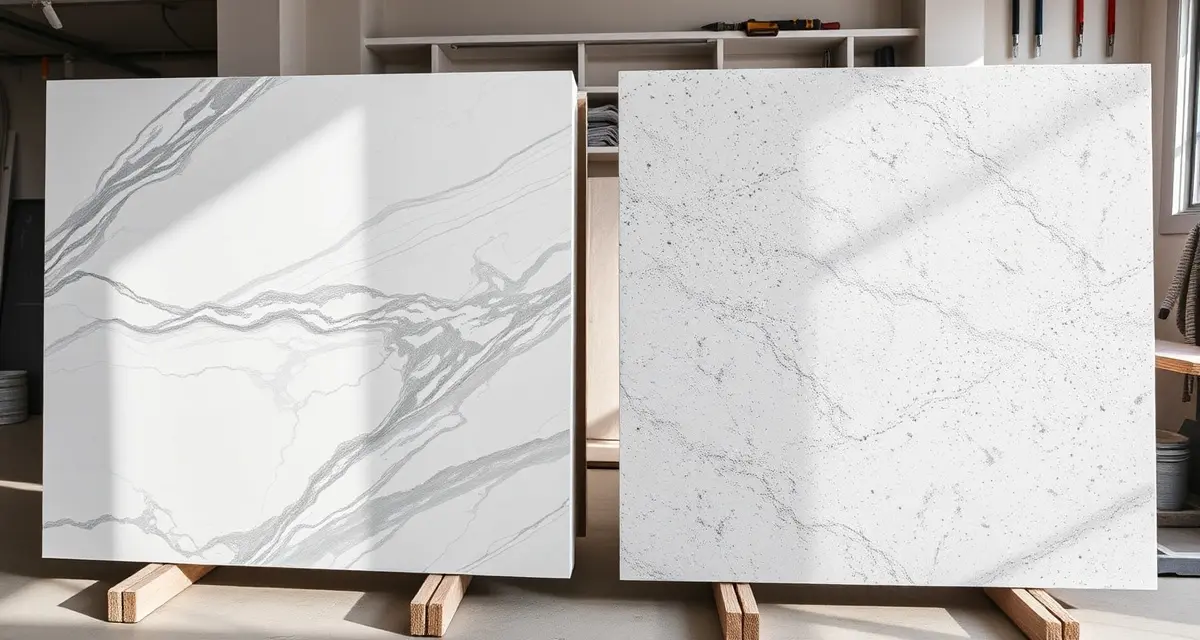
Marble vs Quartzite Countertops: 2026 Comparison
This marble vs quartzite countertops breaks down the key differences for countertop fabricators.
Marble and quartzite both deliver the veined, elegant look that homeowners love. But the two materials could not be more different in durability and day-to-day maintenance. This comparison covers everything you need to know before choosing between these premium natural stones.
TL;DR
- Quartzite is dramatically harder than marble (7 Mohs vs. 3-5), making it far more scratch and chip resistant
- Marble etches from acid contact (lemon, wine, vinegar) --- quartzite does not
- Both cost similar amounts at the premium end: marble $75-$250/sq ft, quartzite $80-$200/sq ft
- Quartzite requires less maintenance overall, though both need sealing
- Marble develops patina over time, which some homeowners love and others hate
- Quartzite is the better kitchen choice for families who cook frequently and want a low-worry surface
- Marble is the luxury statement for homeowners willing to accept the upkeep
What Is Marble?
Marble is a metamorphic rock formed when limestone is subjected to heat and pressure. It is composed primarily of calcium carbonate, which is what makes it reactive to acids. Marble has been used in architecture and design for thousands of years, and it remains one of the most recognizable luxury materials in the world.
Calculate your material waste savings
See exactly how much slab material and money you could save with optimized cutting layouts.
Try the free Waste CalculatorPopular countertop varieties include Calacatta, Statuario, Carrara, and Danby (American marble from Vermont).
What Is Quartzite?
Quartzite is also a metamorphic rock, but it forms when sandstone --- not limestone --- undergoes extreme heat and pressure. The result is a stone made primarily of interlocking quartz crystals, making it one of the hardest natural stones available.
Quartzite often features flowing veins and translucent depth that closely resemble marble, which is exactly why it has become so popular with buyers who want the marble look without the marble maintenance.
Side-by-Side Comparison
| Feature | Marble | Quartzite |
|---|---|---|
| Type | Metamorphic (calcium carbonate) | Metamorphic (quartz crystals) |
| Hardness (Mohs) | 3-5 | 7 |
| Installed Cost (per sq ft) | $75-$250 | $80-$200 |
| Sealing Required | Every 3-6 months | Every 6-24 months |
| Heat Resistance | Moderate | Excellent |
| Scratch Resistance | Low | Very High |
| Acid Sensitivity | Very High (etches) | None |
| Stain Resistance | Low (porous) | Moderate (when sealed) |
| UV Resistance | Yes | Yes |
| Outdoor Use | Not recommended | Yes |
| Appearance | Veined, soft, luminous | Veined, crystalline, depth |
| Maintenance Level | High | Low-Medium |
| Lifespan | 50+ years (with patina) | 50+ years |
The Critical Difference: Acid Sensitivity
This is the single biggest factor separating marble from quartzite.
Marble etches. Any contact with acidic substances --- lemon juice, wine, vinegar, tomato sauce, even some cleaning products --- causes a chemical reaction that dissolves the calcium carbonate on the surface. This leaves dull, lighter-colored marks called etch marks. Etching happens in seconds and cannot be prevented by sealing.
Quartzite does not etch. It is chemically inert to household acids. You can spill lemon juice on quartzite and wipe it up an hour later with no surface damage.
This distinction matters enormously in kitchens, where acidic foods and beverages are part of daily life. Homeowners who cook frequently, have kids, or entertain regularly will have a much easier time with quartzite.
Cost Comparison
Marble Pricing
- Carrara marble: $75-$120/sq ft installed (the most affordable premium marble)
- Calacatta marble: $150-$250/sq ft installed (the most sought-after variety)
- Statuario marble: $130-$200/sq ft installed
- Danby marble: $100-$175/sq ft installed
Quartzite Pricing
- Standard quartzite (White Macaubas, Super White): $80-$120/sq ft installed
- Premium quartzite (Taj Mahal, Sea Pearl): $120-$180/sq ft installed
- Exotic quartzite (Patagonia, Azul Macaubas): $150-$200/sq ft installed
For a 40-square-foot kitchen:
- Marble: $3,000-$10,000
- Quartzite: $3,200-$8,000
The price ranges overlap significantly. At the mid-range, quartzite and marble cost about the same. At the very top end, rare Calacatta marbles exceed the price of most quartzites.
Durability Breakdown
Scratch Resistance
Marble ranks 3-5 on the Mohs hardness scale. A steel knife blade (5.5 Mohs) can scratch marble. Quartzite ranks 7 --- harder than the knife blade --- so knives cannot scratch it.
In a real kitchen, marble countertops develop fine scratches over time from cutting, sliding dishes, and normal use. Quartzite stays smooth unless hit with something extremely hard.
Heat Resistance
Quartzite handles heat better than marble. While neither will crack from a hot pan, marble can experience thermal shock if exposed to extreme temperature changes. Using trivets is wise for both materials, but it is especially important for marble.
Chip Resistance
Both materials can chip on edges if struck by a heavy object. Marble chips more easily due to its softer composition. Quartzite's hardness gives it better chip resistance, though no stone is chip-proof.
Appearance: Subtle but Real Differences
Both materials feature veining, but they look different up close:
Marble's appearance:
- Soft, warm glow with a buttery quality
- Veining tends to be fluid and organic
- Translucent depth --- light seems to enter the stone
- Colors: predominantly white, gray, and green; some rare pink, blue, and black varieties
- The surface has a gentle, almost powdery feel when honed
Quartzite's appearance:
- Crystalline sparkle --- tiny quartz crystals catch light
- Veining can be flowing or more angular/fractured looking
- More visual depth and dimension than marble in many cases
- Colors: white, cream, gray, gold, and blue-green varieties
- Surface feels glassy and hard
If you put a Calacatta marble slab next to a Calacatta quartzite slab, most people can tell the difference. Marble looks softer. Quartzite looks crisper.
Maintenance Comparison
Marble Maintenance
Marble requires the most maintenance of any common countertop material:
- Seal every 3-6 months in kitchen applications
- Wipe spills immediately --- especially acids (within 30-60 seconds)
- Use only pH-neutral cleaners --- no vinegar, no citrus-based products
- Use coasters, trivets, and cutting boards at all times
- Accept that etching will happen --- it is part of owning marble
- Professional re-polishing may be needed every 3-5 years ($300-$800)
Quartzite Maintenance
Quartzite is much simpler:
- Seal every 6-24 months depending on the variety
- Clean with soap and water --- standard routine
- Avoid acidic cleaners (they won't damage the stone, but they can degrade sealant)
- Wipe spills reasonably promptly to prevent staining on unsealed areas
- Use cutting boards to protect your knives, not the quartzite
The Patina Question
Here is where personal preference becomes the deciding factor.
Marble develops patina over time. Etch marks, fine scratches, and subtle wear create a lived-in appearance that changes the surface's character. Some homeowners love this. They see it as the stone aging gracefully, gaining history and personality.
Others find it stressful and frustrating. If every water ring and lemon squeeze feels like damage, marble will be a constant source of anxiety.
Quartzite does not develop patina. It looks essentially the same after 10 years as it did after installation (with proper sealing). If you want a surface that stays pristine, quartzite is the clear winner.
Fabrication Notes
For fabrication shops, here is how these materials compare on the production floor:
Marble Fabrication
- Softer material --- cuts and polishes faster
- Less tool wear than quartzite or granite
- Requires careful handling to avoid chipping and breaking
- Seam work is straightforward
- Higher breakage risk during transport and installation
- Remakes are extremely expensive given material cost
Quartzite Fabrication
- Very hard on tooling --- expect significant blade wear
- Takes longer to cut and polish
- Some varieties have internal stress fractures that can cause problems
- Requires experienced fabricators who understand the material
- Higher material cost means waste is expensive
- Slab nesting optimization (like SlabWise offers) saves significant money on quartzite projects
Best Uses for Each Material
Choose Marble When:
- Aesthetics are the top priority and you accept the maintenance trade-off
- It is a bathroom vanity --- bathrooms see less acid exposure than kitchens
- You appreciate natural patina and the idea of a surface that ages
- The kitchen is primarily for light use or has a dedicated cooking area
- You are designing a luxury space where marble's prestige matters
Choose Quartzite When:
- You want the marble look with far less maintenance
- The kitchen gets heavy daily use --- cooking, kids, entertaining
- You do not want to worry about every spill and hot pan
- Outdoor installation is part of the plan
- Long-term appearance consistency matters to you
Is quartzite a good substitute for marble?
Yes. Quartzite is the most popular natural stone alternative to marble. It offers similar veining and visual depth with dramatically better durability and stain resistance. Many homeowners who initially wanted marble end up choosing quartzite after learning about the maintenance differences.
Does quartzite look like marble?
Quartzite can look very similar to marble, with flowing veins on a white or cream background. However, quartzite tends to have a crystalline sparkle and slightly crisper appearance compared to marble's softer, more luminous quality. Up close, the difference is noticeable.
Can marble be used in a busy kitchen?
It can, but you need to accept the maintenance reality. Marble in a busy kitchen will develop etch marks, fine scratches, and patina. If you are comfortable with that evolving look, marble works. If you want a pristine surface, choose quartzite instead.
Which is better for a bathroom vanity?
Both work well for bathroom vanities since acid exposure is lower than in kitchens. Marble is an especially popular vanity choice because the main risks (etching from food acids) are minimal in a bathroom setting. Quartzite is the safer pick if you use acidic skincare products frequently.
Does quartzite need to be sealed like marble?
Yes, quartzite needs sealing, but less frequently. Quartzite typically needs sealing every 6-24 months compared to every 3-6 months for marble. Sealing quartzite prevents staining from absorbed liquids, while sealing marble prevents staining but does not prevent etching.
How long does marble last?
Marble can last 50+ years and even centuries in architectural applications. However, it will change appearance over time as etching and patina develop. Structural longevity is not the concern --- cosmetic changes are what most homeowners worry about.
Why is Calacatta marble so expensive?
Calacatta marble comes from specific quarries in the Carrara region of Italy, and the supply of high-quality Calacatta is limited. The bold, dramatic veining and bright white background are in high demand, and limited supply drives prices to $150-$250+ per square foot installed.
Can quartzite be used outdoors?
Yes. Quartzite is UV-stable, heat-resistant, and weather-resistant, making it an excellent outdoor kitchen countertop material. Seal it every 6-12 months when used outdoors.
What is the hardest natural stone for countertops?
Quartzite is among the hardest natural stones used for countertops, with a Mohs hardness rating of 7. This makes it harder than granite (6-7) and significantly harder than marble (3-5). Only a few specialty stones exceed quartzite's hardness.
Which material has better resale value?
Both marble and quartzite are premium materials that add value to a home. In neutral colors, either material appeals to buyers. Quartzite may have a slight edge because buyers increasingly understand that it requires less maintenance than marble.
Make the Right Choice
Both marble and quartzite are beautiful natural stones that belong in well-designed kitchens. The decision comes down to how much maintenance you are willing to accept and whether you value marble's unique patina or quartzite's lasting consistency.
Comparing costs for your project? Use our countertop cost calculator to see real pricing for marble and quartzite in your area. Fabricators can try SlabWise free for 14 days to optimize slab nesting on premium materials and reduce expensive waste.
Try These Free Tools
- Cost Calculator -- Compare material costs instantly across different countertop options.
- Compare Materials -- Side-by-side material comparison with pricing, durability, and maintenance.
- Kitchen Visualizer -- Let customers preview countertop materials in their actual kitchen.
Sources & Further Reading
-
Natural Stone Institute - Technology and Software Solutions for Stone Fabricators
-
International Surface Fabricators Association - Fabrication Software and Digital Tools
-
National Kitchen & Bath Association - Technology Integration in Countertop Design
-
Marble Institute of America - Digital Fabrication and Software Standards