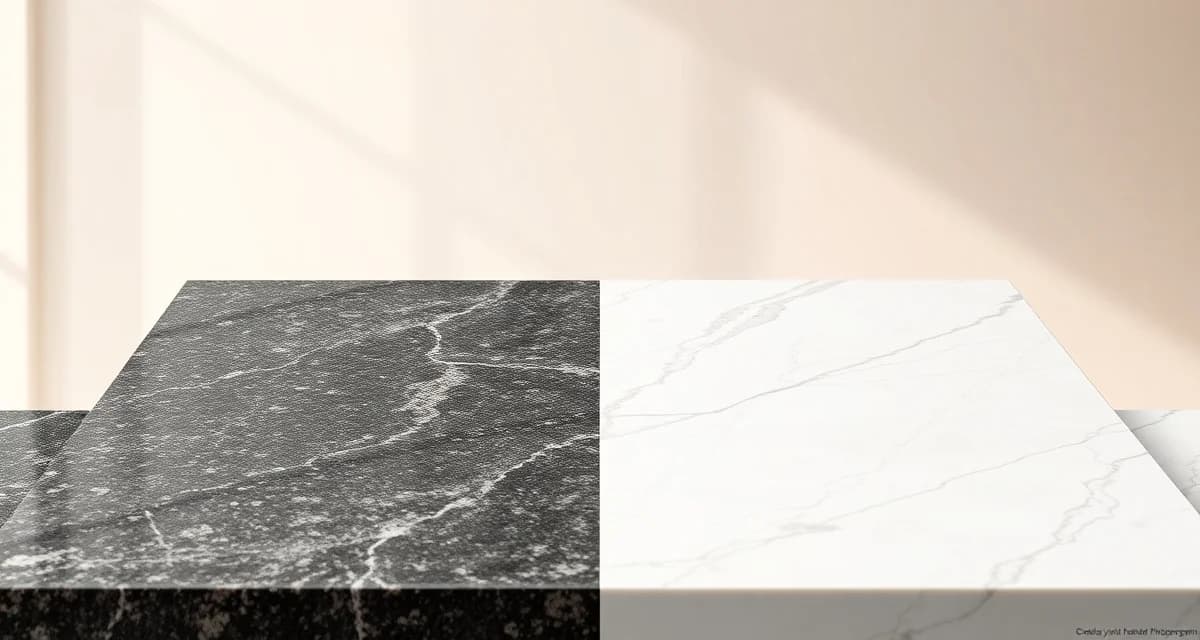
Granite vs Marble Countertops: 2026 Comparison
This granite vs marble countertops breaks down the key differences for countertop fabricators.
Granite and marble are both natural stones, but they form through completely different geological processes and behave very differently in your kitchen. Granite is an igneous rock formed from cooled magma, making it extremely hard and heat-resistant. Marble is a metamorphic rock formed from limestone under heat and pressure, resulting in a softer, more porous surface with distinctive veining. Granite costs $40-$175 per square foot installed, while marble ranges from $65-$250 per square foot.
TL;DR
- Granite is significantly harder than marble (6-6.5 vs 3-4 Mohs scale)
- Granite handles heat, stains, and scratches far better than marble
- Marble etches from contact with acids like lemon juice, wine, and tomato sauce
- Granite needs sealing every 1-3 years; marble needs sealing every 6-12 months
- Budget granite starts at $40/sq ft installed; budget marble starts at $65/sq ft
- Marble is preferred for luxury kitchens and baking (stays cool for dough work)
- Granite is the more practical choice for high-use family kitchens
Side-by-Side Comparison
| Feature | Granite | Marble |
|---|---|---|
| Formation | Igneous (cooled magma) | Metamorphic (heated limestone) |
| Installed Cost | $40-$175/sq ft | $65-$250/sq ft |
| Avg Kitchen Cost (40 sq ft) | $2,800-$7,000 | $3,800-$10,000 |
| Hardness (Mohs) | 6-6.5 | 3-4 |
| Heat Resistance | Excellent | Low-Moderate |
| Stain Resistance | Good (with sealing) | Poor (porous + etching) |
| Scratch Resistance | Very Good | Poor |
| Etching | Resistant | Highly susceptible |
| Maintenance Level | Moderate | High |
| Sealing Frequency | Every 1-3 years | Every 6-12 months |
| Color Range | Extremely wide | Primarily whites, greys, greens, blacks |
| UV Resistance | Excellent | Good |
| Lifespan | 50-100+ years | 50-100+ years (with maintenance) |
| Outdoor Use | Yes | Not recommended (weather damage) |
| Best For | Kitchens, outdoor, high-traffic | Luxury kitchens, bathrooms, baking |
Cost Comparison
Material Costs for Fabricators
| Tier | Granite Slab Cost | Marble Slab Cost |
|---|---|---|
| Budget | $8-$18/sq ft | $18-$30/sq ft |
| Mid-Range | $18-$40/sq ft | $30-$60/sq ft |
| Premium | $40-$70/sq ft | $60-$100/sq ft |
| Ultra-Premium/Exotic | $70-$150/sq ft | $100-$200/sq ft |
At every tier, marble costs more than granite. The price gap widens at the premium level where rare Italian marbles command significant premiums.
Calculate your material waste savings
See exactly how much slab material and money you could save with optimized cutting layouts.
Try the free Waste CalculatorTotal Project Cost: 40 Sq Ft Kitchen
| Component | Mid-Grade Granite | Carrara Marble |
|---|---|---|
| Material (50 sq ft w/ waste) | $1,500 | $1,750 |
| Fabrication | $500 | $575 |
| Edge Work (22 lin ft, ogee) | $550 | $605 |
| Sink Cutout | $250 | $275 |
| Installation | $600 | $625 |
| Initial Sealing | $120 | $175 |
| Total Installed | $3,520 | $4,005 |
| 5-Year Maintenance | $240-$360 | $750-$1,250 |
| 5-Year Total | $3,760-$3,880 | $4,755-$5,255 |
Durability: A Clear Winner
Hardness
Granite at 6-6.5 Mohs is nearly twice as hard as marble at 3-4 Mohs. In practical terms:
- A steak knife dragged across granite leaves no mark. The same knife scratches marble.
- Ceramic plates set down firmly on granite cause no damage. On marble, they can leave scratches.
- Granite resists daily wear from cooking, cleaning, and general kitchen activity. Marble shows wear patterns within 1-2 years of heavy use.
Heat Resistance
Granite handles direct contact with hot pots, pans, and baking sheets without damage. Its igneous origin means it formed at temperatures over 1,000 degrees Fahrenheit---kitchen heat is no threat.
Marble has moderate heat resistance but is vulnerable to thermal shock. A very hot pan placed directly on a cold marble surface can cause cracking. Additionally, marble's lighter colors can develop yellow or brown discoloration from repeated heat exposure.
The Etching Problem
Etching is the defining drawback of marble in kitchens. Marble is primarily calcium carbonate, which reacts with any acid:
| Substance | Etching Speed on Marble | Effect on Granite |
|---|---|---|
| Lemon juice | Immediate (seconds) | No effect |
| Red wine | 1-5 minutes | No effect (may stain if unsealed) |
| Tomato sauce | 1-5 minutes | No effect |
| Vinegar | Immediate | No effect |
| Coffee | 5-15 minutes | No effect (may stain if unsealed) |
| Cola / Soda | 1-5 minutes | No effect |
Etch marks appear as dull, lighter spots on polished marble. Sealer does not prevent etching---it only helps prevent staining (absorption). This distinction is critical to explain to customers considering marble for kitchens.
Appearance
Granite Character
Granite comes in an enormous range of colors and patterns. The crystal structure creates speckled, swirled, or flowing patterns depending on the granite type:
- Speckled/uniform: Uba Tuba, Black Pearl (tight, consistent patterns)
- Moving/flowing: River White, Alaska White (soft veining and movement)
- Dramatic/exotic: Blue Bahia, Fusion (bold, multi-colored patterns)
- Classic: Santa Cecilia, Giallo Ornamental (warm golds and browns)
Granite patterns are less predictable than marble. Each slab needs careful inspection because natural inclusions, pits, or dry seams can appear in areas that look clean on the surface.
Marble Character
Marble is defined by its veining---soft to dramatic lines flowing through a typically light-colored background. The appeal is elegant, timeless, and distinctly associated with luxury:
- Carrara: Soft grey veining on a grey-white background (most common, most affordable)
- Calacatta Gold: Bold gold and grey veining on warm white (highly prized)
- Statuario: Dramatic dark grey veining on bright white (theatrical)
- Thassos: Pure white with minimal veining (clean and modern)
Marble's veining creates a visual warmth and movement that granite's crystalline structure cannot replicate. For design-forward kitchens where aesthetics are the top priority, marble remains the prestige choice.
Maintenance Comparison
Granite Maintenance
| Task | Frequency | Annual Cost |
|---|---|---|
| Daily cleaning | Daily | $0 |
| Sealing | Every 1-3 years | $40-$100/year |
| Deep cleaning | Quarterly | $15-$30/year |
| Professional polishing | Every 10-15 years | $20-$40/year (amortized) |
| Total Annual Maintenance | $75-$170 |
Marble Maintenance
| Task | Frequency | Annual Cost |
|---|---|---|
| Daily cleaning (pH-neutral only) | Daily | $30-$60 (specialty cleaners) |
| Sealing | Every 6-12 months | $75-$150/year |
| Etch mark polishing | Monthly-quarterly | $0-$100 (DIY) or $200-$400 (pro) |
| Deep cleaning | Monthly | $25-$50/year |
| Professional restoration | Every 3-5 years | $100-$200/year (amortized) |
| Total Annual Maintenance | $230-$960 |
Granite's annual maintenance cost is 60-80% lower than marble's. For homeowners who want natural stone without a significant ongoing maintenance commitment, granite is the practical choice.
Best Uses for Each Material
Choose Granite When:
- The kitchen sees heavy daily cooking and food preparation
- You need a durable, low-maintenance natural stone surface
- Heat resistance is important (no trivets needed)
- The countertop is for an outdoor kitchen or barbecue area
- Budget is a significant factor (budget granite is 40% cheaper than budget marble)
- The home has children or heavy kitchen use
Choose Marble When:
- The kitchen is primarily a design showcase or entertaining space
- Baking is a primary activity (marble stays cool for pastry and dough work)
- The homeowner understands and accepts the maintenance commitment
- The home design calls for a classic, luxury, or Mediterranean aesthetic
- The countertop is in a bathroom (lower acid exposure than kitchens)
- The homeowner appreciates the patina that develops over time
Fabrication Considerations
Fabrication Time and Risk
| Factor | Granite | Marble |
|---|---|---|
| Cutting time | Standard | +10-15% (softer but more careful) |
| Chipping risk | Low | Moderate-High |
| Polishing | Standard process | More passes, more care needed |
| Transport damage risk | Low | Higher (softer, chips easier) |
| Callback rate | 3-5% | 8-12% (etching complaints) |
| Remake probability | 2-3% | 5-8% |
Fabricator recommendation: Add 15-20% to your fabrication pricing for marble jobs. The additional cost covers extra handling time, higher breakage risk, and the customer education effort required to prevent post-install dissatisfaction. Always have marble customers sign a care acknowledgment form.
FAQ
Is granite or marble better for a kitchen?
For most kitchens, granite is the better practical choice. It is harder, more heat-resistant, more stain-resistant, and requires less maintenance. Marble is appropriate for luxury kitchens where the homeowner prioritizes aesthetics and accepts the higher maintenance demands. If the kitchen is the home's workhorse (daily cooking, kids, entertaining), granite will look better longer with less effort.
Which is more expensive, granite or marble?
Marble is more expensive at every price tier. Budget marble starts at $65/sq ft installed versus $40/sq ft for budget granite. At the premium level, exotic marble (Calacatta) can reach $250-$350/sq ft, while even exotic granite rarely exceeds $200-$250/sq ft. The ongoing maintenance cost of marble adds another $150-$800/year.
Does granite stain like marble?
Granite is significantly more stain-resistant than marble. While granite is porous and benefits from sealing, it is much denser and absorbs liquids more slowly. A sealed granite surface resists wine, oil, and coffee stains effectively. Granite also does not etch from acids, which is marble's primary weakness.
Can I use marble near my stove?
You can, but proceed with caution. Hot pans placed directly on marble can cause thermal shock cracking and discoloration. Oil splatters will stain unsealed marble. The area near your stove receives the most heat and food spills in any kitchen---it is marble's worst-case environment. If you choose marble for the kitchen, consider using granite or quartz for the cooktop area.
How long does granite last compared to marble?
Both materials can last 50-100+ years with proper care. Granite requires less ongoing maintenance to reach that lifespan. Marble will need consistent sealing, etch mark management, and occasional professional restoration throughout its life. A well-maintained marble countertop can look beautiful for generations, but it requires commitment.
Which natural stone is better for resale value?
Both add strong resale value. In luxury markets ($500K+ homes), marble may add slightly more because of its luxury associations. In mid-range homes, granite is often preferred by buyers because they recognize it as durable and practical. Real estate agents rank both materials highly, with the specific advantage depending on the local market and home price point.
Can I mix granite and marble in the same kitchen?
Yes, and this is becoming increasingly popular. A common combination uses granite on the primary work surfaces (perimeter countertops, cooking areas) and marble on the island (where it is more of a showpiece and less exposed to cooking abuse). This gives you marble's beauty where it matters most and granite's durability where you need it.
Is it true that marble is better for baking?
Yes. Marble naturally stays cooler than granite and other countertop materials, which is genuinely useful for rolling out pastry dough, making chocolate, and other temperature-sensitive baking tasks. Professional pastry chefs have used marble work surfaces for centuries. If baking is a significant part of your kitchen use, marble has a legitimate functional advantage.
Which stone is harder to fabricate?
Granite is harder to cut and fabricate due to its greater hardness (6-6.5 Mohs vs 3-4 for marble). However, marble requires more careful handling because it chips and scratches more easily. A scratch during fabrication on granite buffs out; a scratch on marble is a defect. Overall, marble jobs require more caution and attention to detail despite being physically softer.
Should I seal granite or marble myself or hire a professional?
Granite sealing is straightforward and most homeowners can do it themselves with a quality impregnating sealer ($20-$40 for a bottle that covers a full kitchen). Marble sealing requires more precision and care---the stone is more sensitive to product selection and application technique. First-time marble owners should consider professional sealing ($150-$300) and learn the process before attempting DIY.
Estimate Your Natural Stone Countertop Cost
Use the SlabWise calculator to compare granite and marble pricing for your specific kitchen layout. Enter dimensions, select your stone, and see full installed pricing in seconds.
Try the Free Cost Calculator →
Make a confident choice between granite and marble with accurate pricing for your project.
Try These Free Tools
- Cost Calculator -- Compare material costs instantly across different countertop options.
- Compare Materials -- Side-by-side material comparison with pricing, durability, and maintenance.
- Kitchen Visualizer -- Let customers preview countertop materials in their actual kitchen.
Sources & Further Reading
-
Natural Stone Institute - Technology and Software Solutions for Stone Fabricators
-
International Surface Fabricators Association - Fabrication Software and Digital Tools
-
National Kitchen & Bath Association - Technology Integration in Countertop Design
-
Marble Institute of America - Digital Fabrication and Software Standards