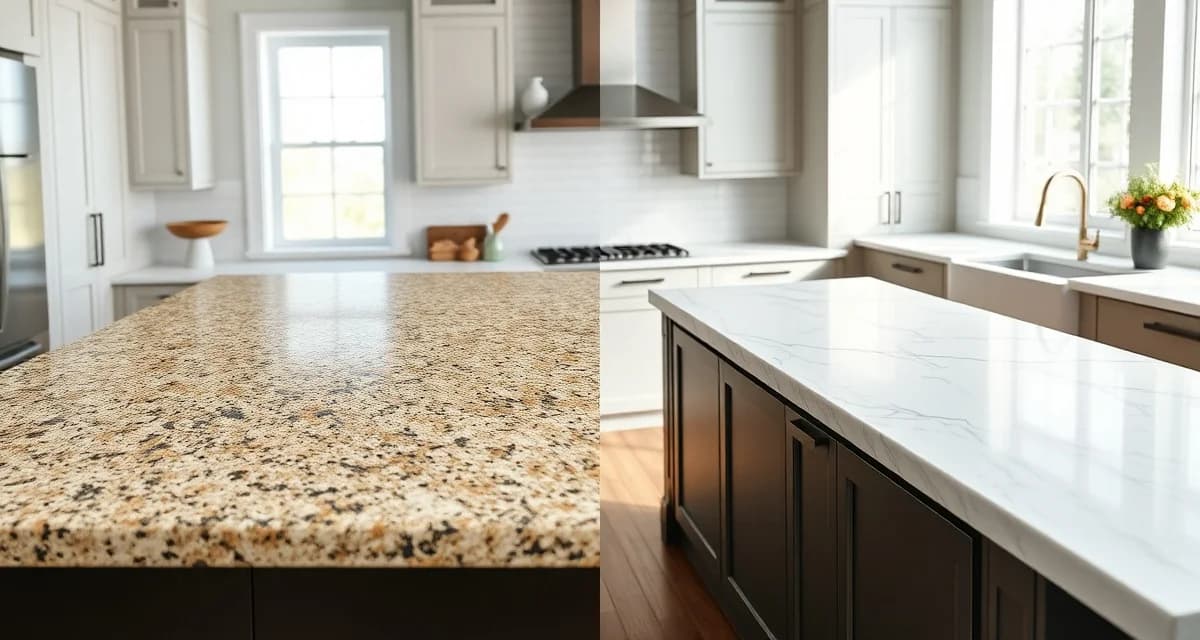
Granite vs Porcelain Countertops: 2026 Comparison
Granite is the tried-and-true natural stone that has anchored American kitchens for decades. Porcelain slabs are the newer contender - engineered, ultra-durable, and gaining fans fast. Both make excellent countertops, but they differ in important ways that affect cost, maintenance, and where you can install them.
TL;DR
- Granite is a natural stone; porcelain is a manufactured product fired from clay and minerals at extreme temperatures
- Porcelain is completely non-porous and never needs sealing; granite requires sealing every 1-3 years
- Porcelain handles heat better - withstands 500F+ without damage; granite also handles heat well
- Porcelain works outdoors (UV-stable); granite also works outdoors
- Granite offers unique, one-of-a-kind patterns; porcelain patterns are printed and can repeat
- Porcelain edges can chip more easily than granite edges
- Pricing overlaps: granite $40-$100/sq ft, porcelain $55-$120/sq ft installed
- Granite has a longer track record and wider fabricator availability
Side-by-Side Comparison
| Feature | Granite | Porcelain Slab |
|---|---|---|
| Type | Natural igneous stone | Manufactured (clay fired at 2,200F+) |
| Installed Cost (per sq ft) | $40-$100 | $55-$120 |
| Sealing Required | Every 1-3 years | Never |
| Heat Resistance | Excellent | Excellent |
| Scratch Resistance | High | High |
| Stain Resistance | Moderate (when sealed) | Very High |
| UV Resistance | Yes | Yes |
| Outdoor Use | Yes | Yes |
| Porosity | Porous (needs sealant) | Non-porous |
| Pattern Uniqueness | Every slab is unique | Printed patterns can repeat |
| Edge Chip Resistance | High | Moderate |
| Thickness Options | 2cm, 3cm | 6mm, 12mm, 20mm, 30mm |
| Edge Profile Options | Wide variety | Limited |
| Lifespan | 50+ years | 25-50+ years |
Cost Comparison
Granite
- Level 1 (builder grade): $40-$55/sq ft installed
- Level 2 (mid-range): $55-$75/sq ft installed
- Level 3+ (premium): $75-$100+/sq ft installed
Porcelain
- Standard patterns: $55-$80/sq ft installed
- Mid-range (Dekton, Neolith standard): $75-$100/sq ft installed
- Premium patterns: $100-$120/sq ft installed
For a 40-square-foot kitchen:
Calculate your material waste savings
See exactly how much slab material and money you could save with optimized cutting layouts.
Try the free Waste Calculator- Granite: $1,600-$4,000
- Porcelain: $2,200-$4,800
Budget-grade granite is notably cheaper than porcelain. At the mid-range and above, pricing overlaps significantly. The cost difference narrows when you factor in granite's ongoing sealing costs ($30-$50 per application, every 1-3 years).
The Sealing Question
This is one of porcelain's clearest advantages. Porcelain is completely non-porous - it never absorbs liquids and never needs sealing. Period. There is no ongoing maintenance cost or effort.
Granite is porous. Without sealing, it absorbs liquids that can cause staining. Light-colored granites are more porous and need sealing more often (every 6-12 months). Dark, dense granites may only need sealing every 2-3 years. The sealing process takes about 15-30 minutes and is straightforward, but it is a maintenance task porcelain simply does not require.
Heat Resistance
Both materials handle heat extremely well, but for different reasons:
- Granite is a natural rock that formed from cooled magma. It handles temperatures well above what a kitchen produces.
- Porcelain is fired at 2,200F+ during manufacturing. No kitchen temperature comes close to affecting it.
You can place hot pans directly on either material without concern. This is a genuine advantage both share over quartz (which scorches) and laminate (which melts).
Appearance and Aesthetics
Granite's Natural Beauty
Every granite slab is unique - formed over millions of years with variations in mineral content, color, and pattern that no two slabs share exactly. This uniqueness is a major selling point. When you pick a granite slab from a yard, you are selecting a one-of-a-kind piece of earth.
Granite comes in hundreds of colors: blacks, whites, blues, greens, reds, golds, and multi-colored options. The speckled, granular texture is distinctive and immediately recognizable as natural stone.
Porcelain's Engineered Patterns
Porcelain slab patterns are created using advanced digital printing technology. Modern porcelain can realistically mimic marble, granite, concrete, wood, and other materials. The printing quality has improved dramatically - from several feet away, distinguishing premium porcelain from natural stone is genuinely difficult.
The limitation: porcelain patterns are printed. Large installations may show pattern repetition, though manufacturers work to minimize this with multiple face designs per production run. Close inspection reveals the printed nature of the surface.
Porcelain also comes in finishes that granite cannot easily achieve: concrete looks, rust effects, solid matte colors, and large-scale architectural patterns.
Edge Profiles and Chipping
Granite excels here. Its natural hardness and thickness (typically 3cm) support a full range of edge profiles: bullnose, ogee, waterfall, beveled, dupont, and more. Granite edges are durable and resist chipping from normal impacts.
Porcelain's thinner profiles (commonly 12mm or 20mm) limit edge options. Mitered edges can create a thicker appearance, but ornate profiles like ogee or dupont are not practical on thin porcelain. More importantly, porcelain edges are more susceptible to chipping if struck by a heavy object. A dropped cast-iron skillet could chip a porcelain edge where granite would survive unscathed.
Outdoor Kitchen Suitability
Both materials work well outdoors, which is notable - many countertop materials (quartz, marble, solid surface) are not suitable for outdoor installation.
- Granite outdoors: UV-stable, heat-resistant, weather-resistant. Needs more frequent sealing (every 6-12 months) when exposed to rain and elements.
- Porcelain outdoors: UV-stable, heat-resistant, weather-resistant, frost-resistant, and requires zero sealing. Porcelain has a slight edge for outdoor use due to its zero-maintenance nature.
Fabrication Considerations
Granite Fabrication
- Standard process - every fabrication shop in the U.S. knows how to work with granite
- Well-established tooling, cutting, and polishing techniques
- Predictable material behavior
- Standard seaming and installation methods
Porcelain Fabrication
- Requires specialized tooling and different cutting techniques
- Not all shops have experience with porcelain
- Thinner material requires careful handling to avoid breakage
- Different adhesive and seaming products
- Growing but not yet universal expertise across the industry
For homeowners: verify that your fabricator has actual porcelain experience before choosing this material. A shop that has only worked with natural stone may struggle with porcelain's different characteristics.
For fabricators: adding porcelain capabilities opens a growing market segment. Nesting and quoting tools like SlabWise work across material types, helping shops manage both granite and porcelain inventory efficiently.
Best Uses
Choose Granite When:
- Budget is a consideration - entry-level granite is the most affordable natural stone
- You value natural uniqueness - every slab is genuinely one-of-a-kind
- Edge profiles matter - granite supports the widest range of decorative edges
- Your fabricator specializes in natural stone - the process is well-established
- You prefer the look and feel of real stone over engineered materials
Choose Porcelain When:
- Zero maintenance is the goal - no sealing, ever
- Heat resistance is critical - you cook heavily and want freedom from trivets
- Outdoor installation is part of the project
- A modern, thin profile fits the design aesthetic
- You want concrete, wood, or unusual pattern options that natural stone cannot provide
Is porcelain cheaper than granite?
At the budget end, granite is cheaper ($40-$55/sq ft vs. $55-$80/sq ft for porcelain). At the mid-range and above, pricing is comparable. When you factor in granite's ongoing sealing costs, the total cost of ownership over 20 years is similar.
Do porcelain countertops look fake?
Premium porcelain slabs look remarkably realistic. From a normal distance, it can be difficult to distinguish high-quality porcelain from natural stone. Up close, the printed pattern may be identifiable, and large installations may show some pattern repetition.
Can granite crack?
Granite can crack from heavy impacts, structural stress (like unsupported overhangs), or dramatic temperature shocks, but cracking under normal kitchen use is rare. Properly fabricated and installed granite is very durable.
Is porcelain strong enough for kitchen countertops?
Yes. Porcelain slabs designed for countertop use are extremely strong. They resist scratches, stains, heat, and UV. The main vulnerability is edge chipping from impact, which can be managed with careful use and appropriate edge treatments.
Which lasts longer, granite or porcelain?
Granite has a slight edge in proven longevity - many granite installations from the 1990s still look excellent. Granite can last 50+ years. Porcelain is expected to last 25-50+ years, but it has a shorter track record as a countertop material.
Can you cut on porcelain countertops?
You should always use a cutting board, but porcelain surfaces are hard enough to resist knife scratches. Cutting directly on porcelain would dull your knives rather than damage the surface, similar to granite.
Does granite stain easily?
Sealed granite resists stains well. Unsealed or poorly sealed granite can absorb liquids and stain, especially lighter-colored varieties. Regular sealing (every 1-3 years) prevents most staining issues.
What is the best porcelain countertop brand?
Dekton (by Cosentino) and Neolith are the two most established porcelain slab brands for countertops. Both offer wide pattern selections, multiple thicknesses, and established fabrication support networks.
Can you repair a chipped porcelain countertop?
Small chips can be filled with color-matched epoxy, but the repair is usually visible. Prevention is better than repair - use caution with heavy objects near edges. Granite chips are easier to repair invisibly than porcelain chips.
Which is better for a rental property?
Granite is typically the better choice for rental properties. Budget granite ($40-$55/sq ft) offers good durability at a lower cost than porcelain, and its edge chip resistance is better suited to tenant use.
Compare Your Options
Both granite and porcelain deliver durable, attractive countertops. The choice often comes down to whether you value natural uniqueness and proven track record (granite) or zero-maintenance convenience and modern versatility (porcelain).
Estimate your project cost with our countertop cost calculator. Fabricators can try SlabWise free for 14 days to manage quoting and nesting across both granite and porcelain.
Try These Free Tools
- Cost Calculator -- Compare material costs instantly across different countertop options.
- Compare Materials -- Side-by-side material comparison with pricing, durability, and maintenance.
- Kitchen Visualizer -- Let customers preview countertop materials in their actual kitchen.
Sources & Further Reading
-
Natural Stone Institute - Technology and Software Solutions for Stone Fabricators
-
International Surface Fabricators Association - Fabrication Software and Digital Tools
-
National Kitchen & Bath Association - Technology Integration in Countertop Design
-
Marble Institute of America - Digital Fabrication and Software Standards