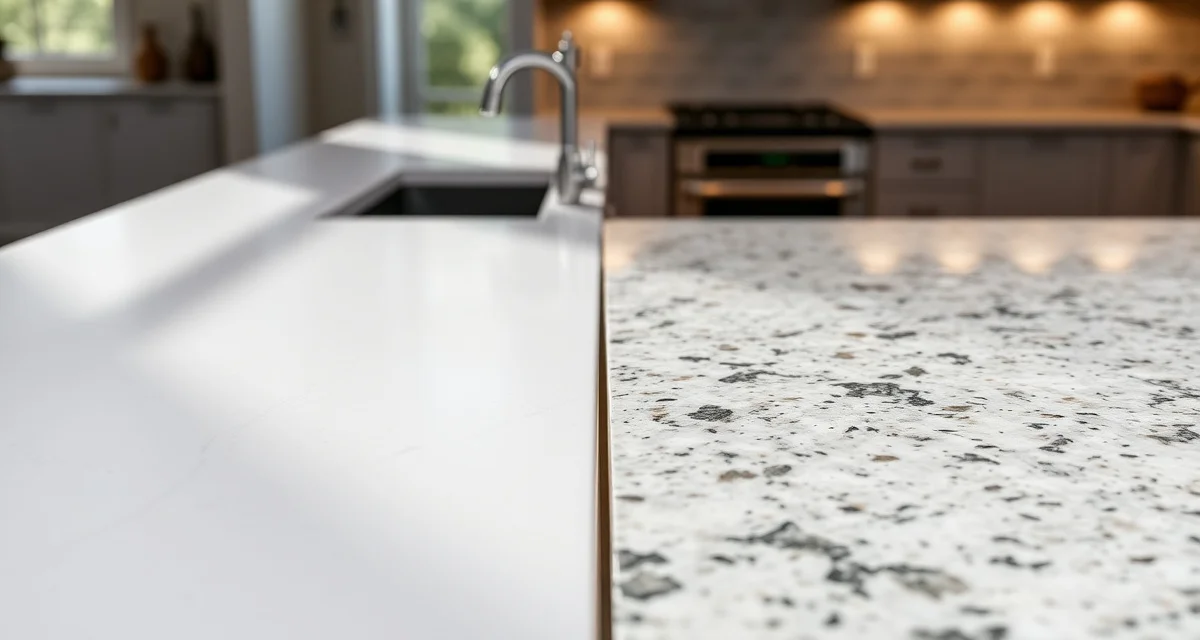
Caesarstone vs Granite Countertops: 2026 Comparison
Caesarstone pioneered quartz countertops and remains one of the most trusted brands worldwide. Granite has been the natural stone standard for decades. Both deliver premium kitchen surfaces, but they differ in maintenance, heat handling, pricing, and aesthetics. Here is the complete breakdown.
TL;DR
- Caesarstone never needs sealing; granite requires sealing every 1-3 years
- Granite handles heat beautifully; Caesarstone's resin scorches above 300F
- Caesarstone has a lifetime warranty (limited, original owner)
- Granite costs less at entry level: $40-$100/sq ft vs. $65-$125/sq ft for Caesarstone
- Caesarstone offers an outdoor-rated product line; granite is also outdoor-safe naturally
- Both are scratch-resistant and durable for daily kitchen use
- Granite provides natural uniqueness; Caesarstone provides pattern consistency
Side-by-Side Comparison
| Feature | Caesarstone | Granite |
|---|---|---|
| Type | Engineered quartz | Natural igneous stone |
| Installed Cost (per sq ft) | $65-$125 | $40-$100 |
| Sealing | Never | Every 1-3 years |
| Heat Resistance | Low (resin-based) | Excellent |
| Stain Resistance | Very High | Moderate (sealed) |
| Warranty | Lifetime (limited) | Varies by fabricator |
| UV/Outdoor | Outdoor collection available | Yes (naturally UV-stable) |
| Pattern | Manufactured, consistent | Natural, unique |
What Sets Caesarstone Apart
Lifetime warranty: Caesarstone's lifetime limited warranty is one of the strongest in the quartz industry. While the terms cover manufacturing defects (not user damage), the warranty provides long-term peace of mind.
Calculate your material waste savings
See exactly how much slab material and money you could save with optimized cutting layouts.
Try the free Waste CalculatorOutdoor collection: Caesarstone is one of the few quartz brands offering a product line specifically rated for outdoor use. This modified formulation resists UV degradation, putting Caesarstone in competition with granite for outdoor kitchen projects.
Pattern consistency: If you fall in love with a Caesarstone sample, your installed countertop will match. Granite's natural variation means the installed product may differ from the sample.
What Sets Granite Apart
Heat resistance: Granite's resistance to hot cookware is unmatched by any quartz product. No trivets needed. No scorching. For serious home cooks, this is a significant practical advantage.
Natural character: Granite is millions of years old. Its patterns formed through geological processes. The uniqueness is genuine and unreplicable.
Price accessibility: Granite starts at $40/sq ft - $25 less than Caesarstone's entry point. For budget-conscious projects, granite offers natural stone at lower prices.
Longevity: Granite countertops routinely last 50+ years. Many 1990s granite installations still look excellent today. Caesarstone is expected to last 25-30+ years.
Detailed Cost Breakdown
Material cost is only part of the picture. Here's what a full project costs for each material:
| Kitchen Size | Caesarstone Installed | Granite Installed | Savings with Granite |
|---|---|---|---|
| Small (25 sq ft) | $1,625-$3,125 | $1,000-$2,500 | $400-$1,125 |
| Medium (40 sq ft) | $2,600-$5,000 | $1,600-$4,000 | $600-$1,800 |
| Large (60 sq ft) | $3,900-$7,500 | $2,400-$6,000 | $900-$2,700 |
Both materials share similar fabrication costs - the same CNC equipment, diamond tooling, and wet cutting processes apply. Edge profile upgrades add $8-$25 per linear foot regardless of material.
Total Cost of Ownership
Granite's ongoing sealing requirement ($30-$100 annually) and slightly higher stain remediation risk close the gap over time. Over 20 years, expect $600-$2,000 in additional maintenance costs for granite compared to Caesarstone's zero-maintenance surface. When factoring in total cost of ownership, the price difference between the two materials becomes minimal for mid-range projects.
Daily Kitchen Performance
Heat and Cooking
Granite's natural heat tolerance is its single biggest practical advantage. You can slide a 500°F baking sheet directly onto granite without concern. Caesarstone's polymer resin binder scorches above 300°F, leaving white marks or permanent discoloration.
For households where multiple cooks work simultaneously and trivets sometimes get forgotten, granite eliminates a meaningful worry.
Stain Resistance
Caesarstone's non-porous surface provides absolute stain immunity. Wine, coffee, turmeric, and oil sit on top until wiped away - no time pressure.
Granite, when properly sealed, resists these same stains effectively for 1-3 years between re-sealing. If the sealant degrades or is neglected, porous granites (especially lighter colors) can absorb liquids and stain permanently.
Scratch and Impact Resistance
Both materials rate 6-7 on the Mohs hardness scale and resist scratching from normal kitchen use. Heavy impact (dropping a cast iron pan) can chip either material, though granite's crystalline structure sometimes fractures more dramatically than Caesarstone's resin-bound composition.
Fabrication Considerations
Fabricators working with both Caesarstone and granite will find the shop processes nearly identical:
- Same CNC and bridge saw equipment for both materials
- Wet cutting mandatory for both (silica dust control)
- Same diamond tooling and polishing pads
- Similar slab weights (approximately 20-22 lbs per square foot for 3cm thickness)
Key differences in the shop:
- Caesarstone's engineered composition means consistent density across the slab - predictable cutting times
- Granite hardness varies by color and quarry origin - some cut 30-40% slower than others
- Caesarstone slab color matching between slabs is reliable; granite requires careful slab selection to minimize variation across a kitchen
- Caesarstone's lifetime warranty requires certified fabrication for full coverage
Resale Value Impact
Both Caesarstone and granite register as "premium countertops" with homebuyers and appraisers. In most US markets, they contribute equivalent value to a kitchen renovation.
Notable exceptions:
- Luxury custom homes: Rare granite varieties (Blue Bahia, Van Gogh) can serve as design centerpieces that command attention at resale
- Modern/new construction: Caesarstone's clean aesthetic aligns with contemporary buyer expectations
- Outdoor kitchens: Granite or Caesarstone's Outdoor collection both add tangible value to outdoor living spaces
Best Uses
Choose Caesarstone When:
- Lifetime warranty is a selling point
- Zero maintenance is non-negotiable
- Outdoor quartz (from the Outdoor collection) is needed
- Stain resistance is the top priority
- Pattern consistency matters for multi-slab kitchens
Choose Granite When:
- Heat resistance matters for your cooking style
- Natural uniqueness and geological character are valued
- Budget is below $65/sq ft
- Maximum longevity (50+ years) is desired
- Outdoor installation without specialty products
FAQ
Is Caesarstone better than granite?
Each excels in different areas. Caesarstone is better for stain resistance and maintenance-free living. Granite is better for heat resistance and natural aesthetics. Your priorities determine which is better for your specific situation.
Does Caesarstone's lifetime warranty cover everything?
The warranty covers manufacturing defects in material and workmanship. It does not cover damage from misuse (heat damage, impact, chemical exposure). Read the full warranty terms before purchasing.
Can Caesarstone's outdoor quartz replace granite outdoors?
Caesarstone's Outdoor collection is specifically designed for exterior use and is a viable alternative to granite for outdoor kitchens. Standard Caesarstone (non-outdoor) should not be used outdoors.
Which is lower maintenance?
Caesarstone. It never needs sealing and cleans with soap and water. Granite needs periodic sealing and should be cleaned with pH-neutral products to protect the sealant.
How do prices compare for a typical kitchen?
For 40 square feet: Caesarstone runs $2,600-$5,000; granite runs $1,600-$4,000. The overlap in the $2,600-$4,000 range is where most comparisons happen.
Does granite stain more than Caesarstone?
When properly sealed, granite resists common stains well. But if the sealant wears off, granite can absorb liquids and stain. Caesarstone is non-porous and does not stain regardless of sealant condition.
Which is more popular in 2026?
Quartz (all brands combined) has a larger market share than granite. However, granite remains the most popular single natural stone countertop material and is far from going away.
Can I switch from granite to Caesarstone (or vice versa)?
Yes. Replacing countertops does not require changing cabinets in most cases. A fabricator can remove old countertops and install new ones in the same cabinet configuration.
Make Your Selection
Caesarstone and granite are both proven, durable countertop materials. The right choice depends on your cooking style, maintenance tolerance, and what matters most in your daily kitchen experience.
Estimate your project using our countertop cost calculator. Fabricators can try SlabWise free for 14 days to optimize quoting for every material type.
Try These Free Tools
- Cost Calculator -- Compare material costs instantly across different countertop options.
- Compare Materials -- Side-by-side material comparison with pricing, durability, and maintenance.
- Kitchen Visualizer -- Let customers preview countertop materials in their actual kitchen.
Sources & Further Reading
-
Natural Stone Institute - Technology and Software Solutions for Stone Fabricators
-
International Surface Fabricators Association - Fabrication Software and Digital Tools
-
National Kitchen & Bath Association - Technology Integration in Countertop Design
-
Marble Institute of America - Digital Fabrication and Software Standards