TL;DR
- A granite fabricator buys raw stone slabs, cuts and edges them to your kitchen's exact dimensions, and installs the finished tops.
- Most homeowners pay $40 to $100 per square foot for fabrication and installation combined, before the slab itself.
- Shop quality, equipment, and lead time vary hugely, so vetting the fabricator matters as much as picking the stone.
What does a granite countertop fabricator actually do?
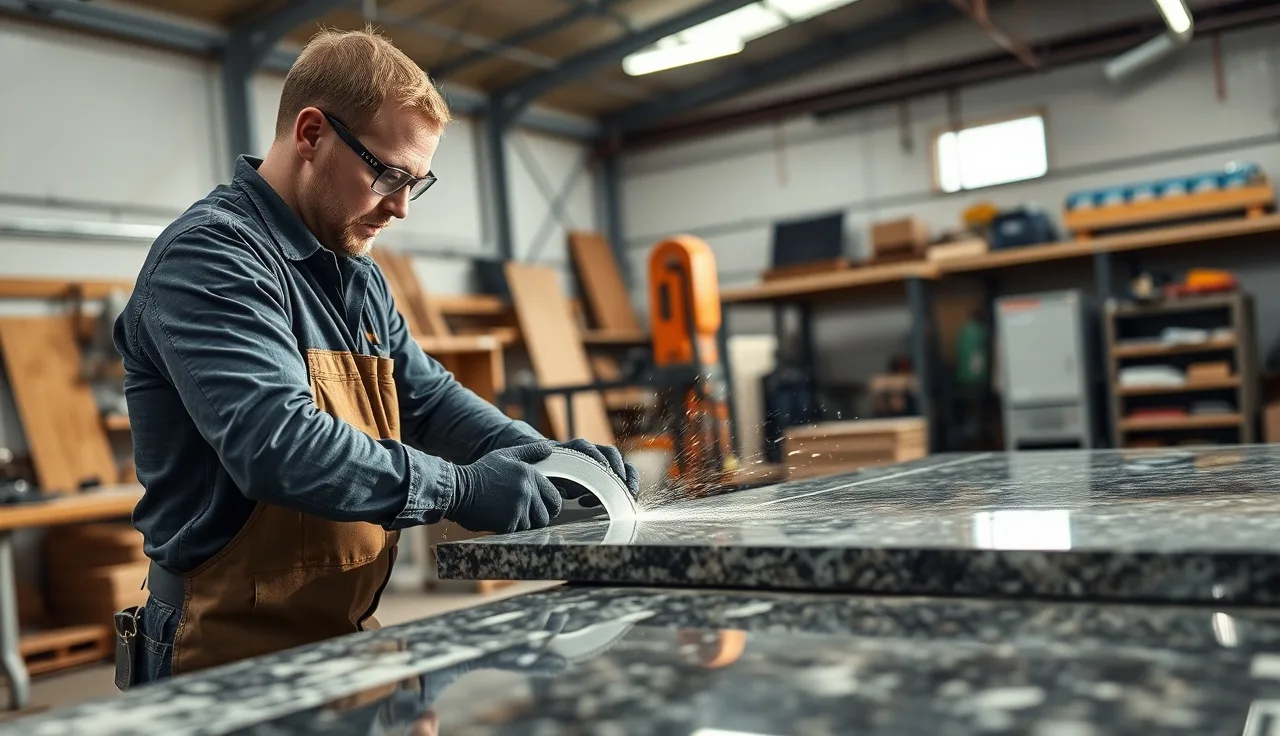
A fabricator is the shop that turns a raw granite slab into finished countertops sitting on your cabinets. Simple to say. Genuinely complex to do. The work starts before anyone touches a saw: the fabricator visits your home after cabinets are set, measures every run with either a laser templating system or old-school cardboard, and builds a layout of your exact space.
From there the shop programs a CNC (computer numerical control) waterjet or bridge saw to cut the slab to those dimensions. Every cut has to account for seam placement, grain direction, and the exact overhang you want at the front edge. After cutting, the edge profile gets machined or hand-ground: bullnose, eased, ogee, or waterfall. Then the slab is polished, seams are color-matched with epoxy and pigment, cutouts for the sink and cooktop are made, and the piece is loaded for delivery.
Install day is when the crew carries the cut tops in, dry-fits them, mixes epoxy for seams, and sets the stone on your cabinets. They level everything, caulk the backsplash line, and drop in any undermount sink. The whole job from template to install usually runs seven to fourteen calendar days at a well-staffed shop, though busy season and backlog can stretch that. [1]
What the fabricator is not, usually: a stone importer, a general contractor, or a tile setter. They work stone. Everything else you coordinate separately.
How much does granite fabrication cost per square foot?
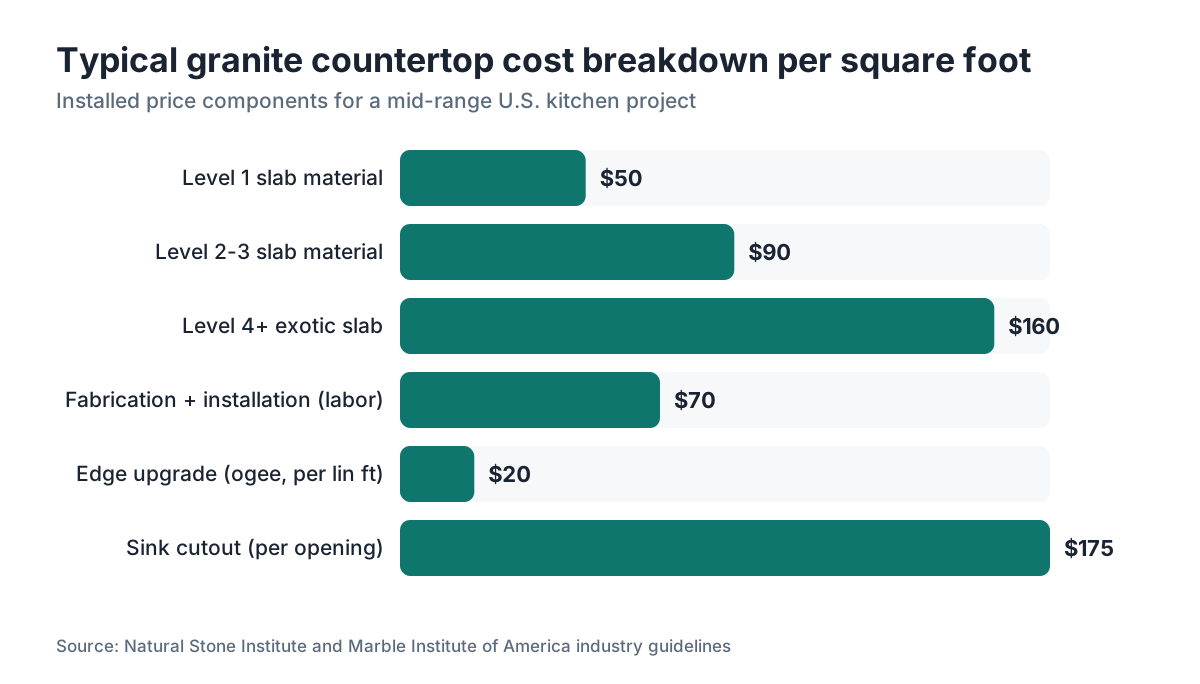
Fabrication and installation together typically cost $40 to $100 per square foot, and the slab itself adds another $40 to $200 per square foot depending on origin and grade. [2] So a 50-square-foot kitchen lands somewhere between $4,000 and $15,000 fully installed, with most mid-range jobs sitting in the $6,000 to $9,000 range.
The number that trips people up is the "installed price." Most fabricators bundle fabrication labor, edge work, and installation into one per-square-foot figure. When you see a quote for $65 a square foot, that is almost never just the stone. It includes cutting, polishing, delivery, and crew time. The slab cost may or may not be folded in, depending on whether you buy through the shop or bring your own.
| Cost component | Typical range | Notes |
|---|---|---|
| Granite slab (Level 1/builder grade) | $40 to $60/sq ft | Thin, simpler patterns, often imported |
| Granite slab (Level 2 to 3) | $60 to $120/sq ft | Mid-range imported or domestic |
| Granite slab (Level 4+/exotic) | $120 to $200+/sq ft | Unusual colors, thick slabs, rare origins |
| Fabrication + installation | $40 to $100/sq ft | Labor, edge, delivery; varies by region |
| Edge upgrades (ogee, waterfall) | $10 to $30/linear ft extra | On top of base fabrication price |
| Sink cutout | $100 to $250 each | Per opening |
| Seam count add-on | $50 to $200 per seam | Some shops charge separately |
Geography moves the number a lot. Shops in San Francisco or New York charge more for labor than shops in mid-size Midwest cities. The same slab with the same edge can swing $25 a square foot on location alone. [3]
A quote that looks very low, say $30 a square foot installed, usually means one of three things: a Level 1 slab with a basic eased edge, a shop cutting corners on template accuracy, or a price that quietly excludes installation. Ask exactly what is and is not in the number.
What equipment separates a quality fabricator from a cheap one?
Equipment matters more than most homeowners realize. The two biggest differences show up in the saw setup and the templating method.
A proper shop runs a CNC bridge saw or a waterjet cutter driven by digital templates. These machines cut to tolerances of about 1/16 inch or better, so seams close tight and edges run straight. A shop using only a handheld angle grinder and a manual tile saw can still produce decent work, but the margin for error is far higher, and you tend to see it in the seams.
Templating technology is the second big tell. Laser systems (Prodim, Slabsmith-connected workflows, standalone LT-2D3D units) capture wall angles and cabinet positions digitally, and the file goes straight to the CNC machine. Cardboard templating relies on a skilled person cutting and taping kraft paper across your counters and hoping nothing shifts in transit. It works. It is also slower, more error-prone, and only as good as the technician holding the tape. [4]
Edge tooling shows up in the finish. Worn-out diamond profile wheels leave rounded, inconsistent ogee lines. A shop that swaps tooling on schedule turns out crisp, repeatable edges. You can read this from photos of past work or, better, by dragging a fingernail along the display counters in the showroom.
Dust and water management tells you how seriously the shop takes the whole operation. Granite cutting throws silica-bearing dust, and OSHA sets an enforceable permissible exposure limit (PEL) for respirable crystalline silica at 50 micrograms per cubic meter as an eight-hour time-weighted average, under 29 CFR 1926.1153. [5] A shop running wet-cutting stations and real ventilation is protecting both its workers and its cut quality. A dry-cutting shop with no controls is a red flag on both counts.
How do fabricators price a job, and what goes into a quote?
Most fabricators calculate square footage from the total surface area of your countertops, including stone lost to kerf cuts, grain matching, and irregular shapes. They multiply that by their installed price per square foot, then add line items for edge upgrades, cutouts, seam locations, and features like waterfall ends or mitered edges.
The square footage math itself confuses people constantly. Fabricators almost always charge for the full slab rectangle that contains each cut piece, more than the finished countertop area. A sink cutout removes stone from the middle of a slab, but you still pay for the rectangle around it, because that leftover stone cannot be resold as a useful remnant. This is standard industry-wide, and it is legitimate, though it catches homeowners off guard. [6]
Some shops run quoting software that pulls digital template measurements straight into a pricing engine, which cuts errors and lets you see exactly what you are paying for. Tools like SlabWise do this on the fabricator side, tying template data to job costing so quotes come from real measured dimensions instead of rough estimates. Worth knowing if you run a shop and you are auditing your own quoting process.
A granite quote you can actually compare shows: price per square foot (or total square footage at that rate), edge profile named, number and location of seams, sink cutout count and type, slab grade or level, lead time from template to install, and warranty terms. A single lump sum with none of those line items is not a quote you can hold up against a competitor.
How do you find a reputable granite fabricator near you?
The referral chain for stone fabricators is tighter than most home trades. Your best move is asking a kitchen designer or cabinet installer who they use. Designers and cabinetmakers see the finished work and field the callbacks, and they will not stake their name on a bad shop. Plumbers who do kitchen remodels are another good source, since they work around undermount sinks daily and notice whether the templating and cutouts were clean.
Online reviews help, but calibrate them. A fabricator with 200 reviews at a 4.3 average is better data than one with 12 reviews at a perfect 5.0. Read for specifics: seam quality, whether the crew showed up on schedule, and how the shop handled a problem when something went wrong. Every shop has problems sometimes. The recovery is what tells you who they are.
Visiting the showroom in person is underrated. Run your hand across the display edges. Check whether the display slabs are labeled with origin and grade. Look at whether the place is organized. A dusty, chaotic showroom does not guarantee bad work, but a shop that takes pride in the physical space usually takes pride in the cut.
Verify the business through your state's contractor licensing database. In California, stone fabricators and installers generally need a C-54 tile contractor license or a C-61 limited specialty license through the Contractors State License Board (CSLB) for installation involving permanent fixtures. [7] Other states classify this differently, so search your own state board for the right category. An unlicensed shop that damages cabinets or causes structural issues becomes a civil liability problem that lands on the homeowner.
Get at least three quotes on any project over $5,000. Not because the lowest bid wins, but because the spread tells you whether one shop is padding margin or another is cutting corners somewhere you can't see yet.
What questions should you ask a fabricator before signing a contract?
The questions that separate good shops from mediocre ones tend to be about operations, not about the stone.
Ask who does the templating, an in-house technician or a subcontractor. Shops that run their own template crews hold tighter quality control than those who farm it out. Ask how many installs the crew does per day. Five a day is rushing. Two or three is a well-run shop.
Ask where the seams will land. A competent fabricator knows before the job is even templated, because seam placement follows slab size, room layout, and support points under the counter. A vague answer is a problem. Seams should sit away from the center of the sink, never directly over the dishwasher cavity, and ideally out of the sightline as you walk in.
Ask to see the actual slab you are getting, more than a sample. Granite is natural, and the slab you approve should be the slab that goes in your kitchen. Plenty of shops let you pick your specific slab at the stone yard and mark it. If a shop refuses, ask why.
Ask about the warranty. Labor warranties run from ninety days to a year. The stone itself does not fail, but epoxy seams can open if the substrate moves or the epoxy was mixed wrong. A shop that warranties seams for a full year is telling you it trusts its own work.
Ask what happens if the slab cracks during fabrication. Natural stone cracks. A reputable shop has replacement procedures and carries liability insurance. Get the insurance certificate in hand before any work begins.
What are the most common fabrication mistakes that cause problems later?
Bad seam placement is the most visible failure. A seam over a dishwasher, tucked in a corner, or running through the center of a sink cutout is weak structurally and obvious cosmetically. The fix is to place seams where cabinet support sits underneath and where the eye doesn't naturally land.
Poor epoxy color matching is the second most common complaint. Stone epoxy comes in dozens of base colors and should be tinted to the specific slab background. A beige seam line in dark charcoal granite is a permanent eyesore. This is a skill problem, not a materials problem, and you catch it by looking at the shop's past seam work.
Over- or under-cut sink openings cause real trouble. Too tight and the undermount sink won't drop in cleanly. Too large and you get a gap the caulk has to bridge, which eventually leaks or grows mold. The cutout should match the manufacturer's sink template to within 1/8 inch.
Thin substrate support causes cracks over time. Granite spanning a dishwasher opening needs a support bracket or a plywood build-up on the cabinet. Skip that step and the install looks fine until the stone shifts under a heavy load or the house settles.
And then there's sealing. Most granite should be sealed before the top goes in, because sealing after means working around the sink and walls. Not every granite needs it (some dense stones like absolute black have absorption rates near zero) but most benefit. Ask the fabricator whether they seal before or after install, and ask what product they use. The Marble Institute of America recommends a penetrating impregnating sealer for granite in kitchen applications. [8]
How long does granite fabrication and installation take?
The realistic timeline from template appointment to finished install is seven to fourteen business days at a shop running at normal capacity. Busy season, generally April through October in most U.S. markets, can push lead times to three or four weeks at popular shops.
Break it down. The template appointment takes one to two hours for a typical kitchen. Digital template files usually get processed the same day. CNC cutting and edging for a standard kitchen runs about half a day of machine time. Then the shop queues your job for the install crew, and that queue is where most of the lead time actually lives.
Install day takes three to six hours for a typical kitchen. Larger projects, complex layouts with many seams, or jobs that include tearing out old countertops take longer. Most crews will not remove existing countertops without a separate demo charge, so confirm that up front.
Rush fabrication is available at some shops for a premium, often 15 to 25 percent above standard pricing. If your cabinet installer finishes late and your timeline gets tight, ask directly about rush service rather than assuming it's off the table.
Should you buy the slab yourself or let the fabricator source it?
You have two real options: buy the slab through the fabricator (most common) or source it yourself from a stone importer and hand it over as customer-supplied material.
Buying through the fabricator is simpler. The shop has relationships with local slab distributors, buys at trade pricing, and marks the slab up to you at retail. That markup usually runs 20 to 40 percent over their cost. [9] What you get for it is convenience: they handle logistics, warranty the material, and deal with defects.
Sourcing it yourself opens up the full distributor inventory, sometimes at a lower net cost. You can also stand in front of the exact slab you want at a stone yard and claim it with a deposit. The risk is liability. If a slab cracks during fabrication, who owns the loss gets murky. Many shops have explicit policies on customer-supplied stone: they'll fabricate it, but they'll warranty only their labor, not the material.
If you go independent, bring your fabricator to the stone yard or ask them to meet you there. A skilled fabricator can look at a slab and tell you whether the natural fissures are structurally concerning, whether the thickness holds consistent, and where the best seam lines fall for your layout. That read is worth the trip.
For how granite stacks up against other materials on cost and performance, the main granite countertops guide covers material properties in depth. If you're weighing granite against engineered stone, the kitchen countertops comparison walks through the tradeoffs across material types.
How do fabricators handle seams, and how visible will they be?
Granite seams are permanent. Knowing where they go and how visible they'll be is one of the most important conversations to have before the job starts.
Granite slabs typically come in sizes of 55 to 65 inches by 100 to 130 inches, roughly 9 to 10 feet long and 4 to 5 feet wide. Most kitchen runs are longer than a single slab, so seams are nearly unavoidable in a full kitchen. The goal is to put them where they show least and where the counter is best supported.
Seam visibility rides on three things: pattern complexity, epoxy color match, and cut precision. A heavily veined or movement-heavy granite like Leathered Fantasy Brown or Van Gogh hides seams better than a uniform speckle like Ubatuba. Uniform granites with consistent small grain show seams more plainly. That's not a reason to avoid them, but it's worth knowing before you fall for one.
A tight seam with excellent epoxy matching is nearly invisible from standing height on a uniform granite. A loose or poorly colored seam is visible and distracting on any granite. The best fabricators spend 20 to 30 minutes per seam on pigment matching. The worst skip that step entirely.
Ask to see seam samples at the showroom before you commit. Run a fingernail across the joint. It should feel flush, or within a hair. Any lip or ridge means the two pieces were not leveled properly during install.
What worker safety rules apply to granite fabrication shops?
This matters to homeowners less directly than to shop owners, but it's a useful vetting signal. Shops that manage safety well tend to manage quality well.
The governing standard is OSHA's rule on occupational exposure to respirable crystalline silica, 29 CFR 1926.1153, which took effect for construction and fabrication in 2018. [5] It sets an action level of 25 micrograms per cubic meter (8-hour TWA) and a PEL of 50 micrograms per cubic meter. In practice, that means any shop doing dry cutting has to switch to wet-cutting methods, local exhaust ventilation, or supplied-air respirators. OSHA published a sample written exposure control plan that most compliant shops use as a template.
Engineered quartz has drawn heavy regulatory attention because it carries far more crystalline silica than natural granite. Granite runs roughly 20 to 45 percent crystalline silica by weight. Engineered quartz can run 90 percent or more. [10] California's Division of Occupational Safety and Health (Cal/OSHA) issued an emergency regulation in 2023 that effectively bans dry fabrication of engineered stone and requires extra controls. [11] If your fabricator handles both granite and quartz, ask how they manage silica exposure.
For a homeowner, the takeaway is plain: a shop running wet saws with workers in respirators is following the rules and taking the work seriously. A shop where workers dry-grind stone with no respiratory protection is breaking OSHA regulations, and it's probably cutting other corners too.
How does granite compare to other countertop materials in fabrication complexity?
Granite sits in the middle of the fabrication difficulty range. It's harder than marble or soapstone, so cutting runs slower and tooling wears faster, but it isn't as silica-dense as engineered quartz, and it doesn't demand the edge-joining precision that laminate or Corian do.
Natural stone like granite needs more human judgment at the seaming and layout stage than engineered sheet goods. Every slab is different. A good fabricator reads the stone and makes calls about where patterns match best and where a natural fissure might split under the saw. That judgment isn't needed with laminate countertops or Corian countertops, where the material is consistent sheet to sheet.
Granite also forgives minor surface imperfections, because the natural pattern hides small tool marks. A router slip on a solid surface like Corian jumps out in bright light. The same tiny variation vanishes in a busy granite pattern.
Lead time is similar across stone materials. Granite, marble, and quartzite all run the same CNC saws and edge machines in most shops. Marble countertops need extra care because marble scratches and etches during fabrication, and some shops add a handling surcharge. Quartzite (not quartz) is often denser and harder than granite and chews through tooling faster, which is worth asking about if you're considering it.
For countertop installation details beyond fabrication itself, including what happens on install day and how to prep your kitchen, that guide covers the process step by step.
Frequently asked questions
What is the difference between a granite fabricator and a granite supplier?
A supplier or distributor imports and sells raw stone slabs. A fabricator cuts, edges, and installs those slabs as finished countertops. Some large operations do both, but many fabricators buy slabs from a separate distributor. To hand-pick your slab, you typically visit the distributor's stone yard, then the fabricator handles everything after that.
How many square feet do I need for a typical kitchen?
Most kitchen countertop projects run 30 to 60 square feet of finished surface. A small galley kitchen might be 25 square feet. A large kitchen with an island can reach 80 square feet or more. Fabricators measure the actual layout, not a rough estimate, so the square footage on your quote may differ from your own tape-measure math.
Can a fabricator work with a slab I already bought?
Yes, most fabricators accept customer-supplied stone, but many will not warranty the material itself. If the slab has a hidden fissure that cracks during cutting, you own that loss. Get the policy in writing before committing. Also confirm the fabricator has seen and approved the slab before you buy, since thickness inconsistencies or deep fissures can complicate fabrication.
What is a Level 1 versus Level 4 granite, and does it affect fabrication cost?
Stone levels are a pricing tier system used by distributors and fabricators, not a formal industry standard. Level 1 usually means thinner slabs, simpler patterns, and higher-volume imported stone. Level 4 or higher means thicker slabs, unusual colors, or exotic origins. Higher levels cost more per square foot for the material, but the fabrication labor itself changes little between levels.
How do I know if a granite fabricator is licensed and insured?
Search your state's contractor licensing board for the shop's business name or license number. Requirements vary: California requires a C-54 or C-61 license through the CSLB for stone installation. Ask the fabricator directly for the license number and insurance certificate before signing a contract. A legitimate shop provides both without hesitation.
Do fabricators remove old countertops?
Many fabricators offer demolition and removal as an add-on, typically $150 to $400 for a standard kitchen, but it isn't universally included. Confirm it in your quote. Some shops refuse to remove tile countertops set in mortar because the work risks damaging cabinets. In that case, a general contractor or tile setter handles demo before the fabricator arrives.
What edge profiles are standard versus an upcharge?
An eased edge (slightly rounded top corner) is the most common standard edge and usually comes in the base price. Beveled and half-bullnose are often standard too. Full bullnose, ogee, dupont, and waterfall edges take extra machining time and typically add $10 to $30 per linear foot. Mitered edges for a thick look add the most, sometimes $50 to $80 per linear foot.
How soon after cabinet installation can the fabricator template?
Cabinets need to be fully set, leveled, and secured to the wall before templating. The fabricator templates to the actual cabinet surface, so any adjustment made after the template can throw off the measurements. Most fabricators want at least 24 hours after cabinet installation before templating, to let shimming or leveling compound cure fully.
Will the fabricator seal the granite, and how often should it be resealed?
Most fabricators apply one coat of sealer before or after install. How often you reseal depends on the specific granite's porosity. A simple water-drop test tells you: if water beads, the seal holds. If it soaks in within a few minutes, reseal. High-traffic kitchen granite often needs resealing every one to three years. Dense granites like absolute black rarely need it at all.
What happens if the granite cracks after installation?
Cracks that show up within a few weeks of install are usually the fabricator's responsibility if caused by poor seam support or a weak install. Cracks from impact, bad cabinet support, or pre-existing fissures in the slab are typically not covered. Get the warranty terms in writing before work begins. Most fabricators warranty labor and seams for 90 days to one year.
Can a fabricator match existing granite if I'm adding an island later?
Possibly. If the original slab left a saved remnant, the match will be very close. Ordering a new slab to match an existing installation is hard, because granite is natural and no two slabs are identical. Some distributors can supply slabs from the same quarry batch if you move quickly after the original install, but an exact match is rare.
Is it cheaper to use a big-box store fabrication service versus an independent shop?
Big-box services (Home Depot, Lowes) subcontract fabrication to local shops and add a layer of margin and scheduling overhead. The slab selection is usually narrower than a dedicated stone yard. Independent fabricators are often comparable in price and usually more flexible on slab choice, edge profiles, and scheduling. Get quotes from both; the spread can surprise you either way.
Sources
- Natural Stone Institute, Dimension Stone Design Manual: Typical granite fabrication and installation timeline from template to install runs seven to fourteen calendar days at a normal-capacity shop.
- U.S. Bureau of Labor Statistics, Consumer Price Index: Granite countertop installed prices typically range from $40 to $100 per square foot for fabrication and installation, with slab costs adding $40 to $200 per square foot depending on grade.
- U.S. Census Bureau, Construction Statistics: Regional labor cost differences cause installed countertop pricing to swing $20 to $25 per square foot between high-cost metros and mid-size interior markets.
- Natural Stone Institute, Fabricator Resources: Laser digital templating captures wall angles and cabinet positions with higher repeatability than manual cardboard templating.
- OSHA, 29 CFR 1926.1153 Respirable Crystalline Silica Standard for Construction: OSHA sets a PEL of 50 micrograms per cubic meter (8-hour TWA) and an action level of 25 micrograms per cubic meter for respirable crystalline silica in construction and fabrication operations.
- Natural Stone Institute, Countertop Fabrication Guidelines: Industry standard practice is to charge for the full slab rectangle containing each cut piece, not just the finished countertop surface area, because kerf-loss and cutout material cannot be resold.
- California Contractors State License Board, License Classifications: California requires stone installers to hold a C-54 tile contractor license or a C-61 limited specialty license through the CSLB for permanent fixture installation.
- Marble Institute of America, Care and Cleaning of Natural Stone: The Marble Institute of America recommends a penetrating impregnating sealer for granite in kitchen applications.
- Natural Stone Institute, Stone Industry Education Program: Fabricators who source slabs for customers typically mark up material 20 to 40 percent over distributor trade pricing.
- National Institute for Occupational Safety and Health (NIOSH), Silica Topic Page: Engineered quartz countertop material can contain 90 percent or more crystalline silica by weight, compared to 20 to 45 percent for natural granite.
- California Department of Industrial Relations, Cal/OSHA: Cal/OSHA issued an emergency regulation in 2023 effectively banning dry fabrication of engineered stone countertops and requiring additional silica exposure controls.
- Natural Stone Institute, Fabricator Accreditation Program: The Natural Stone Institute runs a shop accreditation program that evaluates fabricator equipment, safety practices, and quality standards.
Last updated 2026-07-09