TL;DR
- Two fabricators can quote the same slab and land 30 to 60% apart.
- The gap comes from CNC equipment, crew wages and skill, shop overhead, stone sourcing deals, warranty terms, and margin targets.
- A lower quote is not always cheaper once you count callbacks and lost warranties.
- Knowing each cost driver lets you compare bids honestly and spot the ones cutting corners.
What actually causes price differences between fabricators?
Two shops can quote the same quartzite slab, the same edge profile, and the same square footage and come back $1,800 apart. That gap is real, and it has real explanations. It is not random.
Every fabricator price is built from the same stack: raw material, labor, equipment depreciation, shop overhead, delivery and install, and the margin the owner needs to survive. What varies wildly is how efficiently they run each layer and what quality they actually deliver inside it.
Labor is the biggest single driver in most shops. Stone fabrication is still a skilled trade. A journeyman fabricator in a metro market earns roughly $25 to $45 per hour, based on Bureau of Labor Statistics wage data for stone cutters and sawyers [1]. A rural shop with lower wages, or one leaning on green help, quotes lower. Sometimes that is fine. Sometimes the quality suffers for it.
Equipment is the second big factor. A shop running a $150,000 to $400,000 CNC bridge saw and a waterjet cuts faster, wastes less stone, and hits tighter tolerances than a shop doing most work by hand with an angle grinder. The CNC shop carries higher fixed costs, and those costs show up in the price. They also show up in the finished product.
Then there is overhead: rent, insurance, workers' comp, vehicles, utilities. A suburban shop paying $8 per square foot for space has a different cost base than an urban one paying $22. Neither is wrong. Both land in the quote.
How much do fabricator prices actually vary for the same job?
The spread is wider than most homeowners expect. For a typical 50 to 60 square foot kitchen in mid-grade granite, installed quotes commonly run $2,500 to $5,500 in the same metro. That is not apples to oranges. It can be the exact same stone from the exact same distributor, just different shops.
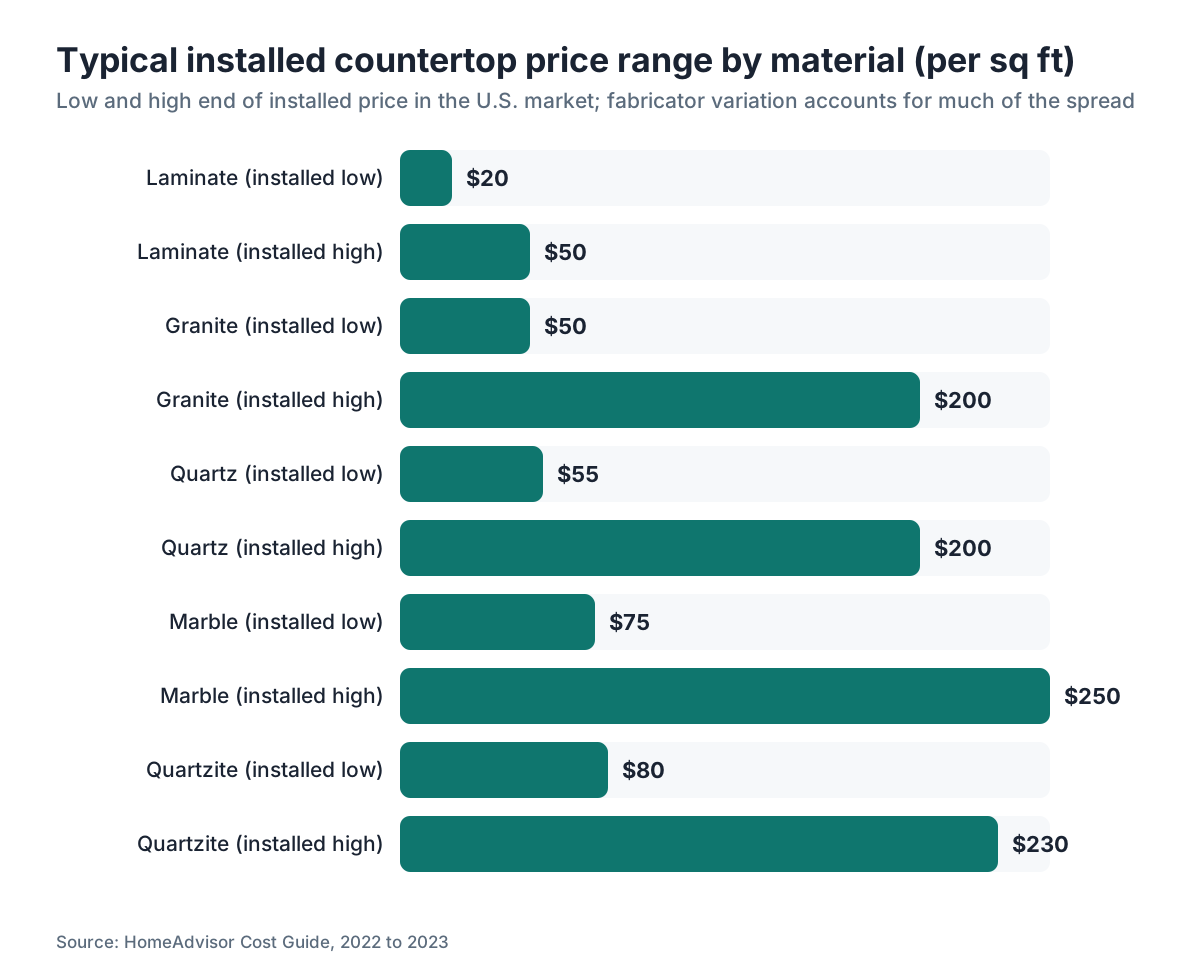
A 2022 HomeAdvisor cost study put the national average installed granite price near $80 to $110 per square foot, with the low end around $50 and custom or high-complexity work reaching $200 or more [2]. Quartz installs run a similar band. Every dollar of that spread traces back to one of the drivers in this article.
Fabrication-only pricing (you source the stone separately) narrows the range because you strip out slab markup. Even then, fabrication labor alone can swing from $30 to $75 per square foot depending on market, shop type, and edge complexity.
Here is the honest part. Nobody has clean market-wide data on fabricator price dispersion. The best benchmarks come from cost aggregator sites and regional kitchen and bath surveys, and they point to 30 to 60% variance as normal within one metro for comparable scope.
Does better equipment mean a higher quote?
Usually yes, in the short term. A CNC bridge saw costs $150,000 to $400,000 new. A waterjet starts around $80,000 and climbs to $300,000 for a large-format machine. A digital templating rig using a Proliner or similar laser device runs $20,000 to $60,000. Those capital costs get depreciated over 5 to 10 years and spread across every job the shop produces.
A shop with all three tools has $300,000 to $700,000 in equipment on the floor. Amortized, that might add $8 to $15 per square foot to their cost base versus a shop using a manual bridge saw and paper templates. You see it in the quote.
What you get back: tighter tolerances, cleaner miters, complex cutouts done in minutes instead of hours, and less chance of a cracked slab from hand-cutting stress. Digital templating cuts remeasure callbacks sharply because there is no hand-measurement transcription to botch.
Still, plenty of skilled shops do beautiful work with simpler tools. A great hand fabricator with 20 years in can outwork a mediocre CNC operator on complex installs any day. Equipment is a proxy for quality, not a guarantee of it. Ask to see finished work no matter what machines a shop runs.
How does stone sourcing affect the final price?
The fabricator's relationship with their distributor matters a lot. High-volume shops buying direct from importers, or keeping warehouse inventory, land slabs 20 to 35% below what a small shop pays buying as-needed from a local wholesaler.
That sourcing edge goes one of two ways. Some shops pass it along as a lower price to win the job. Others keep it as margin. Both are rational. Both change what you see on the quote.
Slab price also moves with material. Standard Level 1 granite might run $40 to $60 per square foot installed from a high-volume shop, while a Level 4 imported quartzite from the same shop runs $120 to $180 [2]. Markup on material typically sits 15 to 40% above landed cost. If a quote looks low on labor but high on material, ask for the slab price separately.
For engineered stones like Cambria, Silestone, or MSI Q Premium, distributors set minimum advertised pricing and fabricators buy at contract rates tied to volume. A certified Cambria fabricator buying heavy has a real cost advantage over a shop that installs it once a month. Read more about how that brand prices in our guide to Cambria countertops.
Some shops let you bring your own slab. That is a fabrication-only or FOB job. It removes their material markup, and it removes their liability if the slab shows up with a hidden crack or a color surprise. Know that going in.
Why does labor cost vary so much between shops?
Labor is the biggest variable in a fabrication quote, and it is shaped by market wages, crew experience, and how tightly a shop is run.
The Bureau of Labor Statistics reports median wages for Stone Cutters and Sawyers (SOC 51-9195) at $21.80 per hour nationally as of May 2023, with the top quarter earning $28 or more [1]. In high-cost metros like San Francisco, New York, and Boston, total compensation with benefits and workers' comp runs well above that. A shop in those markets simply cannot price like one in rural Tennessee.
Experience counts too. A journeyman with 10 years on complex installs is faster and makes fewer mistakes than someone two years in. Fewer mistakes means less stone waste, fewer callbacks, and quicker installs. That person earns more per hour but costs the shop less per finished job once you fold in rework. Shops that stock experienced crews price higher and usually earn it.
Layout and workflow discipline move the number too. A shop that walks slabs cleanly from saw to polisher to truck burns less labor than one where slabs sit and wait. That efficiency shows up as either a lower quote or a fatter margin, depending on the owner.
Install is its own labor line. A two-person crew on a standard kitchen takes 3 to 6 hours. Heavy stone, undermount sinks, or tight spaces stretch that out. Shops running their own experienced install crews instead of subs hold better quality control and price for it.
What role does shop overhead play in the price gap?
Overhead is the cost of keeping the lights on before a single slab gets cut. Rent, utilities, insurance, vehicle payments, software, advertising, and admin salaries all live here.
Industrial rent swings hard by market. CoStar Group reported national average industrial rents at $9.67 per square foot annually in 2023, but gateway markets like Los Angeles, Miami, and New Jersey ran $15 to $25 [3]. A shop holding 10,000 square feet of fabrication space in Los Angeles spends $150,000 to $250,000 a year on rent alone before touching a slab. That cost rides along on every job.
Workers' comp for stone fabricators carries some of the higher rates in the trades because of dust exposure and cut risk. In California, the stone-cutting classification (NCCI Code 1803) has historically carried a base rate around $5 to $8 per $100 of payroll, though the actual number depends on the employer's experience modifier [4]. Silica dust compliance under OSHA rules adds ventilation, wet-cutting, and monitoring costs that also feed overhead [9]. A clean safety record pays less. A history of claims pays more. Both get passed to customers.
Liability insurance, delivery-truck insurance, and general business coverage stack on top. A fully insured shop carrying $2 million in general liability spends $4,000 to $12,000 a year on that one policy, depending on revenue and claims.
None of this is waste. It is the cost of running a legitimate, insured, accountable business. When a shop quotes far below market, the first question is simple: what overhead did they cut? Sometimes the answer is efficiency. Sometimes it is missing insurance.
How does the fabricator's warranty and service policy affect price?
Warranty costs money. A shop offering a one-year warranty on fabrication defects, a free remeasure if their template is wrong, and a callback guarantee on install issues has to budget for those outcomes. They price it in.
A shop offering no warranty, or one buried in exclusions, is not absorbing that risk. You are.
For a homeowner, this is real money. A cracked top on install, a seam that opens in year two, or a cutout measured wrong can cost $500 to $2,500 or more if you pay out of pocket. When the fabricator eats that risk, it shows up as roughly a 5 to 10% premium in the quote.
Ask every shop you quote two questions. What happens if the seam opens in 18 months? What happens if your template is off and the counter does not fit? The answers tell you how they price and what kind of business they run.
Does waste and slab yield affect what you pay?
Yes, more than most people realize. Stone sells by the slab, and every cutout for a sink, a cooktop, or a corner angle is material headed for the scrap pile. A skilled fabricator using nesting software keeps that waste down. A sloppy shop throws away expensive stone and prices to cover the loss.
A typical kitchen carries 15 to 25% material waste from cutouts, edge overhangs, and seam planning. On a complex L-shaped kitchen with two sink cutouts and a cooktop, waste can hit 30 to 35% if the shop does not plan cuts carefully.
Nesting software, which digitally maps slab cuts before the saw runs, can trim material waste by 8 to 15% on complex jobs according to fabrication industry benchmarks. SlabWise is built specifically to help shops quote accurately and nest cuts efficiently, which tightens the gap between what they quote and what the job actually costs them.
From your side of the table: if two shops bid the same job but one quotes more square footage of material, ask why. It might be honest (they account for waste upfront) or it might be inefficiency (they cut sloppily and bill you for it).
Is a cheaper quote a red flag or a bargain?
Sometimes a bargain. Sometimes a trap. The difference is what got cut to make it cheap.
Legitimate reasons a shop quotes lower: lower overhead in a cheaper market, high volume that buys better stone pricing, tight workflow that shaves labor per job, or a newer shop building a client base at thin margins.
Warning signs that cheap means risky: no physical shop address (they are a broker outsourcing the work), no workers' comp or liability insurance on file, no portfolio, no references you can actually call, a quote that excludes installation, or a price so far below every other bid that no explanation fits.
A shop 10 to 15% under the market average might just be efficient. One 40% under every other quote earns hard skepticism. Stone work done wrong is expensive to fix. A botched install of marble countertops means a cracked slab that may be unrepeatable if it came from a discontinued lot. See our guide to marble countertops for why material sourcing is part of the quality question.
Get at least three quotes on any job over $3,000. Make sure the scope matches: same material grade, same edge, same sink cutouts, same install included or excluded, same warranty. Quote comparison only works when it is apples to apples.
What specific line items should you compare across quotes?
Most fabricator quotes are not itemized the way a general contractor's bid is. You can ask, and you should. Here is a table of the typical components and what to watch for:
| Line Item | What to Ask | Red Flag |
|---|---|---|
| Material (slab) | Price per square foot, grade level, origin | Vague "granite" with no level or source |
| Fabrication labor | Included in sqft price or separate | No breakdown at all |
| Edge profile | Which profile, how many linear feet | Upcharge not disclosed upfront |
| Sink cutout | Per cutout price | Missing from quote |
| Template/measure fee | Included or separate | Hidden charge added later |
| Installation | Included, by whom | Subcontracted without disclosure |
| Haul-away of old tops | Included or extra | Not mentioned at all |
| Warranty | Duration and scope | None stated |
| Deposit and payment terms | Percentage and timing | 100% upfront |
Ask each shop for a written quote with these items separated. Most reputable shops will do it. If a shop flat refuses to break out pricing, that tells you something.
For countertop installation specifically, confirm whether the crew is the shop's own employees or a subcontractor. Subs are not automatically bad, but you want to know who shows up at your house and who carries the liability if something breaks.
Material grade is the sneakiest variable. "Granite" can mean a $40-per-square-foot commodity stone or a $130-per-square-foot imported slab. Get the specific name, the country of origin, and the distributor if you can. Compare that across bids.
Do certifications or brand partnerships change the price?
Some material brands require fabricators to meet certification standards to install their product and pass through the warranty. Cambria runs a network of certified fabricators. Silestone and Caesarstone have similar programs. Being certified usually means the shop has met training requirements, carries the right equipment, and has signed on to quality standards the manufacturer sets [10].
Certified fabricators may pay more for materials under their volume agreements, but they get better support, marketing, and a warranty that passes through to the customer. That is worth something.
Non-certified shops can often install the same material, but the manufacturer's warranty may not hold if something goes wrong. For engineered quartz especially, that warranty (10 years to lifetime on some brands) is real financial protection. Losing it to save 8% on install is a bad trade.
Broader industry credentials include the Natural Stone Institute's Accredited Fabricator program (formerly the Marble Institute of America), which sets standards for shop practices, tooling, and installer training [5]. Accredited shops have been audited against documented standards. It does not guarantee perfect work, but it means someone checked.
These credentials cost money to hold, sit inside shop overhead, and land in quotes. For a job involving expensive or hard-to-replace stone, paying a small premium for a credentialed shop is usually worth it.
How does location affect what fabricators charge?
Geography is one of the most underrated factors in fabricator pricing. Two shops with identical equipment, identical crews, and identical stone costs will quote differently if one sits in Manhattan and one sits in Memphis.
Wages, real estate, fuel, and local competition all vary by market. BLS Occupational Employment Statistics show stone cutter wages ranging from about $18 per hour median in some Southern states to $30 or more in California and the Northeast [7]. That gap flows straight into fabrication quotes.
Delivery and install logistics vary too. A shop serving a dense urban market fights elevator access, parking permits, tight staircases, and building superintendent scheduling. All of that eats labor time and drives cost. A suburban shop working large open-floor kitchens has none of those headaches.
Seasonality moves the needle in some markets. In colder climates, spring and summer are peak remodel season and shops book out. Tight capacity kills the incentive to discount. In the off-season, the same shop might sharpen its pricing to keep crews busy. If your timeline is flexible, off-peak quoting can save 5 to 12% in high-demand markets.
What margin does a fabricator typically build into a quote?
Fabrication is not a fat-margin business. Most independent shops run net margins of 8 to 15% after all costs, per industry financial benchmarks from the National Kitchen and Bath Association [6]. Gross margins on a job before overhead run higher, typically 35 to 50%, but overhead eats a big slice of that.
Material markup usually sits 20 to 40% above landed cost. Labor is priced to cover wages plus burden (taxes, benefits, workers' comp) plus a share of overhead, which often means billing labor at 2.0 to 2.5x the direct wage rate. The capital equipment behind those numbers gets depreciated over its useful life, a cost the SBA lays out in its startup cost guidance [8].
A shop quoting a job at 50% gross margin on a $4,000 invoice makes $2,000 gross. After overhead allocated to that job (rent, insurance, equipment depreciation, admin), net profit might be $400 to $600. That is a thin business.
When you push a fabricator to slash price, you are often asking them to drop into a margin where the job barely makes sense. Some will do it to fill capacity. Others will pass. Neither answer is wrong. Knowing that the margin in stone fabrication is not enormous explains why legitimate shops cannot always match a lowball, and why some shops that do match it end up cutting corners somewhere.
Frequently asked questions
Why is one fabricator's granite quote $1,500 higher for the exact same stone?
The gap usually comes from labor cost (wages, experience, market rates), shop overhead (rent, insurance, equipment), and material markup. A shop with a CNC saw, digital templating, and experienced installers carries a higher cost base than one working with older equipment and a lower-wage crew. The pricier shop is often delivering a meaningfully different product, though not always. Ask both to itemize.
Is it worth paying more for a fabricator with CNC equipment?
Usually yes for complex jobs. CNC machines produce tighter tolerances, cleaner edge profiles, and more precise cutouts, and they cut the risk of cracking thick or brittle stone like marble or quartzite. For a straightforward rectangular counter with a simple edge, a skilled hand fabricator can match the result for less. Complexity is the deciding factor.
How do I know if a fabricator's high price is justified or just inflated?
Ask for a portfolio of similar jobs, call references, and request a written line-item quote. Check that they carry general liability insurance and workers' comp. Verify any certifications they claim (Natural Stone Institute accreditation, brand partnerships). A shop that is genuinely more expensive because of real overhead and skilled labor can explain where the price comes from. One padding margin gets evasive.
Can I negotiate a fabricator's price?
Yes, within limits. Shops with open capacity, especially off-peak, will often sharpen a quote by 5 to 10%. Paying cash or shortening the payment schedule can occasionally get a small discount. Asking for a simpler edge profile or reducing scope removes real cost. What rarely works is demanding a lower price with no scope change. That just squeezes margin that may already be thin.
Does supplying my own slab save money?
It can, depending on your sourcing. If you buy a slab below the fabricator's material cost plus markup, you save the markup (typically 20 to 40%). The tradeoffs: you own the risk if the slab is damaged before cutting, you handle delivery, and you lose the fabricator's material warranty. For standard materials the savings are modest. For rare or exotic slabs you source directly, it can be meaningful.
Why do fabricators charge extra for certain edge profiles?
Edge profiles take labor time and tooling wear. A simple eased or beveled edge takes minutes per linear foot. An ogee, waterfall, or multi-step profile needs multiple tool passes, careful alignment, and sometimes hand finishing, which can take 4 to 10x as long. Shops charge $10 to $30 per linear foot for simple profiles and $35 to $80 for complex ones. On 30 linear feet of edge, that difference is $750 to $1,500.
What does fabricator certification actually mean for the customer?
It means a third party has audited the shop against documented standards. The Natural Stone Institute's Accredited Fabricator program checks tooling, training, and shop practices. Brand certifications (Cambria, Silestone, and others) verify the shop is trained on installation requirements and that the manufacturer's warranty will be honored. Certification does not guarantee perfect work, but it creates accountability that uncertified shops lack.
How does slab waste affect what I pay?
Fabricators build waste (from cutouts, seams, and offcuts) into their pricing. A shop that plans cuts efficiently wastes 15 to 20% of a slab on a typical kitchen. A disorganized shop might waste 30% or more and price to cover it. If one quote shows more material for the same job, ask the shop to explain their waste assumptions. Nesting software helps shops minimize waste, and the savings can flow to customers in competitive bids.
Are subcontracted installers a reason to pay less?
Not necessarily. Some fabricators subcontract install consistently with trusted, experienced crews and quality is fine. The concern is accountability. If an in-house crew cracks your counter, the fabricator owns it directly. If a subcontractor does it, the chain of responsibility blurs. Ask upfront who installs, whether they carry their own insurance, and who you call if something goes wrong on install day.
Does the type of stone significantly change the fabrication cost?
Yes. Harder, more brittle stones like quartzite, marble, and certain granites take longer to cut and polish, wear blades faster, and carry higher crack risk on complex cuts. Engineered quartz is more uniform and predictable. Softer stones like soapstone fabricate more easily. Labor cost per square foot can vary by 20 to 40% based on material alone, separate from the raw slab cost.
Why do urban fabricators charge so much more than shops in smaller markets?
Real estate, wages, and logistics are the main drivers. Industrial space in dense metros costs 2 to 3x rural rates. Wages for skilled fabricators are higher in high-cost cities. Urban delivery and install take more time per job (parking, elevator access, tight spaces). These are structural costs, not padding. If you live near a market border, quoting shops in lower-cost suburbs can sometimes save 15 to 20%.
What is the biggest mistake homeowners make when comparing fabricator quotes?
Comparing total price without confirming scope is identical. One quote might skip installation, use a Level 1 stone versus Level 3, omit the sink cutout fee, or leave out haul-away of the old counter. A $500 price difference can vanish once you align scope. Always get written quotes that specify material grade, edge profile, cutouts, installation, and warranty, and compare those documents line by line.
Sources
- U.S. Bureau of Labor Statistics, Occupational Employment and Wage Statistics, SOC 51-9195 Stone Cutters and Sawyers: Median hourly wages for stone cutters and sawyers nationally; range by state; top-quartile earnings
- HomeAdvisor, Granite Countertops Cost Guide: National average installed granite countertop price of $80 to $110 per square foot; range from $50 to $200+; quartz at similar range
- CoStar Group, Industrial Market Report 2023: National average industrial space rent at $9.67 per square foot annually in 2023; gateway markets running $15 to $25
- National Council on Compensation Insurance (NCCI), Classification Lookup: Workers' compensation classification and base rate range for stone cutting operations
- Natural Stone Institute (formerly Marble Institute of America), Accredited Fabricator Program: NSI accreditation program audits shops against documented standards for tooling, training, and shop practices
- National Kitchen and Bath Association (NKBA), Industry Financial Survey: Independent fabrication shops typically run net margins of 8 to 15%; gross margins 35 to 50% before overhead allocation
- U.S. Bureau of Labor Statistics, Occupational Employment Statistics, Stone Cutters and Sawyers: State-level wage variation for stone cutters: median around $18/hr in some Southern states, $30+ in California and Northeast
- U.S. Small Business Administration, Calculate Your Startup Costs: Capital equipment costs and depreciation methods relevant to fabrication shop cost structure
- Occupational Safety and Health Administration (OSHA), Silica: Dust exposure risk context for stone fabrication; compliance costs that affect shop overhead
- Cambria, Fabricator Partnership Program: Certified fabricator program requirements and warranty pass-through conditions for Cambria engineered stone
Last updated 2026-07-11