TL;DR
- Apply penetrating sealer after final polish, when the slab surface is clean and dry (ideally 65-80°F).
- Pour or spray a thin, even coat, let it penetrate 3-5 minutes, wipe off all excess before it hazes, then repeat for denser stones.
- Most granites need one to two coats.
- The whole process takes under 30 minutes per slab.
Why seal granite in the shop instead of on-site?
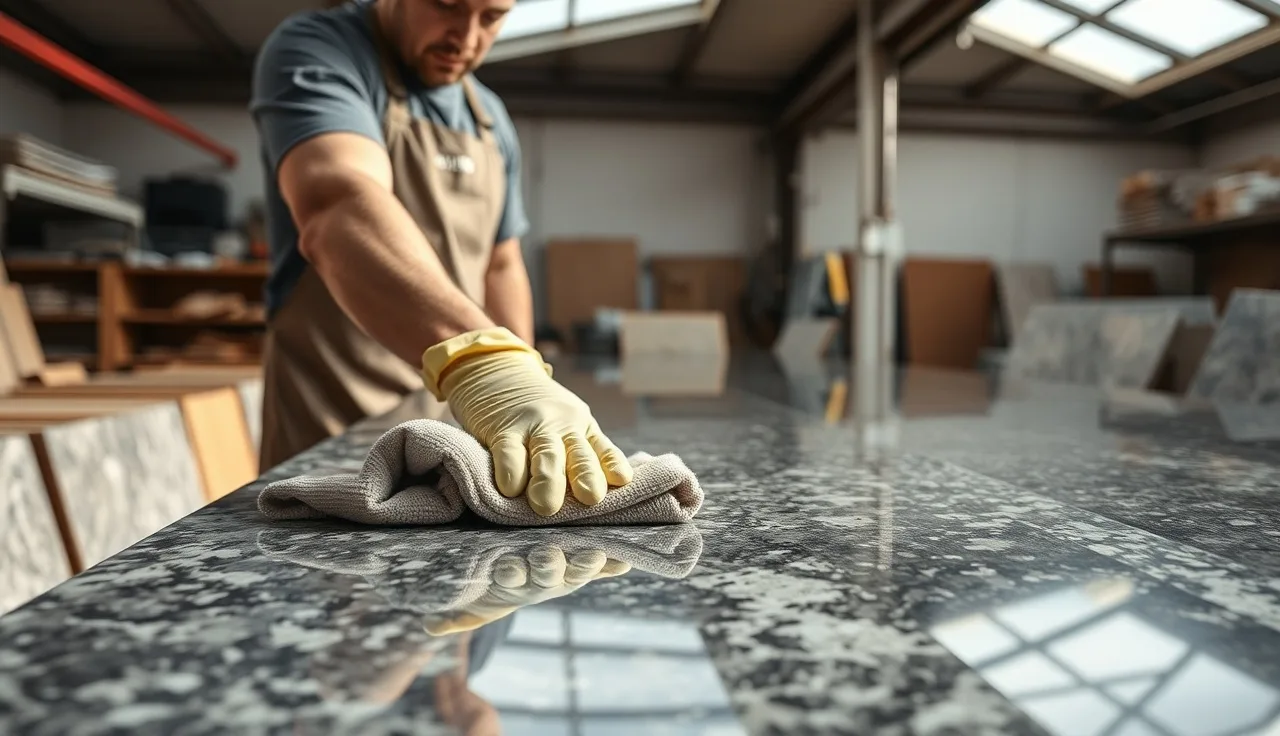
Sealing in the shop is faster, cleaner, and gives you controlled conditions that are almost impossible to match in a finished kitchen. You're working on a flat surface, at a comfortable height, with good ventilation, without cabinet hardware in the way, and without a homeowner watching over your shoulder.
On-site sealing has a real failure mode: the installer hands the homeowner a bottle and says 'seal it after 30 days.' That never happens. Or it happens wrong. When you seal in the shop, it's done, documented, and you've taken one variable out of the callback equation.
There's also a quality argument. Freshly polished granite is porous and clean. No cooking oils, no soap film, no grout residue. Sealer penetrates better into an uncontaminated surface. A study published in the journal Construction and Building Materials found that silane/siloxane impregnators achieve measurably lower water absorption in stone treated before exposure to organic contamination [1]. The chemistry just works better on a virgin surface.
For fabricators running volume, in-shop sealing fits right into the workflow after polishing and before wrapping or loading. It adds maybe 20-25 minutes per slab, which is easy to batch.
What products actually work as penetrating sealers for granite?
Penetrating sealers (also called impregnating sealers) work by filling the microscopic pores and microcracks in stone with a water- and oil-repelling agent, without forming a surface film the way a topical sealer does. The active chemistry is almost always fluorocarbon- or siloxane-based, and those two classes perform differently.
Fluorocarbon (fluoropolymer) sealers repel both water and oil. They're the professional-grade choice for kitchen countertops where cooking oil is a real threat. PFAS-free fluoropolymer formulations have become common since 2023 as manufacturers respond to EPA regulatory pressure on long-chain fluorinated compounds [2].
Siloxane/silane sealers repel water excellently but have weaker oil resistance. Fine for exterior stone or bathroom vanities, but not ideal for kitchen counters. A lot of big-box retail products are siloxane-based, which is one reason they underperform compared to professional impregnators.
Solvent-based vs. water-based is a separate question. Solvent-based sealers penetrate faster and deeper, especially in cooler shop conditions, but require ventilation and PPE (respirator, gloves). Water-based formulas are safer and still perform well if the stone is fully dry. Most high-volume shops have shifted to water-based for OSHA compliance reasons [3].
Brands most commonly found in professional shops as of 2025 include Tenax Proseal, StoneTech BulletProof, Dry-Treat 40SK (solvent), and Aqua Mix Sealer's Choice Gold (water-based). Nobody pays me to say that. I'm listing them because they consistently show up in trade discussions and have real technical data sheets behind them.
| Sealer type | Water repellency | Oil repellency | VOC level | Dry time |
|---|---|---|---|---|
| Fluoropolymer (professional) | Excellent | Excellent | Medium-high | 2-4 hr |
| Siloxane/silane | Excellent | Poor-fair | Low-medium | 1-3 hr |
| Water-based impregnator | Good-excellent | Good | Low | 2-6 hr |
| Topical/film-forming | Good | Good | Varies | 1-2 hr |
Topical sealers are not penetrating sealers. They sit on top of the stone and will scratch, peel, and change the sheen. Don't use them on polished granite countertops.
How do you test whether the granite actually needs sealing?
Not all granite needs sealing. Absolute Black, for example, is essentially non-porous, and a sealer barely does anything. Applying sealer to a nearly impervious stone wastes product and time, but it's mostly harmless. Applying no sealer to a highly porous granite like Baltic Brown or Giallo Ornamental is a real problem.
The standard shop test is the water drop test. Put a few drops of water on the polished surface and time how long before it darkens or absorbs. If the stone absorbs water in under 5 minutes, it needs sealing. If it sits on the surface and beads for 10-15 minutes with no darkening, sealing is optional. Most fabricators also run an oil drop test right next to the water: a drop of mineral oil or vegetable oil left for 5 minutes. Oil absorption tells you whether a fluoropolymer sealer specifically is warranted.
This is a real, published test protocol. The Marble Institute of America (now part of the Natural Stone Institute) has long recommended the water absorption test as the field check before sealing [4].
Run the test on each new lot from a supplier, more than by stone name. Two slabs called 'Santa Cecilia' from different quarries or production runs can have meaningfully different porosity.
What shop conditions do you need before applying sealer?
Surface temperature matters a lot. Most penetrating sealers are formulated to work between 50°F and 90°F (10-32°C), with the sweet spot around 65-80°F. Cold stone slows penetration because the sealer thickens and the pores contract slightly. Hot stone (especially in summer near roll-up doors) causes solvent-based sealers to flash off before they penetrate, which leaves a milky haze on the surface.
The stone must be dry. Not 'wiped down 10 minutes ago' dry. Actually dry. If you finished polishing with water-cooled equipment, give the slab 30-60 minutes with a fan or heat gun before sealing. Any moisture in the pores blocks penetrant entry. Water-based sealers tolerate a little residual moisture better than solvent-based, but you still want the surface dry to the touch.
The surface must be clean of polishing compound residue. A quick wipe with an appropriate stone cleaner (not an ammonia or bleach cleaner, which can etch) and let it fully evaporate before sealing.
Ventilation is non-negotiable with solvent-based products. OSHA's 29 CFR 1910.94 covers ventilation requirements for spray operations in general industry [3]. Even with water-based sealers, you want airflow. Set up a fan pulling air out of the work area, not blowing across the slab (that dries it unevenly).
What PPE do you need when applying penetrating sealer?
Nitrile gloves are the floor for any sealer application. Sealer solvents and carriers can irritate skin, and some are dermal sensitizers with repeated exposure.
For solvent-based sealers, add a NIOSH-approved half-face respirator with organic vapor cartridges (OV/P100 combination is the common choice) [8]. OSHA's respiratory protection standard is 29 CFR 1910.134 [3]. Don't use a paper dust mask. It does nothing against organic vapor.
Safety glasses protect against splash, especially when pouring or spraying. That's a basic shop habit that applies here too.
Water-based sealers are much lower hazard, but read the SDS (Safety Data Sheet) for every product before the first use. Manufacturers are required to provide an SDS under OSHA's Hazard Communication Standard (29 CFR 1910.1200) [3]. The SDS tells you exactly what PPE is required and what the exposure limits are.
How do you apply the sealer: step by step?
Here's the actual process used in production shops. This is for a standard polished granite countertop, applied before installation.
Step 1: Confirm the stone needs sealing. Run the water drop test. If it absorbs in under 5 minutes, proceed. If not, document it and move on.
Step 2: Clean and dry the surface. Wipe with a residue-free stone cleaner. Let it dry completely. Surface should be room temperature.
Step 3: Apply the first coat. Pour sealer directly onto the stone in a thin ribbon (about a 1/4-inch stream) or spray it on with a pump sprayer at low pressure. Spread with a clean lint-free cloth (microfiber works, so does a short-nap foam applicator). You want a thin, even wet film, not a puddle. Work in sections of about 3-4 square feet at a time so you can manage the dwell time.
Step 4: Let it penetrate (dwell time). Follow the product's spec sheet. Most penetrating sealers need 3-5 minutes of dwell time on the surface. Some thick-formula products say up to 10 minutes. Don't let it dry on the surface. If you see it starting to haze or tack up, you've waited too long.
Step 5: Wipe off ALL excess. This is the step most people get wrong. Every drop of sealer that isn't inside the stone has to come off before it cures. Use a clean, dry microfiber cloth and buff it off firmly. Work in the same direction. If you see any haze starting, the sealer is beginning to cure on the surface, not in it. Work faster, or add a small amount of fresh sealer to re-wet and re-wipe the area.
Step 6: Evaluate and repeat if needed. For porous granites, a second coat is worth doing after the first coat's cure window (usually 20-30 minutes for water-based, 1-2 hours for solvent-based). Apply the second coat the same way. For dense granites, one coat is typically enough.
Step 7: Final buff and inspect. Once the last coat has cured per the product label, do a final dry buff with a clean cloth. Check for any hazy spots in raking light. Residue on the surface can sometimes be removed with a light application of mineral spirits on solvent-based products, or more sealer re-applied and immediately wiped off.
Step 8: Allow full cure before wrapping. Most sealers are 'dry to touch' in 1-4 hours but reach full chemical cure in 24-72 hours. You can wrap and transport the slab after the dry-to-touch window. Don't let plastic wrap sit directly on the surface for extended periods before full cure; it can trap solvents.
How many coats does granite need?
One coat is enough for most dense, well-polished granites: Absolute Black, Black Galaxy, Ubatuba (dark varieties), and similar tight-grained stones. The water drop test confirms it. After one coat, re-test: if water still beads well, stop.
Two coats are standard for medium-porosity granites: Santa Cecilia, Giallo Ornamental, Venetian Gold, Kashmir White. These make up the bulk of residential granite jobs.
Three coats are sometimes warranted for highly porous or honed granite. Honing opens the surface texture dramatically, and the same stone that needs one coat polished might need two or three coats honed. Let each coat cure enough before the next, and re-test after each coat rather than defaulting to three.
A common shop mistake is dumping too much sealer in one coat. A thick, heavy application doesn't penetrate better. It just leaves more residue to wipe off, and any you miss cures into a hazy film. Thin coats, properly wiped, beat heavy coats every time.
What causes that white haze after sealing, and how do you fix it?
White haze (sometimes called sealer residue or blush) is the most common sealer application error. It happens when excess sealer cures on the stone surface rather than inside it. The sealer is doing exactly what it's supposed to do, curing into a polymer, just in the wrong place.
Causes include letting dwell time run too long, applying too thick a coat, working in a hot shop where the sealer evaporates before you can wipe it, or just missing spots during the buff-off phase.
Fixing fresh haze (within the same day): apply a small amount of the same sealer to the hazed area to re-dissolve the residue, then wipe off aggressively right away. The fresh solvent softens the partially cured residue.
Fixing cured haze (days or weeks later) is harder. Options include a light application of mineral spirits or paint thinner (test in an inconspicuous spot first), a commercial sealer stripper made for stone, or, in stubborn cases, very fine (3000+ grit) polishing to physically remove the film. Some shops keep a bottle of the manufacturer's recommended haze remover on hand for exactly this reason.
Prevention is easier. Work in manageable sections, hold good shop temperature, and always buff with a fresh dry cloth, not one already saturated with sealer.
How do you seal the edges and backside of granite?
Edges need sealing too. Fabricated edges (eased, bullnose, ogee) expose raw stone that may be more porous than the polished face. Apply sealer to the edge with a small brush or a folded microfiber cloth, working section by section. Dwell and wipe the same way as the face.
The underside of granite countertops matters less for staining, but some fabricators seal it anyway for moisture protection, especially in humid climates or where the slab sits on an uncured substrate. If you seal the underside, do it before you flip the slab for final polishing, or as a separate step before loading.
Cut-outs (sink holes, cooktop cutouts) expose fresh stone on their perimeter edges. Seal those edges carefully. They get forgotten, and they're exactly where moisture from sink areas gets in.
For shops doing large volumes, job tracking software helps you document which slabs were sealed, with what product, and when. SlabWise has job notes and slab-level tracking built into its workflow if you want to log this without paper tickets floating around the shop.
How long does penetrating sealer last, and when should it be reapplied?
Manufacturer claims range from 1 year (cheaper consumer products) to 15-25 years (premium fluoropolymer products like Dry-Treat 40SK, which carries a 15-year warranty on some applications [5]). Real-world performance sits somewhere in the middle for most products, usually 3-10 years depending on stone porosity, sealer quality, and how hard the surface gets used.
A kitchen counter that sees daily cooking, acidic foods, and heavy cleaning product use needs resealing sooner than a bathroom vanity. The water drop test is the honest answer: when water stops beading and starts absorbing within a few minutes, it's time to reseal.
For homeowners, the practical advice is to test annually [10]. Most granite in a kitchen benefits from resealing every 1-3 years.
For fabricators, what matters is giving the homeowner clear written instructions. Put the sealer product name, date of application, and recommended retest schedule on a care card. That's professional, it cuts callbacks, and it's evidence of the service you provided if a warranty question comes up later.
You can find more on stone care routines in our article on how to clean stone countertops.
Are there any stones where penetrating sealers don't work or cause problems?
Yes. A few categories need different thinking.
Very dark, dense granites (Absolute Black, Black Galaxy, some Zimbabwean blacks) are nearly non-porous. Sealer doesn't really enter the stone. It mostly evaporates or sits on the surface. Sealing these is low-risk but low-benefit. The main risk is over-application leaving haze on a very unforgiving black surface where any film shows. If you seal them at all, use a very thin coat and wipe carefully.
Serpentine (often sold as 'green marble' or 'verde' stones) and some soapstones contain magnesium silicates that can react with certain solvent carriers. Always test on a small corner or offcut first.
Leathered or brushed finishes behave differently from polished. The texture traps sealer in small grooves and makes the wipe-off stage harder. Apply less product than you would on a polished face, work sealer into the texture with a brush, then wipe before it can cure in the grooves.
Quartzite is often confused with granite at point of sale, but some quartzites are significantly more porous and may need three or more coats. If you're working with quartzite, the process is the same but the sealer demand is often higher. Related reading: how to clean quartzite countertops.
Engineered stone (quartz composite like Cambria, Silestone, etc.) doesn't need or benefit from penetrating sealer. The resin binder makes it essentially non-porous. Applying sealer to it is wasted product. Cambria countertops are explicitly marketed as not requiring sealing.
What does sealing actually cost, and is it worth charging for?
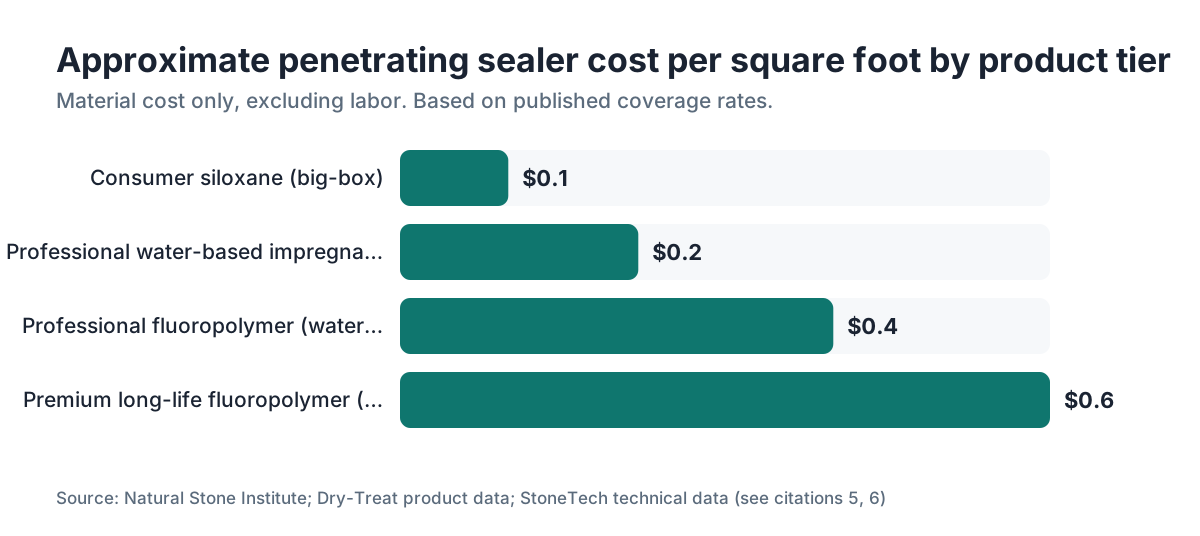
Product cost for a professional-grade penetrating sealer runs roughly $0.15 to $0.60 per square foot of coverage, depending on the product and stone porosity [5][6]. A 1-quart bottle of most professional sealers covers 100-300 square feet, costing $25-$60 retail, less in shop quantities.
Labor time is 15-25 minutes per slab for a single coat, maybe 30-40 minutes for a two-coat job. At a shop labor rate of $50-$80/hour, that's roughly $12-$55 in labor per slab.
Fabricators typically charge $40-$100 per job for sealing as a line item, or roll it into material pricing as a standard include. Some shops offer it as a premium upgrade at $75-$150 for high-end fluoropolymer products.
Is it worth charging separately? Yes, if you can explain the value. A line-itemed sealing charge on the quote forces the conversation about why it matters and what product you're using. That conversation sets you apart from competitors who throw in a generic sealer as an afterthought. A customer who understands why you use a specific professional-grade sealer is less likely to balk at the price.
For tracking material costs per job across multiple slabs and stone types, software that ties sealer costs to specific job line items saves real time at invoicing. That's part of what job-costing tools in fabrication software like SlabWise are built to handle, if you're running enough volume to care about the margin detail.
What are the most common sealer application mistakes in fabrication shops?
Letting the sealer dry on the surface is the biggest one. It's always a time-management problem: someone starts a coat on a 10-foot island and by the time they reach the far end, the near end has already tacked. Work in sections. Put a second person on larger pieces.
Not wiping enough is the second mistake. One wipe-through isn't sufficient. You need three or four firm passes with a dry cloth, and you need to flip to a clean side of the cloth regularly.
Skipping the pre-application clean is common when shops are in a hurry. Polishing compound residue acts as a barrier and makes the sealer bead on top of the compound instead of the stone. The job looks fine until the compound is washed off and you find bare unsealed pores underneath.
Using the wrong product is underrated as a failure mode. Selling a kitchen client on a water-only sealer because it was cheaper, then getting a callback about an olive oil stain six months later, is a painful way to learn that oil repellency matters in a kitchen.
Not testing after application is the last one. Always run a quick water drop test after the sealer has cured. If it's not beading, something went wrong and you still have a chance to fix it before the countertop is installed.
Frequently asked questions
Can you apply penetrating sealer to granite right after polishing?
Yes, but give it time to dry. Wet-polishing leaves residual moisture in the pores that blocks sealer penetration. Let the slab sit 30-60 minutes after polishing, or use a fan or heat gun to speed drying. The surface should be completely dry to the touch before you apply any sealer. Clean off polishing compound residue first with a stone-safe cleaner, and let that dry too.
How long does penetrating sealer take to dry in a shop setting?
Most penetrating sealers are dry to the touch in 1-4 hours at 65-75°F. Full chemical cure takes 24-72 hours depending on the product and temperature. You can wrap and transport a slab after the dry-to-touch window. Avoid letting plastic sheeting sit tight against the surface for extended periods before full cure, as it can trap solvent and slow curing.
Do you have to seal every granite countertop, or just some?
Not every granite needs sealing. Dense, dark granites like Absolute Black are nearly non-porous and sealer does little. The water drop test tells you: put a few drops of water on the surface. If it absorbs in under 5 minutes, seal it. If it beads for 10-plus minutes with no darkening, sealing is optional. Run this test on each new material lot, more than by stone name.
What's the difference between a penetrating sealer and a topical sealer for granite?
A penetrating sealer enters the pores and bonds inside the stone. It doesn't change the surface appearance and doesn't peel or scratch. A topical sealer forms a film on top of the stone. Topical sealers were common decades ago but are now considered outdated for granite countertops: they alter the sheen, scratch under use, and require periodic stripping. Always use a penetrating impregnator on polished granite.
Can you over-seal granite by applying too many coats?
You can't harm the stone with extra coats, but you're wasting product and creating more chance for surface residue. A fully saturated stone simply stops accepting more sealer. Once the pores are full, any additional product stays on top and has to be wiped off. The water drop test after each coat is the honest signal: if water is already beading well, skip the next coat.
Does sealing granite make it completely stain-proof?
No. Penetrating sealer makes granite stain-resistant by slowing liquid absorption, giving you time to wipe up spills. It doesn't make stone impervious. A glass of red wine left sitting overnight can still stain even well-sealed granite, especially if the sealer is older. The Natural Stone Institute is clear that sealer is a risk reducer, not a guarantee [7]. Retest annually and reseal when the stone stops beading water.
What happens if you don't wipe off all the excess sealer?
Excess sealer cures on the stone surface as a white, streaky, or greasy-looking haze. On polished granite, this shows clearly under raking light. Fresh haze (same day) can usually be re-dissolved by applying more sealer and wiping immediately. Cured haze may require mineral spirits, a commercial haze remover, or light mechanical polishing. Prevention is far easier: wipe aggressively, flip to a clean cloth section frequently.
Does honing or leathering granite change how you apply sealer?
Yes, significantly. Honing removes the polished surface layer and opens up far more pores. A honed version of the same granite can absorb two to three times more sealer than its polished counterpart and typically needs more coats. Leathered or brushed finishes trap sealer in the texture grooves, making the wipe-off stage harder. Apply thinner coats on textured finishes and use a brush for even coverage.
Is solvent-based sealer better than water-based for granite?
Solvent-based sealers generally penetrate faster and deeper, especially in cool conditions, which helps in some shops. But they require stronger PPE and ventilation, carry higher VOC content, and face increasing regulatory attention [9]. Water-based fluoropolymer sealers have closed most of the performance gap and are safer for daily shop use. Choose based on your shop's ventilation, your local VOC rules, and the specific stone porosity you're dealing with.
How should you document sealer application for customer records?
At minimum, record the slab identifier, the sealer product name and lot, the date of application, number of coats, and recommended retest interval. Many shops include a care card with the installation that lists the sealer used and when to retest. Job-level documentation also protects you if a warranty dispute comes up later. Some fabrication management systems let you attach notes at the slab level for exactly this purpose.
Can you apply penetrating sealer to granite outside in warm weather?
You can, but high temperatures cause rapid evaporation, especially with solvent-based sealers. If the surface is above 90°F, the sealer may flash off before it penetrates, leaving residue. Work in shade, avoid direct sun, and if possible bring the slab inside or wait for cooler conditions. Water-based sealers tolerate warmer temperatures slightly better but still shouldn't be applied to hot stone in direct sunlight.
How do penetrating sealers interact with epoxy or resin repairs on granite?
Penetrating sealer won't bond to cured epoxy the way it bonds to stone, because epoxy is non-porous. The sealer will either bead off or leave a slight residue on the epoxy repair. This generally isn't a problem: just wipe the repaired area clean. The stone around the repair seals normally. Avoid getting sealer on fresh or uncured epoxy, as some solvents can interfere with the cure.
What's the minimum temperature for applying penetrating sealer to granite?
Most manufacturers specify a minimum application temperature of 50°F (10°C). Below that, the stone pores contract, the sealer thickens, and penetration drops sharply. Some solvent-based professional products can be pushed to 45°F, but results are inconsistent. If your shop gets cold in winter, check the stone temperature with an infrared thermometer before starting, and use a space heater to bring the immediate work area up if needed.
Sources
- Construction and Building Materials, Elsevier, 2018. 'Effect of surface contamination on the performance of silane/siloxane water repellents applied to natural stone.': Silane/siloxane impregnators achieve measurably lower water absorption in stone treated before exposure to organic contamination.
- U.S. EPA, PFAS Action Plan and Regulatory Updates: EPA regulatory pressure on long-chain fluorinated compounds (PFAS) has driven manufacturers to release PFAS-free fluoropolymer sealer formulations.
- U.S. Occupational Safety and Health Administration (OSHA), Regulations 29 CFR 1910: OSHA 29 CFR 1910.94 covers ventilation for spray operations; 29 CFR 1910.134 covers respiratory protection; 29 CFR 1910.1200 requires SDS for hazardous chemicals.
- Natural Stone Institute, Technical Bulletin on Stone Care and Maintenance: The Natural Stone Institute recommends the water absorption field test as the standard method to determine whether a stone surface requires sealing.
- Dry-Treat, 40SK Product Data Sheet (manufacturer published documentation): Dry-Treat 40SK carries a 15-year performance warranty on qualifying stone applications; professional fluoropolymer sealers cost roughly $0.30-$0.60 per square foot of coverage.
- StoneTech Professional, BulletProof Sealer Product Technical Data: Professional impregnating sealers coverage rates and cost basis for per-square-foot pricing estimates in the $0.15-$0.60 range.
- Natural Stone Institute, ANSI/NSI Standards for Stone Care: Sealer is described as a stain-risk reducer, not a stain-proof coating; reapplication is recommended when water absorption resumes.
- NIOSH, Respiratory Protection Equipment Selection Guide: NIOSH-approved OV/P100 combination respirator cartridges are appropriate for protection against organic solvent vapors in construction and stone trades.
- U.S. EPA, Volatile Organic Compounds (VOC) Overview: VOC content in solvent-based sealers contributes to indoor air quality concerns; EPA provides guidance on VOC limits and exposure in indoor environments.
- Marble Institute of America (now Natural Stone Institute), Care and Cleaning Guide for Natural Stone Surfaces: MIA/NSI guidance recommends annual retest of sealer performance using the water drop test for kitchen granite surfaces.
Last updated 2026-07-10