TL;DR
- Most countertop fabricators charge $75 to $250 for a template visit, with the national median around $150.
- Simple rectangular kitchens sit at the low end.
- Large homes with multiple rooms, radius edges, or a rush deadline push toward $250 and up.
- The fee is often credited back against your final job total, but not always.
- Ask before the templater shows up.
What does a countertop template fee actually cover?
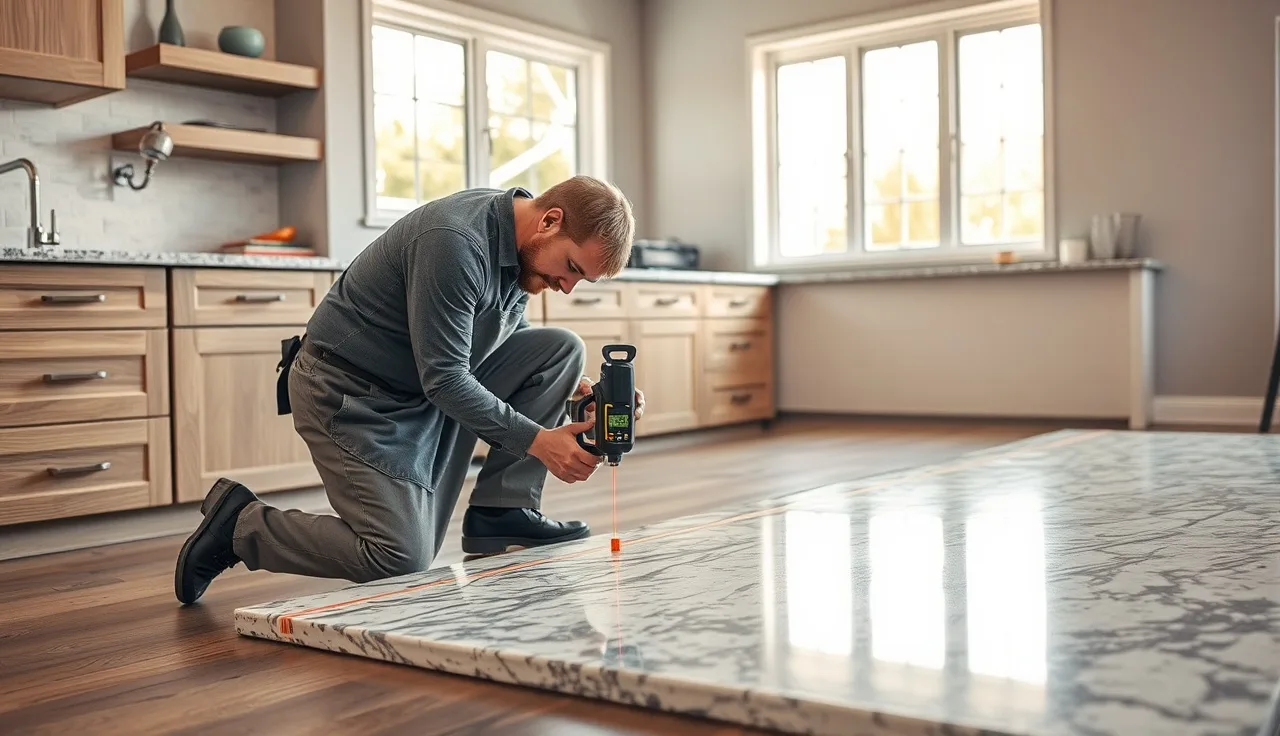
A template fee pays for a fabricator (or a dedicated templater) to come to your home or job site, measure every countertop run precisely, capture sink cutout locations, document edge details, and record obstacles like windows, outlets, or appliance clearances. That visit usually takes 30 to 90 minutes for a standard kitchen.
The output is one of two things. Either a physical cardboard or Masonite template cut to the exact shape of your counters, or a digital point cloud and drawing produced by a laser tool like a Proliner or a Laser Products Industries system. Both do the same job: they give the shop a 1:1 map of your space so the slab can be cut before anyone returns to install.
Why charge for it separately? It takes a skilled person, a vehicle, specialized equipment, and usually two or three hours of total time once you add drive time, note-taking, and back-at-shop drawing. Shops that fold the cost into the per-square-foot price are still charging you. They've just hidden it.
What is the typical price range for a countertop template fee?
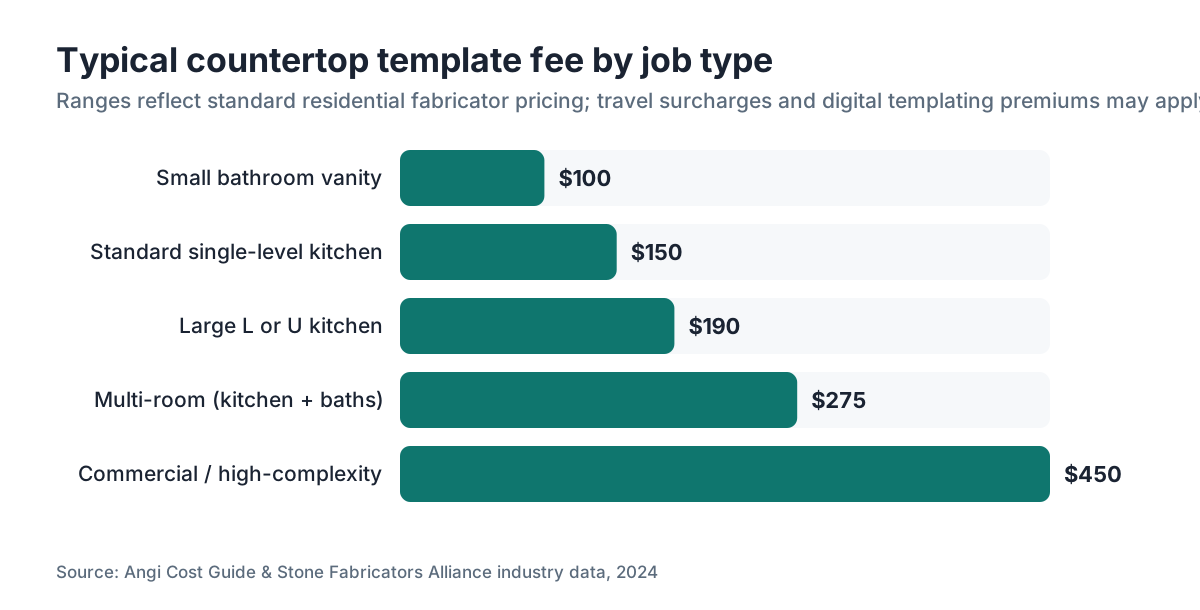
The honest answer is $75 to $250 for most residential jobs, with outliers on both ends. Here is how the market breaks down based on fabricator pricing surveys and regional cost data.
| Job type | Typical template fee range |
|---|---|
| Small bathroom (1-2 vanities) | $75, $125 |
| Standard kitchen, single level | $100, $175 |
| Large kitchen, L or U shape | $150, $225 |
| Multi-room: kitchen + baths | $200, $350 |
| Commercial or high-complexity | $300, $600+ |
Digital laser templating tends to cost $25 to $75 more than hand templating. The equipment investment is higher, even though the on-site time is often shorter. Some fabricators pass that savings back in reduced fabrication error. Others simply pocket the margin. Ask which method they use.
Geography matters more than most homeowners expect. Shops in high cost-of-living metros like San Francisco, New York, or Seattle routinely charge $200 to $300 for a standard kitchen template. Rural shops in the Midwest or Southeast may price the same job at $75 to $100. Your local labor rate is the biggest single driver, not the size of the shop. [1]
For kitchen countertops specifically, the template fee is almost always a separate line item. Getting it waived entirely is rare unless you are buying a very large job.
Is the template fee refundable or credited toward the job?
About half of fabricators credit the fee back when you sign a contract and proceed. The other half treat it as a non-refundable service charge no matter what you decide. Neither practice is dishonest. They reflect different business models.
Why charge a non-refundable fee? Templating is expensive labor that produces a real deliverable. A shop that templates your kitchen and then loses the bid has spent two to three hours of skilled time with nothing to show for it. Charging $150 up front filters out tire-kickers and pays for that risk.
The credit-back model is more common at shops confident they will win the job. They treat the template appointment as a sales tool: get in the home, build rapport, make the measurement feel like a service rather than a cost. That approach works well for shops with strong closing rates.
If a fabricator offers a free template, read the fine print. Some require you to sign a contract before they will template, which means the visit is not really a free comparison tool. Others genuinely offer free templates to stand out, especially in markets with several shops fighting for the same jobs.
Ask in writing every time: "Is the template fee credited toward my final invoice if I proceed?" Get the answer before the templater shows up.
What factors make a template fee go higher?
Distance is the fastest way to inflate a template fee. Most shops have a service radius, often 20 to 30 miles, within which the standard fee applies. Beyond that, expect a travel surcharge of $1 to $3 per mile or a flat add-on of $50 to $150 depending on the shop. [2]
Complexity adds cost too. Radius corners, curved islands, and odd cutouts (cooktops with unusual shapes, farm sinks, integrated drainboards) all take more time to template accurately. A commercial kitchen with six undermount sinks costs more to template than a residential kitchen with one.
Multiple locations in one visit sounds like it should be cheaper per room, and sometimes it is. But if your project includes a kitchen, a primary bath, two more bathrooms, and a laundry room, expect a longer visit and a bigger bill. Some shops charge by the hour after an included baseline. Others use a flat per-room add-on of $25 to $75.
Material type can change the approach. Marble countertops and other natural stones that come in irregular slab sizes sometimes require the templater to sketch a nesting layout on site so the shop knows which slab to pull. That adds time. Granite countertops with dramatic veining need the same care for book-matching.
Rush scheduling is the one nobody talks about. Need the template done in two days because your contractor is on a tight clock? Expect a premium. Shops often charge $50 to $150 extra for priority scheduling because it means bumping another job.
When is a template fee waived entirely?
Large-volume relationships are the most common reason. A general contractor who sends a shop 30 jobs a year rarely pays template fees. The shop builds the cost into the relationship margin.
Some material categories skip templating altogether. Laminate countertops and formica countertops are often sold at big-box retailers with their own in-home measurement programs that charge separately or bundle the cost into the product price. The measurement there is simpler because the material tolerates more cut-and-scribe fitting on site.
If a fabricator is hungry for work, they may template for free as a sales tactic. That is their call. It is not necessarily a red flag, but it is worth asking why they can absorb the cost when competitors cannot.
Some prefabricated countertop lines, like certain Cambria countertops sold through dealers, include templating as part of the dealership service model because the brand mandates it to control quality. The cost is baked into the higher material price.
How does digital laser templating compare to traditional hand templating in cost and accuracy?
Traditional hand templating uses cardboard, Masonite, or a stick-and-plate system to physically replicate the countertop shape. The equipment costs little, and experienced templaters are fast. Error rates depend heavily on the person: a good hand templater is extremely accurate, and a rushed or green one can produce costly mistakes.
Digital laser templating uses a device like a Proliner, made by Prodim, to capture points in three-dimensional space and output a digital DXF file straight to the shop's CNC saw. [3] The on-site visit is often shorter (30 to 45 minutes versus 45 to 90 for hand templating on a comparable job), but the equipment costs $15,000 to $30,000 or more, and training adds to that.
From a homeowner's standpoint, digital templating tends to produce fewer installation surprises. The point cloud captures wall bow, out-of-square corners, and elevation changes in ways hand templating can miss. For large jobs with complex geometry, paying an extra $50 for digital templating is usually money well spent.
From a shop's standpoint, digital templating cuts remake costs. Remakes from bad templates are brutal: wasted slab material, return trips, unhappy customers. Shops running Proliners or similar systems often see their template-related remake rates drop hard, which is why fabrication software that imports digital template data (CNC-ready DXF) has become standard at larger operations. [4]
For a straight, rectangular vanity top, the accuracy gap between digital and hand templating is small. For a curved island with a waterfall edge and two undermount sinks, digital wins.
Should homeowners pay a template fee before getting a firm quote?
Yes, in most cases. The logic is simple. A quote based on your measurements or a contractor's tape-measure sketch is a rough estimate, not a real number. Fabricators build in overage allowances when working from unverified dimensions. The final invoice after a professional template is often lower than the estimate, because the actual square footage comes in under the buffer. Sometimes it is higher.
Paying $150 for a template that produces an accurate, binding quote beats collecting three "free" quotes based on sloppy dimensions and then getting surprised at invoice time.
The exception is when you are early in the decision and genuinely do not know which material you will choose. In that case, get shop estimates based on your rough dimensions first, narrow to one or two fabricators, and then pay for a template with your preferred shop.
SlabWise's instant quote tool lets homeowners enter their own dimensions and get a ballpark range before committing to any template visit. That tells you whether a fabricator's number is in the right neighborhood before you spend money on a site visit.
Never pay for a template before you have verified the shop is legitimate. Check Google reviews, look for a physical showroom address, and confirm they carry liability insurance. A $150 template fee is not a big risk, but it is not zero risk either.
How do fabricators decide what to charge for templating?
Most shops set their template fee by working backward from their loaded labor cost. If a templater earns $25 per hour and the visit plus travel takes three hours, the raw labor cost is $75. Add vehicle cost (the IRS standard mileage rate for 2025 is 70 cents per mile [5]), equipment depreciation, and overhead, and the true cost to the shop for a standard residential template is often $100 to $175. The fee they charge covers that cost plus a small margin.
Smaller shops with higher overhead per job tend to charge more. Larger shops running 20 templates a week have lower per-unit overhead and can price more competitively.
Market positioning matters too. A premium shop that targets high-end renovations may charge $250 for a template not because it costs more, but because their client expects to pay for quality at every touchpoint. A volume shop competing on price might charge $99 and make it up on material margin.
Some fabricators price templates as a percentage of expected job value, typically 1% to 3% for smaller jobs. This approach is less common and harder to justify to customers, but it shows up in commercial work.
Fabricators using software that connects quote-to-template-to-CNC workflows, like the kind SlabWise is built around, can track exactly what templating costs them per job over time and price accordingly. Shops flying blind on their true template cost tend to undercharge and bleed margin.
Does the template fee change based on countertop material?
Mostly no, but there are real exceptions.
For standard natural stone (granite, quartzite, soapstone) and engineered quartz, the template process is identical. The fee does not change based on what you pick.
For materials that need special handling, the fee can differ. Very thick slabs (3 cm plus some exotic materials) can affect how a templater documents reveals and overhangs, but this rarely moves the fee.
Some materials sold through specific dealer programs bundle or exclude the template cost. Corian countertops sold through certified fabricators, for example, often follow Corian's own installation standards, which may include templating as part of the certification process. Butcher block countertops are sometimes templated differently because scribing to walls is more common with wood, and the visit might involve measuring for plumbing rough-in as well.
For stone specifically, if the job involves matching veining across multiple slabs, some fabricators will bring slab photos to the appointment, or require you to come to the yard to slab-select first. That extra coordination may or may not change the template fee depending on the shop.
What should you ask a fabricator before paying a template fee?
Get clear answers to these questions before anyone shows up at your door.
- Is the template fee credited toward my invoice if I proceed? If so, is that credit automatic or do I need to ask for it?
- What is included in the fee, and what triggers extra charges? (Travel beyond X miles, additional rooms, rush scheduling.)
- Will you use digital laser templating or hand templating? Does that affect the fee?
- What happens if you find a problem during the template, like a wall that is badly out of plumb or a cabinet that is not level? Is that assessment included or billed separately?
- How long after the template will I receive a final, binding quote?
- If I decide not to proceed after the template, do I get the template drawings or any documentation I can take to another shop?
That last question is a real one. Some shops treat the template data as proprietary. Others will hand over the DXF file or the cardboard cutouts. Knowing upfront whether you own the output changes how much bargaining power you have if the quote comes back too high.
The template is the foundation of any countertop installation. A bad template means a bad install. Paying a slightly higher fee to a shop with demonstrably good accuracy is almost always worth it.
Are there alternatives to a traditional template visit?
For simple, rectangular jobs (a single bathroom vanity with a straight run), some fabricators accept homeowner measurements and waive the template fee, absorbing the small risk that the dimensions are slightly off. They then do a quick verification at delivery. This works fine for straightforward applications and saves everyone time.
Some big-box retailers offer countertop programs (Home Depot, Lowe's) where an independent measurement company comes out for a fee of $35 to $50, credited toward the purchase. [6] These programs work adequately for standard laminate or prefabricated stone tops. They are not suitable for complex custom stone work.
Virtual templating, where a homeowner uses an app to capture room dimensions, is emerging but not yet reliable enough for custom stone fabrication at scale. The margin for error in stone is tiny. A 1/8-inch mistake in a template can mean a slab that does not fit, and slabs are not cheap. Until the technology matures, trust a person in your space for anything made from natural stone or engineered quartz.
All the care in the world for how to clean stone countertops means nothing if the template was wrong and the stone had to be recut. Get the template right the first time.
How does the template fee fit into the total cost of countertops?
Put the template fee in context. Installed natural stone countertops run $50 to $200 per square foot depending on material, complexity, and region. [7] A standard kitchen with 50 square feet of countertop might cost $4,000 to $7,000 installed. A template fee of $150 is 2% to 4% of that total.
Here is the per-square-foot cost breakdown for a typical installed stone countertop project.
| Cost component | Typical range (per sq ft) |
|---|---|
| Material (slab) | $15, $90 |
| Fabrication (cutting, edging) | $20, $60 |
| Template | $2, $5 |
| Installation | $10, $30 |
| Edge upgrades, cutouts | $0, $15 |
| Total installed | $47, $200 |
The template line, spread across the square footage, is one of the smallest components of the whole project. Homeowners who negotiate hard on the template fee and let the material or fabrication price slide are optimizing the wrong line item.
Where fabricators actually leave money on the table, or lose it, is material waste during cutting. Accurate templating, especially with digital tools that allow tight nesting, directly reduces slab waste. The Stone Fabricators Alliance has noted that material waste from poor nesting can represent 15% to 25% of a slab's value on complex jobs. [8] A $150 template fee that saves one recut is an easy return.
For homeowners, the cleaner strategy is this: use rough square-footage estimates to compare fabricators, then pay for one template with the shop you trust most, and get a final binding quote from that data.
Frequently asked questions
Is the countertop template fee negotiable?
Sometimes. Shops are more willing to negotiate or credit the fee if you are placing a large order or you are a repeat customer. Cold negotiating on a standard residential job rarely works, and pushing too hard can signal that you will be a difficult client. A better play: ask if the fee is credited toward the job total, then let price competition happen at the material and fabrication level.
Do I pay the template fee before or after the visit?
Most fabricators collect it before the templater arrives, either at booking or on the day of the visit. Paying up front is standard because it confirms you are a serious buyer. A few shops invoice after the visit. Ask how they handle it when you schedule, so there are no surprises.
What if the fabricator's quote after the template is higher than I expected?
You can decline the job. You will lose the template fee unless the contract says otherwise. That is the risk. To reduce it, get a rough quote based on your own measurements before scheduling the template, so you know the fabricator is in your price range before you pay for the site visit.
How long does a countertop template appointment take?
For a standard kitchen, 30 to 60 minutes on site. Add 15 to 20 minutes if there are multiple rooms. Digital laser templating often runs 15 to 20 minutes faster than hand templating for the same job. If the templater is also doing a final design consultation or slab selection on site, the visit can stretch to 90 minutes or more.
Can I use my own measurements instead of paying for a template?
For very simple rectangular vanity tops, some fabricators accept homeowner measurements. For kitchens, L-shapes, radius corners, or anything with multiple cutouts, almost no reputable stone shop will fabricate to unverified dimensions. The risk of a costly mistake is too high. Pay for the template.
Do bathroom countertops cost less to template than kitchens?
Yes, typically. A single bathroom vanity template often costs $75 to $125, versus $125 to $200 for a full kitchen. If you are doing both in the same project, many fabricators will template them together in one visit for a combined fee that comes in below two separate trips.
What is a Proliner and does it affect my template fee?
A Proliner is a digital laser templating device made by Prodim, widely used in stone fabrication shops. It captures countertop dimensions as a point cloud and outputs a DXF file straight to a CNC saw. Shops using a Proliner often charge $25 to $75 more for the template but deliver higher accuracy and faster production. For complex jobs, that premium is usually worth paying.
What happens if the templater finds my cabinets are not level?
A good templater will note unlevel or out-of-square cabinets and flag them in the documentation. The fabricator then decides how to handle it, whether by scribing the stone to fit, building up with shims, or recommending you have a carpenter fix the cabinets first. This assessment is usually included in the template fee, but ask upfront.
Do fabricators charge a template fee for commercial jobs differently?
Commercial template fees are usually quoted as a flat fee or hourly rate rather than a fixed residential price. Large commercial projects with multiple rooms, complex layouts, or unusual substrates can run $300 to $600 or more for templating alone. Commercial clients typically expect to pay this separately and without a credit-back arrangement, because the projects are large enough that templating is just a line item.
Is the template fee the same as a measuring fee or site visit fee?
These terms mean the same thing. Some fabricators say "measuring fee," others say "site visit fee" or "template fee." They all refer to the charge for sending a person to your location to capture accurate countertop dimensions. The deliverable and the pricing structure are identical regardless of what the shop calls it.
Can I get a countertop quote without a template visit?
Yes, for a rough estimate. Fabricators will quote based on your dimensions for budgeting purposes. But that quote is not binding. The final price after a professional template may be higher or lower depending on what the templater finds. For accurate project planning, budget the template fee as a necessary early cost.
Do I need to be home for the countertop template?
Usually yes. The templater needs access to every surface being templated, and often needs to discuss edge profiles, sink placement, and appliance openings with someone who can make decisions. If you cannot be there, make sure another decision-maker is present. Templating with someone who cannot approve changes on the spot leads to return trips and extra fees.
Sources
- U.S. Bureau of Labor Statistics, Occupational Employment and Wage Statistics: Regional labor cost variation drives significant differences in service pricing across metropolitan areas versus rural markets
- IRS, Transportation (Automobile) Standard Mileage Rates: Standard mileage rate reference for vehicle operating costs used by service businesses
- Marble Institute of America (now Natural Stone Institute), Fabrication Best Practices: Digital templating integrated with CNC workflows reduces fabrication errors and material waste on complex countertop jobs
- IRS, IR-2024-312, Standard Mileage Rates for 2025: The IRS standard mileage rate for business use of a vehicle is 70 cents per mile for 2025
- Home Depot, Countertop Installation Services: Home Depot's countertop measurement program charges a fee credited toward purchase for in-home measurement of countertop dimensions
- HomeAdvisor (Angi), Countertop Installation Cost Guide: Installed natural stone countertops run $50 to $200 per square foot depending on material, complexity, and region
- Stone Fabricators Alliance, Industry Operations Resources: Material waste from poor nesting can represent 15% to 25% of a slab's value on complex fabrication jobs
- National Kitchen and Bath Association, Cost vs. Value in Kitchen Remodeling: Countertop material and installation represent a substantial share of total kitchen renovation budgets
- Remodeling Magazine, Cost vs. Value Report 2024: Kitchen remodel costs and return on investment data by region, used to contextualize countertop cost components
Last updated 2026-07-11