
TL;DR
- Most countertop installation crews are 2 people: one lead installer and one helper.
- Heavy stone slabs, complex layouts, or commercial jobs usually push it to 3.
- A 4-person crew is rare and signals oversized stone or a stairs carry.
- Solo installs happen only with laminate or lightweight material.
- Crew size drives your labor cost and install time.
What is the standard crew size for countertop installation?
The standard crew for a residential countertop install is 2 people. That's what most fabrication shops default to for a typical kitchen with granite, quartz, or quartzite in the 3/4-inch or 1.25-inch thickness range. One person leads. The other carries, positions, and cleans up.
No code writes this down. It's physics and money landing in the same spot. A finished granite section weighs roughly 18 to 22 pounds per square foot for 3/4-inch material, and a typical L-shaped kitchen holds 40 to 60 square feet of stone [1]. That's 700 to 1,200 pounds total, split into pieces. Two people can carry and place pieces in that range safely. One person can't. Three is overkill unless something complicates the job.
Shops price most residential installs by the job, not the hour. A third body costs the shop money with no matching markup unless the scope calls for it. So the 2-person default isn't laziness. It's tuned to the job that walks in the door most often.
When does a countertop install need 3 or more people?
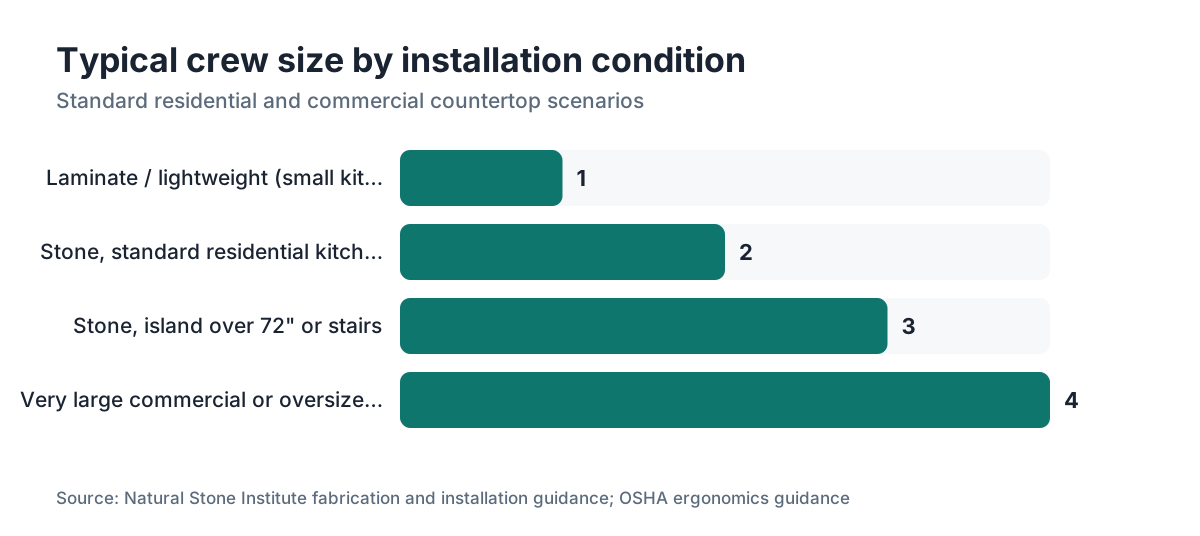
Three people get sent when the slab pieces are very large, when the carry goes up or down stairs, when an island top runs past 72 inches, or when a commercial deadline makes speed worth the labor. Any one of those is enough.
Slab size is the trigger you'll hit most. An island top at 48 by 120 inches in 1.25-inch quartz weighs around 450 to 500 pounds as a single piece. Two people can technically lift that. It's also a real injury risk, and positioning accuracy falls apart. A third person under the middle of a long piece is just good sense.
Stairs are the next trigger. A stairwell forces awkward angles that cut safe carrying capacity, and OSHA's manual handling guidance leans toward team lifts once a load or its shape passes what one person can handle cleanly [2]. Most shops add a third body for any carry that climbs or drops a full flight.
Commercial jobs run 3 or 4 people because time on site burns money. A restaurant kitchen with long runs, or a hotel renovation with 20 rooms to finish, might use rotating crews. That's not the situation most homeowners are in.
The table below matches crew size to the conditions that call for it.
How does material type affect how many installers you need?
Material weight is the biggest single variable. Here's the honest breakdown by surface.
Laminate countertops like Formica or Corian are light enough that one experienced installer can handle pieces solo. Most shops still send 2, for quality and speed, not because the weight demands it. A 3/4-inch particleboard laminate sheet runs about 4 to 5 pounds per square foot, maybe 200 to 250 pounds for a full kitchen [3].
Butcher block countertops land in the middle. A 1.5-inch hardwood top runs about 12 to 15 pounds per square foot, so a 10-foot run might be 150 to 180 pounds. Two people handle that without breaking a sweat.
Granite countertops, marble countertops, quartzite, and engineered quartz like Cambria are the heavy hitters. Figure 18 to 22 pounds per square foot for 3/4-inch, up to 28 for 1.25-inch. These are the slabs that push jobs to a 3-person crew once the pieces get big. Cut a full-height backsplash from the same stone and you add weight and handling steps.
Fragility matters too. Marble and some quartzites flex-crack during a carry if they aren't supported at multiple points. A third person isn't only about raw weight. It's about holding a 10-foot piece at the middle while the ends drop into place.
What does each person on the crew actually do?
On a standard 2-person crew, the roles are clean. The lead handles layout verification, shimming, adhesive placement, seaming, and final leveling. The helper carries, holds position, mixes epoxy, runs tools, and manages cleanup. It's a routine good shops build over hundreds of jobs.
Add a third person and their job is usually the carry assist plus dedicated tool and material running, which frees the lead and helper to focus on positioning and quality. On big commercial jobs, the third role can be full-time dry-fitting and template verification while the other two prep substrate.
Solo work is almost always limited to lightweight materials or replacement tops where the substrate is intact and pieces are small and pre-cut. Solo work on stone is genuinely dangerous and the results are worse. If a shop quotes a stone install with one person, ask them straight: how do you handle the large pieces?
How long does a typical countertop installation take?
A standard residential kitchen with a 2-person crew takes 2 to 4 hours for most stone installs. That covers carry-in, positioning, shimming, adhesive, seam work, sink cutout if it's pre-cut, and basic cleanup. Complex layouts with multiple seams, a separate island, and a full backsplash can stretch to 6 or 8 hours.
Countertop installation timelines ride on template-to-install accuracy. A shop that templates tight cuts install time hard, because pieces drop in instead of needing repeated adjustment. Shops running digital templating and CNC cutting land at the low end of those ranges routinely.
Solo installs on lightweight material run similar clock times, because the pace is set by one worker's capacity, not the weight. A single installer doing a full laminate kitchen can actually take longer than a 2-person stone crew, since one set of hands does everything.
Add roughly 30 to 60 minutes if the crew has to tear out old countertops. Most residential quotes include demo. Confirm that before install day.
Does crew size affect what you pay for installation?
Yes, but maybe not the way you'd guess. Most residential installs are quoted as a fixed job price, not an hourly rate, so crew size doesn't move your invoice line by line. Shops that habitually send 3 people to standard jobs carry higher overhead than shops sending 2, and that gap shows up somewhere in their pricing.
Crew size hits cost directly on large or complex jobs. A shop that has to add a third person for your 14-foot island or your basement bar with stairwell access typically tacks on a labor surcharge. That surcharge runs $75 to $200 in most markets, though nobody publishes a standard rate and it swings by region and shop.
For labor context, tile and stone setters had a median hourly wage in the low $20s per hour nationally per the Bureau of Labor Statistics, which is part of why an extra body on a job isn't cheap [5]. Crew size is a poor comparison metric on its own, though. A well-run 2-person crew with real systems beats a scrambling 3-person crew every time. Judge the shop on template quality, seam work from past jobs, and warranty terms.
Fabricators tracking labor by job, crew deployment, and material yield can actually see margin by job type. Software like SlabWise is built for that workflow, tying the quote stage to install scheduling so crew calls stop happening by guesswork.
Are there safety rules that govern how many people install countertops?
No federal rule says "countertop installation requires X people." OSHA covers manual lifting through its general duty clause, which requires employers to provide a workplace free of recognized hazards [7]. Repetitive heavy lifting with too few people is a recognized hazard, but the standard never names a crew size for countertop work.
The OSHA general duty clause, Section 5(a)(1), requires each employer to furnish "a place of employment which is free from recognized hazards that are causing or are likely to cause death or serious physical harm" [7]. OSHA's manual handling guidance points toward team lifts once a load passes what one person can handle safely or its size makes a solo lift awkward [2]. A single perimeter section for a standard kitchen can weigh 150 to 300 pounds. A two-person carry there is appropriate, and it's also just common sense.
State agencies sometimes add their own rules. California's Division of Occupational Safety and Health (Cal/OSHA) has a repetitive motion injury standard under Title 8 that requires employers to identify and correct repetitive and heavy-lifting hazards [4]. California shops with regular stone installation should know it.
For homeowners, the practical read is simple: if one installer shows up to set stone alone, the shop either has unusual gear (like vacuum lift equipment) or is cutting a corner on safety.
What equipment can reduce the crew size needed?
Suction cup lifters change the crew-size math more than anything else. A pair of good vacuum handles rated for 400 to 600 pounds lets 2 people lift and place pieces that would otherwise need 3. Most professional stone shops own them. Asking your fabricator whether they carry vacuum lifters is a fair question.
Pneumatic stone dollies and slab carts handle the haul from truck to work area, often the most physical part of the whole job. A cart cuts the number of people needed for transit and leaves placement as the labor-heavy step.
High-volume shops run gantry cranes and mechanical vacuum lifters that let 1 or 2 people move slabs a 4-person team would otherwise wrestle. Those are shop tools, not job-site tools, so they affect fabrication more than installation.
Here's the honest part: most residential installers don't roll up with elaborate mechanical assists. They rely on technique, communication, and the right number of bodies for the slab weight and layout. The 2-person standard sticks around because it works for the typical job without extra gear.
How should fabricators decide crew size before scheduling a job?
The template tells you nearly everything. Once it's done, the shop knows total square footage, the number and size of individual pieces, whether there's an island, whether there's a stairwell carry, and the substrate condition. That data should drive the crew call, not habit.
A basic decision rule works: any single piece over 250 pounds gets 3 people. Any carry involving stairs or an elevator gets 3 people. Any island top over 72 inches long gets 3 people. Everything else is 2.
Some shops bake this into their scheduling workflow. Others lean on the lead installer's judgment, which is fine with seasoned leads and fails hard without them. If your shop is growing and newer leads are making the calls, write the rules down. It takes 20 minutes and saves arguments.
Profitability also depends on not over-crewing. Sending 3 people to a standard 40-square-foot kitchen is a straight labor loss. Shops tracking crew hours against job revenue catch that pattern. Shops that don't keep wondering why labor costs creep. Tools that connect quoting to scheduling and job costing, like the workflow in SlabWise, surface those patterns before they compound.
What questions should homeowners ask about the installation crew?
You don't need to quiz the shop on crew theory. A few practical questions tell you what matters.
First: how many people will be on site for my install? If the answer is one and you're getting stone, ask how they handle large pieces safely. A good shop explains its process, whether that's suction equipment or smaller pre-cut pieces.
Second: does the quote include removing my existing countertops, and how does that change the crew and timing? Demo adds time, and sometimes a third person if there's heavy old material to pull out.
Third: what happens if a piece gets damaged or doesn't fit during install? Knowing the callback policy and whether they keep extra material on hand tells you more about the operation than crew size does.
You can also just watch. A professional 2-person stone crew works in a rhythm. They aren't rushing, they're talking to each other, and they're not dragging material across the floor. That rhythm comes from reps. If the crew looks unsure about how to carry a piece or where to set it, that's a flag no matter how many people showed up.
How does crew size differ between residential and commercial countertop jobs?
Commercial installs almost always run larger crews, for plain reasons. Speed matters more. A restaurant under renovation loses revenue every day it's dark, so a 3 or 4-person crew that finishes the kitchen counters in one day instead of two is worth the extra labor.
Volume changes things too. A hotel or office project with dozens of identical units often runs crews of 3 to 5 in a relay: one team prepping substrate, another following with placement, another doing seams and finish. That's assembly-line logic aimed at stone.
For kitchen countertops in residential construction, especially production builders working tract neighborhoods, you'll see 2-person crews moving through several homes a day. The template-to-install process is tuned for repetition, pieces come pre-cut to spec, and the 2-person standard holds even at volume.
Material shifts by sector as well. Commercial jobs lean on laminate more often to control cost, which pushes toward smaller crews. High-end hospitality uses the same stone as luxury residential, so the weight and complexity math is identical.
Frequently asked questions
Can one person install countertops alone?
Yes, for lightweight materials. A solo installer can handle laminate, thin solid-surface panels, and small replacement pieces without help. For stone, a solo install is possible with vacuum suction equipment and small piece sizes, but it's uncommon and not recommended for full kitchens. Most professional stone shops send at least 2 people for any natural or engineered stone job.
How long does a 2-person crew take to install kitchen countertops?
Most standard kitchen installs take 2 to 4 hours with a 2-person crew. That covers carry-in, positioning, shimming, adhesive, seaming, and basic cleanup. Kitchens with multiple seams, a separate island, or a full-height stone backsplash can run 5 to 8 hours. Complex layouts or tough access add time no matter the crew size.
Does a bigger crew mean better installation quality?
Not automatically. Quality comes from skill and preparation, not headcount. A well-trained 2-person crew with precise templates beats a disorganized 3-person crew most of the time. The cases where more people improve quality are physical: large piece carries where a third person prevents flex-cracking or positioning errors that would ruin a seam.
Why do some countertop quotes include a crew size surcharge?
When a job needs 3 people instead of the standard 2, the shop's labor cost rises by roughly 50% for that install. Many shops absorb it on borderline jobs but add a surcharge for clearly oversized situations: second-floor carries, very long island tops, or commercial timelines. The surcharge typically runs $75 to $200 and should be itemized in the quote.
What is a lead installer vs. a helper on a countertop crew?
The lead makes all the layout, shimming, adhesive, and seam decisions and owns the final result. The helper carries, holds pieces in position, mixes adhesive, passes tools, and manages cleanup. On a well-run crew, the helper anticipates the lead's needs without being told. Both roles need experience; a truly green helper slows the whole job down.
Do fabricators charge more for upstairs countertop installation?
Most fabricators add a surcharge for any carry involving stairs, up or down. It reflects the added labor, time, and injury risk, and it often triggers a third crew member, which is another labor cost. Some shops build stairwell surcharges into standard pricing; others add them as a line item after templating confirms the access. Always ask.
How much does countertop installation labor cost per square foot?
Labor for stone countertop installation typically runs $10 to $30 per square foot, separate from material. That range moves with region, material complexity, and access difficulty. Some shops quote a flat install fee per job. Laminate labor is generally lower, often $5 to $15 per square foot, since the material is lighter and faster to work.
Are there OSHA rules about how many people need to install countertops?
No specific OSHA regulation names a crew size for countertop work. OSHA's general duty clause requires employers to protect workers from recognized hazards, including heavy lifting risks. OSHA manual handling guidance points toward team lifts for loads that exceed safe single-person capacity or have awkward shapes. For stone slabs at 150 to 400 pounds, a 2-person minimum is both safe practice and common sense.
What's the crew size for installing an oversized island countertop?
Any island top over roughly 72 inches long or 400 pounds typically gets a 3-person crew. A very large island, say 48 by 144 inches in 1.25-inch quartz, can weigh 600 pounds or more and may warrant 4 people. The risk on oversized pieces is flex-cracking during the carry and seam errors at placement. Most shops recognize this and crew up.
How does crew size affect countertop installation scheduling?
Shops assign crews after templating, once they know the actual piece sizes and complexity. A 2-person crew can typically handle 2 to 3 residential jobs in a day. Adding a third person pulls them off another crew or another job. Shops that template precisely and plan assignments ahead run tighter schedules and see fewer callbacks.
Does the type of countertop material change how many installers are needed?
Yes, directly. Laminate and solid-surface materials can often be set by 1 or 2 people because they weigh less. Stone materials, including granite, marble, quartzite, and engineered quartz, almost always need 2 people minimum and can push to 3 on large pieces. Butcher block sits in between. Weight per square foot is the main driver.
What tools do countertop installers bring to a job site?
A standard stone crew brings suction cup lifters, a level, shims, epoxy or silicone adhesive, a grinder or oscillating tool for minor adjustments, color-matched seam filler, a router for final sink cutout if it isn't pre-cut, and cleaning supplies. Some crews bring a laser level for precise leveling. The template and pre-cut pieces should do most of the heavy work before the crew arrives.
Sources
- Natural Stone Institute (formerly Marble Institute of America), technical resources: Granite and natural stone slabs weigh approximately 18 to 22 pounds per square foot for 3/4-inch thickness, used to estimate total slab weight for a typical kitchen installation.
- U.S. Occupational Safety and Health Administration, ergonomics guidance: OSHA manual handling guidance points toward team lifts for loads that exceed safe single-person capacity, applicable to heavy stone slab carries.
- APA - The Engineered Wood Association, panel weight data: Standard 3/4-inch particleboard and laminate substrate panels weigh approximately 4 to 5 pounds per square foot, informing laminate countertop weight estimates.
- California Division of Occupational Safety and Health (Cal/OSHA), Title 8 repetitive motion injury standard: Cal/OSHA Title 8 requires employers to identify and correct repetitive motion and heavy lifting hazards, applicable to stone countertop installation crews in California.
- U.S. Bureau of Labor Statistics, Occupational Employment and Wage Statistics: BLS occupational data for tile and stone setters provides wage and employment context for countertop installation labor cost ranges.
- National Kitchen and Bath Association (NKBA), design standards: NKBA guidelines address standard countertop dimensions and layout complexity relevant to estimating installation time and crew requirements.
- U.S. Department of Labor, OSHA General Duty Clause, Section 5(a)(1) of the OSH Act: Employers must furnish a workplace free from recognized hazards likely to cause death or serious physical harm; applies to crew-size decisions involving heavy stone carries.
- Natural Stone Institute, fabrication and installation guidance: Industry guidance on handling stone slabs recommends multi-person lifts and suction equipment for pieces above safe manual carry thresholds.
- Natural Stone Institute, safety and health technical resources: Stone industry technical resources address the physical risks of carrying large stone pieces and the role of vacuum lifting equipment in reducing crew size requirements.
- U.S. Bureau of Labor Statistics, National Compensation Survey: BLS compensation and requirements survey data provides context for installation labor cost ranges by region and trade category.
Last updated 2026-07-11