TL;DR
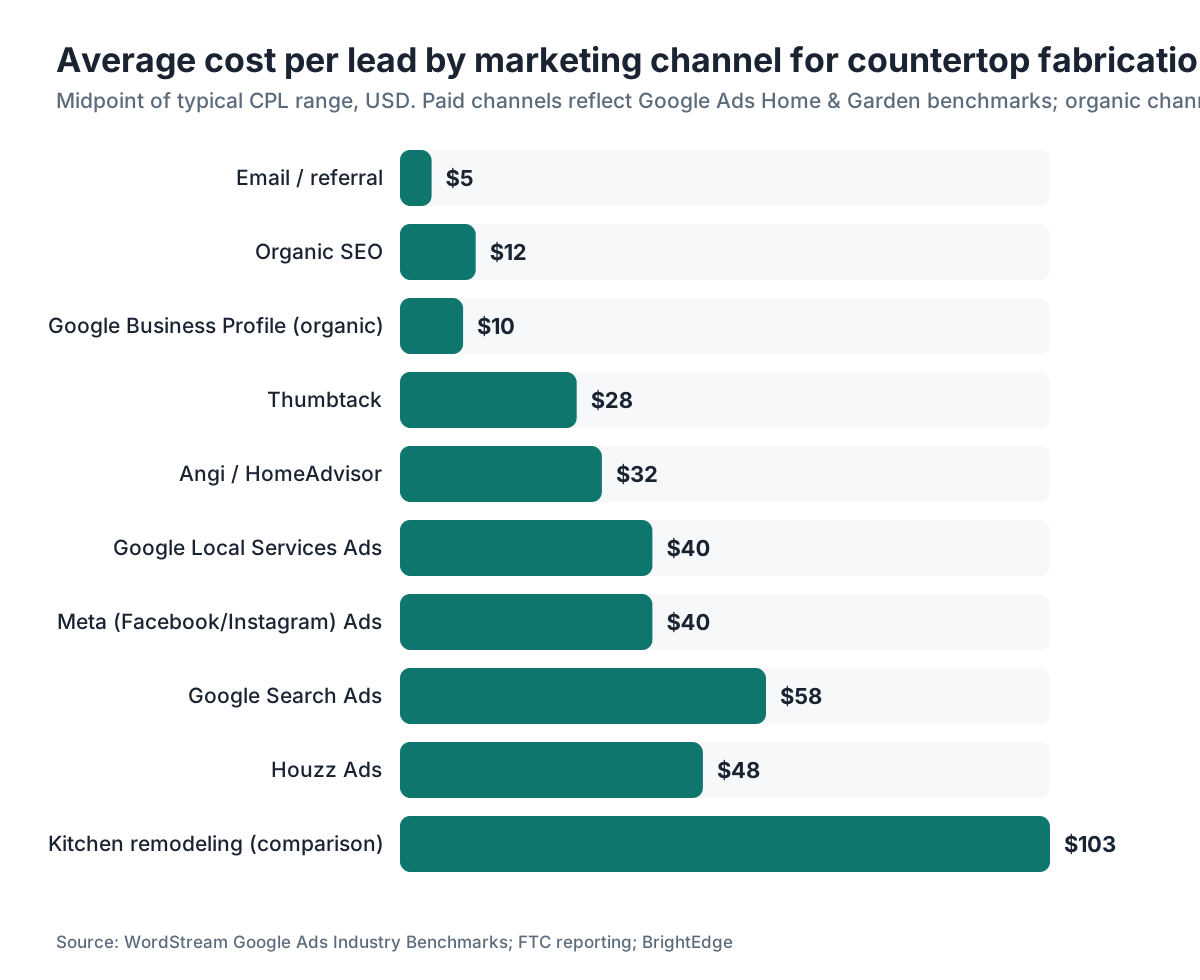
- Countertop fabrication shops typically pay $18 to $120 per lead, with Google Search Ads landing in the $35, $80 range, Local Services Ads closer to $25, $55, and lead-resale platforms like Angi or Thumbtack running $18, $45 per shared lead.
- Organic SEO and referrals cost far less per lead once established, but they take months to build.
- Channel mix matters more than any single number.
What does 'cost per lead' actually mean for a countertop shop?
Cost per lead (CPL) is your total marketing spend divided by the number of leads that spending generated. Spend $1,500 on Google Ads in a month and get 30 phone calls or form fills, and your CPL on that channel is $50. Simple math. The number hides a lot.
The tricky part is defining a lead. A phone call that lasted 8 seconds is not the same lead as someone who submitted a countertop quote request with measurements. Most Google Ads conversion tracking counts any call over 30 or 60 seconds, which can inflate lead counts and make your CPL look better than it is. On the other end, lead-resale platforms count a lead the moment they sell your contact info to a homeowner, whether the homeowner ever responds to you or not.
For a fabrication shop, a qualified lead is someone actively pricing a countertop project with a realistic timeline (usually within 90 days) and a home or project that can physically receive a countertop. Keep that definition consistent when you calculate CPL, or you'll make bad channel decisions based on apples-to-oranges comparisons.
CPL is also not the same as cost per acquisition (CPA). A lead that costs $35 and closes 40% of the time is more profitable than a lead that costs $15 and closes 8% of the time. Shops that chase only cheap leads often end up buried in tire-kickers.
What is the average CPL for countertop fabrication by channel?
No single industry survey publishes fabrication-specific CPL by channel. What follows pulls from Google's own benchmarks for the Home & Garden category, WordStream's annual paid search reports, and firsthand data shared in fabricator forums and trade publications. Treat these as directional ranges, not promises.
| Channel | Typical CPL range | Lead quality | Notes |
|---|---|---|---|
| Google Search Ads (non-branded) | $35, $80 | Medium, High | Competitive in metro areas; CPC can hit $8, $18 [1] |
| Google Local Services Ads (LSA) | $25, $55 | High | Pay-per-lead model; leads are phone calls only |
| Google Business Profile (organic) | $5, $15 est. | High | Indirect; hard to track precisely |
| Meta (Facebook/Instagram) Ads | $20, $60 | Medium | Demand generation, not capture; lower intent |
| Angi / HomeAdvisor | $18, $45 | Low, Medium | Shared leads; sold to multiple contractors [2] |
| Thumbtack | $15, $40 | Low, Medium | Pay-to-quote model; varies by market |
| Houzz Ads | $25, $70 | Medium | Higher-income demographic; slower volume |
| Organic SEO | $3, $20 est. | High | Amortized cost over time; takes 6 to 18 months [3] |
| Email / past-customer referral | $2, $8 est. | Very High | Lowest CPL of any channel |
Paid search CPL for home services broadly averaged around $66 in WordStream's Home & Garden benchmarks [1]. Fabrication skews slightly lower than full kitchen remodeling because the average ticket is smaller, so competition on countertop terms is a bit less fierce than on "kitchen remodel near me."
Google's Local Services Ads work on a verified, pay-per-lead basis. Google charges you only when a customer contacts you through the ad. Lead generation platforms vary widely in their verification standards, and the FTC has taken action against companies that misrepresented lead quality to service providers [4], which is worth knowing before you commit budget.
Why do countertop leads cost more in some markets than others?
Geography is the single biggest variable. CPL in a market like Phoenix or Dallas, where dozens of active fabrication shops all bid on the same keywords, runs 40 to 60% higher than in a mid-size market like Boise or Tulsa. Google Ads auctions are real-time competitive bidding, so wherever more competitors fight for attention, everyone pays more [1].
Season matters too. The countertop business peaks in spring (March through May) and again in early fall. During those windows, CPL on paid search can jump 20 to 35% because more shops run campaigns at once and homeowners are actively searching. Launch paid advertising in January or August and you'll get cheaper CPL while you learn what converts.
Project type affects lead quality, which sets what CPL you should be willing to pay. A lead for a full kitchen gut-rehab with 60 square feet of quartz is worth more than a lead for a single bathroom vanity top, so your tolerable CPL scales with average ticket size. A shop averaging $4,500 per job can afford a higher CPL than one averaging $1,800.
Your website's conversion rate matters as much as what you pay per click. Two shops both pay $6 per click on Google. Shop A converts 8% of clicks to leads, Shop B converts 3%. Shop A's CPL is $75. Shop B pays $200 for the same clicks. The industry average landing page conversion rate for home services is around 3 to 5% [1], but well-built countertop pages with instant pricing or a fast quote form reach 8 to 12%.
How much should a countertop fabricator spend to acquire a customer?
Work backward from your economics. The formula most fabrication shops should use:
Max tolerable CPL = (Average job revenue x Gross margin %) x Target marketing cost %
Say your average countertop job is $4,200, your gross margin after materials and labor is 40%, and you're comfortable spending 15% of gross profit on marketing for a new customer. That's $4,200 x 0.40 x 0.15 = $252 maximum you can spend to acquire a paying customer. If your close rate on leads is 35%, your max CPL is $252 x 0.35 = $88.
That math shows a lot of shops leave money on the table by setting arbitrary CPL caps of $30 or $40 when their economics could justify $70, $90, especially for higher-ticket jobs. The reverse is also true: shops running vanity top or laminate work at thin margins have much less room to pay for leads.
The Small Business Administration points to marketing budgets in the single-digit-to-low-teens percent of revenue for growing small businesses [5]. In fabrication, most shops land somewhere between 5% and 12% of gross revenue on marketing, with the higher end typical for shops actively pushing to grow.
Close rate improvement is the most overlooked lever. Cutting CPL from $60 to $45 is hard. Improving close rate from 30% to 40% through faster response times and better follow-up is often achievable in 60 days, and it has the same effect on your cost per job.
Is buying leads from Angi, Thumbtack, or HomeAdvisor worth it for fabricators?
Shared lead platforms are a recurring argument in fabricator communities, and the honest answer is it depends on how fast you respond and how realistic your expectations are.
Angi (which merged with HomeAdvisor in 2021) sells the same lead to several contractors at once [2]. The FTC reached a settlement with HomeAdvisor in 2022 over allegations that it sold leads that did not match what providers were promised, resulting in a $7.2 million payment to affected service providers [4]. That settlement doesn't make the platform useless today, but it tells you what can go wrong when you outsource your lead quality to a third party.
If you buy shared leads, response time is everything. Harvard Business Review research found that firms contacting web leads within an hour were far more likely to reach a decision-maker, and the odds drop sharply the longer you wait [6]. On a shared lead, every minute you wait is time your competitor is on the phone with the homeowner.
Shared platforms can work for a new shop with no organic presence and no ad account history yet. A $25 Angi lead that closes 12% of the time costs you $208 per acquired customer. Not great, but it's real revenue while you build other channels. Once you have Google reviews, an established Google Business Profile, and a converting website, you can usually get your CPL lower through owned channels.
For shops doing granite countertops or premium marble countertops with higher average tickets, the economics of shared leads are more forgiving. For budget-tier laminate countertops or formica countertops jobs, thin margins make shared leads hard to justify.
How do Google Local Services Ads compare to regular Google Ads for fabricators?
Local Services Ads (LSA) sit above regular paid search results and show your business name, rating, and a "Google Guaranteed" or "Google Screened" badge. You pay per lead (phone call or message), not per click, and Google vets you through a background check and license verification before you can run them [7].
The Google Guaranteed badge matters for home services. It tells homeowners that Google has verified your business and that Google will reimburse the customer up to a set limit if the job goes wrong. That trust signal can lift your conversion rate meaningfully compared to a plain text ad.
LSA leads for countertop and stone work typically run $25, $55 per lead according to practitioners in the stone fabrication community, though Google sets prices algorithmically and they shift by market and season. You set a weekly budget and pause campaigns easily, which makes LSA a good first paid channel for shops that have never run Google Ads.
The downside is limited control. You can't target specific keywords, write custom ad copy, or send traffic to a landing page you choose. You also can't run retargeting through LSA. Standard Google Search campaigns give you that flexibility at the cost of managing keyword bids and quality scores.
Many shops run both. LSA catches the Google-verified, high-intent searchers at a predictable CPL. Standard Search picks up longer-tail queries and lets you highlight specific materials like quartz, cambria countertops, or corian countertops that convert at different price points.
What is a realistic CPL target for a countertop shop using organic SEO?
Organic SEO doesn't have a clean per-lead cost the way paid ads do, because the cost is front-loaded (writing content, building links, optimizing your Google Business Profile) and the leads come later and keep coming without extra spend. To estimate SEO CPL, take your total monthly SEO spend (agency retainer, content costs, tools) and divide by leads attributed to organic search.
A fabrication shop spending $1,500/month on SEO that generates 40 organic leads per month after 12 months of work has a CPL of $37.50. In month 3 it might generate only 5 leads at an apparent CPL of $300, which looks terrible. SEO CPL is only meaningful measured over at least 6 months.
BrightEdge research has found that organic search drives 53% of all website traffic on average across industries [3]. For home services, local search intent is extremely high, so Google Business Profile optimization and local landing pages for the neighborhoods or cities you serve can generate leads at very low marginal cost once the infrastructure is in place.
The content that drives countertop leads organically is mostly project-education content: how much does quartz cost, how to compare materials, what to expect during countertop installation. Homeowners doing that research are often 2 to 6 weeks from buying. Pages that answer those questions and include a fast quote form convert well.
SEO and paid ads work together. Shops that rank organically for a term and run a paid ad for the same term see higher overall click-through rates than either channel alone, because dual presence signals authority.
How does close rate affect what your leads actually cost per job?
This is the number most fabrication shops track least and it matters most. CPL is a marketing metric. Cost per acquired job is a business metric. The link between them is your close rate.
A $45 CPL at a 40% close rate means your cost per job is $112.50. Let CPL creep to $65, but invest in faster response, better follow-up, and an instant quoting tool that gives homeowners a real number in under 2 minutes, and push your close rate to 55%, and your cost per job is $118. Nearly identical outcome. The second shop is doing more volume and probably making more revenue.
Close rate in countertop fabrication varies widely. Shops that respond within 5 minutes, give an accurate quote during the first call or visit, and follow up twice in the first week tend to close 35 to 50% of qualified leads. Shops that take 48 to 72 hours to respond and require an in-home measure before giving any number often close below 20%.
Quote speed is where a lot of shops bleed revenue without realizing it. Homeowners contacting 3 to 4 shops at once often just go with whoever responds fastest with a real number. Tools that let you generate a preliminary quote from a photo or floor plan, even a range estimate, keep you in the conversation. SlabWise's quoting software is built around exactly this problem, letting shops generate a quote in minutes rather than days. That kind of speed improvement usually shows up in close rate within the first month.
Track your leads in a simple spreadsheet at minimum: source, date, response time, quote sent, follow-up dates, won/lost, and reason lost. Even 90 days of that data tells you more than any industry benchmark.
What CPL benchmarks exist for home services broadly, and how does countertop fabrication compare?
WordStream publishes annual Google Ads benchmark reports with CPL data by industry. Its Home & Garden category (the closest proxy for countertop fabrication) shows average CPLs around $65 for Google Search, with a wide spread because the category includes everything from lawn care to kitchen renovation [1].
For context, here are CPLs from adjacent home services categories (WordStream Home & Garden benchmarks) [1]:
| Home service category | Avg. CPL (Google Ads) |
|---|---|
| Home & Garden (broad) | ~$65 |
| HVAC | ~$75, $90 |
| Plumbing | ~$60, $85 |
| Flooring | ~$45, $65 |
| Kitchen remodeling | ~$85, $120 |
| Countertops (est.) | ~$35, $80 |
Countertop fabrication sits in the middle of the home services spectrum. It's more competitive than flooring (lower average ticket) but less than full kitchen remodeling (bigger scope, more players). The Google Ads average click-through rate for home services is around 4 to 5%, and average conversion rate is 3 to 5% [1], so a shop needs roughly 400 to 700 clicks to generate 20 leads at those average rates.
The BrightLocal Local Consumer Review Survey found that 87% of consumers used Google to evaluate local businesses in 2022 [8]. For fabricators, that confirms Google is the right primary channel, and it also means everyone is there competing for the same eyeballs.
How can a fabrication shop lower its cost per lead without cutting budget?
Better targeting beats bigger budget almost every time. Here are the highest-leverage moves, ranked by how quickly they produce results.
First, add negative keywords to your Google Ads campaigns. Countertop searches bring a lot of junk traffic: people searching for countertop microwaves, countertop dishwashers, DIY tutorials, and rental property queries. Adding negative keywords like "microwave," "portable," "rental," and "how to install yourself" can cut wasted spend by 15 to 30% and drop CPL without touching your real budget.
Second, improve your landing page. The single highest-return change most shops can make is putting a real phone number and a fast quote form above the fold. A/B testing landing pages is worth doing if you have enough traffic (at least 500 monthly clicks per page). A 2-point improvement in conversion rate on a page getting 300 clicks a month at $7 CPC is roughly $420/month in recovered budget.
Third, run ads at the right times. Most countertop decisions happen Tuesday through Saturday during business hours. Running ads 24/7 and paying for 2 a.m. clicks that nobody converts is a common waste. Google Ads ad scheduling lets you reduce bids or pause entirely during low-converting hours.
Fourth, use call tracking. If you can't tell which leads came from which channel, you're making budget decisions blind. CallRail, CallTrackingMetrics, and similar tools cost $50, $150 per month and immediately clarify which channels actually produce calls versus which just look good in impressions data.
Fifth, ask every customer how they found you. Survey data is imperfect, but over time it reveals which channels produce your best customers, more than your cheapest leads. Some shops find their $80 Google Ads leads are their most loyal repeat customers, while their $20 Angi leads are price-shoppers who never come back.
What should a new fabrication shop expect to spend before leads become consistent?
The ramp-up period is the hardest part to budget for, because CPL is highest when your account is newest, your Google Ads Quality Score is lowest, and your organic presence doesn't exist yet.
For paid search, expect the first 60 to 90 days to cost 30 to 50% more per lead than your eventual steady-state CPL. Google's auction algorithm rewards accounts with strong history, good Quality Scores, and relevant landing pages. A new account bidding against an established competitor pays more for the same ad position [1]. Budget for that learning tax.
For Local Services Ads, the ramp is faster because Google vets you and then starts sending leads within days of approval. The catch is that new LSA accounts with no reviews don't rank as well as established ones. Getting your first 5 to 10 Google reviews is the fastest way to improve LSA ranking and CPL at the same time.
For organic SEO, Google's own guidance is that SEO changes can take months to show effect, and new sites competing in established local markets often take longer [9]. Content you publish today often won't generate meaningful traffic for 6 to 9 months. That's why shops should start SEO alongside paid ads, not instead of them.
A reasonable first-year marketing budget for a new fabrication shop trying to generate consistent lead flow might look like: $2,000, $3,500/month on Google Ads and LSA combined, $500, $1,500/month on content and SEO infrastructure, and $300, $600/month on reputation management and review generation. That's $2,800, $5,600/month, which should produce 40 to 100 leads/month depending on market, enough for a one- or two-person shop to stay busy while building organic equity.
For shops doing kitchen countertops specifically, where the average ticket is highest, that marketing spend is usually justified within the first quarter.
Frequently asked questions
What is a good cost per lead for a countertop fabricator?
A CPL below $50 from Google Ads or LSA is solid performance in most markets. What really matters is cost per acquired job. If your average job is $4,000+ and you close 35% of leads, you can profitably pay $80, $100 per lead. For budget countertop work with thin margins, you need CPL under $30 to make the math work. Always back into your target CPL from your margin and close rate, not from a competitor's number.
How much do Google Local Services Ads cost per lead for countertops?
Google Local Services Ads for countertop and stone work typically cost $25, $55 per verified lead, though Google sets prices algorithmically and they shift by market and season. You only pay when a customer contacts you directly through the ad. The Google Guaranteed badge that comes with LSA tends to lift conversion rates, making the effective cost per acquired customer better than the raw CPL suggests.
Are Angi or HomeAdvisor leads worth buying for countertop shops?
They can work for a shop with no organic presence yet, but go in clear-eyed. Angi sells the same lead to several contractors, and the FTC reached a $7.2 million settlement with HomeAdvisor in 2022 over lead quality issues. If you use these platforms, respond within 5 minutes. Speed is your only competitive edge when the homeowner is simultaneously fielding calls from your competitors.
How do I calculate my own cost per lead?
Take your total spend on a given channel in a month and divide it by the number of qualified leads that channel produced. Use a consistent definition of qualified, such as a phone call over 60 seconds or a form fill that includes contact info and a project description. Track CPL separately by channel so you know which ones are actually working rather than looking at blended averages that hide poor performers.
What is the average Google Ads click cost for countertop keywords?
Countertop-related keywords on Google Search typically cost $6, $18 per click in competitive metro markets, based on WordStream's Home & Garden benchmarks and industry practitioner data. Branded material terms like 'quartz countertops near me' tend to run $8, $15. More competitive markets like Los Angeles, Miami, or Dallas push toward the top of that range. Rural or smaller markets often see CPCs of $4, $8.
How does close rate affect cost per acquired countertop job?
Directly and dramatically. A $50 CPL with a 20% close rate means you're spending $250 per job won. The same $50 CPL with a 40% close rate is $125 per job. Faster response times, accurate preliminary quotes, and consistent follow-up are the highest-leverage ways to improve close rate. Many fabrication shops can double their close rate without spending a dollar more on advertising.
Is organic SEO cheaper than paid ads for countertop fabrication?
Long-term, yes. Once established, organic leads often cost $3, $20 each when you amortize your SEO spending over steady-state traffic. But it takes 6 to 18 months to reach that state. In the first year, SEO is not cheaper; it's an investment in future leads. Most shops should run paid ads during the SEO ramp-up so they have lead flow while the organic engine builds.
How many leads does a countertop shop typically need per month?
It depends on your capacity and close rate. A single-fabricator shop doing $40,000, $60,000 in monthly revenue at an average job size of $4,000 needs roughly 10 to 15 new jobs per month. At a 35% close rate, that requires 30 to 45 qualified leads. A larger shop with 3 to 5 fabricators and $150,000 in monthly revenue might need 80 to 120 leads to stay at capacity, assuming a similar close rate.
What channels produce the highest-quality leads for countertop fabricators?
Referrals from past customers and contractor partners consistently produce the highest close rates and lowest CPL. After referrals, Google Local Services Ads and organic Google search produce leads with the strongest purchase intent. Facebook and Instagram ads generate awareness but lower intent; homeowners who click those ads are often earlier in the decision process and require more nurturing before they're ready to buy.
Should a countertop shop use a CRM to track leads?
Yes, even a basic one. At minimum, track source, date received, response time, quote status, and won/lost with reason. Without this, you're guessing about which channels work and which don't. Free tools like HubSpot CRM or even a Google Sheet will do the job for a shop under $1M in revenue. Purpose-built quoting and job management tools designed for fabricators often include lead tracking built in.
How does response time affect countertop lead conversion?
Dramatically. Harvard Business Review research found that firms contacting web leads within an hour were far more likely to reach a decision-maker than those who waited longer, and the odds fall off fast with each hour of delay. In countertop fabrication, where homeowners often contact 3 to 4 shops at once, being first to respond with a real number or a scheduled appointment wins the job before the homeowner finishes their search.
What percentage of revenue should a countertop fabricator spend on marketing?
The SBA points to single-digit-to-low-teens percentages of revenue for growing small businesses. In countertop fabrication, most shops land between 5% and 12% of gross revenue, with newer or faster-growing shops at the higher end. A shop at 5% that's fully booked through referrals is in great shape. A shop trying to add $500,000 in new revenue should expect to invest closer to 10 to 12% until the pipeline matures.
Do countertop material type or ticket size affect what CPL a shop should target?
Absolutely. A shop specializing in high-end natural stone with average jobs over $8,000 can justify a CPL of $100, $150 and still have healthy unit economics. A shop doing entry-level countertops at $1,500 average needs CPL under $30 to remain profitable. Match your CPL target to your gross margin per job, not to industry averages that mix shops across every price tier.
How can I track which marketing channel is generating my countertop leads?
Use unique phone numbers per channel through a call tracking service like CallRail or CallTrackingMetrics ($50, $150/month). Pair that with UTM parameters on all digital ads and a simple intake question ('How did you hear about us?') on every quote form. No single tracking method is perfect, but combining call tracking, UTM data, and self-reported source gives you a reliable enough picture to make channel budget decisions.
Sources
- WordStream, Google Ads Industry Benchmarks for Home & Garden: Average CPL for Home & Garden category on Google Ads is approximately $65; average CTR is 4 to 5% and conversion rate is 3 to 5%
- Angi (formerly Angie's List / HomeAdvisor), How Angi Leads Work: Angi sells leads to multiple service providers; shared leads are distributed to several contractors simultaneously
- BrightEdge, Organic Search vs. Paid: Organic Commands 53% of Traffic: Organic search drives 53% of all website traffic on average across industries
- Federal Trade Commission, consumer protection actions and press releases: FTC reached a $7.2 million settlement with HomeAdvisor in 2022 over allegations of misrepresented lead quality; lead generation platforms vary widely in verification standards
- U.S. Small Business Administration, business guide: SBA guidance points to marketing budgets in the single-digit-to-low-teens percent of revenue for growing small businesses
- Harvard Business Review, The Short Life of Online Sales Leads: Firms contacting web leads within an hour were far more likely to reach a decision-maker; odds drop sharply the longer the response is delayed
- Google, Local Services Ads Help Center: Google Local Services Ads operate on a pay-per-lead model and require background check and license verification for Google Guaranteed badge
- BrightLocal, Local Consumer Review Survey 2022: 87% of consumers used Google to evaluate local businesses in 2022
- Google Search Central, SEO documentation: Google's documentation indicates SEO changes can take months to show effect, and new sites in competitive markets often take longer
- Federal Trade Commission, advertising and endorsement guidance: FTC regulates endorsement and lead generation transparency requirements for businesses operating in U.S. markets
Last updated 2026-07-11