TL;DR
- Digital templating systems, using laser or structured-light scanners, hold positional accuracy within ±1/32 inch (0.8 mm), and the best probe arms reach ±1/64 inch (0.4 mm).
- Hand cardboard templates run ±1/8 inch or worse.
- That gap decides everything for stone: a 1/16-inch misread on a sink cutout or range can cost you a whole slab.
What does 'accuracy tolerance' actually mean for digital templates?
Tolerance is the biggest allowable gap between what the template says and what the room actually looks like. In countertop work, that boils down to one question: how close is the digital file's edge line to the real finished wall, cabinet edge, or sink rim?
Two numbers matter here. Dimensional accuracy is how faithfully the system captures a straight-line distance, like the run from one corner to another. Positional accuracy is how well it places every point relative to a fixed origin, and that error compounds across longer runs. A system might hold ±1/64 inch on a 12-inch span, then drift to ±3/32 inch across a 20-foot L-kitchen if its registration slips.
When a shop tells you their digital template is accurate to ±1/32 inch, ask which number they mean. Most are quoting dimensional accuracy on short spans. That is an honest benchmark. Long kitchens still deserve a second look.
What tolerance do digital countertop templating systems actually achieve?
Two technologies dominate job sites today. Laser distance systems (the Prodim Proliner is the best known) and structured-light or photogrammetry systems (Slabsmith, or iPad apps built on LiDAR). Their real-world specs are not the same.
| System type | Stated accuracy | Span | Source |
|---|---|---|---|
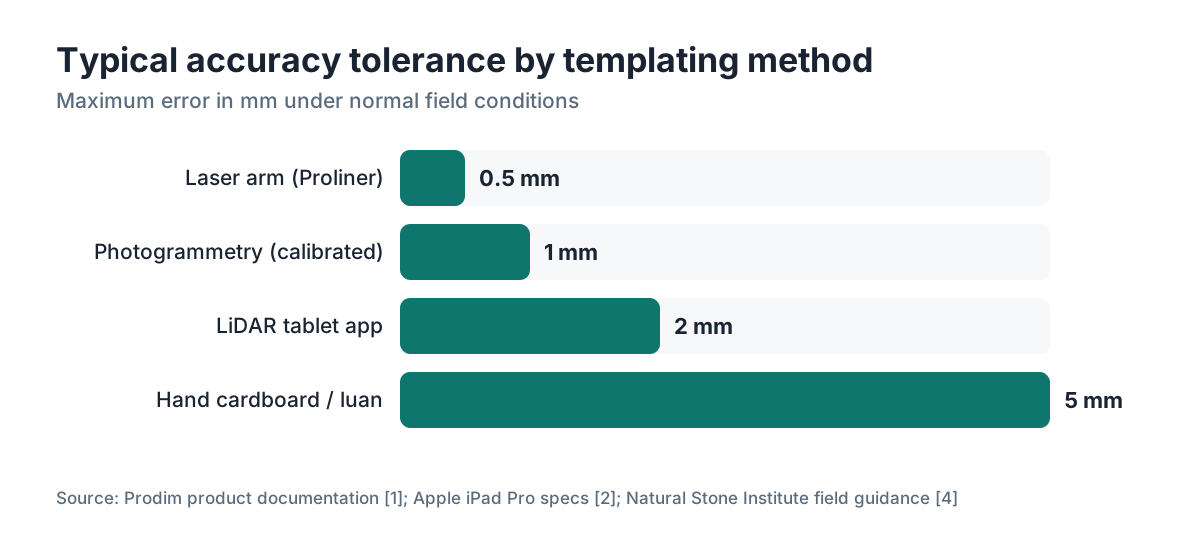
| Laser arm (Proliner style) | ±0.5 mm (≈±1/64 in) | Full room | Prodim product documentation [1] |
| Structured light / LiDAR tablet | ±1 to 2 mm (±1/32 to 3/32 in) | Up to 10 ft | |
| Photogrammetry (multi-photo) | ±0.5 to 1 mm at calibrated scale | Full room | |
| Hand cardboard / luan template | ±3 to 6 mm (±1/8 to 1/4 in) | Any span | Industry field experience |
The Proliner uses a physical probe arm with rotary encoders, and it shows up in trade discussions as the accuracy benchmark. Its maker lists measurement uncertainty at ±0.5 mm [1]. LiDAR tablets need software compensation to hit sub-2 mm accuracy for fabrication. Apple's iPad Pro carries a LiDAR scanner with a 5-meter range, rated by Apple at roughly ±1 cm for room-scale scanning [2], so the countertop apps built on it have to do real work to tighten that up. Purpose-built apps claim ±1 mm after their own calibration routines, but independent verification of those claims is thin.
Photogrammetry lives or dies on operator discipline. Shoot enough overlapping photos, set a calibrated scale bar, and it rivals the Proliner. Get sloppy, and error climbs past 3 mm and lands as misaligned seams.
How does digital accuracy compare to hand-cut cardboard templates?
Cardboard and luan (thin plywood) hand templates have been the standard for decades. They still work. But they stack up error sources fast: cutting a curved wall with a jigsaw leaves a ragged edge, scribing adds another 1/16 inch of guesswork, and the template shifts shape if it gets wet or bakes in a hot truck.
Field consensus puts hand template error at ±1/8 inch (3 mm) on a good day, worse on long runs or complex shapes. A careful, methodical templater can hold ±1/16 inch. One distracted moment or one warped piece of luan erases that.
Digital templates delete those mechanical error sources. The template is a file, not a physical object. It doesn't warp. It goes from the field to the CNC router with nobody re-tracing anything by hand. That alone removes a full category of transcription error.
On a 96-inch kitchen run, the difference between ±1/8 inch and ±1/32 inch sounds trivial. On a full slab of granite countertops or marble countertops, that same gap between template and wall reads as either a clean scribe line or an ugly gap you can't patch.
Why does ±1/32 inch matter so much in stone fabrication?
Stone punishes error in a way laminate countertops and butcher block countertops do not. You can trim butcher block on site. You can route laminate at the job. You cannot trim a granite slab in a kitchen without the right rig, and field-cutting stone invites cracks near cutouts and chewed-up finishes.
Three spots where template tolerance bites hardest:
-
Sink cutouts. A cutout 1/8 inch too large exposes the undermount sink rim. A cutout 1/8 inch too small means the stone physically won't drop into place.
-
Wall-to-stone scribe. A 3/32-inch gap against a painted wall is visible from where you stand at the counter. Caulk hides gaps up to about 3/16 inch convincingly. Wider than that calls for a recessed scribing strip.
-
Seam alignment. When two slabs meet, a 1/16-inch mismatch in the template throws off the veins and edge profiles, and no amount of careful installation saves a bad cut.
For countertop installation, the rule most fabricators live by is simple: template error has to be less than half the caulk joint width you plan to run. A 1/8-inch caulk joint tolerates up to 1/16-inch template error. A dry-set install with no caulk tolerates almost nothing.
What factors cause digital templates to drift from their rated accuracy?
Every digital templating system has a rated spec and a real-world result. The gap between the two comes from a short, predictable list.
Registration drift is the big one for laser arm systems. If the reference point moves mid-measurement because someone bumped the tripod or the floor flexed, every point after that is offset by the same amount. Good systems detect and flag registration events. Cheap ones don't.
Surface reflectivity trips up structured-light and LiDAR systems. High-gloss tile, mirrors, and stainless appliances scatter the signal. Matte surfaces read well, matte cabinets read great. The trouble clusters around shiny backsplashes and chrome fixtures.
Calibration frequency matters more than most shops admit. Laser arm probes accumulate encoder wear. A system that left the factory at ±0.5 mm can run at ±1 mm after two years of heavy use with no recalibration. The probe tips wear physically too.
Operator technique matters just as much. A perfect instrument still needs the right workflow. Skipping datum points, rushing corner measurements, or failing to seat the probe tip fully into a corner introduces error that has nothing to do with the hardware spec.
Temperature and humidity affect the reference arms. Manufacturers publish operating ranges. Pull a cold aluminum arm out of a winter truck, carry it into a heated kitchen, and measure before it reaches room temperature, and thermal expansion writes error straight into your file.
What accuracy tolerance should fabricators set as their internal standard?
Most fabricators running digital templates hold themselves to ±1/16 inch (1.6 mm) as the shop standard, even when the gear can do better. The reasoning is practical. Walls are rarely plumb, cabinets set by even careful contractors can sit ±1/4 inch out of level, and the stone has to fit the real world, not the idealized one.
A tighter internal standard, say ±1/32 inch, earns its keep on radius work, tight corners, and any project where the design demands a true dry-set look. Scribing allowance handles wall irregularities separately from template accuracy.
One habit separates serious digital programs from casual ones: do they run a verification measurement? A good workflow sends the fabricator back to check at least two known distances on the final digital file against physical measurements before the CNC cut runs. That catches most gross errors before they cost a slab.
Shops that track rework attributable to template error have a real number to manage against. The industry rework rate for all causes runs somewhere in the 2 to 5 percent range based on Natural Stone Institute member discussions [6], though nobody has clean published data isolating template error specifically. The closest figure is anecdotal: shops that switched from hand to digital templates commonly report measure-related remakes dropping from roughly 3 to 4 callbacks per 100 jobs to under 1.
Fabrication software like SlabWise can ingest digital template files directly and flag dimensional outliers before they hit the CNC queue, which is one practical place shop-level tolerance enforcement actually happens.
How do wall and cabinet tolerances interact with template accuracy?
Here is the part homeowners rarely hear: the countertop template can be perfect and the counter can still miss, because the cabinets are the variable.
Residential cabinet installation guidelines from the National Kitchen and Bath Association allow cabinets to sit ±1/8 inch out of level over a 10-foot run [3]. Walls in residential construction get framed to roughly ±1/4 inch plumb per 8 feet under conventional carpentry practice [8]. So the real world the counter has to fit into carries more variation than the template's rated accuracy.
What fabricators do about it: they template the actual installed cabinets and walls, not the plans. The digital template captures what is there, not what was drawn. The fit tolerance then lives between the template and the cut stone, which is where the ±1/32 inch figure sits. Wall irregularities beyond that get handled with scribing, caulk, or both [9].
For materials like Cambria countertops or other engineered stone sold on tight pattern matching, wall bow can wreck the visual seam even when the stone cut is flawless. There, the shop has to flag it to the homeowner at template, not at install.
Does material type affect what accuracy tolerance you need?
Yes, and the difference is real.
Natural stone, quartzite, and engineered quartz have zero field-adjustability once cut. They demand the tightest templates. Porcelain slab has the same problem, and it's even more brittle at the edge if you try to grind it.
Solid surface (Corian-type) material can be field-trimmed and seamed with adhesive. A ±1/8 inch template error is workable because the installer can plane the edge on site. Corian countertops have always sold partly on that: installers handling field conditions stone cannot.
Laminate and Formica countertops go on as postform or get field-routed. Template tolerance matters less because the material is workable at the job.
Butcher block sits in between. You can trim it with a circular saw, but big corrections show, especially near a sink cutout.
The upshot: for any stone or engineered quartz project, digital templating is the right call, and ±1/32 inch is the goal. For laminate or solid surface, a hand template is still defensible if the shop is careful.
What does a digital template accuracy verification workflow look like?
A good verification workflow has four steps, and good shops run them rather than just describe them.
First, capture. The templater measures the space with the digital system, catching all walls, sink locations, appliance openings, and any reference points they'll check against later.
Second, check-point validation. Before packing up, the templater picks two or three distances they can verify physically, like the gap between two window jambs or the inside width of a run, and compares the digital readout to a steel tape. The Natural Stone Institute recommends that digital templates include at least two independent check measurements per field session [4]. Any discrepancy over 1/16 inch triggers a re-measure.
Third, file review at the shop. The CNC programmer or shop manager opens the file, confirms overall dimensions look plausible, checks that seam placements land in sane spots, and flags critical dimensions like sink cutout centerlines from the cabinet edge.
Fourth, the shop cut tolerance. The CNC router itself positions to roughly ±0.005 to ±0.010 inch (0.13 to 0.25 mm) on a modern bridge saw or CNC router [5]. That is tighter than the template, so the CNC is never the limiting factor. The field measurement always is.
Projects with complex geometry, radius walls, or unusual sink layouts earn a second template visit before cutting. Two site visits cost less than one remade slab, every time.
What are the accuracy specs of specific digital templating systems?
A handful of systems own the professional market, and their published specs give a realistic benchmark.
Prodim Proliner: the maker rates measurement uncertainty at ±0.5 mm (±0.020 inch) across the measurement area [1]. It uses a physical probe arm with rotary encoders, and accuracy degrades slightly at full arm extension. The Proliner is the closest thing the industry has to a reference standard.
LiDAR tablet systems: Apple's LiDAR scanner in the iPad Pro (4th generation and later) has a published range accuracy of roughly ±1 cm at the device level [2]. Countertop apps stack registration and calibration algorithms on top of that baseline and typically claim ±1 mm in marketing. Real-world fabricator reports put ±1.5 to 2 mm as the honest field number on complex shapes.
Structured light scanners adapted for countertops: these run ±0.5 to 1 mm on short spans, close to the Proliner, but need more setup and calibration.
Total station and laser tracker hybrid setups: used occasionally on big commercial jobs, capable of ±0.25 mm, but overkill for a residential kitchen and slow to set up.
All of these specs assume clean conditions. On a live site with other trades working, substrate vibration and dust can degrade any system by a factor of two.
How does digital templating accuracy affect the homeowner's finished countertop?
Most homeowners never think about templating until something goes wrong. Accurate templating looks like a counter that fits on the first install, with consistent caulk lines, aligned seams, and sink cutouts that don't show daylight around the clip.
Bad templating looks like a gap along the backsplash wall, a caulk line that thickens and thins as it chases a wall that got measured wrong, or a sink cutout the installer had to grind open on site (which risks cracking and always looks a little rough).
For kitchen countertops, the flatness of the seam is one of the most-noticed quality signals. A seam ±1/32 inch in height is detectable by touch but barely visible. A seam ±1/8 inch is visible from across the room and flags a template or CNC error.
Homeowners can ask their fabricator one direct question: what templating system do you use, and what is your policy if the stone doesn't fit because of a template error? Shops that use digital templating and stand behind it answer both without hesitation. Shops running hand templates who aren't confident in them get evasive.
SlabWise's quoting tools let fabricators record template method and risk notes in the project file, which makes that conversation easy to document before the slab is cut.
Frequently asked questions
What is the standard accuracy tolerance for digital countertop templates?
Professional laser arm systems like the Prodim Proliner are rated at ±0.5 mm (±1/64 inch). LiDAR tablet systems in real-world shop use typically land at ±1 to 2 mm (±1/32 to 3/32 inch). Most fabricators set their internal pass standard at ±1/16 inch to account for real-world variables like wall bow and cabinet installation tolerances.
Are digital templates more accurate than cardboard templates?
Yes, significantly. Hand cardboard or luan templates typically carry ±3 to 6 mm error (±1/8 to 1/4 inch) from cutting, scribing, and warping. Digital systems hold ±0.5 to 2 mm depending on equipment. The bigger gain is consistency: digital files don't change shape in a hot truck or lose a scribed line when the pencil smears.
What happens if a countertop template is off by 1/8 inch?
A 1/8-inch error is visible at walls (gap shows under backsplash), creates an exposed seam line, and can make an undermount sink cutout either too tight to drop in or too loose to cover the rim. On stone that can't be field-trimmed, 1/8 inch often means returning the slab and remaking the piece, which costs the fabricator a slab and the homeowner days of delay.
How accurate is the Prodim Proliner for countertop templating?
Prodim rates the Proliner at ±0.5 mm measurement uncertainty across its operating range. That translates to roughly ±1/64 inch, which is tighter than most CNC routers need to hit their own cut tolerance. The Proliner uses a physical probe arm with rotary encoders rather than optical sensors, which makes it less sensitive to surface reflectivity issues.
Can iPad LiDAR be used for countertop templating, and how accurate is it?
Yes, several fabrication apps use iPad Pro LiDAR for templating. Apple's hardware is rated at roughly ±1 cm at the device level, but countertop-specific apps apply calibration on top of that and claim ±1 mm. Real-world fabricator experience puts the honest field number closer to ±1.5 to 2 mm on complex shapes. Adequate for most work, not as tight as a probe arm system.
What tolerance should I expect between the stone cut and the template file?
The CNC router or bridge saw is rarely the weak link. Modern CNC equipment positions to ±0.005 to 0.010 inch (0.13 to 0.25 mm), much tighter than the template itself. The full system tolerance is dominated by the field measurement step. If your shop's digital template holds ±1/32 inch and the CNC adds another ±0.010 inch, the total stack-up is still under 1 mm.
Does wall or cabinet irregularity affect whether a digital template will result in a good fit?
Yes. NKBA guidelines allow cabinets to be ±1/8 inch out of level over 10 feet, and residential walls can vary ±1/4 inch per 8 feet. Digital templating captures the actual installed conditions, not the design plans. The template accuracy gets you a stone that matches what was measured; wall bow and cabinet variation are handled separately through scribing or caulk.
How many check measurements should be included in a digital template session?
The Natural Stone Institute recommends at least two independent check measurements per field session. These are known distances verified against a steel tape before packing up the equipment. Any discrepancy over 1/16 inch should trigger a re-measure. Skipping this step is the single most common reason a shop gets a file that looks clean but cuts wrong.
Does material type change what accuracy tolerance I need from my template?
Absolutely. Natural stone, engineered quartz, and porcelain slabs can't be field-trimmed and need templates accurate to ±1/32 inch or better. Solid surface materials like Corian can be trimmed on site, so ±1/8 inch is more workable. Laminate countertops are the most forgiving since they're router-trimmed at install. The less field-adjustable the material, the tighter the template needs to be.
What questions should a homeowner ask their fabricator about templating accuracy?
Ask three things: what system do you use (laser arm, LiDAR tablet, or hand template), what is your accuracy standard for that system, and what is your policy if the stone doesn't fit because of a measurement error. A shop with confidence in their process answers all three without hedging. Evasive answers about remakes are a red flag before anything is cut.
Can digital template error compound across long kitchen runs?
Yes. Most systems quote accuracy on short spans. Positional error compounds across longer runs, especially in L-kitchens or U-kitchens where the device registration point is far from the measurement point. A system rated ±0.5 mm on a 12-inch span may drift to ±2 mm across a 20-foot L. Shops should verify total-run dimensions against tape before releasing files to the CNC.
How often should digital templating equipment be recalibrated?
Manufacturer guidelines vary, but most laser arm systems should be sent for factory calibration annually under heavy commercial use. Probe tips wear physically and should be inspected monthly. LiDAR tablet apps rely on the device hardware, which is factory-calibrated and not field-adjustable, but the software calibration routine should be run per the app's guidance, often at the start of each job.
What causes a digital template to fail even when the equipment is accurate?
Operator technique accounts for most failures. Skipping corner datum points, bumping the reference arm mid-session, measuring against shiny or reflective surfaces that scatter the signal, and rushing the check-point validation step all produce bad files from good equipment. Temperature changes, like taking a cold probe into a heated house and measuring before it stabilizes, also introduce thermal drift.
Sources
- Apple Inc., iPad Pro technical specifications: Apple LiDAR Scanner range and accuracy specifications for iPad Pro
- National Kitchen and Bath Association (NKBA), Kitchen and Bath Planning Guidelines: NKBA installation guidelines allow cabinets ±1/8 inch out of level over a 10-foot run
- Natural Stone Institute, Dimensional Stone Design Manual and Fabrication Standards: NSI recommends at least two independent check measurements per field template session
- OMAX Corporation, CNC waterjet and machining accuracy specifications: Modern CNC routing and bridge saw equipment positions to ±0.005 to ±0.010 inch under normal operating conditions
- Natural Stone Institute, member survey and industry data: Industry rework rate across fabrication operations cited in member discussions at approximately 2-5%
- National Kitchen and Bath Association (NKBA), Kitchen and Bath Planning Guidelines: Residential wall framing and cabinet installation tolerances per standard construction practice
- Natural Stone Institute, fabrication and installation education resources: Scribing and caulk joint practices for managing wall irregularity at stone countertop installation
- Thermwood Corporation, CNC router product line: CNC router positioning tolerance in stone fabrication applications
Last updated 2026-07-10