
TL;DR
- Training a new countertop templater takes roughly 4 to 12 weeks of hands-on work before they run jobs solo.
- Start with tool familiarity and shop math, then kitchen layouts and edge conditions, then progressively harder jobs.
- Most training failures come from rushing the solo handoff and skipping sink cutout practice on scrap material.
What does a countertop templater actually need to know?
Templating looks like measurement work. It's really decision work. A templater walks into a kitchen, bathroom, or outdoor project and captures every dimension, every condition, and every risk so the fabricator can cut the slab without a single return trip. Miss one detail and you're re-cutting an $800 piece of quartzite.
The core skill set breaks into four buckets. First, measuring. A templater reads a tape to 1/16 inch reliably, understands how walls go out of square, and knows how to transfer an irregular wall profile onto the template material. Second, material knowledge. They need to know what's standard for granite, engineered quartz, quartzite, and laminate, because each material has different overhang limits, seam rules, and sink cutout tolerances. Third, sink and appliance coordination. Most templating errors happen at sinks, cooktops, and range cutouts. The new hire has to know undermount versus overmount versus farmhouse reveals, and has to verify rough opening dimensions against spec sheets on-site. Fourth, communication. The templater is your company's face in the customer's home. They document everything in writing and ask the right questions before they leave.
None of these skills takes long to explain. All of them take repetition to make automatic. That's the whole training challenge.
What tools does a new templater need to learn first?
Physical tools before anything digital. A new hire needs to be comfortable with a 25-foot tape measure, a framing square, a level, and a Sharpie before they touch a digital templating system. These are the backup plan when batteries die or tablets crash, and they build the spatial intuition that makes digital work faster.
The standard kit for physical templating: 1/4-inch luan plywood or cardboard template strips, a jigsaw or multi-tool for cutting template material on-site, a compass or scribing tool for wall profiles, and a permanent marker for labeling every piece clearly. Every template piece gets labeled with its location, its orientation, and any critical notes (cooktop cutout, left wall scribe, and so on). Sloppy labeling is a fabrication mistake waiting to happen.
Digital templating tools are common in professional shops now. Systems like Proliner (Prodim) and LT-2D3D (Laser Products Industries) use laser or contact measurement to capture point clouds or direct coordinates. They speed up complex jobs and cut transcription errors. Prodim's own training material puts the learning curve at about two to four days of guided practice before a new user can capture a simple kitchen without supervision. Complex shapes take longer.
Here's the honest sequencing. Physical templating first, two to three weeks minimum. Then introduce digital tools on jobs where a veteran templater is also present. The new hire who only knows the digital tool is helpless when the device dies on a $50,000 natural stone job in a customer's home.
How long does it take to train a new countertop templater?
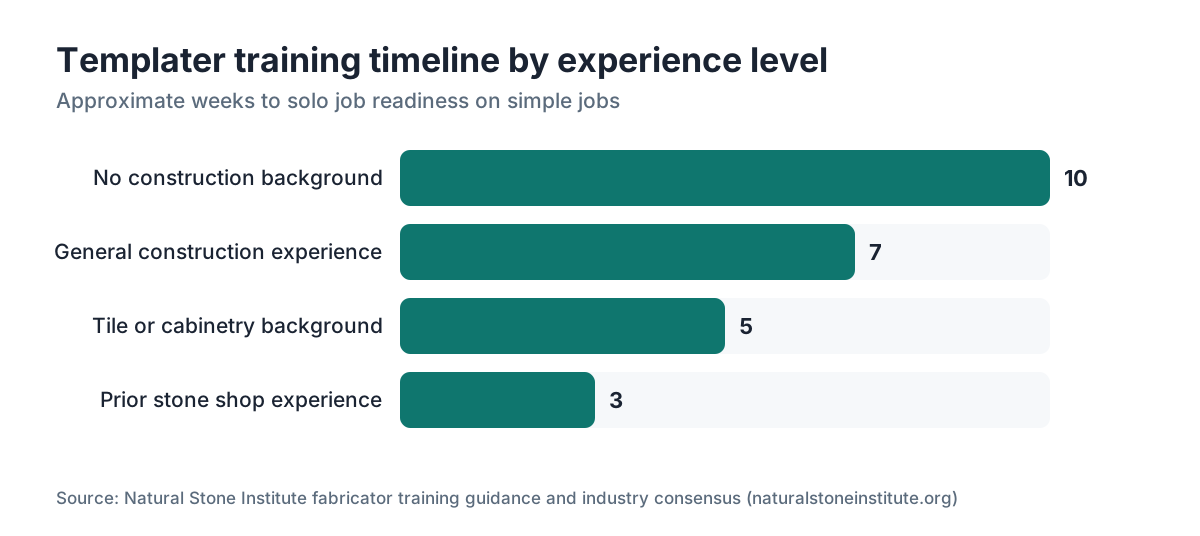
The honest answer depends on three things. The trainee's baseline (do they have construction experience or shop math?), the complexity of the jobs your shop runs, and how structured your training is.
For someone with zero construction background, budget 8 to 12 weeks before they run solo on anything but the simplest straight-run kitchen. For someone who has worked tile, cabinetry, or finish carpentry, 4 to 6 weeks is realistic. These aren't benchmarks from a published study. They're the consistent range you hear discussed in fabricator forums and at industry training programs run by the Natural Stone Institute (formerly MIA+BSI).
The Natural Stone Institute offers an Accredited Fabricator program and publishes installation and fabrication standards that touch on templating requirements. Their guidance treats templating as a professional skill with documented competency, more than a task anyone picks up in a day.
A rough phase breakdown:
| Phase | Duration | What They Learn |
|---|---|---|
| Shop orientation | Week 1 | Tool names, safety, shop layout, material types |
| Measurement fundamentals | Weeks 1-2 | Tape reading, squareness checks, shop math |
| Shadow experienced templater | Weeks 2-4 | Observe full jobs, label templates, carry tools |
| Assist on live jobs | Weeks 4-6 | Take measurements under supervision, verify against mentor |
| Lead simple jobs with oversight | Weeks 6-9 | Straight kitchens, basic bathrooms, mentor present |
| Solo on simple jobs | Weeks 9-12 | Independent, but mentor reviews template before shop cuts |
| Full solo | Week 12+ | All job types, periodic quality audits |
What are the most common templating mistakes new employees make?
Watch for these. They aren't random. They cluster around specific failure points that show up again and again in training.
The number-one error is not checking for square. New templaters assume walls are square and measure from a single corner. A kitchen with walls 3/8 inch out of square over 10 feet gives you a countertop that doesn't fit, won't scribe cleanly, or leaves a visible gap. Teach the 3-4-5 method and require your trainee to document wall squareness on every job.
Second, wrong sink reveal. Undermount cutouts depend on the exact sink model and the stone thickness. A reveal that's 1/8 inch too wide looks bad and can void a manufacturer's warranty. Train new templaters to always have the physical sink model number on-site and to pull the spec sheet, never guess from memory.
Third, missing the cooktop cutout dimensions. Cooktop cutouts happen at the shop. A mistake here means re-cutting the whole top. Require your trainee to verify rough-in dimensions from the appliance spec sheet against the model number on the appliance itself, more than what the homeowner reports.
Fourth, forgetting overhangs. The standard breakfast bar overhang for stool seating is 12 inches, but some designers and homeowners want 15 inches. That's a structural question for stone that needs support, and a template without that note causes a fabrication error. Every overhang gets measured and noted.
Fifth, unlabeled or reversed template pieces. A sheet of luan that makes it back to the shop with no clear label for which edge is the wall edge becomes a coin flip for the fabricator. Require a consistent labeling convention and verify it before the trainee leaves the site.
How do you structure the first week of templater training?
Day one is shop orientation, not job sites. Walk them through every tool by name, show safe handling of slabs, and explain what each material type costs so they understand what's at stake when something goes wrong. A slab of imported quartzite can run $80 to $150 per square foot or more wholesale. That context matters.
Day two is tape reading drills. Set up scrap pieces and cabinets in the shop or yard and have the trainee measure them three different ways, then compare. Require accuracy to 1/16 inch. If they're consistently off by 1/8 inch or more, don't move to job sites yet. Practice more.
Day three introduces template material. Have them build a physical template of something simple in the shop, like a workbench top with one inside corner. The point is learning the physical skill of cutting, fitting, and labeling without the pressure of standing in a customer's kitchen.
Days four and five are a ride-along on a real job. The trainee carries tools, watches, and asks questions afterward (not during, if the homeowner is present). After the job, debrief. What did you notice? What would you have done differently? What did we check that you wouldn't have thought to check?
The first week sets the habit of observation before action. Templaters who skip the observation phase and jump straight to measuring make the same mistakes over and over, because they've never seen the full picture of what a finished, correct template looks like.
How do you teach someone to handle out-of-square walls and irregular conditions?
This is the skill gap that separates a mediocre templater from a good one. Square walls are easy. Real kitchens aren't square.
Start with the scribing concept. A countertop edge that meets a wall should follow the wall's actual profile, not a straight line. A 1/4-inch variation in a 10-foot wall might be invisible to the eye but shows as a gap if the stone is cut straight. Teach the trainee to use a scribing compass or a thin strip of template material to trace the wall profile directly.
For bowed walls, teach the two-point and mid-point check. Measure from each end of the wall to a reference line, then measure the middle. If the middle is closer or farther, the wall bows. Document the bow distance and location. The fabricator needs that to decide whether to scribe the stone or add a caulk joint.
For out-of-square corners, the 3-4-5 triangle is reliable and fast. Measure 3 feet along one wall, 4 feet along the adjacent wall, and check whether the diagonal reads exactly 5 feet. If it doesn't, the corner isn't 90 degrees, and the template has to reflect the actual angle, not an assumed right angle.
Make the trainee run these checks on every job, even when walls look square. The habit of checking beats knowing what to do when something's wrong. They can't catch a problem they never looked for.
How should a shop owner create a templating checklist for trainees?
A written checklist does two things. It cuts errors during training, and it becomes a quality control tool you can audit after every job. The trainee shouldn't have to hold all of this in their head from week two. Give them a sheet.
Here's what a solid field checklist covers:
- Sink model confirmed, spec sheet in hand or photographed
- Cooktop/range model confirmed, cutout dimensions verified
- Wall squareness checked at every corner (note deviations)
- Overhangs measured and noted (standard or custom)
- Seam locations agreed with customer or noted for shop decision
- All template pieces labeled: location, wall edge, front edge, direction
- Photos taken: full kitchen, each sink area, each appliance cutout, any unusual condition
- Customer signed off on seam placement if visible seams are involved
- Backsplash height confirmed if included
- Cabinet level checked; shims documented if cabinets aren't level
That last one gets missed constantly. Cabinets out of level give you a countertop that looks level against the wall but shows a gap at the front, or the reverse. The templater has to catch it and document it so the installer can plan for it.
For shops running digital quoting and production software, tools like SlabWise let you attach field notes, photos, and measurements straight to a job record so nothing gets lost between the template and the fabrication ticket. That integrated workflow also makes it easier to review a trainee's documentation without hunting through paper files.
When should a new templater be allowed to run jobs solo?
Not before they've run at least 15 to 20 supervised jobs across different job types. That's not a made-up number. It reflects the range where pattern recognition starts to stick. The first five jobs, they're still learning the physical routine. Jobs six through fifteen, they start hitting conditions they haven't seen. By job 20, a trainee who's been paying attention has run into most of the common problems.
The solo handoff should be gradual, not a switch. A good intermediate step is having the trainee run the job solo but call or text a photo of every unusual condition before they leave the site. The supervisor reviews the documentation before the job hits the cut list. That catches errors without requiring the supervisor to be physically present.
Never make the first solo job a complex one. The first solo should be a straight bathroom vanity or a simple galley kitchen with no island, no cooktop cutout, and a standard undermount sink. Save complex L-kitchens, waterfall islands, and outdoor kitchens for after they've proven themselves on simpler work.
A useful benchmark: before fully solo, a trainee should produce templates that need zero clarification calls from the fabricator. If the shop floor keeps calling the templater with questions about the paperwork, they're not ready.
What math skills does a new templater need, and how do you teach them?
Templating math isn't advanced, but it has to be automatic. A templater who stops to think about fractions on a job site makes mistakes under pressure.
The core skills start with fraction arithmetic in 16ths of an inch. Adding 5 3/8 + 2 9/16. Converting 19/16 to 1 3/16. A surprising number of candidates can't do this confidently. Test it before you hire, or plan to spend a week on it in training.
Square footage calculation comes next. They need to estimate the square footage of an L-shaped kitchen quickly to catch obvious measurement errors. If their total comes back at 18 square feet for a kitchen that clearly has 40 square feet of counter, something's wrong and they should catch it before leaving.
Then overhang limits. Standard overhang on a 3 cm (1 3/16 inch) slab runs up to about 1/3 of the slab depth unsupported, though the Natural Stone Institute's installation standards set support requirements based on cantilever length and stone type. For granite and quartz, overhangs past 8 to 10 inches generally need support corbels or brackets. The templater doesn't engineer this. They just have to know when to flag it.
For teaching fractions, drills are the only thing that works. Worksheets, then timed verbal quizzes, then practical exercises with a tape measure. Plan on 3 to 5 days of concentrated practice for someone who comes in weak on fractions. It pays off.
How do you train for different countertop materials and their special requirements?
The templating process itself is mostly the same across materials. The decisions that flow from the template change a lot by material. A new templater doesn't need to be an expert in everything on day one, but they need to know enough to ask the right questions and flag the right conditions.
Granite countertops are the most common natural stone. Key training points: seam placement matters because veining direction is visible in granite, so seam placement gets discussed with the customer. Grain direction on the template must be marked.
Marble countertops are softer and more sensitive to overhang stress. Larger unsupported spans carry higher risk. Marble jobs also tend to have tighter aesthetic requirements around veining and bookmatching, which means the templater's seam notes carry more weight.
Engineered quartz (brands like Cambria countertops) has consistent patterning and more forgiving seam aesthetics, but it's heavy (roughly 20 to 25 lbs per square foot for 3 cm) and has specific manufacturer guidelines around seam placement and sink cutout tolerances.
Laminate countertops and Formica countertops involve different templating considerations entirely, including edge profile options and post-form versus custom fabrication. If your shop does both stone and laminate, train these separately.
Butcher block countertops expand and contract with humidity. Templaters working with wood have to understand that a tight fit today can cause stress cracking in six months. A small gap at walls is intentional, not an error.
For each material, have the trainee read the manufacturer's installation or fabrication guide before touching a job in that material. Most major manufacturers publish these documents publicly, and they list the exact tolerances your templater needs.
How do you handle quality control for a trainee's templates?
Quality control during training should be explicit and documented. Don't rely on the fabricator to catch problems. Set up a formal review for every template a trainee produces until they go fully solo.
Step one, the trainee fills out the checklist (above) for every job. Step two, the supervisor or lead fabricator reviews the physical or digital template and the checklist before the job enters the cut queue. Step three, any discrepancy or question gets noted and discussed with the trainee the same day, while the job is fresh.
Track error types, more than error counts. A trainee who keeps missing sink reveals needs different feedback than one who makes labeling errors. Pattern-based feedback beats generic "be more careful."
For shops running job management software, attaching a quality review step to each job means nothing slips through. SlabWise's production tracking, for example, can flag a job for supervisor review before it advances to cutting, which builds the review into the workflow rather than relying on memory.
After training wraps, run periodic audits. Pull three random completed jobs per month from each templater and verify that the field measurements match the finished countertop dimensions. Without a feedback loop between installation and templating, errors compound invisibly for months before anyone notices the pattern.
What safety training does a new countertop templater need?
Templating is lower-risk than fabrication. It's not risk-free. New templaters work in occupied homes, often around active construction, cutting template material on-site, sometimes sharing a job site with other trades.
OSHA's general industry and construction standards both apply, depending on the job site context. For residential renovation sites, the relevant standards include fall protection when working on elevated surfaces, safe use of cutting tools, and respiratory protection if any cutting or grinding happens on-site. California's Division of Occupational Safety and Health (Cal/OSHA) has additional silica dust regulations that apply to stone workers. Templating itself rarely generates silica dust, but your templater has to understand the risk if they're on a site where fabrication is also happening.
The practical safety training for a new templater covers a few things. Safe use of the jigsaw or multi-tool for cutting template material: blade guards, cut direction, securing the material. PPE: safety glasses are mandatory any time they're cutting. Shoes: closed-toe, hard-sole, no exceptions at job sites.
Lifting protocol. Template pieces are light, but some on-site samples or tile countertops get heavy. Train proper lifting form and two-person handling for anything over 40 lbs.
Customer home protocols. Tools on drop cloths. Nothing dragged across floors. Know how to protect cabinets from jigsaw vibration when cutting template material on-site.
How do you know if someone is going to be good at templating before you invest weeks in training?
There's no perfect filter, but a few screening methods surface reliable signals.
Give a practical tape-reading test in the interview. Hand them a tape measure, set up three measurements of different lengths with fractions, and ask them to read the values and add two of them. Candidates who struggle with fractions on a tape are going to struggle in the field, and you'll know in five minutes.
Ask them how they'd figure out whether a room's walls are square. Anyone with construction or spatial intuition describes something reasonable: check the diagonals, use a square. Someone with no idea gives you something vague. That vagueness is useful information.
Look for patience. Templating is detail-heavy and often slow. Someone who gets antsy and wants to move fast before the job is fully documented is a risk. Patience is hard to fake over a long conversation about process.
Prior trades experience (tile, finish carpentry, cabinetry installation) is a strong positive signal. Cabinetry installers often make excellent templating candidates because they've already fought out-of-square walls and finished surfaces. Plumbers have the measurement mentality but not always the finish-work patience.
No screening process is perfect. The tape test catches most of the candidates who won't make it. Everything else is probabilities.
Frequently asked questions
How long does it take to learn countertop templating?
For someone with zero construction background, expect 8 to 12 weeks of supervised practice before they run simple jobs solo. Someone with carpentry or tile experience can often reach that point in 4 to 6 weeks. The milestone to aim for isn't a time number, it's whether the fabrication shop can process their templates without clarification calls.
What's the best order to teach templating skills?
Start with physical measurement and shop math, then move to template material handling and labeling, then shadow on live jobs, then assist under supervision, then lead simple jobs with a mentor present, and finally run solo on easy jobs before taking on complex ones. Skipping steps in that sequence is where training programs fail.
Do I need to buy a digital templating system for a new templater?
Not immediately. Physical template skills come first, and a new hire shouldn't rely on a digital tool before they understand what it's measuring. Digital systems like Proliner are valuable for speed and accuracy on complex jobs, but a templater who only knows the digital system is helpless when the device fails on a job site.
What are the most important things to check on every countertop template?
Wall squareness at every corner, sink model and spec sheet verified, cooktop rough opening confirmed against appliance specs, all overhangs measured and documented, all template pieces labeled with location and orientation, photos of every cutout and unusual condition, and cabinet level documented. Missing any of these is how re-cuts happen.
How do I teach a new templater to handle out-of-square walls?
Teach the 3-4-5 triangle method for checking corner squareness and scribing technique for following irregular wall profiles. Require them to check squareness on every job, even when walls look fine. The habit of checking beats knowing what to do when something's wrong, because they can't catch a problem they never looked for.
What math does a countertop templater need to know?
Fraction arithmetic in 16ths of an inch is the core skill, and it has to be automatic. They also need to calculate square footage quickly to catch measurement errors, and understand when overhangs need support (generally past 8 to 10 inches for granite and quartz). Test fraction skills before hiring; plan a week of drills if the candidate is weak.
When should a new templater be allowed to work without supervision?
After at least 15 to 20 supervised jobs across different job types, and only on simple layouts first. A good intermediate step is having them run jobs solo but require photos of every unusual condition before they leave, with a supervisor reviewing documentation before it goes to the cut queue. Full independence gets earned through demonstrated error-free work.
How do you build a templating checklist for new employees?
A field checklist should cover sink model confirmation, cooktop dimensions verified, wall squareness documented, overhangs noted, all pieces labeled, photos taken, seam placement confirmed, backsplash height noted, and cabinet level checked. Keep it on a single printed sheet or a mobile form. The goal is zero fabricator clarification calls because every question got answered in the field.
What are the safety requirements for countertop templating work?
Safety glasses are mandatory any time template material is cut on-site. Closed-toe hard-sole shoes are required at all job sites. OSHA general industry and construction standards apply depending on the site context. In states like California, Cal/OSHA has specific silica dust regulations that apply to stone work environments. Teach proper lifting form and home protection protocols as standard practice.
How do you handle quality control for a trainee's templates?
Require a completed field checklist for every job. Have a supervisor or lead fabricator review the template before it enters the cut queue. Track error types, more than counts, so feedback is specific. After training, run periodic audits by comparing field measurements to finished countertop dimensions. The feedback loop between installation and templating is what keeps error rates from creeping up.
Does countertop material type change how you template?
The physical templating process is mostly the same, but the decisions differ. Granite and marble require marking grain direction and careful seam placement. Engineered quartz has manufacturer-specific sink cutout tolerances. Butcher block needs intentional gaps at walls for seasonal movement. Train material-specific knowledge separately from the core measuring skills, and have trainees read manufacturer installation guides before their first job in each material.
How do you screen a job candidate to see if they'll be good at templating?
Give a tape-reading and fraction-arithmetic test in the interview. Ask how they'd check whether a room's walls are square. Look for patience and attention to detail, not speed. Prior experience in tile, cabinetry, or finish carpentry is a strong positive signal. The tape test alone filters out most candidates who will struggle, and it takes five minutes.
What sink cutout mistakes do new templaters make most often?
The most common error is using the wrong reveal for the specific sink model, either guessing from memory or using a generic number instead of pulling the actual spec sheet. Undermount cutouts have to match the exact model's required opening, and being 1/8 inch off in the wrong direction can void a manufacturer's warranty or leave a visible gap. Always have the model number and spec sheet in hand on-site.
What is the Natural Stone Institute's role in templating training?
The Natural Stone Institute (formed from the Marble Institute of America and Building Stone Institute) publishes installation and fabrication standards that include templating requirements, and offers an Accredited Fabricator program for professional credentialing. Its standards treat templating as a professional competency, not a casual task. Shops that use these standards as a training baseline have a documented benchmark for what "correct" looks like.
Sources
- Natural Stone Institute (formerly MIA+BSI), Accredited Fabricator Program: The Natural Stone Institute offers an Accredited Fabricator program and publishes fabrication standards treating templating as a professional skill requiring documented competency.
- National Kitchen and Bath Association (NKBA), material pricing guidance: Imported quartzite wholesale slab pricing can run $80 to $150 per square foot or more, depending on origin and thickness.
- Natural Stone Institute, Dimension Stone Design Manual: Natural Stone Institute installation standards specify support requirements for countertop overhangs based on cantilever length and stone type, with general guidance that unsupported overhangs past 8 to 10 inches require corbels or brackets for granite and quartz.
- Cambria, Installation and Care Guide: Engineered quartz manufacturers including Cambria publish specific installation guides with sink cutout tolerances and seam placement requirements that fabricators and templaters must follow to maintain warranty coverage.
- U.S. Department of Labor, Occupational Safety and Health Administration (OSHA), General Industry Standards 29 CFR 1910: OSHA general industry and construction standards apply to countertop templating work depending on the job site context, covering cutting tool safety, PPE requirements, and fall protection.
- California Division of Occupational Safety and Health (Cal/OSHA): Cal/OSHA maintains silica dust regulations that apply to stone fabrication and stone work environments in California.
- U.S. Occupational Safety and Health Administration, Crystalline Silica Rule: OSHA's crystalline silica standards set a permissible exposure limit and require exposure controls for workers in environments where silica dust is generated, including stone fabrication shops.
- National Institute for Occupational Safety and Health (NIOSH): NIOSH has documented occupational hazards in stone fabrication including silica exposure and musculoskeletal risks from heavy lifting, relevant to shop safety training programs.
- Natural Stone Institute, Dimension Stone Design Manual: The Dimension Stone Design Manual provides span tables and engineering guidance for countertop overhangs in various stone types, which inform field decisions during templating.
Last updated 2026-07-10