TL;DR
- An integrated drainboard countertop has parallel ridges and a sloped field milled straight into the surface, so water runs off dishes into the sink with no rack or mat.
- A CNC router does most of the work in stone, solid surface, or wood.
- Expect the feature to add roughly $150 to $600 to a standard countertop job.
What exactly is an integrated drainboard countertop?
An integrated drainboard is a section of countertop that's been shaped, not attached, to drain water toward the sink. The fabricator mills a field of parallel ridges (called flutes or ribs) into the surface next to the sink cutout, then pitches that whole field slightly, usually 1/8 inch per foot toward the drain, so water runs off dishes and straight into the basin.
The word "integrated" earns its place. A separate drainboard is a rubber mat or a wooden rack you set on the counter. An integrated one is part of the stone, solid surface, or wood itself. Nothing to move, nothing to replace, nothing to scrub underneath.
The ribs lift dishes off the flat surface so water doesn't pool under them. The pitch carries that water into the sink. It's a simple idea that goes back centuries in wooden work surfaces, and modern CNC tooling has made it practical again in granite, quartz, marble, and engineered solid surface like Corian.
You'll hear it called a drainboard, a ribbed drainboard, a fluted drainboard, or a dish-draining countertop. Same thing every time.
Which countertop materials can have an integrated drainboard?
Not every material works. The process needs enough thickness and enough surface integrity to hold clean, sharp ribs without chipping or cracking. Here's how the main options compare.
| Material | Typical slab thickness needed | CNC or hand tool | Chip risk | Sealing needed after milling |
|---|---|---|---|---|
| Granite | 3 cm (1-3/16") preferred | CNC strongly preferred | Medium (grain-dependent) | Yes, annually |
| Quartz (engineered) | 3 cm | CNC required | Low | No |
| Marble | 3 cm | CNC preferred | Medium-high | Yes, more often |
| Soapstone | 3 cm | Hand tool or CNC | Low | Periodic oiling |
| Solid surface (Corian, etc.) | 3/4" or thicker | CNC or router jig | Very low | No |
| Butcher block / hardwood | 1-1/2" or thicker | Hand planes, router jig, CNC | N/A (wood flexes) | Yes, food-safe finish |
| Laminate | Not recommended | Cannot mill ribs cleanly | Substrate exposed | N/A |
Solid surface is the easiest material to work with. It machines cleanly, throws no silica dust, and the ridges come out crisp every time. Corian-type solid surfaces can also be thermoformed, so you can get a smooth curved transition between the field and the sink if the sink is solid surface too.
Granite countertops are the most common stone choice, but the fabricator has to read the stone's grain and crystal structure. A coarse-grained granite chips at rib edges. A fine-grained one holds detail well.
Soapstone countertops are the traditional drainboard material in old farmhouse kitchens and still a smart pick. Soapstone is soft enough to hand-carve, dense enough to shrug off water, and it never needs a sealant the way granite or marble does.
Butcher block countertops with milled drainboards are having a moment in farmhouse and craftsman kitchens. The trick is keeping the wood finish intact in the grooves, since those are the spots that see the most standing water. End-grain butcher block is the worst choice for exactly that reason. Flat-grain or edge-grain holds up better.
How is an integrated drainboard fabricated step by step?
The process runs in four phases no matter the material: layout and design, programming or template setup, machining, and finishing.
Layout and design. The shop sets the drainboard zone's dimensions from the counter plan. A typical residential drainboard runs 12 to 18 inches wide alongside a single sink. The designer specs rib width, rib spacing, rib height, and field pitch. Common numbers are 3/8" wide ribs spaced 3/4" on center, sitting 3/16" to 1/4" above the field, with a pitch of 1/8" to 3/16" per foot toward the sink.
Programming (for CNC work). A CAD/CAM technician draws the geometry in software like Alphacam, Cabinet Vision, or a stone-specific CAM package. The program builds the toolpaths: a roughing pass with a larger end mill to clear bulk material, then a finishing pass with a smaller ball-nose or flat-nose bit to clean up the rib profiles. The pitch gets programmed straight into the Z-axis moves so the whole milled zone tilts toward the sink. If the shop runs quoting and nesting software like SlabWise, the drainboard shows up as a machined feature in the job record alongside the edge profiles and cutouts.
Machining. The slab goes on the CNC bridge saw table or a dedicated router table, usually held flat with vacuum pods. For stone, the machine runs with water cooling to suppress silica dust and keep the bit from overheating. "Wet methods" are the control OSHA calls out by name in its silica standard [1]. For solid surface or wood, air cooling is fine. Speeds vary a lot: stone typically runs 15,000 to 18,000 RPM with slow feed rates (around 100 to 200 mm/min on finish passes), while solid surface runs faster. A single granite drainboard field usually takes 45 to 90 minutes of machine time depending on size and rib count.
Finishing. After machining, the rib edges and field get hand-polished or honed to match the rest of the top. This is tedious work. Every rib face, every groove bottom, and the sloped field between them has to reach the same finish as the surrounding slab. On a polished granite drainboard, this step alone can add an hour or more of hand labor. Many shops offer a honed drainboard even on polished tops because it's faster to reach and holds up better in a wet zone.
Shops without a CNC still do this by hand. The old method uses a router with a straight bit and a shop-made jig: parallel guide rails clamped to the slab at the right spacing, shimmed on one end to create the pitch. It works. Consistency across the ribs rides entirely on the operator's attention, though, and a CNC does it better and faster once the program is dialed in.
How much does an integrated drainboard countertop cost?
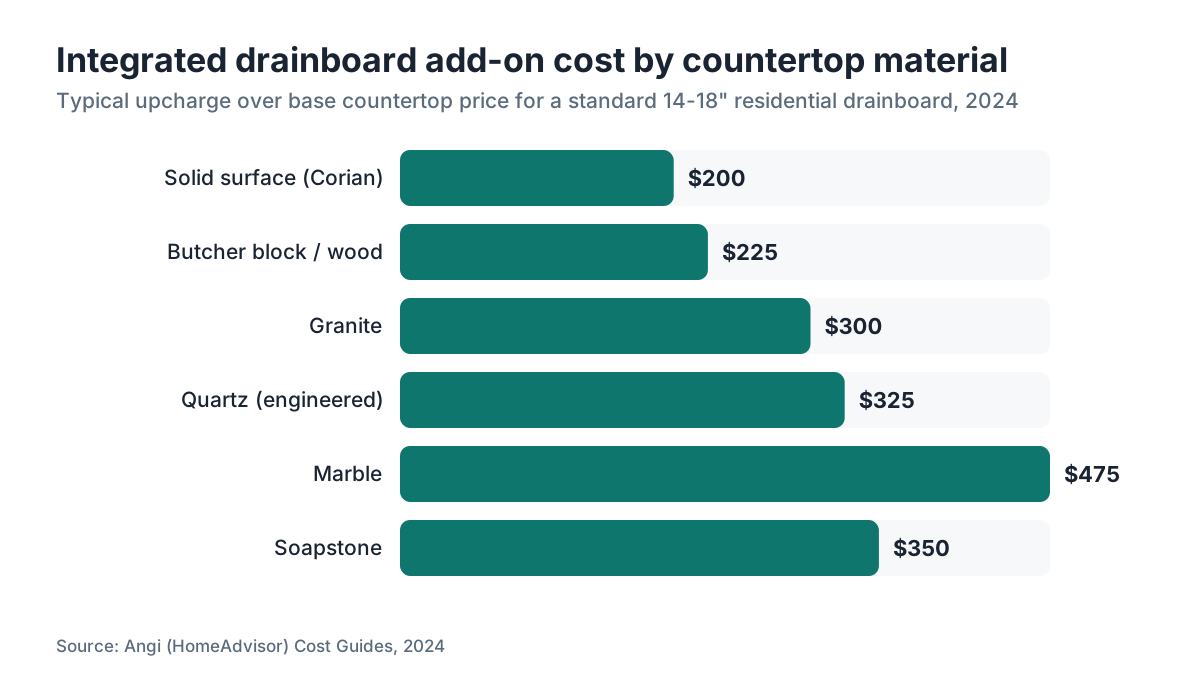
Most fabricators charge a $150 to $600 add-on over the base countertop price for a standard 12-to-18-inch stone drainboard [2]. Solid surface shops sit at the low end because machining is easier. Stone shops with a dialed-in CNC program land around $200 to $350. Shops doing it by hand, or doing it rarely, charge more because setup eats a bigger share of the job.
The base countertop runs the full material spectrum. Granite averages $40 to $100 per square foot installed in 2024 [3]. Solid surface like Corian runs $40 to $80 per square foot installed [4]. Marble is $60 to $150 or more depending on the stone and the complexity [3].
Adding a drainboard to laminate makes no sense. The substrate shows at every rib groove. Want a low-cost drainboard? Solid surface or a wood countertop beats laminate every time.
One cost detail homeowners miss: the sink. An integrated drainboard works best with an undermount or integral sink (same material). A drop-in sink rim sits above the counter and creates a lip that blocks drainage into the basin. Plan for an undermount sink at the same time you plan the drainboard, and price them together.
What are the real advantages of an integrated drainboard?
The practical case is simple. Dish racks sit on the counter, collect water underneath, and create a zone you can never quite keep clean. Silicone mats do the same. A milled drainboard erases both objects. The counter is the draining surface.
For people who hand-wash regularly, it makes a real difference. The sloped field means no puddles left behind after every wash session. The surface dries faster because water doesn't sit flat.
Cleaning a drainboard takes extra attention in the grooves, but you can sanitize it directly. A rubber mat is a biofilm magnet you have to keep running through the dishwasher. Stone or solid surface with the right finish is more hygienic in daily use.
Then there's the look. A well-made stone drainboard with crisp parallel ribs reads as intentional in a way no rubber mat ever will. Whether that justifies the cost is your call.
What are the drawbacks and limitations?
The grooves are the biggest daily headache. On a polished granite drainboard, hard-water minerals collect in the rib valleys and need periodic descaling. A honed or matte finish in the drainboard zone hides those deposits and cleans up easier.
Marble is a problem child despite the looks. Marble etches on contact with acidic water and dish soap [5]. The milled rib faces are fresh, unsealed stone with more open porosity than the factory-polished top, so etching shows up faster in the grooves. If you want a marble drainboard, go in knowing you'll see wear marks and you'll reseal often. Marble countertops are already high-maintenance, and a drainboard zone turns the dial up.
The other limitation is permanence. The drainboard is milled into the slab. You can't un-mill it. Change your mind and you're replacing the countertop. Make sure you hand-wash enough dishes to justify it before you commit.
For fabricators, the limit is throughput. A drainboard job takes longer than a plain slab. If the CNC program isn't already built, programming time lands on the quote, and the hand-finishing after machining is real labor. Shops that do these often get quick. Shops that do one every few months take longer and charge for it.
How do you design the right drainboard for your kitchen layout?
Start with two things: where the sink sits, and which hand does most of the dishes. Most people want the drainboard on their non-dominant side so they can hold a dish in their dominant hand and set it on the board. The sink's position in the run still has to cooperate, though. You can't put a drainboard on a side with 6 inches of counter.
A minimum usable drainboard is about 12 inches wide (from the sink edge outward) and as long as the sink cutout. More typical is 14 to 18 inches. Going past 20 inches rarely helps, because dishes stack toward the back of a wide board instead of draining toward the front.
Rib orientation matters. Ribs that run perpendicular to the sink edge (front-to-back) let dishes lean against each other in rows. Ribs parallel to the sink edge (side-to-side) create a washboard effect and hold plates upright poorly. Most fabricators default to perpendicular ribs.
Tight on counter space? Some fabricators put the drainboard over the second basin of a double sink. It works well and keeps the drip zone directly over a drain.
If you're thinking about the countertop installation sequence, lock the drainboard spec before fabrication. You cannot add it after the slab is cut and polished.
What tools and CNC bits does a fabricator use to mill drainboard ribs?
For stone, the standard rig is a CNC bridge router or a dedicated CNC router table. The roughing pass uses a solid carbide or PCD (polycrystalline diamond) end mill, 1/4" to 1/2" diameter, to clear the bulk between ribs. The finish pass drops to a smaller flat-nose or ball-nose carbide bit, often 1/8" to 3/16" diameter, to clean the groove bottom and rib face [6].
Bit life is a real cost line in stone. Diamond-coated bits outlast uncoated carbide but cost more up front. A shop running lots of drainboards tracks bit wear closely, because a worn bit leaves ragged rib edges and drives up the hand-finishing time.
For solid surface, standard router bits do the job. The material cuts like dense plastic, throws chips instead of dust, and needs no water cooling.
For wood, a router table with a straight bit and a shop-made fence jig is the classic setup. Larger shops run CNC routers with the same programming approach as stone, just different speeds and feeds.
Silica dust is the one safety issue you don't get to shrug off in stone. OSHA's permissible exposure limit for respirable crystalline silica is 50 micrograms per cubic meter of air as an 8-hour time-weighted average [1]. Wet cutting at the CNC and real dust collection aren't optional extras. They're the line between compliance and a serious long-term health hazard for the people on your shop floor.
How is the drainboard pitch set and why does it matter?
The pitch is the slope of the whole milled field, angled toward the sink so water flows down and in. Too little pitch and water pools in the low spots of the rib valleys. Too much and dishes slide.
The standard range is 1/8" to 3/16" per linear foot of run toward the sink [9]. A 16-inch-wide drainboard pitched at 1/8" per foot drops about 3/16" from the outer edge to the sink, barely visible but plenty to drain water reliably. Bump it to 3/16" per foot on that same board and you get about 1/4" of total drop, which you'll notice if you look for it.
On a CNC, the pitch lives in the toolpath. The technician steps the Z-axis values across the drainboard zone. The table stays flat and the tool path creates the slope. On a hand-routed jig, the fabricator shims one end of the guide rails to tilt them, then routes flat against the sloped rail.
The pitch also has to meet the sink's rim height. On an undermount, the drainboard field meets the sink opening edge cleanly and water falls straight into the basin. A good template includes the sink opening position, so the fabricator can program the pitch to terminate at exactly the right point.
How do you maintain and clean an integrated drainboard countertop?
Day to day, clean it like the rest of the counter: warm water, mild dish soap, a soft cloth or sponge. The grooves want a little more attention than a flat surface. A stiff nylon brush gets into the rib valleys without scratching the stone.
The main enemy of a stone drainboard is hard-water mineral buildup. Water counts as hard above 120 mg/L as calcium carbonate, and the USGS notes that most of the US has moderately hard to very hard water [7]. If yours qualifies, you'll see white chalky buildup in the grooves within weeks. A 1:1 white vinegar solution dissolves calcium deposits. On granite and quartz, that's fine. On marble and other calcium carbonate stones, do not use vinegar. It etches the surface [5]. Reach for a pH-neutral descaler instead.
For stone drainboards, reseal once a year with the same penetrating sealer you use on the rest of the top. The milled grooves are fresh, cut stone with more open porosity than the polished faces, so they drink up sealer and benefit from it. Cleaning stone countertops follows the same protocol whether or not a drainboard is present.
Solid surface needs no sealing, and you can lightly sand out scratches that build up in the groove bottoms. That's one of the genuine advantages of solid surface over stone in a wet working zone.
Wood drainboards need the finish in the grooves checked regularly. A food-safe mineral oil or a hardwax oil finish protects the wood from water. Reapply whenever the wood looks dry or water stops beading.
How does an integrated drainboard affect countertop quoting and fabrication time?
From the shop's side, an integrated drainboard is a profitable add-on if the process is dialed in, and a time sink if it isn't.
A first-time drainboard at a shop with no existing program might run 3 to 5 hours of combined programming, machining, and hand-finishing for a standard 16x24-inch field. A shop that does these regularly, with a saved program and a set polishing workflow, can bring that down to 90 minutes to 2 hours of total labor.
The quoting problem is communicating value. Homeowners hear "drainboard" and picture a minor feature. Fabricators know it's a full custom machining operation. Break it out in the quote, show the machining time and the hand-finish labor as separate lines, and the upcharge stops looking arbitrary.
Shops on digital quoting tools can tag drainboard work as a fixed add-on feature with a preset price floor, so sales staff don't undersell it by accident. SlabWise lets fabricators build custom job features, milled drainboards included, into quote templates so the cost lands automatically instead of getting bolted on as an afterthought.
Here's the thing homeowners should know about competing bids. The wide range in drainboard pricing (anywhere from $100 to $800 for the same job) usually tells you how often a shop does this work, not how good the result will be. Ask to see photos of finished drainboards. Ask flat out whether they run a CNC or a hand jig.
Frequently asked questions
Can you add a drainboard to an existing countertop without replacing it?
Technically yes, if the slab is still in place and a CNC machine can reach it, but it's rare and rarely practical. The machine needs a flat, stable, accessible surface to work from. In almost every case, adding a drainboard means fabricating a new countertop with the feature built in. Get an honest assessment from a fabricator who does in-place machining before assuming it's possible.
What is the best material for an integrated drainboard countertop?
Solid surface (Corian and similar) is the most forgiving: it machines cleanly, needs no sealing, and can be refinished by sanding. For natural stone, soapstone is the most practical because it handles moisture well without aggressive sealing. Granite is the most popular stone choice. Skip marble in a drainboard zone unless you're ready for etching and frequent maintenance.
How wide should a drainboard be?
Most residential drainboards run 12 to 18 inches wide measured from the sink edge outward, and as long as the sink opening. Fourteen to sixteen inches is the most common spec. Wider than 20 inches tends to be wasted, because dishes stack toward the back instead of draining toward the front. The counter space next to the sink usually sets the practical limit.
Does an integrated drainboard need a special sink?
Yes, in practice. It works best with an undermount or integral sink where nothing sits above the counter surface to block drainage. A drop-in sink rim rises above the countertop and creates a raised edge that stops water from flowing into the basin. Planning a drainboard means planning for an undermount sink at the same time.
Is a drainboard milled into quartz countertops possible?
Yes. Engineered quartz machines cleanly on a CNC router and holds rib edges well with low chip risk. The catch is that quartz must be cut with water cooling because the resin binders produce hazardous dust when cut dry. Most stone fabricators with CNC equipment can program and cut a drainboard in quartz, and the upcharge is similar to granite.
How deep are the ribs on an integrated drainboard?
Typical rib height is 3/16" to 1/4" above the field, and the grooves between ribs run the same depth. Going deeper risks structural issues at the rib base in harder stones and makes cleaning worse. Shallower than 1/8" and dishes don't drain reliably, because water bridges across the low ridges. Most CNC programs target 3/16" as the compromise.
What is the slope (pitch) of an integrated drainboard?
The standard slope is 1/8" to 3/16" of drop per linear foot of drainboard width, angled toward the sink. A 16-inch drainboard at 1/8" per foot drops about 3/16" total from outer edge to sink, enough to drain water without making dishes slide off. The fabricator programs this slope into the CNC toolpath or sets it with a shimmed jig.
How long does it take a fabricator to make an integrated drainboard?
Machine time for a CNC-cut stone drainboard runs 45 to 90 minutes. Hand polishing and finishing the ribs adds another 60 to 90 minutes of labor. A shop doing this for the first time also needs 1 to 3 hours of CAD/CAM programming. Shops that run these regularly, with saved programs and efficient polishing workflows, finish the full process in under 2 hours total.
Can a butcher block countertop have an integrated drainboard?
Yes, and it's a traditional pairing. Flat-grain or edge-grain hardwood works. End-grain doesn't handle standing water well. The fabricator cuts the ribs with a router jig or CNC, then finishes the milled surface with a food-safe penetrating oil or hardwax finish. The grooves need regular inspection and re-oiling since they see more water than the surrounding surface.
Is a milled stone drainboard sanitary compared to a rubber mat?
In practice, yes. A rubber or silicone mat traps moisture underneath, creating a warm, humid pocket where bacteria and mold thrive. A stone or solid surface drainboard cleans and sanitizes directly like any other countertop. The grooves need a brush to clean thoroughly, but there's no dark, trapped underside harboring biofilm the way a mat has.
How much does an integrated drainboard add to countertop cost?
Most fabricators charge $150 to $600 as an add-on over the base countertop price for a standard residential drainboard. Solid surface shops trend toward the low end. Stone shops doing hand-intensive work charge more. The base countertop cost still applies on top of that, ranging from $40 to $150 per square foot installed depending on material.
Do integrated drainboards work well for people who use a dishwasher most of the time?
Less so. If nearly all your dishes go through the dishwasher and hand-washing is rare, a drainboard is a feature you'll use occasionally but paid $200 to $600 for. It makes the most sense for households that regularly hand-wash pots, pans, cutting boards, or oversized items. If that's not your kitchen, a well-placed undermount rack or a separate mat is the more honest choice.
What finish should I choose for a stone drainboard, polished or honed?
Honed is the more practical choice for the drainboard zone even if the rest of the counter is polished. Hard-water deposits and soap scum stay nearly invisible on a matte honed surface but jump out on a high polish. Hand polishing every rib face to a mirror finish also takes far more labor, which raises the cost. Many shops offer a polished top with a honed drainboard field as a standard option.
Sources
- OSHA, Occupational Exposure to Respirable Crystalline Silica (29 CFR 1910.1053 and 1926.1153): OSHA's permissible exposure limit for respirable crystalline silica is 50 micrograms per cubic meter of air as an 8-hour time-weighted average, and wet methods are a named control, making wet cutting and dust collection required practices in stone fabrication.
- HomeAdvisor (Angi), Countertop Installation Cost Guide 2024: Integrated drainboard add-on pricing of $150 to $600 over base countertop cost reflects typical custom feature upcharges reported by homeowners and fabricators.
- HomeAdvisor (Angi), Granite and Marble Countertop Cost 2024: Granite countertops average $40 to $100 per square foot installed; marble ranges from $60 to $150 or more per square foot installed in 2024.
- HomeAdvisor (Angi), Solid Surface Countertop Cost 2024: Solid surface countertops like Corian run approximately $40 to $80 per square foot installed.
- Natural Stone Institute, Care and Cleaning for Natural Stone Surfaces: Marble and other calcium carbonate stones etch on contact with acidic substances including vinegar and citrus; acidic cleaners should not be used on marble drainboard surfaces.
- Society of Manufacturing Engineers, CNC Routing of Stone and Solid Surface Materials (SME Technical Reference): Roughing passes for stone CNC routing use solid carbide or PCD end mills; finish passes for drainboard ribs typically use flat-nose or ball-nose bits 1/8 to 3/16 inch diameter.
- USGS, Hardness of Water (Water Science School): Water is considered hard above 120 mg/L as CaCO3, and most of the US has moderately hard to very hard water; hard water mineral deposits accumulate in stone drainboard grooves and require periodic descaling.
- EPA, Water Research: Hard water is widespread across the United States, affecting a majority of municipal water supplies.
- Natural Stone Institute, Dimensional Stone Design Manual and Fabrication Best Practices: Standard drainboard field pitch recommendation of 1/8 to 3/16 inch per linear foot toward the sink is consistent with industry fabrication guidance for sloped countertop features.
Last updated 2026-07-10