TL;DR
- A stone veneer fabricator cuts natural or manufactured stone into thin panels, typically 3/4 inch to 1.5 inches thick, then shapes, finishes, and installs them on walls, fireplaces, exteriors, or countertops.
- Costs run roughly $15 to $50 per square foot for material and fabrication, with installation on top.
- Finding a qualified shop means checking portfolio work, asking about cutting equipment, and verifying they use the right setting materials for your substrate.
What exactly does a stone veneer fabricator do?
A stone veneer fabricator takes raw stone, either quarried natural stone or cast manufactured stone, and turns it into thin panels that bond to a surface instead of standing as structural mass. That word "thin" carries the whole idea. Full-thickness countertop slabs run 3 cm (about 1.25 inches) or thicker. Veneer panels usually land between 3/4 inch and 1.5 inches, sometimes thinner for engineered products, and the point is to get the look and weight-free feel of real stone without the cost of solid construction.
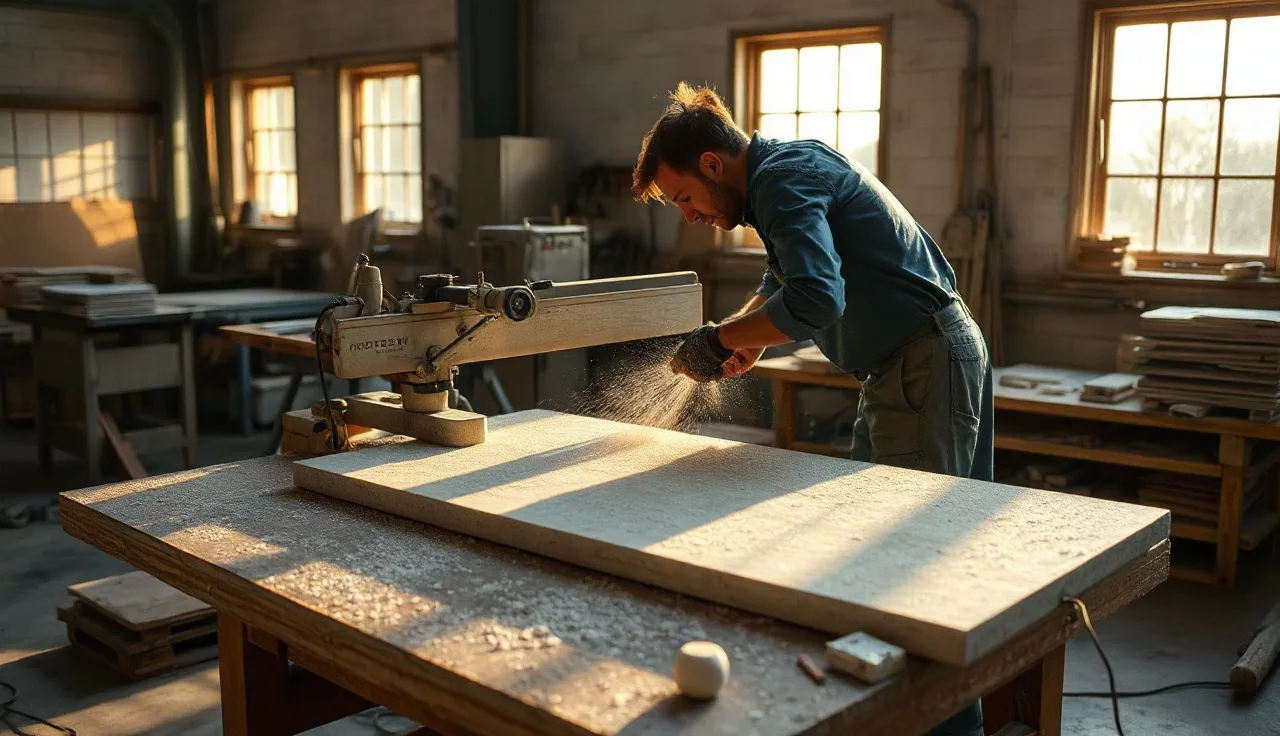
Fabrication starts with selecting material. For natural stone veneer, that usually means travertine, limestone, slate, quartzite, or granite blocks that get split or sawn into consistent thicknesses [1]. The fabricator runs these through a gang saw or wire saw to rough-cut slabs, then uses a CNC router or bridge saw to cut panels to spec. After cutting, the pieces get profiled on the edges, surface-finished (honed, brushed, or polished), and sometimes hand-chiseled for a rustic texture.
Manufactured stone veneer, sometimes called MSV, is a different animal. It's a cast concrete product engineered to mimic natural fieldstone, ledgestone, or brick. A fabricator working with MSV still handles cutting, corner fabrication, and custom fitting on-site, but the core product comes from a mold rather than a quarry. The Masonry Veneer Manufacturers Association (MVMA) publishes installation guidelines that most professional fabricators follow when working with manufactured product [2].
Beyond cutting, a full-service fabricator handles layout planning, templating the substrate, coordinating with masons or tile setters, and often doing the install themselves. Some shops fabricate only and hand off to a separate installer. That split changes both pricing and accountability, so ask every shop you talk to which model they run.
What types of stone are used for veneer fabrication?
Natural stone veneer covers a broad material range, and the choice drives everything from cutting method to maintenance. These are the materials fabricators work with most:
| Stone Type | Typical Thickness | Common Uses | Relative Cost (material only) |
|---|---|---|---|
| Slate | 3/4" to 1" | Accent walls, exteriors | Low to mid ($4-$10/sq ft) |
| Travertine | 1/2" to 3/4" | Fireplaces, indoor walls | Mid ($6-$14/sq ft) |
| Limestone | 1" to 1.5" | Exteriors, feature walls | Mid ($8-$18/sq ft) |
| Quartzite | 3/4" to 1.25" | Shower walls, exteriors | Mid-high ($10-$22/sq ft) |
| Granite | 3/4" to 1.25" | Exterior cladding | Mid-high ($10-$25/sq ft) |
| Marble | 1/2" to 3/4" | Interior accent walls | High ($15-$40/sq ft) |
| Manufactured stone | 1" to 1.5" | Exterior, fireplace surrounds | Low to mid ($5-$14/sq ft) |
Slate is forgiving to cut and cleaves naturally into flat pieces, which is why fabricators reach for it on entry-level veneer projects. Quartzite and granite need diamond blade saws and take longer to profile, which pushes labor costs up. Marble is beautiful and unforgiving. Any slight variation in bed thickness shows the moment light rakes across the wall.
Manufactured stone veneer has grown fast in popularity. It runs cheaper than most natural stone and has become one of the more cost-effective exterior cladding options in residential construction [2]. For a fabricator, it needs less heavy equipment than natural stone but demands precise substrate prep, because MSV fails at the bond layer if moisture gets behind it.
Outdoor applications live or die on freeze-thaw performance. Dense stones like quartzite and granite handle freeze-thaw far better than porous travertine or soft limestone. Ask any fabricator you interview whether the stone they recommend is rated for your climate zone [3].
How much does stone veneer fabrication cost?
Pricing splits into three buckets: material, fabrication labor, and installation labor. You almost never see these quoted together in a clean line-item breakdown, and that opacity creates most of the confusion homeowners run into.
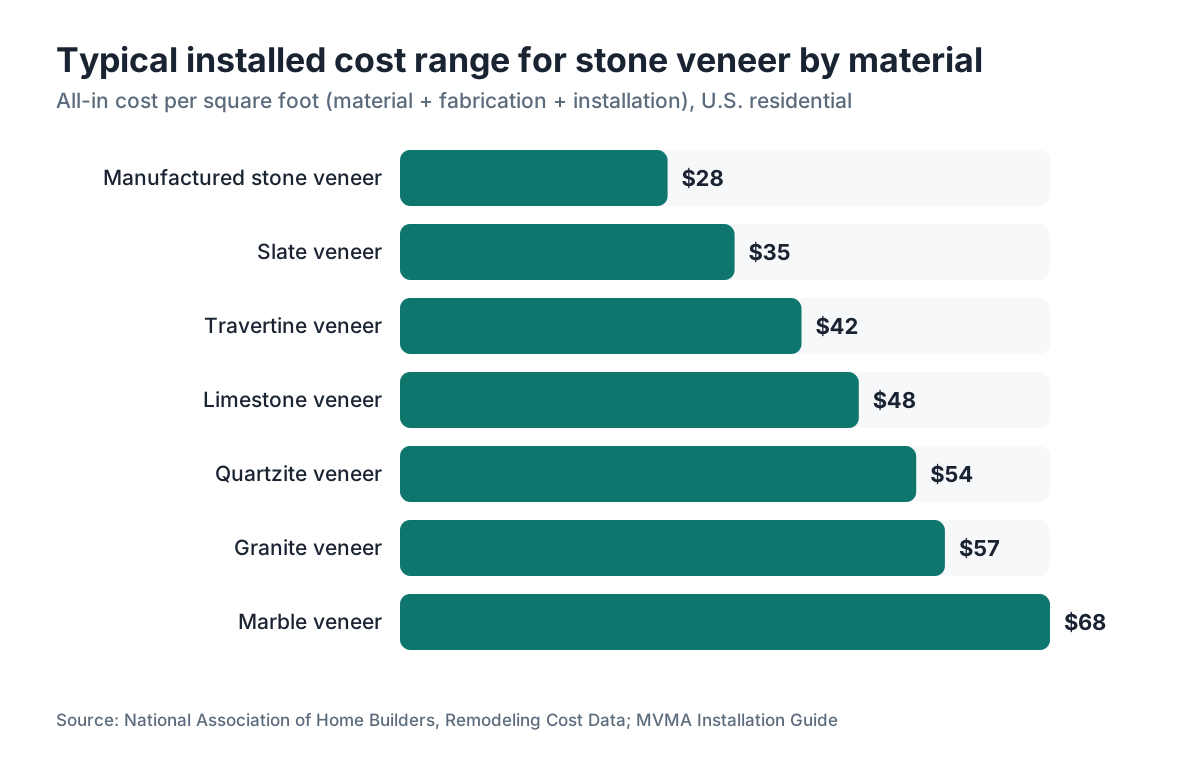
Material costs for natural stone veneer run $4 to $40 per square foot depending on species and where you source it. Fabrication labor (the cutting, shaping, and finishing done in the shop) typically adds $8 to $20 per square foot on top of material. Installation labor (setting the panels on-site with mortar and grout or thin-set) runs another $10 to $30 per square foot depending on complexity, wall height, and whether the substrate needs prep [4].
All-in, budget roughly $22 to $70 per square foot for a professionally fabricated and installed natural stone veneer wall. Manufactured stone veneer comes in cheaper: most projects land between $15 and $40 per square foot installed, depending on region.
Several things push costs up:
- Corners and returns. Cutting and fitting outside corners cleanly is slow. Fabricators often charge a linear-foot premium for corners, anywhere from $8 to $25 per linear foot extra.
- Height. Anything above eight feet needs staging, which adds time and cost.
- Pattern complexity. Running stone in a random ashlar pattern takes far longer to dry-fit than a simple coursed ledgestone layout.
- Substrate condition. A wall that needs a weather-resistant barrier, a scratch coat, or lath repair adds cost before a single piece of stone goes up.
- Waste factor. Curved walls, arched fireplaces, and detailed patterns can push waste to 15 to 20 percent. Straight walls on rectangles run 10 percent or less. [5]
One thing fabricators rarely volunteer: the markup on material is real. Many shops buy stone at 40 to 60 percent of what they quote you for it. That isn't necessarily wrong, but it's the reason you should compare quotes that itemize material separately against those that lump everything into one number.
What equipment does a professional stone veneer fabricator use?
Equipment tells you a lot about a fabricator's ceiling. A shop running only an angle grinder and a wet tile saw can handle simple straight-cut jobs but will fight anything complex. A full-service veneer fabricator typically runs:
A bridge saw or gantry saw for long, straight cuts through slabs. These machines take a full slab down to panel dimensions reliably and repeatably. A CNC router or waterjet cutter handles shaped pieces, arches, and detailed profiles. Waterjets cut cold, which matters for delicate stones that crack from heat. Diamond profiling wheels do the edge work, and different profiles (eased, bullnose, chiseled) need different wheel heads. Splitting equipment, sometimes called a splitter or guillotine, produces natural-cleft finishes on slate and some limestone. That gives the irregular, handset look without chiseling every piece by hand.
On the software side, a high-volume operation uses nesting software to lay panels across raw slab stock efficiently and cut waste. A shop still doing that layout by hand on paper is leaving material cost on the table. Tools like SlabWise help fabricators quote jobs and optimize cuts across slabs, which is worth asking about on a large project when you want confidence the pricing reflects efficient material use.
Dust management matters just as much. Dry cutting natural stone throws off respirable crystalline silica dust, which carries serious occupational health risks. OSHA's silica standard for construction (29 CFR 1926.1153) requires fabricators to use wet methods or local exhaust ventilation when cutting stone, and to provide medical surveillance for workers with regular silica exposure [6]. A shop that shrugs off dust control is cutting corners on worker safety. Notice that.
How is stone veneer different from full-thickness stone or countertop slabs?
The difference is mostly thickness and structural role. A granite countertop slab typically comes in at 2 cm (3/4 inch) or 3 cm (1.25 inch) and gets supported by cabinetry. A veneer panel of the same granite might be cut to 3/4 inch too, but it's bonded to a wall substrate instead of resting on a support structure. The loads are completely different.
Full-thickness countertop fabrication and veneer fabrication share equipment, overlap in stone species, and sometimes happen under the same roof, but the skill sets diverge. Countertop fabricators obsess over dead-flat, level surfaces and mitered or waterfall edges. Veneer fabricators care more about consistent panel thickness across a wall, mortar bond strength, and how joints read from across the room.
Weight is the practical separator. A square foot of 3 cm granite weighs about 18 to 19 pounds. A square foot of 3/4-inch veneer panel weighs roughly 9 to 10 pounds. On a fireplace surround or an exterior wall covering 200 to 400 square feet, that difference matters a lot for the structural load calculation. Building codes in most jurisdictions require veneer installations over a certain weight per square foot to be attached to structural framing rather than to drywall or foam sheathing [7].
Manufactured stone veneer is lighter still, typically 9 to 15 pounds per square foot depending on thickness and aggregate, and many MSV manufacturers publish installation guides listing exactly which substrates are acceptable. That documentation matters for warranty claims and code inspections.
What should you look for when hiring a stone veneer fabricator?
Portfolio is the obvious starting point, but go past the photos. Ask to see a project in person, or at least ask for a client reference you can call. Photos hide bad grout joints and uneven coursing in ways that standing six feet from the actual wall does not.
License and insurance matter more than most homeowners check. In most states, contractors doing stone or masonry installation above a certain dollar threshold need a contractor's license. Some states also require a separate masonry contractor license. Verify both, because if an unlicensed worker damages your home, your homeowner's insurance may push back on the claim. Check your state licensing board's website directly rather than taking the contractor's word [8].
Ask these directly:
- What mortar system do you use, and why? A fabricator who can't answer this in detail is a yellow flag. Manufactured stone veneer in particular needs polymer-modified mortars and specific scratch-coat mixes; the wrong product voids the manufacturer's warranty [2].
- How do you handle moisture on exterior applications? Proper weather-resistant barriers and flashing at transitions are non-negotiable for exterior stone veneer. This is one of the most common failure points [7].
- Do you fabricate in-shop or source pre-cut panels? Either can work, but know which you're paying for.
- What's your waste assumption in the quote? This tells you whether the number is real.
Get at least three quotes. Not so you can take the middle one (that's lazy advice), but because the spread reveals how differently shops price labor, material markup, and complexity. A quote that comes in 40 percent below the others isn't a deal. It's a question mark.
How does the stone veneer installation process actually work?
Installation starts before anyone touches stone. The substrate has to be right. For interior walls, the surface needs to be flat, plumb, and able to accept mortar. Drywall alone usually isn't adequate for heavy natural stone; most fabricators will want cement board or a scratch coat over metal lath. For exterior applications, ASTM C1063 governs the installation of lathing for plaster and stone veneer systems, and the International Building Code (IBC) references this standard for exterior veneer attachment [7].
Once the substrate passes inspection, the fabricator lays out the pattern dry on the floor or staging area. This is the dry layout or dry fit, and it's where the craft shows. A skilled fabricator sequences panels so joints stagger properly, color variation reads naturally across the wall, and any pieces that need cutting get flagged before mortar goes anywhere.
Mortar goes on next. For manufactured stone veneer, the MVMA recommends a two-coat system: a scratch coat left to cure, then a setting bed for the panels [2]. For thin natural stone, a polymer-modified thin-set is common. The fabricator back-butters each panel, presses it to the wall, and checks for level and plumb constantly.
Joints get grouted or left open depending on the design. Ledgestone patterns often look best with tight, almost dry-stacked joints. Ashlar and coursed patterns usually get a 3/8-inch to 1/2-inch mortar joint. After grout cures, exterior applications typically get a penetrating sealer; interior applications may or may not need sealing depending on stone type. Our guide on how to clean stone countertops gives a sense of what ongoing maintenance looks like for natural stone surfaces.
Start to finish on a typical fireplace surround (about 80 to 120 square feet) takes two to four days for an experienced crew, substrate prep through final grout cleanup.
What are the most common stone veneer installation failures and how do fabricators prevent them?
Bond failure is the big one. Panels that pop off the wall within a year or two almost always trace to one of three causes: wrong mortar, insufficient coverage (less than 95 percent back-butter coverage on the panel), or moisture getting behind the installation before it fully cured [5].
On exterior applications, efflorescence is a chronic problem. That's the white salt deposit that bleeds through the face of the stone when water moves through the assembly and carries dissolved minerals to the surface. Drainage planes behind the veneer, adequate flashings at grade and at window heads, and a penetrating sealer on the stone face all reduce efflorescence, but none of them eliminate it. Any fabricator who claims their installation is efflorescence-proof is overselling.
Freezing and thawing cracks and spalls porous stones. Travertine and soft limestone are the usual casualties. If you live where winters bite, your fabricator should be steering you toward denser stones or manufactured veneer products with freeze-thaw cycle ratings. ASTM C67 is the standard test method for freeze-thaw resistance of masonry units; ask whether the stone in your project has been tested to that standard [3].
Grout cracking at corners and transitions usually signals missing expansion joints. Stone and mortar expand and contract at different rates. A caulked expansion joint every 12 to 16 feet on exterior installations, and at every inside corner, releases the built-up stress before it cracks through grout lines. Fabricators who skip this step are booking their own call-backs.
Installations over foam sheathing on exterior walls have failed at higher rates than those over rigid substrates, because foam compresses under the weight of stone and breaks the mortar bond. The MVMA installation guidelines address this directly, and several MSV manufacturers exclude foam-sheathing installations from their product warranties unless a specific fastened-lath system is used [2].
Can a stone veneer fabricator also do countertops?
Many can, and many do. The equipment overlaps heavily. A bridge saw cuts both veneer panels and kitchen countertops. A CNC router shapes both. What differs is the expertise and the finishing workflow.
Countertop fabrication runs on tighter tolerances than veneer work. A 1/16-inch variation in slab thickness matters on a countertop because it shows up in the seam between two sections or under a cooktop. On a veneer wall, that same variation disappears into the mortar bed. The edge profiling for countertops, especially waterfall edges, 45-degree miter joints, and sink cutouts, is a specialized skill that not every veneer fabricator has sharpened.
If you need both a stone veneer wall and a stone countertop in one project, asking a single shop to do both can save money on design coordination and material sourcing, since they can often match stone from the same quarry lot. Just ask to see countertop-specific work in their portfolio, not only wall installations, before you assume they're strong in both.
Some homeowners use stone veneer as a backsplash surface behind a countertop. This works well with thinner panels (1/2 inch to 3/4 inch) in slate or quartzite, though grout joints in a backsplash need careful sealing to resist cooking splatter and cleaning chemicals. See our guide on marble countertops for how the maintenance math changes with stone porosity.
How do fabricators quote stone veneer projects?
A professional quote should break out at minimum: material cost per square foot, fabrication labor, installation labor, substrate prep if needed, corner linear footage, and waste percentage assumption. If you get a single lump-sum number with no breakdown, ask for the line items. A fabricator who can't produce them either doesn't track costs carefully or doesn't want you comparing.
Measurement is the starting point. Fabricators measure the total square footage of the surface, subtract openings (windows, doors, outlets), and add back a waste factor. For straight walls with no openings, 10 percent waste is reasonable. For projects with lots of corners, openings, or curved surfaces, 15 to 20 percent is more honest.
Corner pieces get counted separately in most professional quotes because they take longer to fabricate and install. Outside corners on natural stone veneer typically mean cutting two pieces to a 45-degree miter or using a purpose-made corner piece, both of which cost more than straight panel runs.
Some fabricators use quoting software to generate consistent, itemized proposals. For shop owners building a higher-volume veneer operation, software like SlabWise can structure the quote so material, waste, labor, and margin stay visible from the first customer conversation through the final invoice. That discipline keeps projects profitable and keeps customers from getting surprised at the end.
Revision cycles cost time too. If a homeowner swaps the stone selection after the quote, or adds a second wall to the scope, a well-structured quote makes repricing fast. A single lump-sum number means starting over from scratch.
What building codes apply to stone veneer installations?
Stone veneer installation in the United States falls under the International Building Code (IBC) and the International Residential Code (IRC), both published by the International Code Council and adopted with local amendments in most states [7]. The relevant sections cover anchored veneer systems and adhered veneer systems, which get treated differently.
Adhered veneer, where the stone bonds directly to the substrate with mortar, is limited to panels weighing 15 pounds per square foot or less under most jurisdictions. Natural stone panels heavier than that typically require mechanical anchoring (ties or clips into the structure) in addition to mortar. That's a code minimum; some fabricators anchor heavier veneers regardless of weight as a quality practice.
IRC Section R703 governs exterior wall coverings, including exterior stone veneer, and requires a water-resistive barrier behind the cladding in most applications [7]. Skipping this step isn't just poor practice. It's a code violation that can fail an inspection and force removal of the entire installation.
Fire rating matters for fireplace surrounds and exterior applications near property lines. Some jurisdictions require stone veneer on fireplaces to sit over non-combustible substrate. Manufactured stone veneer products typically carry an ASTM E119 fire-resistance rating or a UL listing, and you should ask your fabricator for documentation if the install is near a fire source [10].
Permit requirements vary by municipality. A small interior accent wall might not trigger a permit. An exterior facade covering hundreds of square feet almost certainly does. Pull the permit. It protects you when you sell the home and puts someone other than the contractor on the hook for verifying the work.
How do you maintain stone veneer after installation?
Maintenance is mostly sealing and cleaning. Most natural stone veneers benefit from a penetrating sealer applied at installation and reapplied every three to five years depending on exposure. Exterior applications need resealing more often because UV and precipitation break down sealer chemistry faster.
Cleaning is straightforward: pH-neutral stone cleaner or plain water for routine work. Skip acidic cleaners (including vinegar) on limestone, travertine, and marble, because acid etches the calcium carbonate in those stones. Slate and quartzite hold up better chemically. The same principles that apply to how to clean quartzite countertops apply to quartzite veneer on a wall.
For exterior veneer, check the grout joints once a year. Cracked or missing grout lets water infiltrate, which speeds up bond failure and freeze-thaw damage. Repointing a few linear feet of grout is a minor repair. Replacing delaminated panels because water got behind them is a major one.
Efflorescence, if it shows up, usually comes off with a dilute muriatic acid solution (no more than 1 part acid to 12 parts water) or a commercial efflorescence remover. Work on a dry day, rinse thoroughly, and don't leave the acid sitting on the stone for more than a few seconds. If efflorescence keeps coming back after cleaning, the drainage problem underneath is the real issue, not the surface staining.
Manufactured stone veneer generally needs less maintenance than natural stone, but it's more vulnerable to power washing. High-pressure water can blast the surface texture right off MSV products. Stick to low-pressure rinsing and a soft brush for MSV cleaning.
Frequently asked questions
How thick is stone veneer compared to a countertop slab?
Stone veneer panels typically run 3/4 inch to 1.5 inches thick. Standard countertop slabs come in 2 cm (about 3/4 inch) or 3 cm (about 1.25 inches). The thicknesses can overlap, but veneer panels are engineered for wall bonding while countertop slabs are sized and finished for horizontal support on cabinetry. The fabrication and finishing differ significantly even when thickness is similar.
Is manufactured stone veneer as durable as natural stone veneer?
In most residential applications, well-installed manufactured stone veneer holds up comparably to natural stone. It's lighter, more consistent in thickness, and easier to cut on-site. The main weaknesses are surface abrasion resistance (it's cast concrete, not dense quarried stone) and vulnerability to high-pressure washing, which can erode the texture. Dense natural stones like quartzite and granite outlast manufactured veneer in high-traffic or abrasive environments.
Do I need a permit to install stone veneer on an exterior wall?
In most U.S. jurisdictions, yes. Exterior wall cladding changes fall under building code review, and stone veneer over a certain area almost always triggers a permit requirement. Interior accent walls in living spaces sometimes fall below the permit threshold, but it varies by municipality. Always check with your local building department before starting, because an unpermitted installation can complicate a home sale and may have to be removed.
What's the difference between adhered veneer and anchored veneer?
Adhered veneer bonds to the substrate purely through mortar without mechanical fasteners. Building codes generally limit this to panels weighing 15 pounds per square foot or less. Anchored veneer uses metal ties or clips mechanically fastened into the structural wall, with mortar filling the gap. Anchored systems handle heavier stone and taller installations. Your fabricator should specify which system applies based on your stone choice and wall height.
How long does it take to fabricate and install stone veneer on a fireplace?
A fireplace surround covering roughly 80 to 120 square feet typically takes two to four days from substrate prep through final grout cleanup with an experienced two-person crew. That assumes panels are pre-fabricated in the shop before the crew arrives. Mortar and grout cure time can extend the project if finishing coats are needed between steps. Custom arches or detailed inlays add time.
Can stone veneer go directly over drywall?
Generally no, at least not for anything heavier than very lightweight tile-format panels. Most professional fabricators require cement board, metal lath with a scratch coat, or another code-compliant substrate before setting stone veneer. Drywall can't handle sustained moisture exposure from mortar, and the bond strength on drywall paper is not enough for stone panels. Using drywall as the substrate almost always leads to delamination within a few years.
How do I match veneer stone to my existing countertop?
Ask your countertop fabricator or the stone yard where you bought your countertops which quarry lot the material came from. Stone from the same quarry lot matches most closely, but even then, vein patterns vary. If you're installing veneer and countertops in the same project, source both from the same slab order when possible. Manufactured stone veneer color-matches to generic stone looks rather than specific quarry material, so it won't match a specific natural stone countertop exactly.
What questions should I ask a stone veneer fabricator before hiring them?
Ask to see completed projects in person, not only photos. Ask what mortar system they specify and why. Ask how they handle exterior moisture barriers and flashing. Ask for their waste percentage assumption and whether corners are quoted separately. Ask for proof of contractor license and liability insurance. Ask whether they fabricate in their shop or source pre-cut panels. A fabricator who answers all of these directly is worth trusting with your project.
Does stone veneer add value to a home?
Industry surveys suggest exterior stone veneer recoups a significant portion of its cost at resale. Remodeling Magazine's Cost vs. Value report has historically ranked manufactured stone veneer among the higher-returning exterior projects, though returns vary by region and market conditions [9]. Interior stone veneer on fireplaces and feature walls is generally viewed positively by buyers but doesn't carry the same consistent return data as exterior applications.
How do fabricators handle curved walls or arched openings with stone veneer?
Curved walls require individual pieces cut to a narrower width so they follow the curve without visible kinking at joints. Tight-radius curves may need hand-chiseled or wet-saw-trimmed edges on every single piece. Arched openings typically require a template of the arch profile so the fabricator can cut the top course pieces to follow the curve accurately. Both add significant labor cost compared to straight-wall runs.
What causes stone veneer to fall off the wall?
Bond failure almost always traces to one of three causes: the wrong mortar for the substrate or stone, insufficient back-butter coverage (less than 95 percent contact between panel and mortar), or moisture infiltration before the mortar cured fully. On exterior walls, missing or damaged weather-resistant barriers also let water behind the veneer, which weakens the bond over time through repeated wet-dry and freeze-thaw cycling.
Is stone veneer safe for a wood-burning fireplace surround?
Natural stone veneer on a fireplace surround is generally safe because stone is non-combustible. The concern is the substrate behind it and the mortar system used. The National Fire Protection Association's NFPA 211 standard covers chimney and fireplace construction, and local codes specify minimum clearances from the firebox opening. Always confirm your installation meets local fire codes, and use mortar rated for high-heat applications in zones directly next to the firebox.
Can I install stone veneer myself, or do I need a professional fabricator?
Lightweight manufactured stone veneer on a small interior wall is within reach for a skilled DIYer who follows the manufacturer's installation guide carefully. Natural stone veneer on exterior walls, fireplaces, or any large surface needs professional fabrication and installation. The risks with DIY on larger projects are bond failure from improper mortar application, code violations from missing moisture barriers, and structural problems from a substrate that wasn't designed for the added weight.
Sources
- USGS National Minerals Information Center: Dimension Stone: Natural stone veneer is cut from quarried dimension stone including granite, limestone, slate, and travertine
- Masonry Veneer Manufacturers Association (MVMA), Installation Guide for Manufactured Stone Veneer: MVMA installation guidelines require polymer-modified mortars, two-coat systems, and specific substrate approvals for manufactured stone veneer; foam sheathing exclusions apply without fastened-lath systems
- ASTM International, ASTM C67 Standard Test Methods for Sampling and Testing Brick and Structural Clay Tile: ASTM C67 is the standard test method for freeze-thaw resistance of masonry units including stone veneer products
- National Association of Home Builders, Remodeling Cost Data: Installed natural stone veneer costs run approximately $22 to $70 per square foot depending on material and complexity; installation labor typically adds $10 to $30 per square foot
- Portland Cement Association, Masonry and Thin-Set Tile Installation Best Practices: Bond failure in adhered veneer installations is most commonly caused by insufficient mortar coverage, wrong mortar type, or moisture infiltration; 95 percent back-butter coverage is the professional standard
- OSHA, Respirable Crystalline Silica Standard for Construction, 29 CFR 1926.1153: OSHA's silica standard requires stone fabricators cutting stone to use wet methods or local exhaust ventilation and provide medical surveillance for regularly exposed workers
- International Code Council, International Residential Code (IRC) Section R703, Exterior Covering: IRC Section R703 requires a water-resistive barrier behind exterior stone veneer in most applications; IBC references ASTM C1063 for lathing systems used with stone veneer
- U.S. Small Business Administration, Apply for Licenses and Permits: Most states require contractor licensing for stone or masonry installation above a dollar threshold; homeowners should verify license status through their state licensing board
- Remodeling Magazine, Cost vs. Value Report: Manufactured stone veneer has historically ranked among the highest-returning exterior remodeling projects in the Cost vs. Value report for U.S. residential construction
- ASTM International, ASTM E119 Standard Test Methods for Fire Tests of Building Construction and Materials: Manufactured stone veneer products carry ASTM E119 fire-resistance ratings relevant for installations near fireplaces or property lines
- ASTM International, ASTM C1063 Standard Specification for Installation of Lathing and Furring to Receive Interior and Exterior Portland Cement-Based Plaster: ASTM C1063 governs lath installation for plaster and adhered masonry veneer systems referenced by the IBC
- National Fire Protection Association, NFPA 211 Standard for Chimneys, Fireplaces, Vents, and Solid Fuel-Burning Appliances: NFPA 211 covers chimney and fireplace construction and clearances relevant to stone veneer fireplace surrounds
Last updated 2026-07-09