TL;DR
- Silestone offers roughly a dozen edge profiles in two tiers: standard (eased, beveled, half-bullnose) and premium (full bullnose, ogee, waterfall).
- Standard edges usually come with the slab price.
- Premium profiles add $10 to $30 per linear foot depending on the fabricator.
- Your pick changes both the look and the chip resistance of the countertop's most exposed spot.
What edge profiles does Silestone offer?
Silestone is engineered quartz made by Cosentino, and like every quartz product sold, its edge gets cut by the fabricator, not the factory. So the edge options you have depend on what your stone shop can cut, not a proprietary Silestone menu. Cosentino groups edges into standard and premium categories in its own documentation, but the real list shifts a little by shop and by what CNC equipment they run.
Most Silestone fabricators can cut these:
- Eased (also called straight or square)
- Beveled (usually a 45-degree top cut)
- Half-bullnose (top rounded, bottom square)
- Full bullnose (both top and bottom rounded to a half-circle)
- Pencil edge (a very slight top rounding, basically a softened eased)
- Ogee (an S-shaped profile, concave on top then convex below)
- Waterfall (a straight drop from counter to floor, usually done as a mitered slab panel rather than a cut profile)
- Dupont (similar to ogee, sometimes used interchangeably)
- Chiseled or leather edge (a rough, organic look, almost never done on quartz)
- Mitered edge (fakes a thick-slab look by joining two pieces at a 45-degree angle underneath)
Waterfall and mitered styles are fabrication techniques as much as profiles, so they cost more in both material and labor than a plain bullnose or ogee. Cosentino recommends a minimum 3 cm thickness for most decorative edge profiles on Silestone, because thinner material chips more easily at the edge detail. [1]
What is the difference between standard and premium edge profiles?
The standard versus premium split is mostly a billing convention, and it maps pretty consistently across the quartz industry even when the names change shop to shop. Standard means one or two simple machine passes. Premium means multiple router passes, more setup, more tooling wear, and hand polishing at the corners.
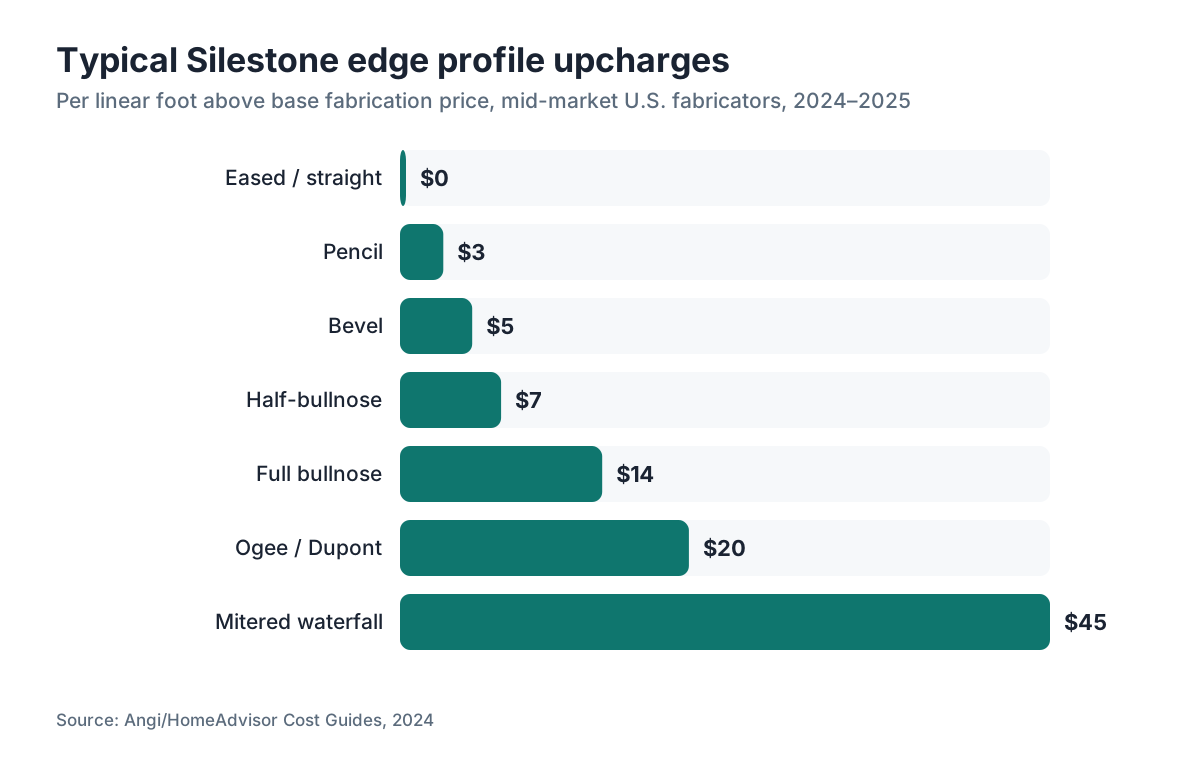
Standard profiles run one or two passes on a CNC edge polisher. They include the eased edge, pencil edge, bevel edge, and half-bullnose. Most fabricators fold one of these into the base countertop price, or charge a small upcharge (commonly $0 to $8 per linear foot). [2]
Premium profiles take multiple passes, more machine time, and often hand work at inside corners. Full bullnose, ogee, dupont, and mitered edges live here. Expect $10 to $30 per linear foot on top of base fabrication, with the mitered waterfall running highest because it eats extra slab for the vertical panel. [2]
The table below shows how common edge profiles stack up on complexity, cost, and best use.
| Profile | Passes on CNC | Typical upcharge (per LF) | Best for |
|---|---|---|---|
| Eased / straight | 1 | $0 (included) | Modern, minimalist kitchens |
| Pencil | 1 to 2 | $0 to $5 | Transitional, high-traffic areas |
| Bevel | 2 | $0 to $8 | Contemporary, easy to clean |
| Half-bullnose | 2 | $0 to $10 | Classic kitchens, family-friendly |
| Full bullnose | 3 to 4 | $10 to $18 | Traditional kitchens, islands |
| Ogee / Dupont | 4 to 6 | $15 to $25 | Formal, decorative kitchens |
| Mitered waterfall | Special setup | $30 to $60+ | High-end modern design |
Prices above reflect mid-market fabricator rates in 2024 to 2025. Actual numbers swing hard on region and shop overhead. [2][3]
How much do Silestone edge profiles cost in total?
Edge cost is always figured per linear foot of exposed edge, so a quick perimeter measurement tells you the damage before you ever call a fabricator. A U-shaped kitchen typically has 40 to 55 linear feet of exposed counter edge.
At an $18-per-linear-foot ogee upcharge, that's $720 to $990 tacked onto your quote. A simple eased edge on the same kitchen adds nothing. That gap is real money. Ask yourself whether you'll actually notice the detail from standing height on a run of counter against the wall.
For the full countertop project, Silestone runs $55 to $100 per square foot installed in most U.S. markets, depending on the collection tier (Entry, Mid, or N-Series), region, and complexity. [3] Edge profiles are a separate line item on top of that square-footage price. Some fabricators bundle a standard edge into their installed rate, so always ask which profile is included before you compare quotes.
Waterfall edges are their own beast. A true floor-to-ceiling waterfall panel needs a full extra slab section for the vertical drop. An island that stands 42 inches tall and runs 10 feet wide needs roughly 35 square feet of additional Silestone for one waterfall side, at full slab price. That can add $1,500 to $3,000 in material alone before labor. [3]
Fabricators running multiple Silestone jobs and tracking edge footage per job save real time with quoting software that auto-calculates edge complexity. SlabWise lets shops assign per-LF edge upcharges by profile type, so the line item lands on every quote automatically.
My honest advice: if budget is tight, pick the eased or half-bullnose, put the savings toward a better Silestone collection, and nobody walking into your kitchen will miss the ogee.
Which edge profile is most durable on quartz?
Eased and full bullnose edges chip the least. They leave the most material in cross-section and have no thin ridge to catch a dropped pan. Quartz is hard (Mohs hardness around 7), but any edge chips at its thinnest point, and the profiles that end in a sharp or narrow shape carry the highest risk.
Ogee and dupont profiles have a concave groove that leaves two relatively thin ridges of stone. Pull a heavy cast-iron pan across the counter and catch the edge wrong, and those ridges can chip. That's more of a worry on natural stone, but it's not zero on quartz.
Eased edges have a flat face with only a tiny top chamfer, so they keep the maximum material behind the detail. Full bullnose rounds the whole edge into a smooth arc with no thin point anywhere. Half-bullnose sits between the two.
Households with young kids should look hard at the full bullnose. The rounded profile has no hard corner to catch a small head at counter height. Kitchen designers have pointed this out for decades. It's not a new idea.
The bevel edge ends in a somewhat thin top ridge, so it chips a little more readily than a plain eased edge. In a quality quartz like Silestone under normal kitchen use, that difference is small.
Going with a 2 cm slab (thinner than the standard 3 cm)? Stick to simpler profiles. Cosentino recommends 3 cm minimum for Silestone because the thinner slab leaves less material at the detail, and complex profiles like ogee get structurally marginal at 2 cm. [1]
What is the most popular Silestone edge profile for kitchens?
The eased edge is the single most common choice today, especially on Silestone, which skews modern. Nobody publishes rigorous sales data on edge profile popularity, so the honest answer comes from fabricator surveys and design reports, not hard statistics.
The National Kitchen and Bath Association's design trends surveys consistently show straight and eased edges plus simple beveled edges dominating contemporary and transitional kitchens, while bullnose stays the most common pick in traditional-style homes. [4] The move toward flat-face eased edges picked up speed with slab-front cabinetry and minimalist design around 2015 to 2018, and it hasn't reversed.
Compared to granite countertops, Silestone leans modern, which is why the eased edge wins so often. The half-bullnose is a close second. It looks clean from the side and kills the hard top corner without looking ornate.
Ogee profiles peaked during the mid-2000s granite boom. They aren't gone, but fabricators report fewer requests than a decade ago.
Mitered waterfall edges show up all over kitchen design media, but they're still a small slice of real projects because of the cost. They look spectacular on islands in magazine shoots. They almost never appear on secondary counters where the vertical face isn't in the main sightline.
Remodeling to sell? Go eased or half-bullnose. Both read as current without polarizing a single buyer.
Can you mix edge profiles on different sections of your countertops?
Yes, and fabricators do it all the time. The usual play is a standard edge on the perimeter counters and a more decorative profile on the island, where the edge shows from multiple sides of the room.
Mixing profiles on the same run of counter (say, ogee on the front edge and eased on the back edge near the wall) is rare and rarely worth it. Fabricators usually charge for the premium profile across the whole setup anyway, more than the feet where it's cut.
No rule stops you from running two profiles in one kitchen, but keep a couple of things in mind. Visual consistency comes first: profiles from very different families (ogee island, stark eased perimeter) can feel disjointed unless the rest of the room has enough going on to bridge them. Resale comes second: mixing profiles is a personal call that may not click with every buyer.
One smart move is matching the edge to the cabinetry detail. Shaker cabinets with a slight bevel on their door profiles pair well with a beveled or half-bullnose counter edge. Flat-panel slab cabinets look best with an eased edge. Raised-panel traditional cabinetry works with ogee or full bullnose.
For islands, running the waterfall on the two short ends only is a common, cost-effective compromise. You get the dramatic floor-to-ceiling look where people see it, without buying extra slab for the long sides.
How does a fabricator actually cut a Silestone edge profile?
Most modern shops cut straight lines on a CNC bridge saw and shape the edge on a CNC edge polishing machine (sometimes the same integrated machine). The edge machine runs diamond tooling in a set of profiled wheels, each one cutting part of the final shape.
A simple eased edge takes one or two passes: a flat polish on the face and a small chamfer on top. A full bullnose runs four to six passes with progressively shaped wheels that build the arc bit by bit. Each pass needs a tool change or a different spindle, which is exactly why premium profiles take longer and cost more.
After the machine passes, a hand finisher checks the profile, especially at inside corners and cutouts where the wheels can't reach. The sink cutout always gets finished by hand. Ogee profiles at inside corners (like a peninsula return) need careful hand blending to make the S-curve meet cleanly.
Polish level matters too. Silestone's standard finish is a mirror polish. Order a leathered or honed Silestone and the fabricator has to match that finish on the edge, which takes extra work. Honed edges on quartz aren't difficult, but leathered quartz edges need specific tooling.
Some fabricators also offer a laminated edge, where a strip of the same Silestone gets glued to the underside of the slab edge to build a thicker look (commonly a 1.5-inch or 3 cm appearance from a thinner slab). That's standard practice with laminate countertops but less common on quartz, since 3 cm slabs are already thick enough for most profiles. [5]
How does the edge profile affect cleaning and maintenance?
Eased and bevel edges are the easiest to wipe down. Their flat face and simple geometry give a damp cloth nothing to snag on. Quartz is non-porous and needs no sealing, which is one of its big advantages over natural stone, so with any profile the issue is trapped debris, not stains. [1]
Ogee and dupont profiles have a concave groove that catches crumbs, grease, and cleaning-product residue. In a busy kitchen, that groove wants a toothbrush or a detail cloth a few times a week to stay clean.
Full bullnose edges wipe easily in a single arc across the top but are harder to clean underneath, especially where the counter overhangs a cabinet face. The curved underside collects drips that are awkward to reach.
Comparing surface types: cleaning a Silestone edge beats cleaning the same profile on marble countertops, because marble's porous surface can stain right in the groove. On quartz, the only concern is buildup. [6]
Where low maintenance is the priority, the eased edge wins on every metric. It looks clean because it is clean.
How do Silestone edge profiles compare to other quartz brands?
The edge options are essentially identical across Silestone, Caesarstone, Cambria, MSI Q Premium, and the rest, because independent stone shops fabricate all of them. The fabricator's equipment sets the menu, not the brand.
Where brands do differ: some, particularly Cambria countertops, publish their own recommended edge lists and may set slightly different thickness minimums. Cambria recommends at least 3 cm for its most detailed profiles. Silestone makes the same call. [1][7]
The real variable is the fabricator. A well-equipped shop with current CNC edge machines can cut any profile on any brand of quartz. A shop running older gear may not do a dupont cleanly and will steer you toward simpler profiles. Ask to see physical samples of premium profiles in Silestone specifically before you commit.
Pricing differences by brand at the profile level are tiny, because labor dominates the cost. The same ogee upcharge applies whether you're running Silestone Eternal Calacatta or an MSI entry-level quartz.
Sourcing quoting data across brands and fabricators? Tools like SlabWise let shops build profile upcharges into pricing templates, so quote consistency doesn't hang on whoever picks up the phone that day.
What edge profile should you choose for a bathroom vanity?
For a bathroom vanity, spend on the profile if it's a master bath and save on it in a kids' bath. Vanity tops carry short lineal footage (often 10 to 20 feet total including two sinks), so the dollar gap between standard and premium is smaller. A $20-per-linear-foot ogee upcharge on a 15-foot vanity adds $300. Real money, but a smaller slice of the project than on a full kitchen.
Design-wise, you view bathroom counters mostly straight on. You stand at the sink looking into the mirror, and the edge sits in your peripheral vision, which makes the profile more visible per square foot than on a kitchen counter. A premium profile lands a bigger proportional design hit in a bathroom.
Bullnose is very common in traditional master baths. Eased edges dominate contemporary spa-style baths. Ogee shows up in formal traditional baths and powder rooms where the counter is the focal point.
For a hall bath or kids' bath, the eased or half-bullnose saves money and shrugs off rough use. For a master bath where you're already spending on tile and fixtures, $15 to $20 extra per linear foot on a profile you'll see every morning is easy to defend.
One thing to watch: vanity tops sometimes have integral backsplashes fabricated as part of the slab. The profile on the backsplash top edge should match or complement the counter edge. Most fabricators match them automatically, but confirm it in your quote.
How do you specify edge profiles on a countertop quote?
Name the exact profile on the quote. A vague line that just says "edge included" without naming which one is one of the most common sources of dispute at installation. Edge profile belongs in the quote document alongside slab color, finish, thickness, and sink cutout type.
A proper edge spec lists the profile name, which sections it covers (all exposed edges, island only, perimeter only), and the upcharge per linear foot with the total footage called out. Mixing profiles? Each one needs its own line.
Ask the fabricator to show you a physical edge sample, not a photo. Photographs of stone edges are notoriously unreliable for conveying the actual geometry. A physical sample on a piece of your Silestone color (or at least a close color and finish) is worth requesting.
For fabricators: edge profiles are one of the most under-specified line items in countertop quotes, and they drive a steady stream of change orders. Building a profile library with standardized upcharges into your quoting process kills the ambiguity. Call out the standard edge explicitly as included at no upcharge, so the customer knows what they're getting without asking.
For homeowners comparing quotes: if one fabricator includes a half-bullnose in the base price and another charges $8/LF extra, those quotes aren't directly comparable. Normalize to the same edge profile before you compare totals. [2]
Check the countertop installation process with your fabricator too, because some profile choices (especially waterfall mitered panels) need special delivery and installation equipment.
Does the edge profile affect how thick your Silestone countertop looks?
Yes, and most people underestimate it. Perceived thickness depends as much on the edge profile as on the actual slab. The profile decides whether a counter reads heavy or light.
Silestone comes in 1 cm, 1.5 cm, 2 cm, and 3 cm thicknesses. The 3 cm (about 1.25 inches) is by far the most common for kitchen counters, because it looks substantial without an underlayment buildup and handles most edge profiles well. [1]
A full bullnose on a 3 cm slab emphasizes the full arc of that thickness, so the slab looks exactly as thick as it is. An eased edge on the same slab shows the front face honestly.
A mitered edge fakes the look of a 6 cm or even 8 cm slab by attaching a vertical strip of matching Silestone under the edge. It's purely cosmetic thickness, but it works. High-end kitchen design often specs a mitered edge to get a sculptural look without the weight and cost of a truly thick slab.
Laminated edges (gluing a strip of matching material under the edge to fake thickness) show up in quartz fabrication but run more common with corian countertops and solid surfaces. On Silestone, fabricators usually reach for the mitered technique instead for thick-look edges.
Want a thin, delicate look? An eased edge on 2 cm Silestone reads crisp and light. That's a favorite in contemporary baths and laundry rooms.
Frequently asked questions
Is the edge profile included in Silestone's price?
Silestone is priced per square foot as a slab product; edge profiles are a fabrication cost your stone shop adds on top. Many fabricators include one standard edge profile (usually eased or half-bullnose) in the installed price. Premium profiles like ogee or mitered waterfall carry upcharges of $10 to $30 or more per linear foot. Always confirm which edge is included before comparing quotes.
What is the easiest Silestone edge profile to keep clean?
The eased edge (flat face with a tiny top chamfer) is the easiest to clean. It has no grooves or concave sections where crumbs and grease collect. Ogee and dupont profiles have a concave channel that needs regular detail cleaning with a soft brush. Quartz is non-porous, so staining isn't the concern, but debris buildup in grooved profiles is real in a busy kitchen.
What is a waterfall edge on Silestone and how much does it cost?
A waterfall edge runs the slab vertically from the counter surface down to the floor on the ends of an island or cabinet run, making one continuous stone panel. It's a fabrication technique (a mitered joint) as much as an edge profile. Material alone adds $1,500 to $3,000 per waterfall side, because a full extra panel of Silestone is required, plus higher labor for the mitered joint and installation.
Can Silestone be cut to any edge profile shape?
Practically speaking, yes, if your fabricator has the CNC tooling for it. Silestone and other engineered quartz machine much like natural stone. Very elaborate custom profiles are possible but need custom tooling or heavy hand work, which gets expensive. For anything beyond standard catalogue profiles, get a written quote and ask to see a test sample on a scrap piece before committing.
What is the difference between an ogee and a dupont edge profile?
Both are S-shaped profiles with concave and convex curves, and many fabricators use the terms interchangeably. Technically, a true ogee has the concave curve on top transitioning to convex below, while a dupont (sometimes called eased ogee or modified ogee) has a flat or eased top leading into the S-curve. The visual difference is subtle. Ask your fabricator to show you a physical sample of each.
Does the edge profile affect the structural strength of Silestone countertops?
Mainly at thin points. Profiles that leave a narrow ridge of material (like the top crest of an ogee) are more prone to chipping from impact than flat-faced eased edges, which keep the maximum material in cross-section. Cosentino recommends a minimum 3 cm slab thickness for decorative profiles on Silestone. In normal kitchen use, any standard quartz profile on 3 cm material is plenty strong.
How do I match edge profiles between Silestone countertops and a tile backsplash?
They don't need to match literally; they need to feel harmonious. A pencil-edge tile trim pairs well with an eased counter edge. A decorative bullnose tile trim pairs with a half or full bullnose counter edge. Ogee counter edges work with traditional tile trims. When in doubt, keep the counter edge simpler and let the backsplash tile do the decorative work.
Can I change the edge profile on existing Silestone countertops without replacing them?
A fabricator can re-profile an installed Silestone counter in place, but it's difficult, dusty work, and results depend on slab thickness and access. Going from a full bullnose to an eased edge is feasible because you're removing material. Going the other direction (adding complexity) is not, because you can't add stone back. For a big profile change, replacement is usually the more practical path.
What edge profile makes a small kitchen look bigger?
Eased and thin bevel edges keep the visual mass of the counter low, which reads lighter and makes counters feel less heavy in a tight space. Full bullnose and ogee profiles add visual weight, which suits larger kitchens better. Mitered waterfall edges on an island make a room feel bold but need enough floor space that the island doesn't become a dominant obstacle.
How long does it take a fabricator to cut a premium Silestone edge profile?
A standard eased or pencil edge adds minimal time to a CNC run. A full bullnose adds roughly 15 to 30 minutes per job for extra polishing passes. An ogee on a full kitchen perimeter (40 to 55 LF) might add 1 to 2 hours of machine and hand-finishing time. Mitered waterfall panels need separate CNC programming, extra setup, and careful templating, adding half a day or more to the shop schedule.
Does Silestone look good with a mitered edge?
Yes, particularly on solid colors and veined patterns where the mitered joint can be aligned to look continuous. Silestone's bookmatching is limited compared to natural stone because engineered quartz patterns are randomized, but a skilled fabricator can orient slab sections to minimize seam visibility at the miter. Bold veined collections like Eternal Calacatta Gold look especially dramatic on a mitered island edge.
What countertop edge profile holds up best for outdoor kitchens?
Silestone is not recommended for outdoor use because prolonged UV exposure can affect the polymer resin binders and cause color shift. For outdoor kitchens in general, granite or porcelain are better material choices. If you do use quartz outdoors in a covered, shaded setting, the eased or bullnose edge is most forgiving because it has no thin points to chip from thermal expansion cycles.
Are there any Silestone edge profiles that cost nothing extra?
Yes. Eased, pencil, and sometimes beveled edges are included at no upcharge by most fabricators as the standard edge profile. What counts as included varies by shop and by which edge they define as standard. Half-bullnose is free at some shops and carries a small upcharge at others. Always confirm the specific profile name in your quote document, more than the word 'standard'.
Sources
- Cosentino Group, Silestone Technical Sheet and Installation Guide: Cosentino recommends a minimum 3 cm slab thickness for Silestone when using decorative edge profiles; Silestone is non-porous and does not require sealing.
- HomeAdvisor (Angi), Countertop Edge Profiles Cost Guide: Standard countertop edge profiles are typically included in base fabrication pricing; premium profiles like ogee and full bullnose add $10, $30 per linear foot in most U.S. markets.
- HomeAdvisor (Angi), Silestone Countertop Cost Guide: Silestone countertops cost approximately $55, $100 per square foot installed depending on collection tier and region; waterfall edge panels add significant material cost.
- National Kitchen and Bath Association (NKBA), Design Trends Report: NKBA design trends surveys show straight/eased and bevel edges dominating contemporary kitchen design, with bullnose most common in traditional-style homes.
- Natural Stone Institute, Countertop Fabrication Guidelines: Laminated edges involve bonding a strip of matching material to the underside of the slab edge to create a thicker visual profile; standard practice varies by slab thickness and material type.
- Natural Stone Institute, Quartz Surface Product Information: Engineered quartz surfaces are non-porous and do not require sealing, distinguishing them from natural stone in maintenance requirements, including at edge profiles.
- Cambria, Surface Care and Technical Specifications: Cambria recommends a minimum 3 cm slab thickness for its most detailed decorative edge profiles, consistent with similar guidance from other engineered quartz manufacturers.
- U.S. Bureau of Labor Statistics, Producer Price Index for Cut Stone and Stone Products: Stone fabrication labor and materials prices serve as a benchmark for regional variation in countertop fabrication costs including edge profile upcharges.
- U.S. Census Bureau, American Housing Survey: Kitchen remodeling is among the most common home improvement expenditures; countertops are a primary cost component in kitchen renovation projects nationally.
- Natural Stone Institute, Countertop Fabrication Tolerances and Methods: CNC edge profiling machines run diamond tooling in multiple passes to achieve decorative profiles; hand finishing is required at inside corners and cutouts regardless of profile type.
Last updated 2026-07-09