TL;DR
- Most marble countertops need resealing every 6 to 12 months.
- Dense marbles like Carrara can stretch past a year.
- The job takes about an hour, costs $15 to $50 in materials if you do it yourself, and needs a clean dry surface, an impregnating stone sealer, and a little patience.
- The water-drop absorption test tells you exactly when it's time.
Does marble actually need to be sealed?
Yes. Marble is a metamorphic rock made almost entirely of calcite, and calcite drinks liquids at a rate that would horrify you if you watched it in slow motion. Red wine can stain Carrara in under five minutes on an unsealed surface. Coffee and citrus juice can also etch marble even when a sealer is present, because etching is a chemical reaction with the calcite, not a staining problem a sealer can stop.
That distinction matters. A sealer slows liquid absorption, so it fights staining. It does nothing meaningful against etching. Put marble in a kitchen where someone squeezes a lemon over the counter, and the sealer buys you time to wipe it up. It doesn't make the stone invincible. You still clean spills fast.
Natural Stone Institute guidance says the porosity of marble varies a lot by variety [1]. Some dense, tightly crystallized marbles absorb almost nothing. Others are so thirsty that one coat of sealer lasts three or four months before the absorption test shows breakthrough. Knowing your specific marble sets your expectations.
How do you know when it's time to reseal marble?
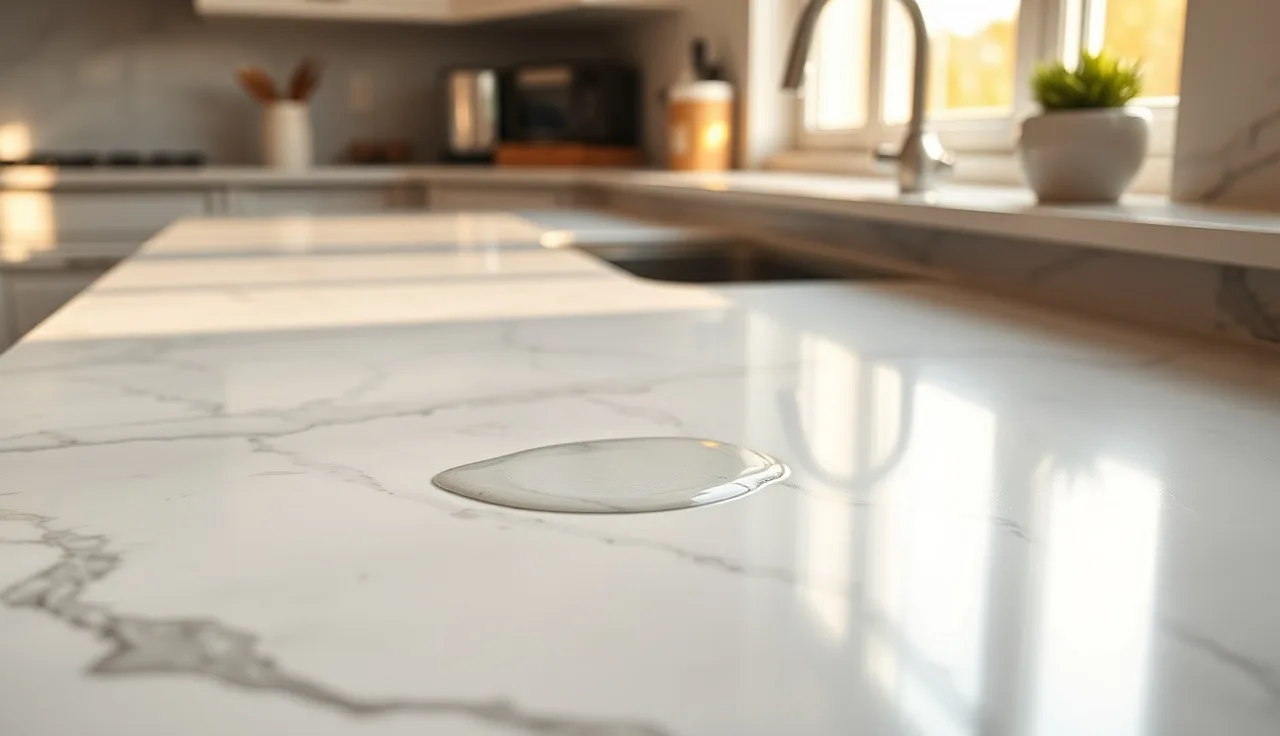
Run the water-drop absorption test. Put a quarter-sized puddle of water on the counter in a spot nobody looks at. Wait 10 minutes without wiping. If the stone darkens noticeably under the water, the sealer has worn off there and you're overdue. If the water beads and the stone stays the same color after 15 to 20 minutes, the sealer is still working [2].
Run the same test with a small puddle of cooking oil, which has bigger molecules than water. If water beads but oil absorbs, you have partial protection. If both bead, you're covered. If both soak in, seal now.
Beyond the test, a few signals tell you the same story:
- Spills soak in faster than they used to.
- The surface looks dull even right after cleaning, sometimes a sign that residue from absorbed liquids sits below the polished layer.
- You haven't resealed in over a year and you use the counter every day.
High-traffic kitchen marble next to a cooktop probably needs the test every six months. Bathroom vanity marble in a guest bath might pass the test two years running.
What type of sealer should you use on marble?
Use an impregnating sealer, also called a penetrating sealer. These soak into the pores and cure below the surface, so they don't change the look of the marble and they don't peel or chip. Topical sealers (waxes and coatings that sit on top) are wrong for polished marble. They cloud the finish, wear unevenly, and trap moisture.
Within impregnating sealers, you pick between two chemistries:
| Chemistry | Protection | Reapplication interval | Typical cost |
|---|---|---|---|
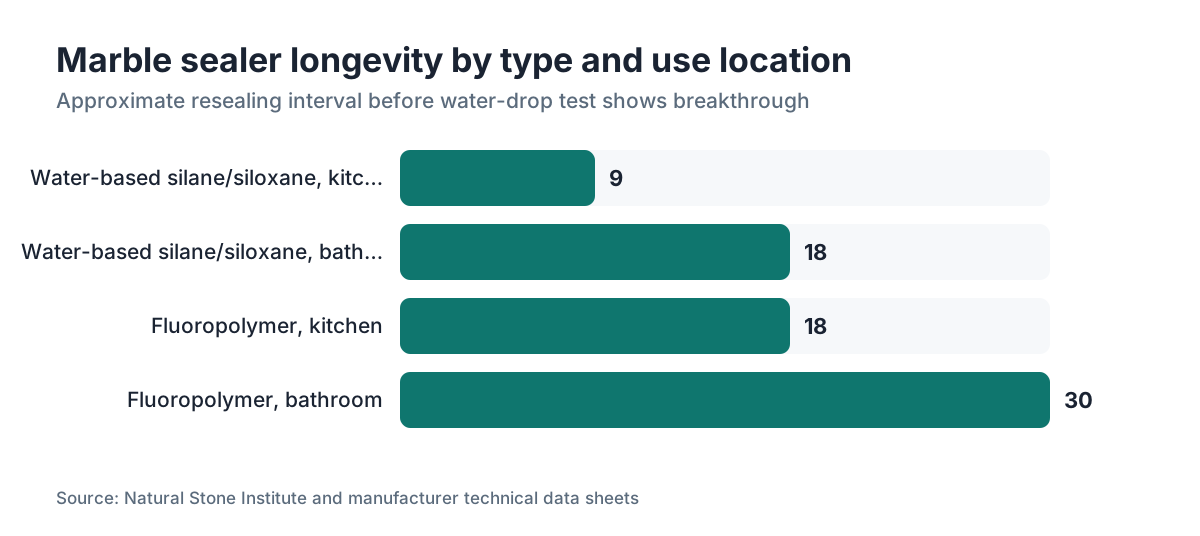
| Silane/siloxane (water-based) | Good stain resistance | 6 to 12 months | $15 to $30 per bottle |
| Fluoropolymer (solvent-based) | Better oil and water resistance | 1 to 3 years | $25 to $60 per bottle |
For a kitchen counter, a fluoropolymer-based impregnating sealer usually earns the extra cost, because cooking oil is harder to repel than water. For a bathroom vanity, either chemistry is fine.
Brand-name products you'll see at stone suppliers and home centers include StoneTech BulletProof, Aqua Mix Sealer's Choice Gold, and Miracle Sealants 511 Impregnator. None of those mentions is paid placement. They just show up over and over in stone fabricator supply channels. Whatever you buy, check the label that it's rated for polished or honed marble. Some products are built for granite or other stones and behave differently on calcite [3].
For how different stone types respond to sealers, the guide on how to clean stone countertops covers porosity by material in plain terms.
How do you reseal a marble countertop step by step?
The process is simple. A few details separate a sealer job that lasts 18 months from one that quits in four.
Step 1: Clean the surface properly Use a pH-neutral stone cleaner. No vinegar, no bleach, nothing with lemon, no general all-purpose kitchen spray. Most household cleaners are acidic or alkaline enough to etch marble or leave a film that blocks the sealer. Wash the surface, then let it dry completely. In humid weather that can take a few hours. The stone has to be genuinely dry for the sealer to penetrate instead of sit on top.
Step 2: Check the temperature Work in a room between 50 and 80 degrees Fahrenheit. Below 50, the sealer may not cure right. Above 80, it can flash off (evaporate) before it soaks in. Most product instructions call for this range [4].
Step 3: Apply the sealer Apply with a clean lint-free cloth or a foam applicator. Work small sections, maybe 2 square feet at a time. Put down enough to wet the surface without flooding it. You don't want pools of sealer sitting on a polished top.
Step 4: Wait for penetration Dwell time varies by product, usually 5 to 15 minutes. Watch the surface. You want the sealer to start absorbing, which looks like the stone going slightly darker in patches. If it pools and shows no absorption after five minutes, an existing sealer or a factory coating is blocking penetration. That's a separate problem, covered below.
Step 5: Wipe off the excess Before the sealer hazes over, wipe off all the excess with a dry cloth. Any sealer that dries on the surface leaves a cloudy residue that's a pain to remove. On a big counter, work in stages so you're always wiping before it hazes.
Step 6: Apply a second coat if needed Heavy sealers on thirsty stone do better with a second coat 30 to 60 minutes after the first. With fluoropolymer sealers especially, two thin coats beat one heavy one.
Step 7: Cure before use Most sealers need 24 to 48 hours of cure time before the surface meets water again. Some newer formulas advertise a two-hour cure, but 24 hours is the safe number. Keep the counter dry through that window.
Hands-on time for a typical kitchen island, maybe 30 square feet of marble: about 45 minutes of real work plus the waiting.
How long does marble sealer last?
It depends on the marble, the sealer chemistry, and how hard you use the surface. Water-based silane/siloxane sealers on kitchen marble usually last 6 to 12 months before the absorption test shows breakthrough. Fluoropolymer sealers on the same surface often last 1 to 2 years. Bathroom marble with light daily contact can test fine after 2 to 3 years even with a mid-tier sealer.
The Natural Stone Institute says manufacturer claims of "lifetime" or "10-year" protection on impregnating sealers for marble come from laboratory conditions that rarely match a real kitchen [1]. Foot traffic, cleaning frequency, and the acidity of everyday spills all speed up wear.
Here's the safe rhythm: test every six months, reseal when the test says so, and don't fret about doing it more often than that. Over-sealing leaves haze on a polished surface and wastes product.
What if the sealer won't absorb into the marble?
This happens more than people expect, especially with newly fabricated marble or marble that came with a factory coating. If you apply sealer and it just sits there with no absorption for 10 minutes, one of a few things is going on:
- The slab still carries a factory resin or epoxy coating from the manufacturer. Those coatings block sealer penetration until they wear off, which can take months of normal use.
- A previous sealer coat hasn't fully worn off, so the stone isn't ready for another one yet.
- The stone is genuinely very dense and doesn't need sealing. Some white Italian marbles have such low porosity that the absorption test comes up clean for years.
In these cases, run the absorption test. If water still beads, the surface has protection, no matter where it came from. Don't force another coat onto a surface that won't accept it. You'll get haze and streaks without adding any real protection.
If you're sure the old sealer is worn off but new sealer still won't absorb, a stone-specific deep cleaner or a product labeled "sealer remover" or "efflorescence remover" can open the pores. Follow that with a 24-hour dry period before you try the sealer again.
How much does it cost to reseal marble countertops?
DIY resealing runs $15 to $60 for the sealer, depending on chemistry and bottle size. A 24-ounce bottle of a mid-tier impregnating sealer covers roughly 100 to 200 square feet, enough for most kitchens or bathrooms with plenty left for the next application.
Professional resealing costs more. Stone restoration pros typically charge $1 to $3 per square foot for a sealer application alone, or $3 to $8 per square foot bundled with cleaning or light honing [5]. For a 40-square-foot kitchen counter, that's $40 to $120 for DIY (sealer plus a fresh applicator cloth) against $120 to $320 for a pro.
The case for hiring a pro is mostly about prep. Someone who hones or polishes the marble before sealing can address scratches and etch marks that a DIY coat will simply lock in. If your marble is in good shape, DIY is the right call. If it has visible etching, scratches, or old staining, price out a professional restoration job that includes sealing.
Fabricators and shop owners quoting restoration work that includes sealing can track per-job material costs more accurately with software built for stone shops. SlabWise has a quoting tool designed for exactly this kind of job breakdown.
Can you reseal honed or matte marble the same way as polished marble?
Yes. The process and the products are the same. The difference is that honed marble is more porous than polished marble of the same variety, because polishing closes some surface pores. So honed marble usually drinks sealer faster, wants two coats more often, and may need resealing more frequently.
The absorption test works the same on honed marble. If anything, the darkening when water absorbs is easier to spot on a matte surface than on a mirror finish.
One wrinkle: honed marble hides etching better. The matte finish shows etch marks less dramatically than a high polish, where you catch every micro-scratch in the right light. But the calcite chemistry is identical, so acid still damages the surface at the same chemical rate. The sealer still doesn't prevent etching. It only slows liquid staining.
For how stone care shifts by material, the guide on how to clean quartzite countertops is a useful comparison, since quartzite gets confused with marble but has different porosity and sealing needs.
What common mistakes ruin a marble sealer job?
A handful of errors show up constantly:
Wrong cleaner before sealing. Vinegar is the worst offender. People clean marble with vinegar because it's "natural," then seal right over it, and wonder why the etch marks are still there and the sealer looks hazy. Vinegar etches marble, period. The Natural Stone Institute is blunt about it: "Never use vinegar, bleach, or other acidic or highly alkaline cleaners on marble" [1]. Clean with a pH-neutral stone cleaner.
Not letting the stone dry. Sealing over damp stone traps moisture under the sealer and can leave the stone milky or foggy. Wait at least two hours after cleaning in dry conditions, four or more in humidity.
Leaving excess sealer to dry on top. This is the number-one cause of haze and streaking. Wipe off excess before it flashes. Work in sections on a big counter.
Over-applying. A thick coat does not last longer than a thin one. The stone only absorbs so much. The extra either sits on top and hazes or wipes off. Two thin coats beat one thick one.
Topical wax or sealer on polished marble. It clouds the finish. Stick with impregnating sealers.
Sealing over existing stains. A sealer locks in whatever sits in or on the stone at application time. If there's an oil stain, pull it out with a poultice first, then seal. Otherwise you seal it in for good.
How do you remove old or failed sealer from marble?
If a previous sealer is hazing, clouding, or peeling, strip it before you apply a new coat. For impregnating sealers that failed without leaving a visible film, a good stone-specific cleaner and several passes with a scrub pad often open the pores enough for a fresh application.
For topical sealers, waxes, or coatings that left a visible residue, reach for a stone sealer remover. These are alkaline strippers built to break down sealer chemistry without etching the calcite. Follow the instructions closely. Most need dwell time, scrubbing, and a thorough rinse before the stone is clean.
In extreme cases where someone applied a commercial coating (sometimes flippers or previous owners who didn't know better), a stone restoration company may need to mechanically hone the surface back to bare stone. That's expensive, but it's the only way to fully reset a surface coated with something chemical strippers won't touch.
After any stripping, wait a full 24 hours before you test for absorption and seal. The stone has to be genuinely dry and chemically neutral for a new coat to work right.
Is sealing enough, or does marble need other regular care?
Sealing is one leg of a three-legged stool. The other two are daily cleaning and fast spill cleanup.
For daily cleaning, use a damp cloth or a spray bottle with water and a drop of neutral-pH dish soap, then rinse. Or use a dedicated pH-neutral stone cleaner. The list of things to keep away is long: no vinegar, no lemon, no bleach, no bathroom tile cleaner, no scrubbing powders. Any of those, used regularly, will etch and dull the surface faster than you'd believe [2].
For spills, the rule is wipe now. The sealer buys time, it doesn't erase risk. Wine, coffee, tomato sauce, citrus juice, and anything carbonated get wiped within a minute or two, not whenever you get around to it.
Sealer can't fix scratches or etch marks that already showed up. Minor etching on a polished surface can sometimes buff out with a marble polishing powder (a mildly abrasive compound that re-closes the top nanolayer of calcite). Deeper scratches and etching need professional honing and re-polishing, which is a bigger job.
Marble in a kitchen is a commitment to active maintenance. That's not a reason to avoid it. It's a reason to understand what you're signing up for before you choose it. The overview at marble countertops covers durability expectations across varieties, worth reading before you pick a type.
If you're weighing marble against lower-maintenance options, granite countertops and quartzite take sealers differently and resist etching a lot better.
Should fabricators include sealing in their installation process?
Most stone fabricators apply a sealer at the shop or at installation as part of their standard process, and that's good practice. Fabrication cuts fresh edges and surfaces that drink liquid before any sealer touches them. Getting sealer on before the counter goes into a home means it's protected from day one.
The complication is managing what the customer expects. Seal at installation but don't tell the homeowner, and they may try to reseal six months later (reasonable) or assume the stone is sealed for life (not reasonable). Clear documentation of what went on, when, and the expected resealing interval for that specific stone cuts down on callbacks.
Shops that do restoration alongside fabrication often bundle a first-year resealing visit into their service. Whether to offer that depends on the shop's model, but it's a real value-add on a high-end marble install. Tracking those service calls, their timing, and their material costs is the kind of detail that adds up across multiple jobs. Software built for stone shops, like SlabWise, helps quote jobs that break out sealing labor and materials separately.
For the install itself, the article on countertop installation has a solid breakdown of where sealing fits in the timeline.
Frequently asked questions
How often should you reseal marble countertops?
Every 6 to 12 months for kitchen marble that sees daily use, and every 1 to 3 years for bathroom marble depending on traffic. The water-drop absorption test beats any calendar: apply a puddle of water, wait 10 minutes, and reseal if the stone darkens beneath it. Dense marbles may pass the test for two years or more. Thirsty varieties may need resealing every three to four months.
What happens if you don't seal marble?
Unsealed marble absorbs liquids straight into its pores. Red wine can stain in under five minutes. Coffee and cooking oil leave permanent dark marks. Acidic liquids like citrus juice and vinegar etch the surface regardless of sealing, but on unsealed stone they stain too. The sealer doesn't make marble bulletproof. It gives you time to wipe up spills before they penetrate.
Can you use Pledge or any household product to seal marble?
No. Pledge and similar furniture polishes leave a waxy coating that can cloud marble's finish and doesn't work as a stone sealer. Generic spray sealers made for grout or tile are also wrong for marble. You need an impregnating stone sealer specifically rated for marble or calcareous stone. These sell at stone supply houses, tile showrooms, and home improvement stores.
Will sealing marble stop it from etching?
No. Etching is a chemical reaction between acid and the calcite in marble. It happens at the surface no matter what sealer sits below. Sealer protects against staining by slowing absorption. If lemon juice or vinegar sits on sealed marble, it still etches. The fix for etching is polishing the surface back out, not more sealer.
Can you reseal marble yourself, or do you need a professional?
For straightforward resealing on marble in good shape, DIY is completely reasonable and costs $15 to $60 in materials. The job takes about 45 minutes on a typical counter. A pro makes more sense when sealing gets bundled with honing, polishing, or stain removal, which need equipment and experience a homeowner doesn't have. If the marble has etch marks or scratches you want fixed, hire a stone restoration professional.
How long after sealing marble can you use it?
Most impregnating sealers need 24 hours before the surface can get wet. Some newer formulas claim a two-hour cure, but 24 hours is the safe number. During that window, keep the surface completely dry. After 24 hours the sealer has cured enough for normal use, though full cross-linking of some fluoropolymer sealers continues for up to 72 hours.
Is there a marble sealer that lasts forever?
No. Any product claiming permanent or lifetime sealing on kitchen marble is overstating what impregnating sealers can do. The Natural Stone Institute notes these claims come from laboratory conditions that don't match real kitchen use. In practice, even the best fluoropolymer sealers on a busy kitchen counter need reapplication every one to three years. Test regularly and reseal when the stone tells you it's time.
What is the best sealer for marble countertops?
For kitchen marble, a fluoropolymer-based impregnating sealer beats water-based silane/siloxane because it repels oil as well as water. Well-regarded products include StoneTech BulletProof, Aqua Mix Sealer's Choice Gold, and Miracle Sealants 511 Impregnator. Confirm the product is rated for polished or honed marble specifically. For bathroom marble with light use, a water-based impregnating sealer is plenty and costs less.
Can sealing marble make it look shiny or change its appearance?
A properly applied impregnating sealer should not visibly change how marble looks. If the stone looks shinier or has a wet look after sealing, too much sealer was left on the surface or a topical sealer got used instead of an impregnating one. On polished marble, excess sealer left to dry causes a hazy film. Wipe off all excess before it dries to avoid this.
Does Carrara marble need to be sealed more often than other marbles?
Carrara is relatively porous compared to denser marbles like Calacatta Michelangelo, but porosity varies a lot even within the Carrara classification. The absorption test is the only reliable way to know where your specific slab lands. In practice, most Carrara kitchen counters need resealing every 6 to 12 months with a quality impregnating sealer.
How do you reseal marble around the sink where it gets wet constantly?
The zone within about six inches of a sink is the most vulnerable part of any marble counter. Seal it the same way as the rest of the surface, but run the absorption test there more often, maybe every three months. Constant wet-dry cycling wears sealer faster in that band. Some fabricators put an extra coat around sinks at installation for exactly this reason.
Can you seal marble tile the same way as marble countertops?
Yes. The same impregnating sealer products and the same application process work for marble tile, whether on floors, backsplashes, or shower walls. One extra consideration with tile is the grout. Most grout is even more porous than the marble itself and needs sealing separately with a grout-specific sealer. Applying an impregnating stone sealer over both the tile and grout at once is common and acceptable.
What should you clean marble with before sealing?
Use a pH-neutral stone cleaner, sold at any stone supply house or home improvement store. Avoid vinegar, lemon-based cleaners, bleach, ammonia, and general-purpose kitchen sprays. These either etch the calcite or leave a film that blocks the sealer. After cleaning, rinse with plain water and let the surface dry completely before you seal, at least two hours in normal conditions.
How do you know if marble was already sealed by the fabricator?
Ask your fabricator directly and request documentation of what product went on and when. If that information isn't available, run the water-drop absorption test. If water beads for 15 minutes or more without the stone darkening, some sealer is present. If water absorbs and the stone darkens within a few minutes, either it was never sealed or the sealer has worn off. Either way, apply a fresh coat.
Sources
- Natural Stone Institute, Care and Maintenance for Natural Stone: Marble porosity varies by variety; manufacturer claims of lifetime sealing don't match real-world kitchen conditions; vinegar, bleach, and acidic cleaners should never be used on marble.
- Natural Stone Institute, Marble Care Guidelines: Water-drop absorption test at 10-15 minutes determines whether resealing is needed; pH-neutral cleaners recommended for daily marble maintenance.
- Marble Institute of America (now Natural Stone Institute), Dimension Stone Design Manual: Impregnating sealers should be confirmed as rated for the specific stone type, including calcareous stones like marble.
- StoneTech Professional, BulletProof Sealer Product Data Sheet: Sealer application temperature range of 50 to 80 degrees Fahrenheit required for proper cure and penetration.
- Angi, Stone Countertop Sealing Cost Guide: Professional stone sealing costs $1 to $3 per square foot for sealing only and $3 to $8 per square foot when bundled with cleaning or honing.
- U.S. Geological Survey, Marble Mineral Resources Data: Marble is a metamorphic rock composed primarily of calcite or dolomite, which are naturally porous and reactive with acidic substances.
- Aqua Mix by Custom Building Products, Sealer's Choice Gold Technical Data Sheet: Water-based impregnating sealers provide 6 to 12 months of protection on porous natural stone under normal use conditions.
- Miracle Sealants, 511 Impregnator Product Information: Fluoropolymer impregnating sealers repel both water and oil-based liquids and may extend protection intervals to one to three years on kitchen marble.
- Penn State Extension, Understanding Natural Stone and Its Maintenance: Topical sealers are not recommended for polished marble; impregnating sealers cure below the surface without altering appearance.
- University of Florida IFAS Extension, Household Cleaning Products and Surface Compatibility: Acidic household cleaners including vinegar (pH 2 to 3) chemically react with calcite-based stone surfaces, causing etching.
Last updated 2026-07-09