TL;DR
- Quartz comes in two real thicknesses: 2cm (about 3/4 inch) and 3cm (about 1-1/4 inch).
- Most US kitchens use 3cm because it skips the plywood substrate, looks substantial at the edge, and often costs less installed.
- 2cm is lighter and cheaper per square foot but needs a buildup board.
- Plan on 3cm adding $5 to $15 per square foot over 2cm material.
What thicknesses does quartz come in?
Quartz slabs get made in two practical thicknesses: 2 centimeters (roughly 3/4 inch) and 3 centimeters (roughly 1-1/4 inch). A third option, 1.2cm, shows up in some engineered-stone lines, but it lives on walls. Backsplashes, shower surrounds, vertical panels. You will almost never see it offered as a horizontal counter.
The 2cm and 3cm labels come from the nominal slab thickness at the factory, before any fabrication. The finished number moves a little. A 3cm slab usually measures between 28mm and 32mm depending on the brand and the color line. Cambria publishes its nominal 3cm slabs at 30mm with a +/-2mm tolerance [1]. Silestone and Caesarstone hold similar tolerances [10].
See a counter labeled 1-1/4 inch? That is 3cm. See 3/4 inch? That is 2cm. American contractors reach for inch fractions and the stone trade uses centimeters, but both point at the same two products.
What is the difference between 2cm and 3cm quartz?
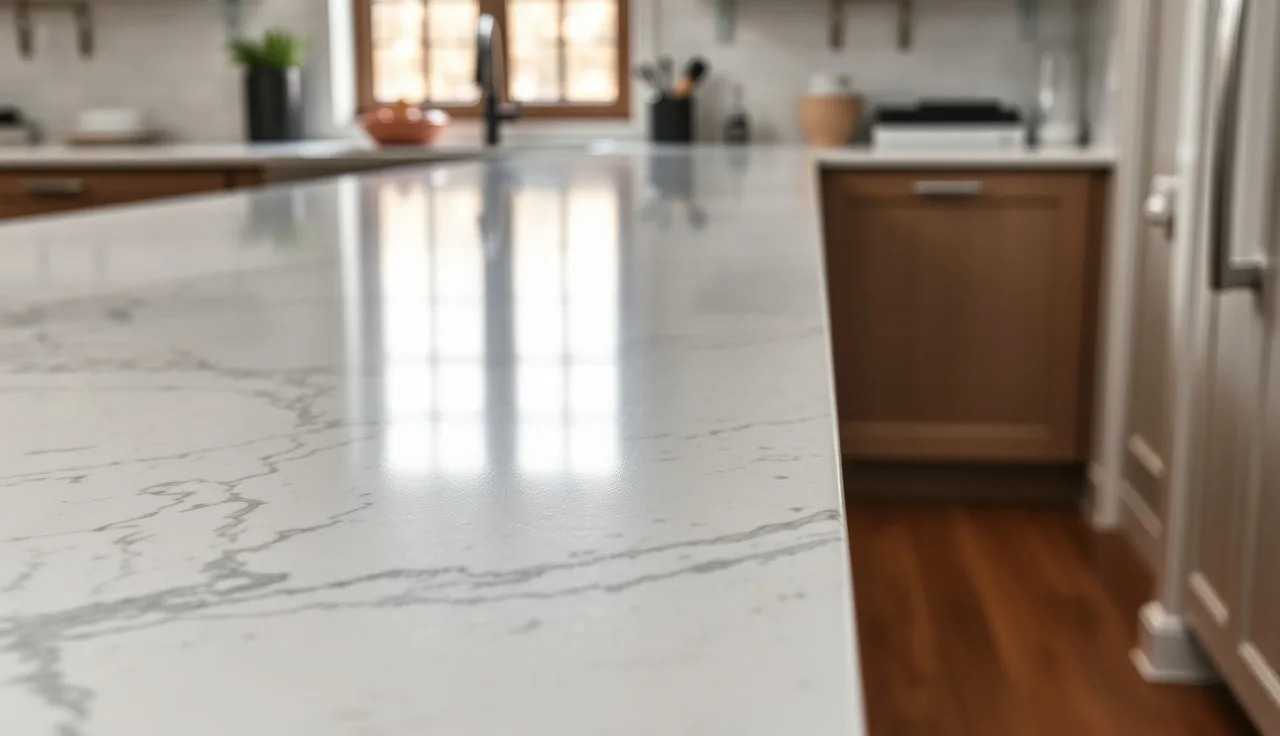
The edge is where you notice it first. A raw 2cm slab gives a thin, almost furniture-like finished edge. A raw 3cm slab reads chunky and substantial, the look most people connect with a high-end kitchen. That visible edge thickness moves perceived value more than almost any other choice you make on a counter.
Weight is the operational difference. A 3cm quartz slab runs about 18 to 20 pounds per square foot [2]. A 2cm slab runs about 12 to 13. On a 50-square-foot kitchen, that is 300 to 350 extra pounds sitting on your cabinets. Standard frameless and face-frame boxes carry that load fine, so weight almost never becomes a structural problem in a normal install.
Overhangs are where the structure actually matters. A 3cm slab holds an unsupported overhang up to about 12 inches before most fabricators reach for steel corbels. A 2cm slab tops out around 6 to 8 inches. Want a waterfall island with a 12 to 15 inch seating overhang? You are on 3cm, or you are buying bracket work.
Fabrication differs too. Thicker stone cracks less during cutting, routing, and transport. Shops cutting 2cm slow down around sink cutouts because the thin corners chip if you rush them.
Which thickness is more common for kitchen countertops?
3cm owns the US residential kitchen. Walk into most fabrication shops and 80 to 90 percent of the quartz on the floor is 3cm. Part of that is taste (thicker looks better to most buyers) and part is labor: 3cm skips the plywood or MDF buildup board, which cuts a whole install step.
The shift happened through the 2000s and picked up between 2010 and 2015 as quartz caught granite on price. Before that, 2cm granite and 2cm quartz were normal, and screwing a 3/4-inch plywood substrate under every run was just the job. Now most shops price 3cm as the default and treat 2cm as a special order or a budget line.
Bathrooms are where 2cm still earns its keep. Shorter spans, lighter cantilever demands, and less weight to hang when a floating vanity is riding on wall brackets. A 24-inch vanity top in 2cm with a laminated edge looks right.
For how thickness fits the whole selection process, see our kitchen countertops guide.
Does 2cm quartz need a plywood substrate?
Almost always, yes. When a fabricator sets 2cm quartz over standard base cabinets, they lay a 3/4-inch plywood or MDF buildup board on the face frame or rail first. The stone sits on that board. Continuous support, no flex, no cracks.
That board costs money and adds weight. Labor to cut, fit, and fasten plywood runs $3 to $8 per square foot depending on your market, and the material is another $1 to $2. So the per-square-foot savings on 2cm material often disappears once the substrate goes in. The math only clearly favors 2cm in bathrooms with short spans, or in commercial work where slab cost is high and the thin profile is the design.
Some shops skip the full deck and lean on continuous cabinet rails instead. That works over frameless boxes with 3/4-inch top rails spaced no more than 18 to 24 inches apart. Most fabricators still avoid it, because any flex in the cabinet transfers straight into the stone.
How does thickness affect countertop edge profiles?
This is where homeowners feel the choice most. The edge profile, meaning the finished shape of the front edge, looks different and prices different depending on whether you start with 2cm or 3cm.
On a 3cm slab, an eased edge or a bullnose costs almost nothing extra, because the fabricator is just polishing the raw slab edge. Ogee, dupont, or a heavy profile adds cost from the extra passes on the edge machine, but one thick piece of stone takes those shapes easily.
On a 2cm slab, any edge that needs to look thicker than 3/4 inch means lamination. Lamination is gluing a second strip of matching quartz under the front edge to fake a thicker profile. A double lamination brings 2cm up to a 4cm edge look. A triple hits 6cm, the dramatic mitered-waterfall range.
Lamination adds $15 to $40 per linear foot depending on complexity [3]. It also leaves a glue line on the edge face. Good shops match the material well enough that you cannot spot it from standing height, but in raking light the seam shows. 3cm has none of that.
| Edge option | Works on 2cm | Works on 3cm | Extra cost |
|---|---|---|---|
| Eased / flat | Yes | Yes | $0 |
| Beveled | Yes | Yes | $0-5/lf |
| Bullnose | Yes | Yes | $0-8/lf |
| Ogee | Yes, with lamination | Yes | $10-25/lf |
| Double laminated eased | Yes (creates 4cm look) | N/A | $15-30/lf |
| Mitered waterfall | Yes, with lamination | Yes | $40-80/lf |
How much does thickness affect quartz countertop cost?
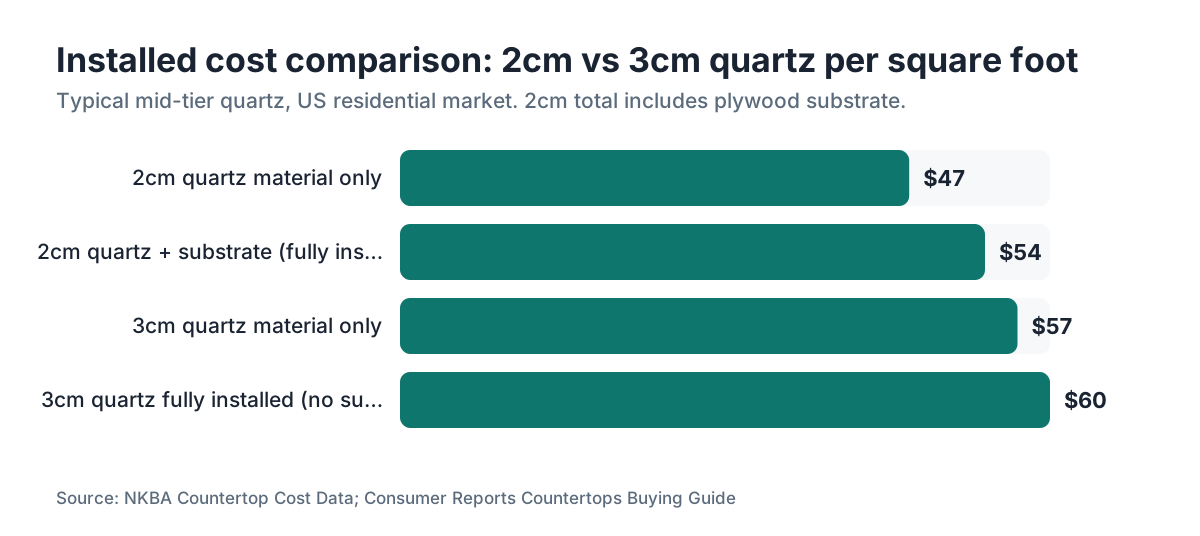
Raw material runs roughly $5 to $15 per square foot more for 3cm than 2cm. That gap shrinks or vanishes in a fully installed comparison, because 2cm carries a substrate charge that 3cm does not.
Here is a realistic breakdown for a 50-square-foot kitchen in a mid-tier color:
2cm installed: $40-55/sqft material + $5-8/sqft substrate = $45-63/sqft total 3cm installed: $50-70/sqft material, no substrate needed = $50-70/sqft total
The ranges overlap hard. In most real quotes, 3cm lands $0 to $10 per square foot over 2cm fully installed. Real, but smaller than people expect when they hear "2cm is cheaper."
Premium brands close the gap further. A high-end Cambria or Silestone color in 3cm might run $80 to $120 per square foot installed in a major metro [4]. Budget 3cm from a mid-tier brand might run $45 to $65 installed. Thickness is a real cost lever, just not the biggest one. Color, veining, and your local labor market move the number more.
For fabricators, track material cost per square foot by thickness tier and keep it consistent. Software like SlabWise builds thickness-specific tiers into your templates so a 2cm job prompts the substrate adder on its own.
What thickness quartz is best for kitchen islands?
3cm, with little argument. Islands push it for three reasons: overhangs, visual mass, and long unsupported runs.
Bar-height seating overhangs on an island usually run 12 to 15 inches. At that length, a 2cm slab wants steel corbels every 18 to 24 inches. That costs money and can look clunky. A 3cm slab carries 12 inches clean, in line with the Natural Stone Institute, which recommends a maximum unsupported overhang of one-third the total counter depth for natural and engineered stone [5].
Islands also tend to be the room's focal point. The extra mass at a 3cm edge just looks right, especially with a waterfall panel on one end. A waterfall in 2cm means matching mitered cuts on laminated strips. Possible, but more work and more cost.
For a standard 8-foot by 4-foot island (32 square feet), the material difference between 2cm and 3cm is maybe $160 to $320. The difference in how it looks and holds up is bigger than that. Spend the money.
Is 3cm quartz strong enough for a bathroom vanity?
Yes, and then some. 3cm quartz is more than strong enough for a bathroom vanity. It is arguably overkill on a 22-inch-deep top, which is exactly why 2cm keeps its spot in bathrooms.
The structural case for 3cm in a kitchen (long spans, heavy overhangs, no substrate) mostly does not apply to a 22-inch top sitting on a solid cabinet box. Short spans. Light loads. A 2cm slab with a laminated edge looks proportional and saves weight on a floating vanity.
One exception. If your top has an integrated vessel cutout, or an undermount sink with thin material between the cutout and the edge, 3cm gives you more stone to work with and cracks less during fabrication. Shops usually price less scrap risk into a 3cm vanity top.
For a double-sink vanity at 60 to 72 inches wide, either thickness works. Pick on the edge look you want, the weight your wall brackets can hold, and what your fabricator stocks.
How does quartz thickness compare to other countertop materials?
Quartz sits in the same thickness range as most natural stone, which tracks, since quartz is engineered to fabricate like stone. Granite comes in 2cm and 3cm, same as quartz, and the install logic is identical [6].
Marble is usually 2cm or 3cm too, though some imported slabs land at odd thicknesses near 18mm or 20mm. Quartzite, the natural stone (not engineered quartz), follows the same slab standards.
Laminate like Formica is typically 1.5 inches thick total, but that number is a 1.25-inch particleboard core with a thin surface on top. The actual surface layer is about 1/16 inch [7]. Its strength comes from the substrate, not the skin.
Solid surface like Corian usually runs 1/2 inch and wants a plywood substrate, much like 2cm quartz. Butcher block is normally 1.5 inches.
Here is how the main options line up:
| Material | Common thickness(es) | Substrate needed? |
|---|---|---|
| Engineered quartz | 2cm, 3cm | 2cm yes, 3cm no |
| Granite | 2cm, 3cm | 2cm yes, 3cm no |
| Marble | 2cm, 3cm | 2cm yes, 3cm no |
| Laminate (Formica) | 1/16" surface + core | Core is structural |
| Solid surface (Corian) | 1/2" | Yes |
| Butcher block | 1.5" | No |
For natural stone comparisons, see our guides on granite countertops and marble countertops.
Does quartz thickness affect how you clean or maintain it?
Barely at all. Quartz is non-porous whether it is 2cm or 3cm. It never needs sealing. Stain resistance, heat resistance, scratch resistance, all of that comes from the resin and binder content, not the slab thickness.
The one indirect link: thicker slabs shrug off thermal shock a hair better, because more mass absorbs a temperature differential. But the guidance is the same either way. Keep hot pots off any quartz surface, full stop. The resin binders that make quartz non-porous also make it prone to heat damage. Silestone's technical data puts sustained damage in the range of 300 to 400 degrees Fahrenheit and warns against direct placement of hot cookware [8].
Day to day, mild soap and water handles quartz. Skip bleach-based cleaners and harsh abrasives on polished finishes. Same rules for 2cm and 3cm.
Our how to clean stone countertops guide covers the full routine for engineered and natural surfaces.
What do fabricators need to know about cutting and installing each thickness?
The differences are real once the slab hits the shop. Handling, cutting, install.
On the saw, 2cm needs more support during the cut. If the outfeed side is not fully backed, the thin material flexes and cracks through the line. A bridge saw wants consistent outfeed tables or roller supports. CNC routers slow the feed rate around sink cutouts on 2cm to keep the corners from chipping.
Transport is riskier with 2cm. A standard A-frame rack works, but thin slabs crack easily if the rack is not padded and the load shifts. A broken 2cm slab on the truck is an expensive mistake.
Install runs faster on 3cm because there is no substrate to cut and set. The crew places stone straight on the cabinet rails with adhesive and epoxies the seams. 2cm needs a substrate run first, and that adds 30 to 60 minutes per job depending on layout.
Seam work is close for both. Same color-match standard, same joint gap. Some fabricators find 2cm seams easier to level because thin material needs less adjustment; others prefer 3cm because the mass holds position during clamping.
Shops quoting both thicknesses in one workflow do better with a system that tracks the substrate adder as its own line. Then the comparison stays apples-to-apples in the customer's quote. The SlabWise quoting engine splits material, fabrication, and installation into separate line items so the cost of each decision is visible.
Can you mix thicknesses in the same kitchen?
You can, but you usually should not. Mixing 2cm and 3cm in one continuous run creates a visible height mismatch at the seam unless you shim the thinner piece up, and shimming builds in a point-load risk. Most fabricators call that bad practice.
Mixing works in separate zones. Perimeter counters in 3cm and an island in 3cm is consistent. A 2cm quartz backsplash behind the range works fine as a design feature, because it is a vertical surface that never meets the horizontal top at a seam.
Some designers spec 3cm for kitchen counters and 2cm for bathroom vanities in the same house, ordering both from one quartz color to match. That is common and legitimate. Different rooms, so the thickness gap never shows.
Frequently asked questions
What is the standard thickness for quartz countertops?
3cm (about 1-1/4 inch) is the standard for US residential kitchen counters. It needs no substrate, holds unsupported overhangs up to about 12 inches, and gives a substantial edge. 2cm (about 3/4 inch) is available but less common in kitchens, showing up mostly in bathrooms, commercial work, and jobs where weight matters.
Is 2cm or 3cm quartz better?
3cm is better for most kitchens. It skips the plywood substrate, carries longer overhangs, and reads more substantial at the edge. 2cm earns its place in bathrooms and lighter-duty jobs where the thin profile suits the design and the savings are real. For an island or any counter with a seating overhang, 3cm is the clear pick.
How much does 3cm quartz weigh per square foot?
A 3cm quartz slab weighs about 18 to 20 pounds per square foot. A 2cm slab weighs about 12 to 13. On a 50-square-foot kitchen, that is roughly 900 to 1,000 pounds for 3cm versus 600 to 650 for 2cm. Standard cabinets carry either load without a structural concern.
Does thicker quartz cost more?
Raw 3cm slab runs about $5 to $15 per square foot over 2cm. But 2cm needs a plywood substrate at $4 to $10 per square foot installed, which narrows the gap. Fully installed, 3cm is usually $0 to $10 per square foot more than 2cm, depending on your market and the material.
How thick is a quartz countertop edge profile?
The visible edge matches the slab thickness unless the fabricator adds lamination. A 3cm slab shows a roughly 1-1/4-inch edge. A 2cm slab shows 3/4 inch. Want a thicker edge on 2cm? The fabricator glues a strip of matching quartz underneath, called lamination, which adds $15 to $40 per linear foot.
Can quartz countertops be 1 inch thick?
Not in standard slab form. Quartz comes in 2cm (3/4 inch) and 3cm (1-1/4 inch). There is no standard 1-inch quartz slab. A counter described as 1 inch is likely a 2cm slab with lamination added to build up the edge, or the measurement is just approximate.
How far can a 3cm quartz countertop overhang without support?
The Natural Stone Institute recommends a maximum unsupported overhang of one-third the total counter depth. On a 25-inch-deep counter, that is about 8 inches. Many fabricators push to 12 inches on 3cm quartz with solid cabinet support. Anything past 12 inches needs steel corbels or brackets regardless of thickness.
Is 2cm quartz OK for a bathroom vanity?
Yes, 2cm is a good pick for most bathroom vanities. Short spans, light loads, and a thin profile that looks proportional on a 22-inch top. It also weighs less, which helps on floating wall-mount vanities. Make sure the fabricator adds a plywood substrate unless the cabinet gives continuous support.
What is quartz slab lamination and when is it used?
Lamination is when a fabricator bonds a strip of matching quartz under the front edge to make a thin 2cm slab look thicker. A double lamination creates a 4cm edge look. It adds $15 to $40 per linear foot and leaves a faint glue seam on the edge face, visible in raking light. It is mainly used on 2cm counters where the customer wants a thick edge.
Does quartz thickness affect heat resistance?
Slightly, but not enough to change how you use the surface. Thicker slabs have marginally more mass to absorb heat, but the resin binders in all quartz can take damage above roughly 300 to 400 degrees Fahrenheit. Use a trivet regardless of thickness. The gap between 2cm and 3cm is not meaningful here.
What thickness of quartz is used for a waterfall island edge?
Waterfall islands are almost always 3cm quartz. The vertical panel is cut from matching slab and mitered at 45 degrees to meet the top. In 2cm it is possible with careful lamination and miter work, but most fabricators prefer 3cm because the thicker material is more forgiving to cut and the miter holds better with less stress on the glue surface.
How does quartz thickness compare to granite thickness?
They are identical in standard form. Granite, like quartz, comes in 2cm and 3cm. The install rules match: 2cm granite needs a plywood substrate, 3cm granite does not. Overhang limits, edge profile options, and lamination techniques carry over directly between quartz and granite.
Can you tell the difference between 2cm and 3cm quartz by looking at it?
Yes, at the edge. The top surface looks the same at any thickness. But the front edge is visibly thinner on 2cm, roughly 3/4 inch versus 1-1/4 inch. Set side by side, most people spot it instantly. On its own, a 2cm counter with a laminated edge can look nearly as substantial as 3cm.
Sources
- Cambria - Product Specifications and Tolerances: Cambria publishes nominal 3cm slabs at 30mm with a +/-2mm manufacturing tolerance
- Ceramic Tile Distributors Association (CTDA) / Stone industry technical references on slab weight: 3cm quartz slab weight is approximately 18 to 20 pounds per square foot; 2cm is approximately 12 to 13 pounds per square foot
- National Kitchen and Bath Association (NKBA) - Countertop Fabrication Cost Data: Edge lamination on 2cm countertops adds approximately $15 to $40 per linear foot depending on complexity
- Consumer Reports - Countertops Buying Guide: Premium quartz countertops in major metro markets run $80 to $120 per square foot installed
- Natural Stone Institute - Fabrication and Installation Standards for Countertops: The Natural Stone Institute recommends a maximum unsupported countertop overhang of one-third the total counter depth for natural and engineered stone
- Natural Stone Institute - Granite Slab Standards: Granite slabs are manufactured in standard 2cm and 3cm thicknesses with installation requirements identical to engineered quartz
- NEMA - Standards for High-Pressure Decorative Laminate: High-pressure laminate countertop surface layer is approximately 1/16 inch thick; structural strength comes from the particleboard substrate
- Silestone (Cosentino) - Technical Product Data Sheet: Quartz resin binders begin to sustain damage at sustained temperatures around 300 to 400 degrees Fahrenheit; direct placement of hot cookware is not recommended
- US Geological Survey - National Minerals Information Center: Engineered quartz is among the most widely used countertop materials in US residential construction
- Caesarstone - Technical Specifications: Caesarstone publishes slab thicknesses at 2cm and 3cm with tolerances consistent with ASTM dimensional standards for engineered stone
Last updated 2026-07-10