TL;DR
- MGM Stone Fabrication is a full-service countertop shop that templates, CNC cuts, edges, polishes, and installs granite, marble, quartzite, and quartz.
- Residential countertops run $40 to $200 per square foot installed, driven mostly by slab grade and edge complexity.
- Knowing how any fab shop works, MGM included, helps you ask sharper questions and dodge expensive surprises.
What does a stone fabrication shop like MGM actually do?
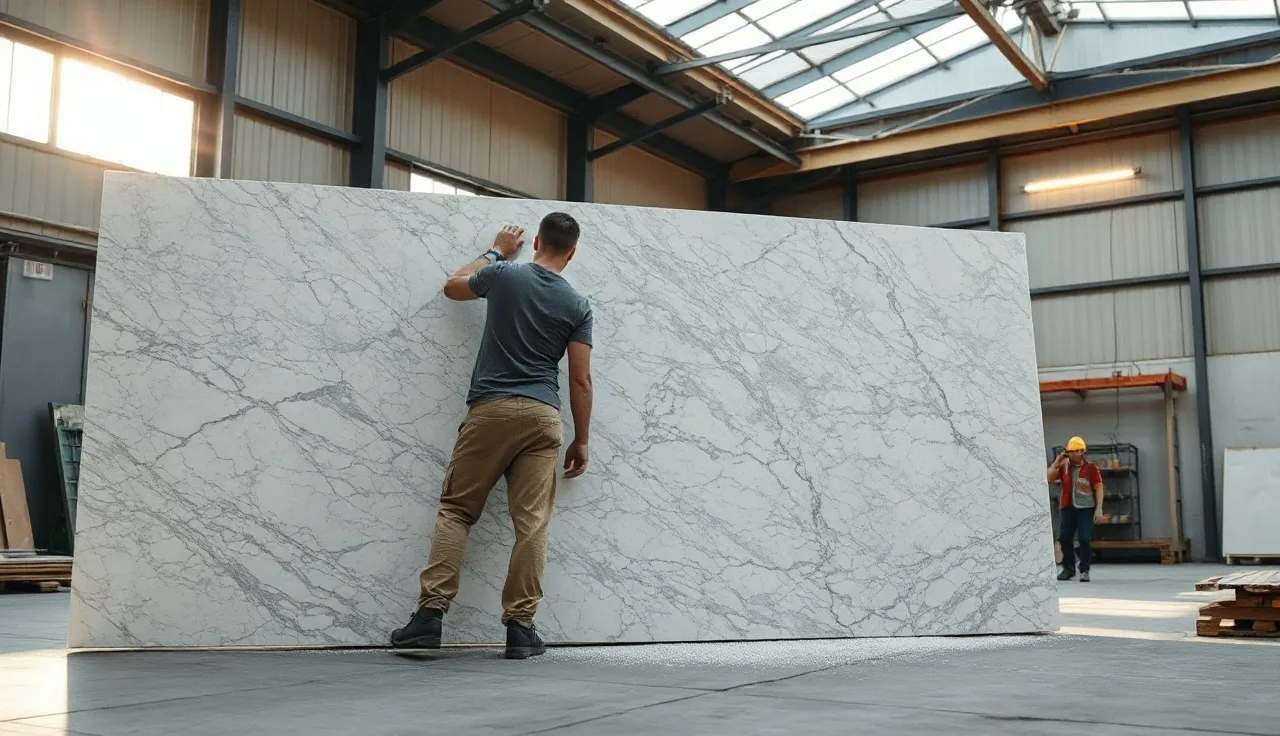
A fab shop turns a raw slab, usually 5 to 6 feet tall and 9 to 10 feet wide, into a countertop that fits your kitchen to the millimeter. It does not quarry stone. It does not warehouse hundreds of slabs for retail walk-ins. It buys slabs from a distributor, then templates, cuts, edges, polishes, and installs them.
The sequence at most professional shops runs like this. A technician visits after your cabinets are set and takes measurements, digitally or by hand. Back at the shop, the layout gets drawn onto the slab. A CNC bridge saw or waterjet cuts the pieces. An edge profile goes on with a CNC router or by hand. The finished pieces travel to your home, get glued to the cabinets with epoxy, and the seams and sink cutout get filled and polished.
That sink cutout deserves a second look. An undermount cutout done on a CNC router comes out clean and consistent. One hacked with a jigsaw by a green installer does not. This is where the quality gap between shops shows up first, and it's a fair thing to ask about before you sign.
Many shops also repair, re-polish, and resurface existing stone. Those services vary shop to shop, so ask.
What materials does a stone fabrication shop work with?
Most full-service shops cut the full spread of natural and engineered stone: granite, marble, quartzite, soapstone, limestone, travertine, and engineered quartz (Silestone, Cambria, MSI). Some also cut porcelain slabs and sintered stone, which need different tooling because they're dense and brittle.
Here's where the common materials tend to land on cost and upkeep:
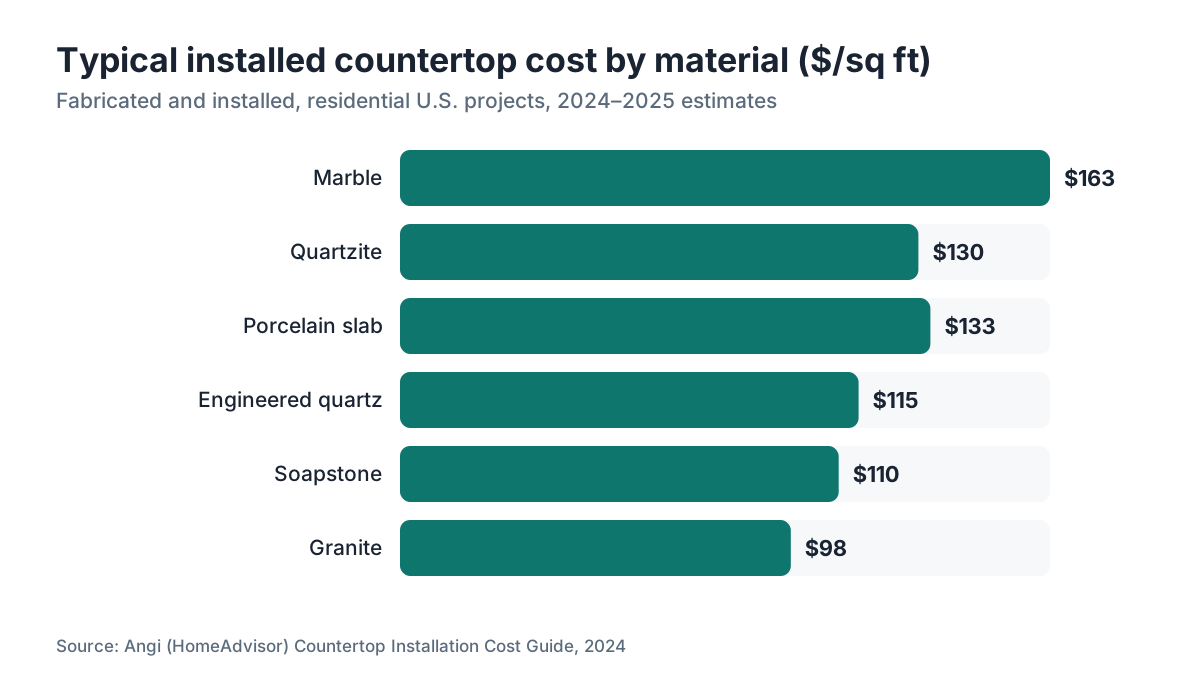
| Material | Typical installed cost ($/sq ft) | Sealing needed? | Hardness (Mohs) |
|---|---|---|---|
| Granite | $45, $150 | Yes, annually | 6 to 7 |
| Marble | $75, $250 | Yes, every 6 mo | 3 to 5 |
| Quartzite | $60, $200 | Yes, annually | 7 to 8 |
| Engineered quartz | $55, $175 | No | ~7 |
| Soapstone | $70, $150 | No (oil instead) | 1 to 2 |
| Porcelain slab | $65, $200 | No | 7 to 8 |
These are shop-fabricated-and-installed estimates based on national distributor and trade pricing for 2024 to 2025. They move with region, material tier, slab availability, and edge complexity. [1]
Granite is still the workhorse at most domestic shops, running around 40 percent of residential countertop volume in recent National Kitchen and Bath Association surveys. [2] The USGS tracks granite as the most widely used dimension stone in U.S. construction. [9] Engineered quartz has climbed steadily and now trades blows with granite in a lot of markets.
Comparing natural stone? The granite countertops and marble countertops guides lay out the tradeoffs in detail.
How does the templating process work at a fabrication shop?
Templating is the measurement step, and it's where mistakes get frozen in place. A bad template means a bad fit. No skill at the saw fixes a wrong number.
Older shops cut cardboard or luan templates on-site. The technician traces the cabinet perimeter, marks the sink and cook-top cutouts, and hauls the physical template back to the shop to lay on the slab. It works. It's also slow and easy to get wrong.
Digital templating with a laser device (the Prodim Proliner runs the U.S. market) captures points in the room and spits out a DXF or CAD file that feeds straight into the saw software. No transcription step. Shops on digital templating see fewer remakes and can send a job to the saw the same day the template lands.
Here's the practical part for homeowners. Ask how they template. Cardboard isn't an automatic red flag, but it stacks risk on complex shapes. If they say digital, ask one more question: does the DXF drive the saw directly, or does someone redraw it by hand in the shop? That redraw quietly adds error back in.
Most solid shops require cabinets fully installed and level before they template. Showing up before cabinets are level is a classic source of callbacks and do-overs.
What does stone fabrication cost, and what drives the price?
Fabrication pricing has two parts: material and labor. Most shops quote one all-in number per square foot, but knowing what sits under that number is how you compare bids without getting fooled.
Material cost rides almost entirely on the slab you pick. A commercial-grade Level 1 granite might cost the shop $4 to $8 per square foot in slab. An exotic Level 5 quartzite can run $25 to $45 per square foot or more at the distributor. That spread is why two quotes on different slab grades look like they came from different planets even when the labor is identical.
Fabrication and installation labor typically runs $30 to $80 per square foot on its own at domestic shops, and it's regional. Coastal metro markets sit near the top of that band. [1]
What else moves the number:
- Edge profile: an eased edge is in almost every quote. A mitered waterfall or a double ogee adds cost, sometimes $20 to $40 per linear foot.
- Sink type: an undermount cutout adds a charge, usually $75 to $150 depending on complexity.
- Seams: more seams mean more labor and more epoxy color-matching. An island needing two slabs joined costs more than one that fits on a single slab.
- Thickness: 3cm (about 1.25 inches) is standard and what most shops quote by default. 2cm is thinner, cheaper, and usually needs a plywood substrate. Some shops laminate a 2cm edge to fake the thicker look.
- Travel: shops set a delivery radius. Outside it, expect a trip charge.
A mid-range kitchen with about 55 square feet of granite, a standard eased edge, one undermount sink, and nothing weird tends to land between $2,800 and $5,500 installed in most U.S. markets. The range is wide because slab grade drives so much of it. [1]
How do fabrication shops handle seams, and where should they go?
A seam is a joint between two pieces of stone. They exist because a kitchen run often outruns a single slab, or an L-shape or island needs a separate piece. Good seam placement is part engineering, part judgment.
The rule most shops follow: put seams where they're least visible and least stressed. That means no seam directly over a sink (the spot most prone to flex and water) and none through a high-traffic stretch where weight lands over and over. The corners of a cook-top cutout are another weak point.
Seams get filled with color-matched epoxy and polished flat. On a dark, even stone like absolute black granite, a good seam nearly disappears. On heavy veining like a Calacatta marble, a sloppy seam screams. Some shops book-match or flow-match to carry the vein across the joint. It takes extra layout time and it looks far better.
Ask to see the slab layout drawing before the shop cuts a thing. Most professional shops will show you. The ones that won't are telling you something.
Engineered quartz follows the same seam logic, but the material is uniform, so getting the epoxy color right is easier.
What questions should you ask a stone fabrication shop before signing?
Any shop can make promises. These questions separate the shops that can keep them from the ones that can't.
-
Do you fabricate in-house or subcontract the cutting? Some small shops sell the job and ship the cutting to a larger fab house. Not automatically bad, but you should know whose hands are on your stone.
-
What's your lead time from template to install? The industry average for a standard job is 7 to 14 business days. A shop quoting 3 to 4 weeks may be short-staffed or oversold. A shop quoting 3 days is cutting a corner somewhere.
-
How do you handle damage during installation? Stone cracks. Ask flat out: whose liability is a break during install, and how fast can they pull a replacement from the same slab lot?
-
What's in the warranty, and for how long? One-year labor warranties are common. Some shops go 2 to 5 years on workmanship. No reputable shop warranties the stone against staining or etching, because those are maintenance issues, not defects.
-
Can I see the slab before you cut it? The answer should be yes, and you should go. Picking off a small sample is how you end up with dramatic veining in a spot you never wanted it.
-
Do you carry a contractor's license and liability insurance? In most states, a contractor doing countertop installation should carry general liability coverage, and many states require a license. Requirements vary by state, so check yours. [3]
Photograph the slab you pick, labeled with the lot number. It protects you if there's a dispute later about whether you got the slab you chose.
How do fabrication shops use technology and software to price and cut jobs?
The back office of a fab shop is more technical than most homeowners guess. A competitive shop in 2024 runs CNC saws, digital templating devices, nesting software, and quoting tools. That stack decides how fast a job moves from sale to install and how much waste comes out of each slab.
Nesting is arranging the cut pieces on the slab to waste as little as possible. A shop nesting by hand might lose 25 to 35 percent of a slab to offcuts. Automated nesting software often pulls that down to 15 to 20 percent. On a $600 slab, that's real money. [4]
Quoting software builds accurate line-item estimates fast, folding in edge footage, cutout charges, and material cost per square foot without rebuilding the math for every job. Shops running quotes on spreadsheets tend to underprice complex jobs and overprice simple ones, which hurts margin and confuses customers.
SlabWise is one example of quoting and nesting software built for countertop shops. If you run a shop and still estimate in spreadsheets, the payback on a software upgrade usually shows up quickly in fewer re-quotes and fewer pricing errors. You can request a demo at SlabWise.
For homeowners, this layer is invisible, but it shapes how fast you get a quote and how accurate it is. A shop that calls you back with a detailed written estimate the same day you sent measurements is almost certainly running software to build it.
How does stone installation actually work on the day of install?
Install day moves faster than most people expect and leaves almost no room for on-the-spot decisions. Knowing the flow keeps you from panicking.
The crew shows up with the cut and polished pieces, usually wrapped in moving blankets or foam. They check cabinet level first. If cabinets are out of level by more than about 1/8 inch over a 10-foot run, the stone can rock or the seam can open. Good installers carry shims and handle small level issues on the spot. Big level problems stop the install until a cabinet installer fixes them.
Pieces go in dry first to confirm fit. Once fit checks out, the substrate or cabinet rail gets a bead of 100% silicone or epoxy, and the pieces set for good. Seams get pulled tight with seam setters and filled with color-matched epoxy. Once the epoxy cures, usually 20 to 30 minutes, it gets razor-bladed and buffed.
Sink drop-in or undermount brackets go last. The plumber connects supply lines after the countertop crew leaves, so plan for the plumber the next day. This is a common scheduling miss: homeowners book the plumber for the same day, then scramble when the stone crew wraps at 4 p.m.
A standard kitchen install runs 2 to 5 hours for the stone crew alone. Complex layouts with many pieces or tricky seams run longer.
For the full picture, the countertop installation guide covers the pre-install checklist, what the crew needs cleared, and how to handle callbacks.
What are the most common complaints about stone fabrication shops, and how do you avoid them?
Read reviews for any shop, even a well-regarded one, and the same complaints repeat. Knowing them ahead of time lets you protect yourself.
Seam placement surprises. The homeowner never saw the layout drawing, the shop dropped a seam through the middle of a dramatic vein, and the result looks chopped up. Fix: review and approve the digital layout before cutting starts.
Install-day damage. A piece cracks during install or a chip appears on an edge. It happens. Ask upfront how the shop handles it: replace at their cost, or patch it and call it done? Get the answer in writing.
Longer lead times than quoted. A shop that says 10 days and delivers in 3 weeks is the single most common complaint in stone fab reviews. Get the lead-time commitment in the contract, more than a handshake at the showroom.
Mismatched slab. The homeowner picked a slab at the yard and the shop swapped a different one from the same lot without a word. Photograph the lot number and ask the shop to confirm in writing which slab they'll use.
Undermount fit issues. The cutout is slightly off and the sink clips don't line up. That's a fabrication error, not an installation error. It should be fixed by re-cutting, not by grinding the clips.
Etching and staining after install. Almost always a maintenance issue, not a defect, but it still lands as a complaint. Marble and limestone etch from acids, period. No shop can stop that. [5] The how to clean stone countertops guide covers what's safe and what wrecks natural stone.
How do you compare stone fabrication quotes fairly?
Three quotes for the same kitchen can look priced in different universes because shops don't quote the same way. One includes the sink cutout. One doesn't. One quotes 3cm. One quotes 2cm. One includes sealing. One bills it separately.
The only honest comparison forces every quote onto the same line items. Use this checklist:
- Square footage of stone (measure twice; some shops apply a per-piece minimum)
- Stone grade and the specific slab lot number or series
- Edge profile type and linear footage
- Number of cutouts and which type (undermount vs drop-in matters)
- Delivery and installation labor
- Sealing (first application)
- Removal and disposal of the existing countertop, if any
- Backsplash stone work, if included
If one quote comes in 30 percent under the others, find the line item that explains it. Usually it's the slab grade. Sometimes it's that they left out installation. Once in a while it's genuine efficiency. A 30 percent gap is almost never good luck.
You can also read costs for other materials like laminate countertops or Corian countertops to see where stone sits in the wider budget.
What should fabricators know about running a competitive stone shop?
Running a fab shop in 2024 isn't the business it was in 2010. Distributors consolidated. Labor got tighter. Engineered quartz took a bite out of granite. And customers walk in with more research than ever, often clutching quotes from three competitors.
The shops that hold margin do a few things without fail. They control slab waste. Nesting software pays for itself on material savings alone, usually inside 6 to 12 months for a shop doing 10 or more jobs a week. [4] They quote fast. A homeowner who gets a detailed written estimate within hours of sending measurements closes at a much higher rate than one who waits three days. And they specialize. A shop known for exotic stone and high-complexity edges charges more and pulls customers who aren't shopping on price alone.
Labor is the biggest cost most shops can't control. Finding and keeping skilled CNC operators and installers is the real headache right now. Some states run apprenticeship programs tied to local trade schools, and the Natural Stone Institute (formerly the Marble Institute of America) publishes training and certification resources for owners and crews. [6]
One more thing worth naming: silica. Dry cutting stone throws respirable crystalline silica, and OSHA sets the permissible exposure limit at 50 micrograms per cubic meter of air over an 8-hour shift. [10] Wet cutting and proper ventilation aren't optional. They're the law and they keep your people breathing.
For a shop quoting on spreadsheets, the first efficiency win is usually dedicated software. SlabWise is built for countertop quoting and nesting, and shops using it report cutting quote time by more than half. You can see how it works if that's the problem you're chewing on.
Pricing strategy counts too. Shops that race to the bottom win jobs and lose profit. A shop competing on turnaround, seam quality, and slab selection can hold 15 to 25 percent better gross margin than the low-price guy. Nobody has clean published data on fabrication margins specifically, but wholesale distributor surveys suggest well-run shops run 35 to 50 percent gross margin on material-plus-fabrication combined before overhead. [1]
How do you maintain and care for stone countertops after fabrication and install?
The shop's job ends the day the install ends. Everything after that is on you, and how you treat the stone decides how it looks in ten years.
Granite and quartzite need periodic sealing. A water test tells you when. Pour a few tablespoons on the surface and wait 10 minutes. Water beads, the seal is holding. Water soaks in and darkens the stone, it's time to reseal. Most granites want sealing once a year; some dense ones almost never need it. [7]
Marble and limestone etch on contact with acids. Lemon juice, tomato, coffee, wine, and most bathroom cleaners will etch marble. Etching is a chemical reaction, not a stain, so a cleaner won't touch it. A honed finish hides etching better than a high polish. The how to clean quartzite countertops and how to clean soapstone countertops guides cover those materials step by step.
Engineered quartz asks the least of you. No sealing, no oiling, just mild soap and water. The binder resins can discolor under long UV exposure, which is why quartz isn't recommended outdoors. [8]
Daily cleaning on any stone is simple: a pH-neutral cleaner or plain warm water. Keep bleach off marble and travertine. Keep vinegar off everything. The how to clean stone countertops guide has the product-by-product breakdown.
One thing the shop does that quietly extends the countertop's life: proper seam sealing and thorough silicone at the sink. Water creeping under the stone at the sink edge is the top cause of substrate damage and discoloration over time.
Frequently asked questions
How long does stone fabrication take from templating to installation?
Most residential jobs take 7 to 14 business days from template to install at a well-staffed shop. Some shops turn rush jobs in 3 to 5 days for a premium. Complex projects with exotic stone or many pieces can run 3 to 4 weeks. Get the lead-time commitment in writing before you sign, not as a verbal estimate at the showroom.
Can a fabrication shop work from my existing countertop measurements without templating?
Technically yes, but most shops won't guarantee fit without their own template. Owner-supplied measurements shift liability to you if the pieces don't fit. For a simple straight run with no cutouts, some shops accept your measurements for a rough quote, then template before cutting. For anything with an L-shape, sink, or cook-top, insist on the shop templating.
What is the difference between fabrication and installation, and are they always done by the same company?
Fabrication is the cutting, edging, and polishing done at the shop. Installation is placing and securing the finished pieces in your home. Many shops do both under one contract. Some fabricate only and hire subcontract installers. A few installers buy fabricated stone and install independently. Knowing the model tells you who to call when something goes wrong.
How do fabrication shops handle unusual edge profiles like waterfall or mitered edges?
A waterfall edge, where stone runs continuously down the side of a cabinet, needs a mitered joint at the corner. It's cut at 45 degrees and requires precise calibration to keep the vein aligned across the joint. Most shops with a CNC router can do it, but it adds labor and eats extra slab for the mitered waste. Expect a 20 to 40 percent premium over a standard eased edge job.
What happens if a slab cracks during fabrication or installation?
A reputable shop covers the replacement. The shop eats the loss and sources another slab from the same lot if it can. If the lot is gone, they work with you to find the closest match. Get this in writing before the job starts. Shops that try to pin cracks from their own fabrication or install on the homeowner are misrepresenting industry standard practice.
Do fabrication shops seal the stone before installation?
Many shops apply a first coat of sealer in the shop or on install day as a standard step, but not all do. Ask directly. Some charge extra. A penetrating impregnating sealer on granite or quartzite applied before grout and caulk work is ideal because it protects the stone before construction debris hits it. Ask for the product name so you can reapply the same sealer later.
Can I supply my own slab and have a fabrication shop cut and install it?
Yes, most shops will cut and install a customer-supplied slab, usually called a customer-furnished material or CFM job. The shop charges fabrication and installation labor only, not material markup. Be aware that some shops reduce the warranty on CFM jobs and won't accept liability for defects in the slab you provide. Expect the fabrication-only price to run roughly 40 to 60 percent of the all-in price.
How do I know if a stone fabrication shop is reputable?
Check Google and Houzz reviews and look at photo portfolios of finished jobs. Ask if they belong to the Natural Stone Institute, which maintains trade standards and a member directory. Verify contractor licensing with your state's contractor license board. Ask for references from recent jobs like yours. A shop that won't provide references or show you their facility is a shop worth skipping.
Is it cheaper to buy stone from a big-box store or from a local fabrication shop?
Big-box programs (Home Depot, Lowes) often use regional fabrication contractors and compete on price for standard materials. For Level 1 granite with basic edges, pricing is often comparable to a local shop. Local shops consistently win on exotic slabs, complex edge profiles, faster lead times, and direct accountability when something goes wrong. If you want to choose your exact slab, you almost certainly need a local shop or distributor.
What thickness of stone should I specify for countertops?
3cm (about 1.25 inches) is the U.S. standard for residential countertops and doesn't need a plywood substrate. 2cm material (about 3/4 inch) is thinner, cheaper, and needs a built-up substrate to hit standard counter height. Most shops recommend 3cm for durability and undermount sink support. For a full-height backsplash or furniture panels, 2cm or even 1cm is common because weight matters there.
What is a remnant slab and should I consider one?
A remnant is a leftover piece from a previous job, usually anything smaller than about 40 by 40 inches. Shops sell remnants at steep discounts, sometimes 50 to 70 percent off full slab pricing. They're great for bathroom vanities, small laundry rooms, or bar tops. The catch is selection: you get what the shop has, not what you'd pick from a full yard. If a remnant is big enough for your project, it's one of the best values in stone countertops.
How is engineered quartz fabrication different from natural stone fabrication?
Engineered quartz (Cambria, Silestone, MSI) is fabricated on the same equipment as natural stone, but it's man-made from crushed quartz and resin. The differences: quartz is uniform, so color-matched seam epoxy is easier to nail; quartz can't be honed or re-polished if scratched the way natural stone can; and quartz needs different blade speeds in some cases. A shop experienced with natural stone handles quartz fine, but not every quartz shop has cut natural stone.
Do I need to be home during templating and installation?
Yes for both, ideally. Templating runs 30 to 60 minutes for a typical kitchen. Be there to confirm sink placement, edge selection, and any corner or filler decisions. Install day matters more: walk the finished install while the crew is still there, check every seam and edge, test that the sink cutout is right, and note any damage before signing off. Problems found after the crew leaves are harder to resolve fast.
Sources
- HomeAdvisor (Angi), Countertop Installation Cost Guide: Typical installed countertop costs range from $40 to $200 per square foot depending on material, region, and edge complexity; fabrication labor typically runs $30 to $80 per square foot.
- National Kitchen and Bath Association, NKBA Design Trends Report: Granite accounts for roughly 40 percent of residential countertop volume in recent NKBA surveys; engineered quartz has grown steadily and now rivals granite in many markets.
- U.S. Small Business Administration, Apply for Licenses and Permits: Contractors performing installation work in most U.S. states are required to carry general liability insurance and in many states must hold a contractor's license.
- Natural Stone Institute, Fabrication Best Practices: Manual slab layout can result in 25 to 35 percent waste; automated nesting software commonly reduces waste to 15 to 20 percent, representing significant material cost savings.
- Natural Stone Institute, Stone Care and Maintenance: Marble and limestone etch from contact with acids including lemon juice, wine, and common household cleaners; etching is a chemical reaction unrelated to sealing or fabrication quality.
- Natural Stone Institute, Education and Training Resources: The Natural Stone Institute publishes training resources and certification programs for stone fabrication shop workers and owners.
- Natural Stone Institute, Granite Care Guide: A simple water test, pouring water on the surface and waiting 10 minutes, is the standard method for determining whether granite needs resealing.
- Cambria, Quartz Technical Specifications: Engineered quartz binder resins can discolor under prolonged UV exposure, which is why quartz is generally not recommended for outdoor countertop applications.
- U.S. Geological Survey, National Minerals Information Center: Granite is the most widely used dimension stone in U.S. construction, with domestic production and import data tracked annually by the USGS.
- Occupational Safety and Health Administration (OSHA), Crystalline Silica: Stone fabrication workers face crystalline silica exposure risk from dry cutting; OSHA's permissible exposure limit for respirable crystalline silica is 50 micrograms per cubic meter of air as an 8-hour TWA.
Last updated 2026-07-09