
TL;DR
- Institutional stone fabrication covers countertops, cladding, flooring, and vanities for hospitals, schools, courthouses, and other public buildings.
- Projects run larger, tighter on spec, and slower to approve than residential jobs.
- Shops need CNC equipment, ADA knowledge, certified crews, and the systems to manage submittals and RFIs.
- Material volumes reach hundreds of slabs per project, and payment can lag a year behind fabrication.
What is institutional stone fabrication and how does it differ from residential work?
Institutional stone fabrication is the cutting, finishing, and installing of natural or engineered stone for hospitals, universities, courthouses, airports, transit stations, K-12 schools, and government offices. The category sits between residential work, where a homeowner picks a slab and signs a contract in a week, and heavy commercial, where a general contractor herds dozens of trades under one master schedule.
Scale is only part of the story. Residential fabricators talk to the homeowner or the kitchen designer. On institutional jobs the fabricator answers to a general contractor, an architect of record, a construction manager, and sometimes a separate stone consultant. Every material choice has to match an approved submittal. Change orders need written approval and often kick off a schedule review.
Tolerances are tighter and spelled out. A homeowner might accept a 1/16-inch seam gap because the kitchen looks great. Institutional specs call out ASTM C615 for granite [1] or ASTM C503 for marble [2], with absorption, flexural strength, and flatness numbers written into the Division 03 or Division 04 spec section. Inspectors actually check them.
Lead times are the part that surprises people. A residential kitchen runs two to four weeks from template to install. An institutional project can carry a 12-to-20-week procurement window for imported stone, plus shop drawing approval cycles of four to eight weeks before a single slab gets cut [3]. Treat institutional work like a bigger residential job and the timeline will bury you.
On jobs that spec granite countertops or marble countertops, the quality grade and country of origin often sit right in the spec text. Your job is to source material that matches the approved sample, document the match, and fabricate to written tolerances.
What types of buildings drive the most institutional stone work?
Healthcare is the biggest single category. Hospitals and medical office buildings use stone for nurses' station tops, patient room sills, lobby flooring, and restroom vanities. Square footage runs high. A mid-size hospital renovation can carry 8,000 to 15,000 square feet of stone spread across floors and departments.
Higher education is close behind. Science buildings, libraries, and student unions spec stone for reception desks, corridor flooring, and restroom vanities. Nobody is chasing a trend here. Administrators are buying a 30-to-50-year surface.
Government and civic buildings, courthouses, transit stations, and airports are a smaller slice by project count but a big slice of revenue per job. Many carry historic preservation requirements, which means matching existing stone from quarries that may be closed. That creates real sourcing headaches.
K-12 schools increasingly spec engineered quartz for lab counters and cafeteria surfaces. The reason is the non-porous surface and its resistance to chemical damage. The Natural Stone Institute (formerly the Marble Institute of America) notes in its technical resources that chemical resistance is a primary reason quartz surfaces show up in laboratory settings [4].
Retail and hospitality sometimes gets called institutional, but most fabricators keep it separate. Hotels and restaurants approve faster and police their specs less tightly than a true institutional client.
Which stone materials are most common in institutional projects?
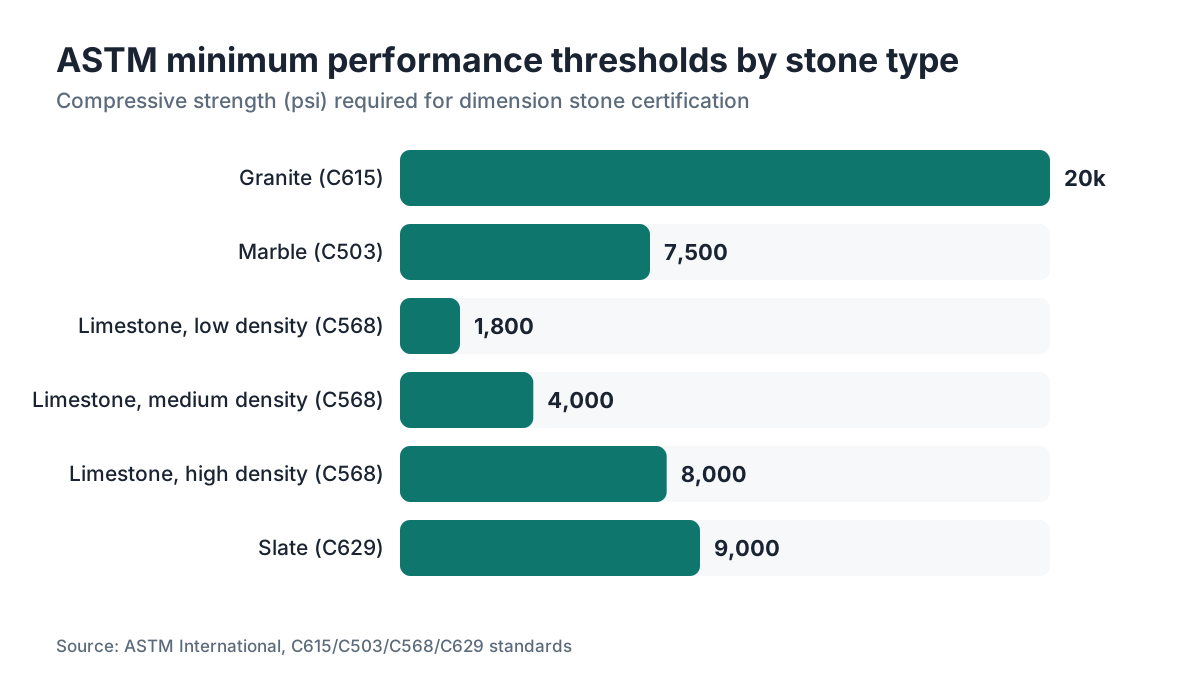
Granite runs the show wherever durability leads. It takes heavy traffic, resists scratching, and shrugs off cleaning chemicals that would ruin softer stone. ASTM C615 covers granite for dimension stone applications, with minimums for compressive strength (at least 19,500 psi), modulus of rupture (at least 1,500 psi), and water absorption (no more than 0.40%) [1]. Institutional specs cite these numbers by the letter.
Engineered quartz shows up heavily in healthcare because it is non-porous, and non-porous matters for infection control. The CDC's environmental infection control guidelines state that non-porous surfaces are easier to clean and disinfect than porous ones [5]. That one fact pushes spec writers toward quartz in patient care areas.
Limestone and marble land in civic and campus buildings, mostly lobbies, corridors, and decorative wall panels. Both need careful spec writing because they are porous and etch under acid. Spec marble for a hospital bathroom floor without thinking through foot traffic and cleaner pH, and you get an etched floor inside a year.
Soapstone turns up in lab counters now and then. It is soft (Mohs hardness around 1 to 2 for talc-rich soapstone) but resists acids, bases, and heat better than most alternatives in a true lab [6]. Our guide on how to clean soapstone countertops covers the maintenance side.
Quartzite, which is not the same as quartz, gets specified in premium lobbies for looks. Source it carefully. Plenty of material sold as quartzite is a softer metamorphic rock with higher absorption, and it fails durability specs fast.
| Material | Typical institutional use | Key ASTM standard | Avg. absorption (max) |
|---|---|---|---|
| Granite | Countertops, flooring, cladding | C615 | 0.40% |
| Marble | Flooring, wall panels, lobbies | C503 | 0.20% |
| Limestone | Cladding, decorative accents | C568 | 3.0-12.0% |
| Slate | Flooring, window sills | C629 | 0.25% |
| Engineered quartz | Lab and healthcare countertops | (manufacturer specs) | <0.05% |
| Soapstone | Lab countertops | (no single ASTM) | varies |
What ASTM standards and building codes apply to institutional stone?
ASTM standards are the backbone of every institutional stone spec. C615 covers granite, C503 covers marble, C568 covers limestone, and C629 covers slate. Each one sets minimum thresholds for absorption, compressive strength, and modulus of rupture. You will find them referenced in the project specs, usually Division 04 (Masonry) for cladding or Division 09 (Finishes) for interior surfaces [1][2].
Beyond material standards, ADA compliance controls countertop heights in any federally funded or publicly accessible building. The ADA Standards for Accessible Design, published by the Department of Justice, require at least one accessible work surface no higher than 34 inches above the finished floor [7]. On projects with food service, reception counters, or lab benches, the fabricator has to make the stone thickness and support system work together to hit that number.
The International Building Code (IBC), adopted in some version by most states, handles stone cladding anchorage, seismic requirements for veneer, and fire ratings. For exterior cladding above a certain height, the IBC requires engineered anchorage. Doing exterior institutional work means working with the structural engineer of record, more than cutting stone to size.
LEED certification steers material choices on a lot of these jobs. The U.S. Green Building Council's LEED v4 rating system awards credits for materials with Environmental Product Declarations (EPDs) and rewards regional sourcing based on distance to the project [8]. A fabricator who can hand over EPD documentation or prove regional sourcing has a real edge on LEED-targeted work.
How does the bidding and submittal process work for institutional stone?
Institutional bidding runs through general contractors, not directly to the building owner. You respond to a subcontractor invitation or a public bid solicitation. Many government projects require public bidding under procurement law, like the Federal Acquisition Regulation for federal work [9] or a state procurement code for state-funded buildings.
The bid documents include architectural drawings, the project specs (organized by CSI MasterFormat division), and addenda that answer questions raised during the bid period. Reading the specs carefully is the job. Fabricators underbid institutional work all the time because they miss a requirement for polished edges on every exposed face, specific seam locations shown on the drawings, or a demand for shop drawings before fabrication.
Shop drawings eat time residential fabricators never budgeted for. You produce detailed drawings showing every piece: dimensions, finish, edge profile, seam locations, anchor points, and the relationship to adjacent trades. The architect and structural engineer review and stamp them. Two or three revision rounds are normal. Nothing gets cut until the drawings are approved.
Submittals want physical samples, usually 12-inch by 12-inch pieces, plus paperwork: safety data sheets, ASTM test reports from the quarry or an independent lab, and product data for any sealers or adhesives. Some specs demand the sample come from the actual lot bought for the project, not a generic reference piece.
RFIs (Requests for Information) are how you formally ask the design team a question during construction. If the drawings show an edge condition that fights the specified material thickness, you file an RFI. The answer becomes part of the contract documents. Clean RFI records protect you in a dispute.
Running several institutional jobs at once means tracking submittals, RFIs, and drawing revisions across all of them. Software built for fabrication workflow, like SlabWise, keeps job documentation and material tracking organized once the moving parts outgrow spreadsheets.
What equipment and shop capacity does institutional fabrication require?
A CNC bridge saw is non-negotiable at any real institutional scale. You cannot hand-cut 200 identical vanity tops or 500 linear feet of corridor sills to spec tolerances. A 5-axis CNC handles miter cuts, sink cutouts, radius work, and edge profiles in one setup, which cuts handling and cumulative error.
Water jet cutting adds room for complex shapes, inlays, and medallions common in civic and academic buildings. Not every job needs it. Shops bidding courthouse lobbies or university libraries should either own one or have a subcontract partner they trust.
Polishing lines pay off on volume. When a hospital wants 300 vanity tops with a consistent honed finish, an automated polishing line beats hand-finishing on both speed and uniformity.
Material handling matters more here because slabs are heavy and there are a lot of them. Overhead cranes, vacuum lifters, and A-frame carts cut breakage and injury risk. OSHA's general industry standards under 29 CFR 1910 apply to shop operations, and institutional GCs will sometimes audit your safety program before awarding work [10].
Shop space becomes a constraint you feel fast. A big hospital job might need 60 to 80 slabs staged on-site at once to keep production flowing. If you cannot store and organize that inventory, you will burn hours hunting for the right slab for each piece.
Labor is the pinch point most shops hit first. Institutional work needs layout people who can read shop drawings, machine operators who can hold tolerance, and installers who understand approved finishes and can document their work. The skilled trades shortage is real. The Bureau of Labor Statistics tracks these workers under tile and stone setter categories, and its projections show tight supply relative to demand [11].
How are institutional stone projects priced and what do they typically cost?
Institutional pricing works by the square foot for countertops and flooring, by the linear foot for cladding, and sometimes per piece for complex custom elements like reception desk tops or stair treads.
For countertops, fabricated and installed granite in an institutional setting runs roughly $60 to $120 per square foot installed, depending on stone grade, edge complexity, sink cutouts, and regional labor. Engineered quartz runs $70 to $130 per square foot installed. Those are fabricator-facing budget numbers. The general contractor stacks their markup on top.
Flooring costs more per square foot than countertop work once you add leveling, pattern layout, and grouting. Polished granite flooring in a large lobby might run $15 to $35 per square foot for material alone, plus $8 to $20 per square foot to install, depending on tile size and pattern. These ranges track RSMeans construction cost data, the reference most institutional estimators use [12].
Overhead is what makes institutional cost more than it looks. Shop drawings, submittals, and RFI responses are billable but eat real hours. A complex job can carry 40 hours of administrative work before a single piece gets fabricated. Shops that skip pricing that in lose money.
Bonding and insurance add cost. Many institutional projects require performance and payment bonds, which run roughly 1% to 3% of contract value depending on the contractor's financials and bond market conditions. Liability limits run higher too, commonly $2 million to $5 million per occurrence versus $1 million on residential.
Change orders are where margin lives or dies. Owners and GCs fight change orders hard, so the bid has to capture scope accurately. A missing detail that forces an extra edge treatment on 400 linear feet of stone is a serious number if you never priced it.
What are the most common mistakes fabricators make on institutional jobs?
Underestimating the paperwork is the top killer. Shops bid fabrication and installation at their usual margin and forget shop drawings, submittal rounds, RFI responses, coordination meetings, and progress documentation. That is real labor that costs real money.
Missing the procurement window is the second. If the spec calls for Absolute Black granite from India with a 14-to-18-week lead time after approval, and you do not order the moment the submittal clears, the schedule slips and you land on the critical path. GCs assess liquidated damages for delays, and those bite.
Ignoring seam locations on the drawings causes rework. On a residential job you pick seams for efficiency and looks. On an institutional job the drawings sometimes dictate seam locations and require architect approval. Cut to the wrong layout and you cut again.
Mixing material lots is a spec violation that gets caught at inspection. Stone from different quarry lots can vary hard on color and veining. Install the first shipment of white Carrara in a lobby, then install a noticeably different second shipment, and the architect rejects it. Order the full quantity from one lot, even if you buy extra. That is the right call every time on institutional work.
Skipping the pre-installation site check creates problems at install. Institutional sites juggle many trades. If the substrate is out of level, the plumbing rough-ins are off, or the supporting structure sits at the wrong height, installing over those problems buries them and hands you a warranty claim later.
The countertop installation fundamentals still apply on institutional work. Every step just carries a documentation requirement stacked on top.
How does ADA compliance affect institutional stone countertop design?
ADA compliance is mandatory in any publicly accessible building or one that takes federal money. For stone countertops the number that matters is the 34-inch maximum height for accessible work surfaces, measured from finished floor to the top of the surface [7]. A standard kitchen or reception counter runs 36 inches, which is non-compliant for wheelchair users.
Institutional projects solve this two ways. One is a continuous lower section: part of the counter runs at 34 inches or below, with knee clearance of at least 27 inches high, 30 inches wide, and 19 inches deep underneath. The other is a fully adjustable surface, more common in labs. Either way your job is to cut the stone to the specified height and confirm the support structure hits that dimension before fabrication.
Edge profiles matter for ADA too. Sharp edges on accessible surfaces can cut a wheelchair user's arms. Specs often call for eased or bullnose edges on any counter section marked accessible.
Restroom vanities get the same treatment. ADA requires at least one lavatory in an accessible restroom to have the rim no higher than 34 inches with open knee clearance below. Institutional restroom vanity tops almost always include at least one ADA-compliant section. Confirm the specified stone thickness works with the plumbing rough-in heights to hit the finished dimension.
The full ADA Standards for Accessible Design are published by the U.S. Access Board and the Department of Justice, free to read online [7]. Every institutional fabricator should know the relevant sections cold, at minimum Sections 305 and 902 for work surfaces.
How do institutional stone projects handle sustainability and green building requirements?
LEED is the dominant green building system in the U.S. institutional market. The U.S. Green Building Council reports that more than 100,000 projects worldwide have participated in LEED, with government and education buildings among the most common certified types [8]. Stone fabricators on LEED jobs need to understand two material credit categories.
Building Product Disclosure and Optimization credits reward materials with Environmental Product Declarations (EPDs). An EPD is a third-party verified document that quantifies a product's environmental impact, including carbon emissions, water use, and waste. Several major quarries and engineered stone makers have published EPDs. If the spec wants EPDs and your source has none, you either switch sources or the project loses those credits.
Regional material credits historically rewarded materials extracted and manufactured within a set distance of the site. LEED v4 reworked this to weigh sourcing distance across supply chain stages. A fabricator who sources granite from a regional quarry and fabricates locally can help the project earn these credits. The documentation is simple: quarry location, shop location, and distances to the project.
Some owners, especially in California and the Pacific Northwest, require Environmental Impact Reports or specify low embodied carbon. Natural stone generally performs well on embodied carbon against concrete or ceramic tile when sourced regionally, but do not make that claim without supporting data.
For high-volume shops, a water recycling system is worth a look. The EPA has published guidance on water reuse for industrial operations that covers stone fabrication [13]. Cutting water use also cuts the cost of treating and disposing of slurry.
Cambria, as one example of an engineered quartz maker, publishes sustainability data including water use per unit of production. Shops using products like Cambria countertops on LEED jobs should pull that documentation straight from the manufacturer for the submittal package.
What should fabricators know about installation logistics on active institutional job sites?
An institutional site is nothing like a house. The general contractor runs a master schedule with dozens of trades sharing access, sequencing, and delivery windows. As the stone sub, you get specific windows to deliver and install. Show up early or late and you snarl other trades and get noticed.
Hospitals are the hardest because construction often happens in occupied buildings. Infection control risk assessments (ICRA) govern how construction zones stay sealed off from patient care. Some projects require you to follow ICRA protocols during install: dust containment, HEPA filtration, and specific paths of travel through the building. Price those in. Do not treat them as surprises.
Educational buildings are often open only during summer breaks, which crushes the schedule. A university science building renovation might have a 10-week install window. Miss it and you wait until next summer and eat contract penalties.
Freight elevator scheduling is a real coordination task in multi-story buildings. Stone weighs 18 to 20 pounds per square foot at 3/4-inch thickness, so a slab 9 feet by 5 feet runs roughly 810 to 900 pounds. Moving material to upper floors where the elevator is shared with 20 other trades takes advance scheduling and often costs money.
Documentation during install is required here in a way it never is on residential. You may owe daily installation reports, photos of substrate conditions before you set stone, and a written punch list response. This is not busywork. It is the paper trail that protects you if someone disputes whether the substrate was suitable or the stone was installed to spec.
Shops carrying documentation for several institutional jobs at once lean on job-level tracking systems. SlabWise's job management tools handle piece-level tracking and job status, which maps directly to the progress reporting institutional GCs expect.
How does institutional stone fabrication compare to residential in terms of business model and profitability?
Gross margin on residential fabrication typically runs 40% to 55% for well-run shops, based on trade surveys from the Natural Stone Institute and similar bodies. Institutional margin often looks lower on paper, running 30% to 45%, but revenue per job is far higher and the sales cost per dollar of revenue drops once you are an approved sub with repeat institutional clients.
Payment terms are slower and stricter. Residential customers pay a deposit at signing and the balance at install, so cash comes in early. Institutional work runs on a monthly pay application cycle: you submit a Schedule of Values, certify work completed each month, and wait 30 to 60 days for payment. Retainage, usually 5% to 10% of each pay application, gets held until project completion and punchlist closeout, which can be 12 to 18 months after your fabrication is done. Plan your cash around it.
Repeat business works differently too. A homeowner remodels once every 10 to 20 years. A hospital system or university may have renovation work running nonstop. Perform well on one building, build a relationship with the construction management team, and you can land sole-source invitations or preferred-vendor status across the system's future projects.
The barrier to entry is capital and capacity for the volume, administrative systems for submittals and documentation, and bonding capacity for large contracts. Plenty of small residential shops want institutional work but cannot get bonded for the contract values because their financials will not support it. Building this capacity is a multi-year business development push.
Here is the honest self-check before you chase institutional work: do you have CNC capacity, experienced layout staff, an admin team that can handle submittals, and enough working capital to float 60 days of receivables on a large job? Yes to all, and the case is strong. No to any, and the risk of cash flow trouble and performance failure outweighs the revenue.
Frequently asked questions
What division of the CSI MasterFormat covers stone countertops in institutional projects?
Stone countertops usually appear in Division 12 (Furnishings) or Division 09 (Finishes), depending on how the architect organized the specs. Exterior stone cladding falls under Division 04 (Masonry). Read all divisions, because lab countertops sometimes land in Division 11 (Equipment) when they are tied to a casework package.
Do institutional stone projects require certified installers?
Some projects specify installation by Natural Stone Institute (NSI) Accredited Businesses or require documented installer training. Federal projects increasingly include workforce certification requirements. Even when it is not explicitly required, NSI accreditation signals real quality control systems and is worth pursuing if you plan to chase institutional work regularly.
How long does a typical institutional stone submittal approval take?
Plan for four to eight weeks from initial submission to final approval. First-round reviews usually run two to four weeks. Each revision round adds two to three weeks. Complex projects with historic preservation requirements or custom stone selection can stretch past 12 weeks. Fabricators who ignore this in their schedule commitments end up on the critical path.
Can a small fabrication shop handle institutional work or is it only for large shops?
Small shops can handle institutional projects if they scope them correctly. A single-trade package, like restroom vanity tops for one building, can work for a shop with two CNC machines and four installers. The risks are cash flow (slow payment), administrative capacity (submittals take real time), and bonding (contract values often require surety bonds your lender has to support).
What is retainage and how does it affect stone fabricators on institutional projects?
Retainage is a percentage of each pay application, typically 5% to 10%, held by the owner until the project reaches substantial completion and the punchlist closes. On a $500,000 stone contract with 10% retainage, you are owed $50,000 at the end of the job, sometimes a year or more after the stone is installed. Build retainage into your cash flow model before signing the subcontract.
What is the difference between architectural stone and dimensional stone in spec language?
Dimensional stone means stone cut to specific sizes and shapes for construction, as defined by standards like ASTM C615 for granite. Architectural stone is broader, covering any stone used in architectural applications, sometimes including thin veneer or decorative elements. When these terms appear in specs, read the associated ASTM reference to find the real performance requirements. The label alone does not tell you enough.
Are there federal buy-American requirements that affect stone sourcing on government projects?
Yes. The Buy American Act applies to federal construction contracts and requires construction materials, including stone, to be mined or produced in the United States unless a waiver applies. FAR Part 25 covers these requirements. Some projects allow waivers when material is not commercially available domestically in the required quantity or quality, but the waiver must be documented and approved before procurement.
How do fabricators handle color matching across multiple stone lots on large institutional projects?
The standard move is to buy the entire project quantity from a single quarry block or lot number, confirmed before the submittal sample is approved. You keep a reference piece from the approved sample and compare incoming slabs against it, visually and sometimes with a colorimeter. Any slab outside the acceptable range gets flagged before fabrication. Ordering extra material from the same lot as a contingency is standard practice.
What does a performance bond cost for an institutional stone subcontract?
Performance and payment bonds together typically cost 1% to 3% of contract value, and the rate depends on the surety's read of your financial strength, bonding history, and project risk. A shop with a strong track record and clean financials may bond at 1% to 1.5%. A first-time applicant or a shop with thin working capital may pay 2.5% to 3% or fail to get bonded at all.
What edge profiles are most common on institutional countertops?
Eased (a slightly softened square) and flat polished edges dominate because they are fast to produce, durable, and easy to clean. Bullnose edges appear on ADA-accessible sections. Ogee and decorative profiles are rare outside lobby and reception areas because they are slower to fabricate and harder to maintain in high traffic. Mitered edges show up on thick-look waterfall applications in high-end civic buildings.
How should a fabricator price for LEED documentation requirements on an institutional job?
Add a line item for administrative time: collecting EPDs from suppliers, calculating regional material percentages, preparing the credit documentation package, and attending LEED coordination meetings. A realistic budget for a fabricator contributing to LEED documentation on a mid-size project is 8 to 16 hours of administrative labor. Bill it as a lump sum or an hourly allowance in the bid.
What happens if stone installed on an institutional project fails an inspection?
The general contractor issues a non-conformance report. You respond with a corrective action plan, usually within a contractual window like 48 or 72 hours. If the stone does not meet spec, you bear the cost of removal and replacement, including any damage to adjacent finishes during remediation. That is exactly why proper submittal approval and pre-installation site checks matter.
Is engineered quartz or natural granite better for hospital countertops?
Engineered quartz is the more defensible choice for healthcare because its non-porous surface supports the infection control cleaning protocols hospitals use, including quaternary ammonium disinfectants. Natural granite, sealed properly, performs fine in low-risk areas but needs sealer maintenance that facilities teams may not keep up with. Specify a manufacturer-tested quartz for healthcare and confirm chemical resistance on the product data sheet.
How does stone thickness selection affect structural requirements in institutional cladding?
Thin panels (3/4 inch or less) need backup support, anchoring hardware, and sometimes a secondary steel frame. Thicker panels (1.25 inches and up) may self-support in some applications but add dead load to the structure. The structural engineer of record specifies the anchor system and checks dead load. Your role is to provide accurate material weights and work with the engineer's anchorage design, not design the system yourself.
Sources
- ASTM International, ASTM C615 Standard Specification for Granite Dimension Stone: ASTM C615 sets minimum requirements for granite dimension stone including compressive strength of at least 19,500 psi, modulus of rupture of at least 1,500 psi, and water absorption no more than 0.40%.
- ASTM International, ASTM C503 Standard Specification for Marble Dimension Stone: ASTM C503 covers marble dimension stone with a maximum water absorption of 0.20%.
- Natural Stone Institute, Technical Bulletins and Project Resources: Material procurement and shop drawing approval cycles for imported stone in institutional projects routinely run 12 to 20 weeks.
- Natural Stone Institute, Dimensional Stone Design Manual: Chemical resistance is a primary reason engineered quartz surfaces are specified in laboratory environments.
- Centers for Disease Control and Prevention, Guidelines for Environmental Infection Control in Health-Care Facilities: Non-porous surfaces are easier to clean and disinfect than porous ones, supporting specification of non-porous materials in patient care areas.
- Natural Stone Institute, Soapstone Technical Bulletin: Soapstone resists acids, bases, and heat, making it suitable for laboratory countertops despite relatively low Mohs hardness.
- U.S. Department of Justice, ADA Standards for Accessible Design: ADA Standards require accessible work surfaces to be no higher than 34 inches above finished floor, with knee clearance of at least 27 inches high, 30 inches wide, and 19 inches deep.
- U.S. Green Building Council, LEED Project Statistics: More than 100,000 projects globally have participated in LEED certification, with government and education buildings among the most common certified types.
- General Services Administration, Federal Acquisition Regulation (FAR) Part 25: The Federal Acquisition Regulation Part 25 covers Buy American Act requirements for construction materials including stone on federal projects.
- U.S. Occupational Safety and Health Administration, 29 CFR 1910 General Industry Standards: OSHA regulations under 29 CFR 1910 govern shop lifting operations and safety programs applicable to stone fabrication facilities.
- U.S. Bureau of Labor Statistics, Occupational Outlook Handbook, Tile and Stone Setters: BLS occupational data shows tight projected supply of stone cutting and related skilled trades relative to industry demand.
- Gordian RSMeans, Building Construction Cost Data (annual reference): RSMeans data shows polished granite flooring material costs of $15 to $35 per square foot and installation costs of $8 to $20 per square foot for institutional lobby applications.
- U.S. Environmental Protection Agency, Water Reuse guidance: EPA has published guidance on industrial water reuse applicable to stone fabrication shop water recycling systems.
Last updated 2026-07-10