TL;DR
- Edge upgrades add $10 to $50 per linear foot above a standard eased edge, depending on the profile and material.
- Shops that show edges visually before the total close upgrades on roughly 40 to 60% of jobs versus 10 to 20% when the edge comes up after the price.
- Homeowners get a more finished look.
- Shops get margin without buying more stone.
Why edge upgrades are the highest-ROI upsell in countertop sales
The edge is already in the quote. The stone is cut, the template is done, the job is basically sold. Bumping the customer to a nicer profile doesn't cost you more material, doesn't stretch the lead time, and doesn't send them back out to price-shop three other shops. That extra revenue is almost pure margin.
The math is real. A kitchen with 30 linear feet of exposed edge adds $300 to $1,500 to the ticket if you move the customer from a free eased edge to a mid-tier ogee or a waterfall miter. Run 10 jobs a week and that's real annual revenue with zero added overhead.
Most fabricators leave it on the table. They forget to mention it, they quote it as a naked line-item number with no context, or they bring it up after the customer has already closed on a price in their head. The fix costs nothing: show the edges, talk about them early, and connect them to how the kitchen will actually look on move-in day.
What edge profiles are typically available and what do they cost?
Edge profiles sort into tiers. Standard edges are free or cheap because a CNC or a basic router bit knocks them out fast. Upgrade edges cost more because they need more passes, more bit changes, or hand-polishing time.
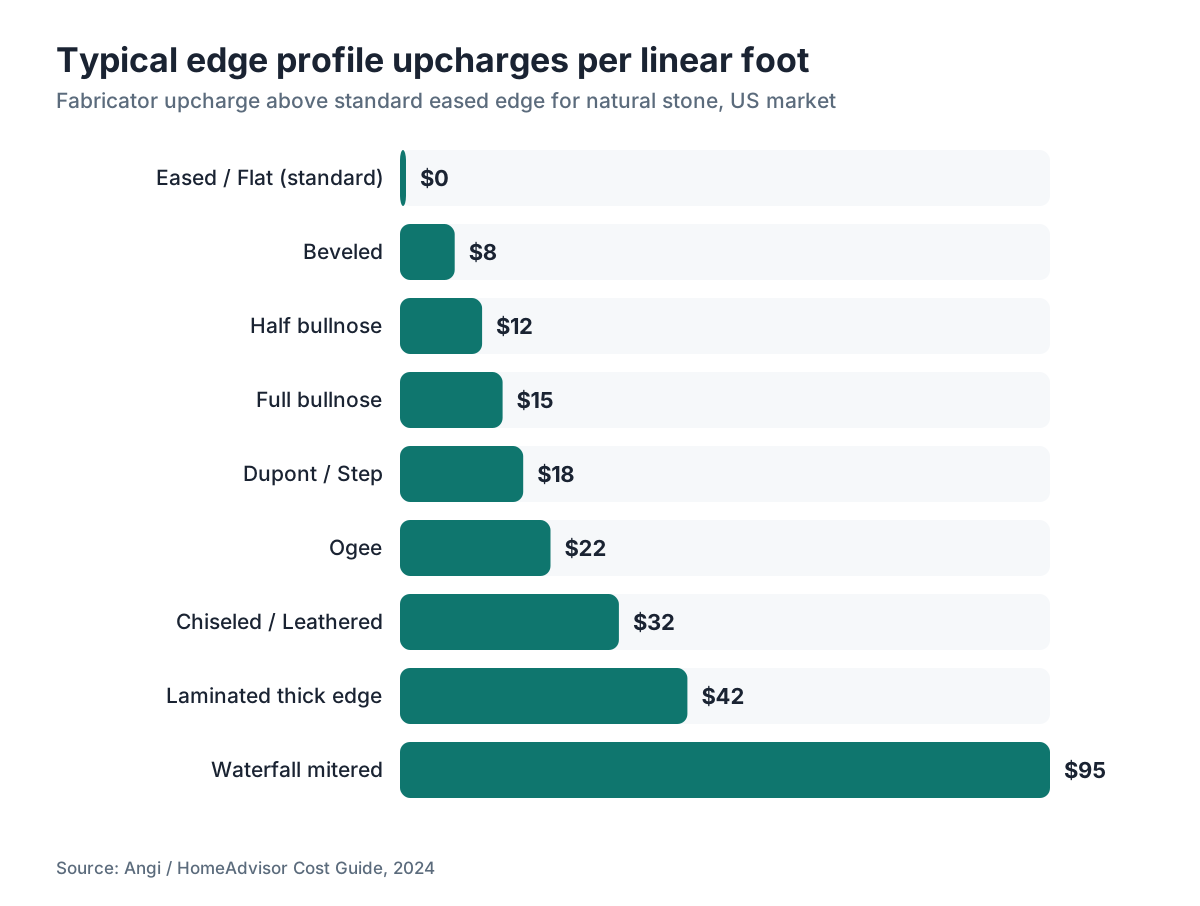
Here's a representative cost table for natural stone (granite, quartzite, marble) and engineered quartz fabricated in the US. Prices are per linear foot and show the fabricator's upcharge above a flat/eased edge. Metro labor markets push these higher.
| Profile | Description | Typical upcharge ($/LF) |
|---|---|---|
| Eased / Flat | Square with a small chamfer, industry standard free edge | $0 |
| Beveled | Angled cut along top face, clean modern look | $5, $12 |
| Half bullnose | Rounded on top only | $8, $15 |
| Full bullnose | Fully rounded top and bottom | $10, $20 |
| Ogee | S-curve profile, traditional/formal style | $15, $30 |
| Dupont / Step | Flat shelf with a small bevel below | $12, $25 |
| Waterfall mitered | Stone continues vertically down cabinet side | $40, $150+ |
| Laminated / Mitered thick edge | Two pieces bonded for 3-inch apparent thickness | $25, $60 |
| Chiseled / Leathered edge | Rough natural texture, popular with quartzite | $20, $45 |
These are fabricator upcharges. The retail price a homeowner sees usually runs 20 to 50% higher depending on markup. [1]
Waterfall edges sit in their own category. They need a miter cut and a second piece of stone, so there's real material cost baked in. Everything else on the list is labor and bit wear.
On granite countertops, full bullnose and ogee are the historic favorites. On marble countertops, a plain eased or beveled edge often looks cleaner because the veining already carries the drama. Here's my opinion: on a heavily veined slab, a fancy edge and a busy pattern fight each other, and one of them always loses.
When in the quoting process should you bring up edge upgrades?
Before you show the total price. That's the whole answer.
Once a customer sees a number, their brain locks in. Any upgrade you float after that feels like you're padding a bill they've already accepted, even when the dollar amount is small. Present the edge options before the final quote, at the same moment you're reviewing the stone selection.
The natural window is during slab selection or the template walkthrough. You're already talking about how the counter will look. "Let me show you the edge profiles we can run on this" lands as a design conversation, not a pitch.
If your shop runs quoting software, build the edge upgrade as a line item the customer sees before signing. Intuit's guidance for service businesses is blunt on this point: itemized estimates that name and price each component read as more transparent and tend to lift the average ticket over lump-sum quotes. [2] The customer knows what they're buying, and nothing feels like a surprise.
Here's the split that matters. Present edges after the total, and you'll close maybe 10 to 20% of customers. Present them as part of the design conversation before the total, and 40 to 60% typically pick an upgrade. Nobody has clean published data on this exact split for countertop shops, so treat the range as a working estimate. The direction is consistent with service-sales research and with what fabricators report.
How do you actually show edge profiles to a customer?
Physical samples. Full stop.
A laminated card with 2D line drawings does almost nothing. A customer holding a 6-inch chunk of granite with a real ogee edge gets it instantly, in a way no CAD diagram ever delivers. The feel and the light closes the sale.
Don't have samples? Make them. Cut 6- to 8-inch pieces from remnants. Run your standard profiles on each one, polish them, label them with the profile name and your upcharge. Line them up cheapest to priciest, or group them modern versus traditional. One afternoon and a few dollars of scrap stone.
For remote or virtual quotes, sharp photos from several angles beat illustrations. Some shops shoot a short video of light moving across the profile. That actually helps, because an ogee looks different under pendants than it does under cabinet lighting, and customers rarely think about that on their own.
Digital quoting tools that show a photo next to each edge line item close better than typed descriptions. If your software lets you attach an image to an option, use it. SlabWise lets you pin edge profile photos to line items right in the quote, so the customer sees the profile name, the price, and a picture in one place. [3]
What do you say? A word-for-word framework for the edge conversation
Keep it short. Long pitches kill the close.
Here's a framework that works without feeling pushy:
-
Introduce: "Every quote includes a standard eased edge at no extra charge. Let me show you two or three options a lot of customers upgrade to."
-
Show the samples in order, from the one you'd recommend first to the premium option.
-
Anchor the value: "On a kitchen this size, the jump from the eased edge to this ogee is about $X total. Most people feel it's worth it, since it's the one thing you touch every day."
-
Ask once: "What's your gut reaction?"
Don't over-explain. Don't recite the whole menu. Three choices beats ten, a pattern that traces back to Iyengar and Lepper's 2000 study in the Journal of Personality and Social Psychology, which found that shoppers facing more options were less likely to buy at all. [4] For edges, three options (free standard, mid-tier upgrade, premium) beats a wall of eight.
One phrase does the heavy lifting: quote the total, not the per-foot rate. "$12 a linear foot" reads as a unit cost the customer has to multiply. "$360 for the whole kitchen" is one concrete yes-or-no decision. The lump sum is easier to answer.
Which edge profiles are easiest to sell and why?
The half bullnose and the eased bevel are the easiest closes. They read as clearly different from a flat eased edge, the price bump is modest (usually $8 to $15 per linear foot), and they don't feel "fancy" to someone who just wants a clean modern kitchen.
The ogee is the reliable upsell for traditional and transitional kitchens. A customer putting in raised-panel cabinets and ornate hardware usually wants an edge that matches the formality. In that room, the ogee reads as coherent, not excessive.
Waterfall edges are the highest-ticket option. They close on a smaller share of jobs, but the revenue per close is big. Customers who ask about waterfalls are already in design mode with a clear picture in their head, often after seeing it on Pinterest. If someone mentions a waterfall island, quote it as a real option with the material cost broken out. Don't wave them off with a vague "that's expensive."
Laminated thick edges are the underused one. You bond a strip to the underside to fake a 1.5-inch or 3-inch apparent thickness. A 2cm slab with a laminated edge looks as heavy as a 3cm slab. On a budget material, that's how a customer gets a high-end look for less than upgrading the stone itself.
How does edge material affect the upsell conversation?
Harder stone takes longer to machine and polish, which changes your actual cost. Quartzite runs about 7 on the Mohs scale; marble sits at 3 to 4, per the USGS Mohs hardness reference. [5] That gap means more bit wear and longer polish time on a complex profile in quartzite. If you charge the same edge upcharge across every material, you're leaving money on quartzite jobs and overcharging on soft stones.
Engineered quartz brings its own edge rules. Cambria countertops and similar brands sometimes restrict certain profiles or set fabricator guidelines that govern what stays under warranty. Check those terms before you promise a customer a specific profile on an engineered product.
Softer, more porous stone like soapstone or certain marbles can chip along thin raised details, like a sharp pencil bead, over years of use. Say that upfront. It builds trust and usually steers the customer toward a profile you can stand behind.
Laminate countertops and Formica countertops have their own edge menu, including post-form rounded edges and applied wood or metal banding, but that's a separate conversation from stone. For Corian countertops and other solid surface, edges get routed and the range of options looks similar to stone, though the cost runs lower because solid surface machines faster.
Should you offer edge upgrades as a package or a la carte?
Both work. The right call depends on how deep your menu is and how much research your customers have done.
A la carte pricing gives transparency. The customer sees exactly what the ogee costs against the bevel and compares them head to head. That fits markets full of design-savvy buyers.
Packaged upgrades work better for customers who freeze up on decisions. A "Premium Edge Package" that folds in your best-selling profile, edge polishing on all exposed surfaces, and an undermount sink edge treatment for one flat price simplifies the yes. Some shops bundle the edge with other finish upgrades (leathered surface, drilled holes, a specific cutout) into a Good / Better / Best tier.
The tiered structure has a real edge: it anchors the customer to the middle. The National Federation of Independent Business, in its Pricing for Profitability material, notes that the middle option in a three-tier offer gets chosen roughly 60 to 70% of the time. [6] Put a half bullnose in your "Better" tier and your edge upsell closes itself, no separate conversation needed.
On a countertop installation with several zones (kitchen, baths, laundry), try quoting the main kitchen with the upgrade and the secondary rooms with the standard edge. It keeps the headline quote clean and opens a natural talk about matching everything up.
How do you handle the customer who says the upgrade is too expensive?
Don't argue. And don't reflexively drop the price.
First, figure out what the objection really is. Sometimes "that's too expensive" means "I don't see why I'd want that." Ask: "Is it the price, or are you not sure the look is worth it for your kitchen?" Two different problems, two different answers.
If it's a genuine budget issue, shrink the scope. "We could run the island in the ogee and keep the perimeter eased, since the island's the focal point. That drops the upgrade to about $Y." Partial upgrades close more often than you'd guess, and they still add revenue.
If they want the look but not the price, a laminated edge on a thinner slab can hit the visual weight they're after for less than a full profile upgrade. Offering alternatives isn't caving. It's selling.
Never apologize for the price. Confidence in your number signals confidence in your work. The fabricator who opens with "I know it seems like a lot..." is training the customer to push back.
The one move to avoid: cutting the price on an upgrade without changing the scope. That teaches the customer your prices are soft by default, and you'll be negotiating on every job you ever quote them.
How do fabricators systematize edge upsells so they happen on every quote?
Make it structural. Don't leave it to whoever's in the room.
The simplest version: every quote has to carry an edge line item that's more than "standard edge included." Show the chosen profile, the per-foot rate, the linear footage, and the total. Even if the customer keeps the free eased edge, seeing it as a real line item primes the conversation.
The better version: a quote template that always presents two or three edge options, with the standard edge pre-selected as the default. Now the customer has to actively engage with the choice. Hide the upgrade in a notes field and nobody decides anything.
This is where digital tooling earns its keep. A system that pulls linear footage straight from the layout, multiplies it across three edge tiers, and shows all three prices side by side turns the upsell into a fixed part of every quote instead of a coin flip. SlabWise handles exactly that, with edge profile options tied to the measurement data from the job layout. [3]
Then track your close rate. If 35% of customers take an upgrade today, that's your baseline. Spend a month showing edges visually before the total and watch the number. Shops that measure it usually see a move within four to six weeks of changing the presentation.
What do homeowners actually get from a better edge profile?
Durability, sometimes. A better-looking kitchen, always.
A flat eased edge is completely functional. It's not a corner-cut or a cheap-out. Commercial kitchens use it precisely because it's durable and easy to wipe down. So the honest pitch to a homeowner is never "eased edges are worse," because they aren't. It's "this profile matches your design better" or "this reads more finished on this particular stone."
The durability argument holds up in a few specific cases. A full bullnose has no sharp 90-degree corner, so it chips less than a square eased edge when someone swings a pot into it. The tradeoff: crumbs collect at the curve. Every profile trades something. Tell the customer both sides.
On value, a nicer edge adds to how finished the whole kitchen feels, and kitchens carry weight at resale. The National Association of Realtors 2024 Remodeling Impact Report found kitchen upgrades recover 67% to 100% of their cost at resale depending on the project. [7] That gives a homeowner a real reason to treat the countertop finish as part of the investment.
On a kitchen countertops project a homeowner lives with for 10 to 20 years, a $300 edge upgrade pencils out under $30 a year. Framed that way, the decision usually makes itself.
Frequently asked questions
How much do edge upgrades typically add to a countertop quote?
Most edge upgrades add $8 to $45 per linear foot above a standard eased edge, depending on profile complexity and material hardness. On a typical 30-linear-foot kitchen, that's $240 to $1,350 added to the quote. Waterfall mitered edges are the exception, sometimes running $100 or more per linear foot because they need an extra piece of stone and a precision miter cut.
What is the most popular edge profile upgrade for kitchen countertops?
Half bullnose and beveled edges are among the most commonly chosen upgrades because they look distinct from the standard eased edge without costing much more. Ogee profiles are the go-to for traditional kitchens. Waterfall edges have grown on islands since roughly 2018 and are often the highest-revenue single upsell a shop closes, though they require a separate piece of stone.
Is a standard eased edge a bad choice?
No. A standard eased edge is durable, easy to clean, and looks clean and modern in most kitchens. The case for upgrading is aesthetic fit and personal preference, not any functional weakness in the eased edge. Calling the eased edge "cheap" is both wrong and counterproductive. The honest pitch is about design match, not an edge quality hierarchy.
Do edge profiles affect how the countertop is sealed or maintained?
Slightly. Complex profiles like ogee or chiseled edges have more surface area and fine geometry that can trap cleaning residue or moisture. Routine sealing covers every profile the same way, but a customer with a bullnose or ogee should run a damp cloth into the curve during cleaning. The maintenance difference is minor and shouldn't stop anyone from an upgrade they want.
Can you upgrade just the island edge and keep the perimeter standard?
Yes, and it's a smart way to close a partial upsell when the full upgrade blows the budget. The island is the visual focal point in most kitchens, so upgrading only the island edge delivers most of the impact at a fraction of the cost. Quote it as a named option, like "island premium edge, perimeter standard," so the customer sees it as a real choice.
What's the difference between a laminated edge and a mitered waterfall edge?
A laminated edge bonds a strip of stone to the underside of the countertop for a thicker apparent edge, usually 1.5 or 3 inches. It adds visual weight but stays horizontal. A mitered waterfall edge continues the slab vertically down the side of the cabinet, usually on an island, with a precisely angled miter joint where the pieces meet. Laminated edges cost far less than waterfalls.
How many edge profile options should a fabricator show a customer?
Three is the practical sweet spot: the free standard, one mid-tier upgrade you'd recommend for most kitchens, and one premium option. Research on choice overload in the Journal of Personality and Social Psychology (Iyengar and Lepper, 2000) found that more options reduce purchase decision rates. Eight or ten profiles breed hesitation; three creates a manageable decision and a natural middle-tier close.
Should edge upgrade prices vary by stone type?
Yes. Harder stones like quartzite (Mohs hardness around 7) cause faster bit wear and need more polishing time on complex profiles than softer stones like marble (Mohs 3 to 4). Charge a flat edge upcharge across the board and you're underpricing quartzite jobs while overpricing soft-stone jobs. Adjusting by material hardness keeps margins consistent and your pricing honest.
When is the worst time to bring up edge upgrades in a sales conversation?
After you've shown the total price. Once a customer has processed a number, any addition triggers loss aversion instead of gain framing. Bring up edge options during the design and material selection phase, before the final quote lands. That way the customer builds the upgrade into their mental budget from the start rather than feeling like you're padding a bill they already accepted.
Do edge profiles affect countertop durability or chip resistance?
The profile does change chip risk at the edge. A full bullnose has no 90-degree corners, so it chips less from a hard bump than a square eased edge. A sharp pencil bead or thin raised detail on an ogee is the most vulnerable, especially on brittle stone like marble. For heavy daily use, simpler profiles (eased, bevel, bullnose) tend to hold up better over time.
Can engineered quartz countertops get any edge profile a natural stone can?
Most engineered quartz supports the same range of profiles as natural stone, but some manufacturers restrict certain profiles under warranty coverage. Cambria, for one, has fabrication guidelines that specify acceptable edge treatments. Always check the manufacturer's spec sheet before promising a customer a specific edge on an engineered product, especially profiles with very thin geometric features.
How do fabricators track whether edge upsell conversations are working?
Track edge upgrade revenue as its own line item in your job management or quoting system, separate from base slab price. That lets you calculate average edge revenue per job and a close rate (upgrades sold divided by jobs quoted). Change your presentation approach and compare the metric before and after. Four to six weeks of consistent data is usually enough to see whether the change moved anything.
Do butcher block or wood countertops have comparable edge upgrade options?
Yes. Butcher block countertops route with most of the same profiles you get in stone, including bevels, bullnose, and ogee. Edge work on wood usually costs less per linear foot because wood machines faster and needs simpler tooling. Wood edges can also be finished differently (painted, stained, left natural), which adds another upgrade variable to the conversation.
Sources
- HomeAdvisor (Angi), Countertop Edge Profiles Cost Guide: Edge profile upcharges for stone countertops typically range from $5 to $50+ per linear foot depending on profile complexity and material
- SlabWise, Countertop Fabrication Quoting Software: SlabWise allows fabricators to attach edge profile photos and calculate linear footage pricing automatically in the quote workflow
- Iyengar, S.S. and Lepper, M.R. (2000), Journal of Personality and Social Psychology, 'When Choice is Demotivating': More choices reduced the likelihood of a purchase decision in experimental settings; three options typically outperforms ten for conversion
- U.S. Geological Survey, Mineral Resources Program, Mohs Hardness Scale: Quartzite rates approximately 7 on the Mohs hardness scale; marble rates 3 to 4, affecting tool wear during fabrication
- National Federation of Independent Business, Pricing for Profitability: In three-tier pricing structures, the middle tier is chosen approximately 60 to 70% of the time, making it the natural landing point for designed upsells
- National Association of Realtors, 2024 Remodeling Impact Report: Kitchen upgrades can recover 67% to 100% of their cost at resale depending on project scope, according to NAR's 2024 Remodeling Impact Report
- Natural Stone Institute (formerly Marble Institute of America), Stone Fabrication Standards: Industry fabrication standards for natural stone cover acceptable edge profiles, polishing requirements, and material-specific tolerances
- National Kitchen and Bath Association, Cost vs. Value in Kitchen Design: Countertop finish and edge detail are consistently cited among the visible quality indicators homeowners and buyers evaluate in kitchen remodels
- U.S. Bureau of Labor Statistics, Consumer Expenditure Survey, Home Improvement Spending: American households spend an average of several thousand dollars on kitchen remodeling components annually, with countertops among the highest per-unit cost items
Last updated 2026-07-11