
TL;DR
- Most countertop fabricators set minimum job sizes between $300 and $800, though the right number depends on your fixed overhead per job, labor floor, and material handling costs.
- Calculate your true cost to touch a job (template, travel, saw time, install), then add your target margin.
- Anything below that number costs you money whether you fill the slot or not.
Why does a minimum job size matter for countertop shops?
Every job carries a fixed cost that doesn't shrink because the slab is small. You still pay a templater to drive out, a fabricator to set up and cut, an installer to load the truck and stand in the customer's kitchen for two hours. Those costs exist whether you install 4 square feet of granite or 40.
Most shops price small jobs the way they price big ones: material plus a markup. That math breaks fast. If your material cost on a 6-square-foot bathroom vanity is $90 and you apply a 40% margin, you quote $126. But your actual cost to touch that job, counting templating labor, shop time, delivery, and install, might be $350 or more depending on your market and wage structure.
You just lost money and told yourself you were profitable.
A minimum job size is the floor below which you won't take a project regardless of what the customer wants to pay per square foot. It isn't a punishment for small kitchens. It's a number that reflects what it actually costs to open your shop, dispatch a crew, and deliver finished stone to someone's house.
What does it actually cost to run a single countertop job?
Before you set a minimum, you have to know your per-job cost floor. That means adding up every cost you incur the moment you say yes, before one square inch of stone gets cut.
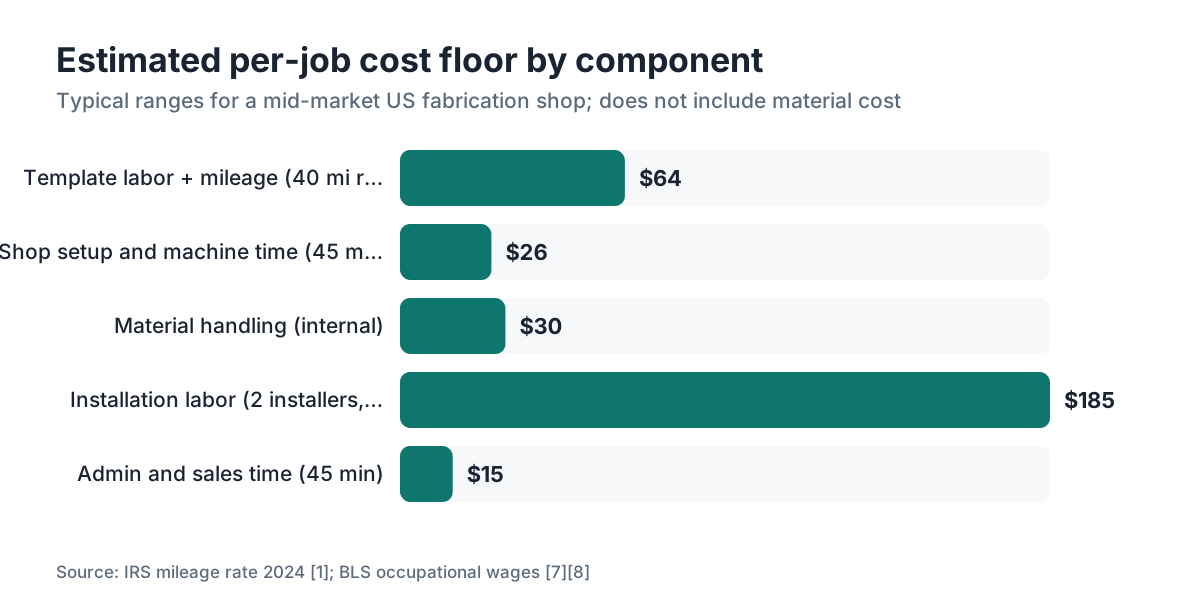
Here's how the components break down:
Templating. A templater driving 20 minutes each way, spending 45 minutes on site, and driving back has burned 90 minutes of paid time. At $25/hour, that's $37.50 before you count vehicle cost. The IRS standard mileage rate for 2024 is $0.67 per mile [1], so a 40-mile round trip adds $26.80. Template labor plus mileage alone: roughly $64 on a conservative estimate.
Shop setup and machine time. Every job needs someone to pull the template, program the CNC or lay out cuts on a bridge saw, and run the stone. Even a tiny job takes 30 to 60 minutes of shop setup. At a fully loaded shop labor rate of $35/hour, that's $17 to $35 before the blade touches material.
Material handling. Moving a full slab for a small remnant cut still takes two people and a forklift or vacuum lift. If the job uses a remnant from your rack, you still retrieve it, inspect it, move it, and return or dispose of the offcut. Figure $20 to $40 for internal handling.
Installation. Two installers, a truck, two to three hours on site. At $30/hour per installer plus vehicle cost, you're looking at $150 to $220 for a standard residential install, even a small one.
Admin and sales. Someone quoted the job, answered emails, processed payment, and scheduled everything. Even 45 minutes of admin at $20/hour adds $15.
Add it up with zero material cost and you're already at $266 to $374 per job in labor and overhead, depending on your wage structure, geography, and whether the job is local or an hour each way.
That's your cost floor before the stone costs a dollar.
What do most fabricators actually charge as a minimum?
Most independent fabricators set minimums between $300 and $800, with the median clustering around $400 to $500 for a basic granite or quartz install in a mid-cost market. There's no industry-wide published standard, because the stone fabrication trade is fragmented across thousands of independent shops with no central body collecting the data. The National Kitchen and Bath Association (NKBA) publishes periodic design and cost surveys [2], but minimum job thresholds aren't tracked in them.
That range comes from fabricator forums, trade discussions, and publicly posted shop pricing pages, not a formal survey. Treat it as a starting reference, not gospel.
Shops in high cost-of-living metros (New York, San Francisco, Seattle) tend to run minimums of $600 to $1,000 or more. Shops in smaller markets with lower labor costs may set minimums as low as $250, though at that level it's very hard to cover real costs unless labor is unusually cheap or the crew is already in the neighborhood.
Specialty materials change the math. A shop doing a lot of quartzite or book-matched marble sets a higher minimum because the material handling risk alone justifies it. A shop doing mostly laminate or Corian countertops may have lower install complexity but similar fixed overhead, so $300 to $500 minimums are common there too.
Set yours from your numbers, not from what you think competitors charge. Their cost structure might look nothing like yours.
How do you actually calculate the right minimum for your shop?
There's a straightforward way to do this. It takes about an hour with a spreadsheet.
Step 1: Calculate your monthly fixed overhead. Rent, utilities, insurance, equipment payments, software, phone, and any salaries you pay regardless of job count. Say the total is $18,000/month.
Step 2: Estimate jobs per month. If you run 40 jobs in a typical month, divide: $18,000 / 40 = $450 in fixed overhead per job.
Step 3: Calculate variable per-job costs. This is the templating, install labor, vehicle, and admin from above. Use your actual wage rates. A conservative estimate for a two-trip job (template plus install) with two installers runs $250 to $400 in most US markets, in line with Bureau of Labor Statistics wage data for tile and stone setters [7].
Step 4: Add material cost floor. What's the cheapest material you'd actually put in? If your cheapest granite remnant is 10 square feet at $8/sq ft installed cost, that's $80 minimum in material.
Step 5: Sum it up. Fixed overhead allocation + variable labor + minimum material = your cost floor. In this example: $450 + $300 + $80 = $830. That's what the job costs before you make a cent.
Step 6: Apply your target margin. For a 30% net margin, divide your cost floor by 0.70: $830 / 0.70 = $1,186. That's your minimum invoice to hit the margin target on the smallest possible job.
If that number shocks you, you have company. Plenty of shops running $400 to $500 jobs are running them at a loss once every cost is fully counted.
In practice you'll probably publish a minimum below your full-margin number, especially if you use remnants well, route jobs tightly, or the work is simple and fast. Just know your real floor before you discount below it.
Should the minimum be a dollar amount or a square footage number?
Use a dollar minimum. It's cleaner to communicate and easier to enforce. "Our minimum project is $500" is unambiguous. A square footage minimum is trickier because customers don't carry material costs in their heads, so "we don't do jobs under 15 square feet" means nothing to them without context.
Some shops set both: a minimum square footage (say, 10 square feet) and a minimum dollar amount (say, $500), whichever is higher. This protects against both small jobs and low-value jobs where someone wants a big remnant installed cheaply.
A third approach is a minimum labor charge. You quote the job normally, and if the material calculation lands below your threshold, you add a "minimum project fee" line item to bring it up to your floor. This is transparent and defensible, and it shows the customer they're paying for your time more than the stone.
For shops running a high mix of job types, including granite countertops, quartz, marble countertops, and engineered surfaces, a dollar minimum is almost always simpler to manage than a square footage rule. Material prices swing too much across product lines for one square footage floor to mean anything.
How should you communicate a minimum job size to customers?
Transparent and early. That's the whole answer.
Put it on your website's pricing or FAQ page. Say it during the first phone or email contact. Include it in your quote template so it lands on every estimate. Customers who learn about a minimum after they've picked their stone and booked a template date feel blindsided, and that's how you earn bad reviews.
The framing matters. "We have a $500 project minimum" reads differently than "Because templating, fabrication, and professional installation carry fixed costs, we apply a minimum project charge of $500. This covers dispatching our team regardless of project size." The second version isn't an apology, it's an explanation, and most reasonable customers get it.
For homeowners who balk, point out what the minimum covers. They're paying for a licensed installer to show up with a truck, proper tools, and insurance, more than square footage of stone. The Small Business Administration teaches service businesses to price around fixed and variable costs rather than material alone [3], and a minimum charge is how a shop covers the fixed part, the same way a plumber charges a service call fee.
Some shops offer a partial workaround: if a customer already has a large job booked and wants a small secondary piece (a laundry room, a bar top), they waive the minimum because the fixed costs are already covered by the main project. That's reasonable, and worth writing into your policy explicitly.
What happens when you don't enforce your minimum?
Your calendar fills with small jobs, and you become known as the shop that does them.
This is one of the quieter traps in countertop fabrication. Small jobs are often urgent, detail-heavy, and demand the same customer service overhead as big ones. They eat a lopsided share of your templaters' and installers' time without moving revenue much.
The opportunity cost is real. A two-hour install slot spent on a $350 vanity is a slot that can't hold a $2,000 kitchen. Across a month with 40 job slots, filling 10 with sub-minimum work can cost you around $16,500 in revenue opportunity, assuming those slots could have held average jobs.
There's a quality risk too. Small jobs, especially oddly shaped remnants or tight bathroom installs, can run longer than planned. When they do, you've eaten into the margin on the next job in your schedule. Fabrication runs thin already. Independent shop net margins are commonly cited in the 8 to 15% range [9], which leaves almost no cushion for underpriced work.
Enforce your minimum consistently. Keep a referral list of smaller shops that specialize in remnant work so you can decline gracefully. That gesture costs you nothing and often comes back as referrals from the same customers when they're ready for a full kitchen.
Are there exceptions worth making to your minimum job size?
Yes, a few. But they should be written policies, not decisions made under customer pressure at the counter.
Repeat customers. A customer who did a $4,000 kitchen with you two years ago and now wants a $200 repair or a small add-on is a different conversation. You're servicing a relationship. Most shops handle this with a "valued client" policy that waives or reduces the minimum for established customers.
Combined project scheduling. If you're already installing in a neighborhood and can pair a small job with a larger one on the same route, your fixed costs drop sharply. Some shops group small jobs geographically and run a "small job day" once a month to spread the fixed overhead across several clients.
Remnant sales. If a customer buys a remnant and has it cut and polished in-shop with no delivery or install, your cost structure changes completely. No truck, no install crew. A shop-pickup remnant job might cost you $60 to $100 in labor. Your minimum for that category can be much lower, say $150 to $200, because the fixed dispatch costs don't apply.
Referral source relationships. A designer or contractor who sends you three or four full kitchens a year might ask for a favor job for their client. There's a commercial relationship to protect. That doesn't mean working at a loss, but it might mean working at cost or at a reduced minimum. Track it so you know what those relationships actually net over a year.
None of these exceptions should be invisible. Put them in your policy document so your sales team applies them the same way every time and customers aren't negotiating with whoever picks up the phone.
How does minimum job size affect your quoting workflow?
If your minimum isn't baked into your quoting system, it won't get enforced. Quoting is where minimums either hold or collapse.
The fix is simple. Every quote template should calculate the project total and compare it against your minimum. If the total falls below, the quote automatically shows a minimum project fee that bridges the gap. No manual decision, no awkward mid-quote call to a manager.
Fabricators using quoting software, including tools like SlabWise, can set a minimum job value that flags or auto-adjusts any quote below the threshold. That takes human error out of enforcement and makes it a system rule instead of a judgment call.
The workflow also shapes how you handle edge cases. What if a customer adds optional items that push them over the minimum? That's a natural upsell. A customer at $420 who's $80 short of your $500 minimum might add a sink cutout or a polished edge upgrade they were already weighing. Build that into your quote template by showing them what it takes to reach the minimum and what they get for it.
For shops running high quote volume across materials like kitchen countertops, a baked-in minimum also protects newer sales staff who might not know when to flag a job for review.
How do competitors' minimums affect your pricing strategy?
Knowing what competitors charge is useful context, but it shouldn't drive your number. A competitor at a $250 minimum might be subsidizing small jobs with margin from big ones, running at a loss, paying lower wages, or operating out of a cheaper facility. You can't see inside their books.
What you can see is your own numbers. If your cost floor is $400 and a competitor works at $250, matching them costs you money on every small job. Let them have those jobs and point your capacity at work that covers your actual costs.
Market positioning still matters. If you're the only shop in your area at a $1,000 minimum and your next competitor sits at $400, you'll lose small-to-mid jobs that might have been profitable for you. Do the math directly: at $1,000, what's your margin? If it's 40%, maybe that's right. But if your real cost floor is $600 and you're leaving profitable $600 to $999 jobs on the table, your minimum is too high.
The research here is easy. Call three competitors and ask for a quote on a small bathroom vanity. You'll learn the local minimums fast, no guesswork.
Should minimum job size vary by material type?
For most shops, a single dollar minimum is simpler to enforce and explain. But there's a real case for tiered minimums by material.
Here's why. Laminate countertops and post-form work carry lower material cost but similar install labor. Granite countertops and quartzite carry higher material cost and higher breakage risk. A $4,000-per-slab book-matched marble installation carries so much material risk and skill requirement that a standard minimum doesn't capture the commitment involved.
A practical approach some shops use:
| Material tier | Typical minimum |
|---|---|
| Laminate / post-form | $300 to $400 |
| Standard granite / quartz | $450 to $600 |
| Premium quartz (Cambria, etc.) | $600 to $800 |
| Natural stone (marble, quartzite) | $700 to $1,000+ |
| Exotic / book-matched stone | No minimum; quote only |
The table reflects general fabricator practice, not a published industry standard. Your numbers will differ based on local labor and overhead.
For shops doing countertop installation across many materials, a tiered minimum also protects you from the customer who wants one square foot of Calacatta Gold installed at your standard $500 minimum. The risk and material cost there don't justify that price even if your standard number technically applies.
If you tier, keep it simple: two or three buckets, clearly defined. Pricing complexity confuses customers and your own team.
What are the legal or contractual considerations around a minimum charge?
In the US, businesses have broad latitude to set minimum charges. No federal law prohibits a service minimum for countertop fabrication, and state consumer protection laws generally permit minimum charges as long as they're disclosed before the contract is signed [5].
Disclosure is the whole game. Your minimum should appear in your written quote, your contract, and ideally your website. If a customer signs a contract that lists your minimum charge as a line item and later disputes it, you have clean documentation.
A few contract points worth including:
First, define it as a "minimum project fee" rather than a "surcharge." A fee reads as a base rate. A surcharge reads like a penalty, which some customers will fight.
Second, if you offer exceptions (repeat customers, combined projects), put those conditions in writing so nobody can accuse you of inconsistent treatment.
Third, for commercial projects, minimum charges may interact with bid requirements. On a government or institutional project, the bid specs define how pricing is structured, and your minimum may not apply the way it does in residential work.
The Federal Trade Commission's guidance for businesses on truthful pricing [6] is worth reading if you're formalizing your policy. The core principle is that the material terms of a deal, including any minimum, should be clear before the customer commits.
Frequently asked questions
What is a typical minimum job size for countertop fabrication?
Most independent fabricators set minimums between $300 and $800, with the median around $400 to $500 in mid-cost US markets. Shops in high cost-of-living areas often run $600 to $1,000 or more. The right number depends on your fixed overhead per job, your labor rates, and how far your crew travels. Calculate your actual cost floor before you pick a number.
How do I calculate my minimum job size?
Add up your monthly fixed overhead and divide by your average monthly job count to get overhead per job. Then add your variable per-job costs: templating labor and mileage, shop setup time, material handling, install labor, and admin. That sum is your cost floor. Apply your target margin on top. A shop with $450 overhead per job, $300 in variable costs, and a 30% margin target needs a minimum near $1,070 to hit that margin.
Should I set my minimum as a dollar amount or a square footage?
A dollar amount is almost always cleaner. Customers don't know material costs, so a square footage minimum means little to them without a lot of explaining. Dollar minimums also apply consistently across materials with very different price points. Some shops use both, a minimum square footage and a minimum dollar amount, but if you pick one, pick the dollar figure.
Can a minimum job size vary by material?
Yes, and for shops handling many materials, a tiered minimum can make sense. Laminate work might warrant a $300 minimum while premium quartz or natural stone installs justify $600 to $800 or more, given higher breakage risk and material cost. Keep tiers simple: two or three buckets. More complexity than that confuses customers and your sales team.
What happens if I don't enforce my minimum?
Your schedule fills with small jobs that individually lose money. Small jobs carry the same fixed dispatch costs as large ones but generate far less revenue. Over time, if 25% of your job slots go to sub-minimum work, you can lose tens of thousands of dollars in monthly revenue opportunity. Worse, you build a market reputation for taking small jobs, which pulls in more of the same.
How should I tell customers about my minimum job size?
Early and clearly. Put it on your website's pricing or FAQ page, mention it in first contact, and list it in every quote. Frame it as a project minimum fee that covers dispatching a licensed, insured team, not a penalty. Customers who learn about a minimum after picking their stone feel blindsided, which is how avoidable bad reviews happen.
Are there jobs I should make exceptions for?
Yes: established repeat customers, jobs that batch with nearby installs, shop-pickup remnant cuts that need no delivery or install, and key referral relationships. But exceptions should be written policies, not decisions made under customer pressure. Inconsistent enforcement breeds resentment from customers who paid the minimum when others didn't.
Does a minimum job size affect my quoting software or workflow?
It should. The minimum needs to live in your quote template so it auto-applies when a project total drops below your threshold. If your sales team has to remember to add a minimum charge by hand, it will get missed. Most good fabrication quoting tools let you set a minimum invoice value that either flags the quote or adds a minimum fee line automatically.
Is a minimum charge legal in countertop fabrication?
Yes. US businesses can set minimum charges for services as long as they're disclosed before the contract is signed. No federal law prohibits service minimums, and state consumer protection laws generally permit them when clearly disclosed. Put your minimum in your written quote and contract, label it a minimum project fee rather than a surcharge, and make sure the customer sees it before signing.
How do competitors' minimums affect what I should charge?
They're useful context, not your primary input. A competitor with a lower minimum might be subsidizing small jobs with margin elsewhere, paying lower wages, or running at a loss. Calculate your own cost floor first. If your minimum is far out of step with your market, find out why competitors are lower rather than just matching them. You can't run your business on someone else's cost structure.
What is a minimum labor charge in countertop fabrication?
A minimum labor charge is a floor on the labor portion of a quote, separate from material cost. Some shops use it instead of a total project minimum. If the labor calculation for a small job comes to $80 but your minimum labor charge is $200, the customer pays $200 in labor plus actual material. This is transparent and easy to explain: you're paying for the team's time regardless of how small the job is.
How do I handle a customer who refuses to pay the minimum?
Be polite and firm. Explain what the minimum covers: two dispatches (template and install), a licensed crew, insurance, and professional equipment. If they still won't accept it, hand them a referral list of smaller shops that specialize in remnant or small-job work. A gracious decline with a referral keeps goodwill and sometimes brings those customers back when they're ready for a full kitchen.
Should I waive the minimum for a really large job that also has a small add-on?
Generally yes. If a customer books a $5,000 kitchen and wants a small laundry room top added during the same install, the fixed costs are already covered by the main project. Your incremental cost for the add-on is just material and a little extra shop time. Charging a separate minimum on top of a large job feels punitive and damages the relationship without protecting your margin.
Sources
- IRS, Standard Mileage Rates: The IRS standard mileage rate for business driving in 2024 is $0.67 per mile.
- National Kitchen and Bath Association (NKBA), Industry Research: NKBA publishes periodic design and cost surveys for the kitchen and bath industry; minimum job thresholds are not specifically tracked in published reports.
- U.S. Small Business Administration: The SBA teaches service businesses to price around fixed and variable costs rather than material alone.
- IRS, Topic No. 510 Business Use of Car: Vehicle operating costs for business travel, including mileage rates, govern how fabricators should account for delivery and template travel costs.
- USA.gov, Consumer Protection: Under US consumer protection law, minimum charges are generally permitted when disclosed before the contract is signed.
- Federal Trade Commission, Business Guidance: FTC business guidance holds that the material terms of a transaction, including any minimum, should be clear before the customer commits.
- U.S. Bureau of Labor Statistics, Occupational Employment and Wages: Tile and Stone Setters: BLS data on wages for tile and stone setters provides a baseline for estimating labor cost components in fabrication and installation.
- U.S. Bureau of Labor Statistics, Occupational Employment and Wages: Structural Metal Fabricators and Fitters: BLS occupational wage data used to estimate shop labor rates for fabrication cost calculations.
- U.S. Census Bureau, Annual Business Survey: Independent stone fabrication and specialty trade contractor net margins are commonly cited in the 8 to 15% range.
- IRS, Small Business and Self-Employed Tax Center: Deductible business expenses, including vehicle and labor costs, factor into how a fabrication shop calculates its true cost floor per job.
Last updated 2026-07-10