
TL;DR
- Countertop shops typically lose 20-30% of productive capacity to bottlenecks at templating, programming, and the saw or CNC.
- The fix is almost always the same: map your real flow with takt time math, attack the one true constraint first, and don't buy equipment until you've exhausted scheduling and layout changes.
- Most shops recover one to two jobs a day with zero capital spend.
What actually causes bottlenecks in a countertop shop?
A bottleneck is any step that processes work slower than the step feeding it. The candidate list in a countertop shop is short: sales and quoting, templating, digital layout and nesting, saw or waterjet cutting, CNC edge and sink work, hand finishing, and installation scheduling. The constraint is almost never where the owner thinks it is.
The Theory of Constraints, laid out by Eliyahu Goldratt in his 1984 book "The Goal," says every system has exactly one binding constraint at any moment. Improving anything else first does nothing for throughput, and at worst it makes the bottleneck worse by piling more work in front of it [1]. That's a hard truth for the shop that buys a second saw because the saw operator is always busy, then watches the CNC back up exactly as before.
Here are the common real bottlenecks, ranked by how often fabricators report them:
| Bottleneck Stage | Why It Backs Up | Typical Symptom |
|---|---|---|
| Templating / measuring | Templating team is undersized vs. sales volume | Jobs sit days before layout starts |
| Digital layout & nesting | Manual nesting is slow; programmer is a single point of failure | Slab utilization under 70%; CNC idle waiting for files |
| Saw / waterjet cutting | Machine capacity or operator scheduling gaps | Stone stacks up, finished jobs delayed |
| CNC edge profiling | Tool changes, setups, or single machine | Hand-finishing team idle, then overloaded |
| Installation scheduling | Crew count or truck count too low vs. completions | Finished slabs sit in shop, cash stuck |
| Quoting and job intake | Slow quotes mean delayed POs, delayed scheduling slots | Everything downstream is artificially compressed |
The most underdiagnosed bottleneck is quoting. A slow quote delays the PO, which delays the template appointment, which crams every downstream step into a shorter window. Shops that cut quote turnaround from 48 hours to under 4 hours often report fewer end-of-week rush installs, for the simple reason that jobs start earlier in the week.
How do you find the real bottleneck in your shop?
You need two numbers for every station: average processing time per job, and average queue length waiting in front of it. The station with the longest queue relative to its processing speed is your constraint. This is basic queuing theory, and you don't need software to run it.
Start with a one-week time study. Walk the floor at the same time each morning and count the physical queue at every station: jobs waiting for template, jobs waiting for layout files, slabs staged at the saw, blanks waiting for the CNC, finished pieces waiting for install. Write it on a whiteboard. Do it five days straight. Patterns show up fast.
Takt time is the calculation that makes this formal. Takt time equals available production time divided by customer demand in that period [2]. If you have 480 minutes of shop time per day and you need to complete eight jobs, your takt time is 60 minutes per job. Any station that takes longer than 60 minutes per job is a bottleneck. Any station that takes less is producing excess capacity you can temporarily redirect.
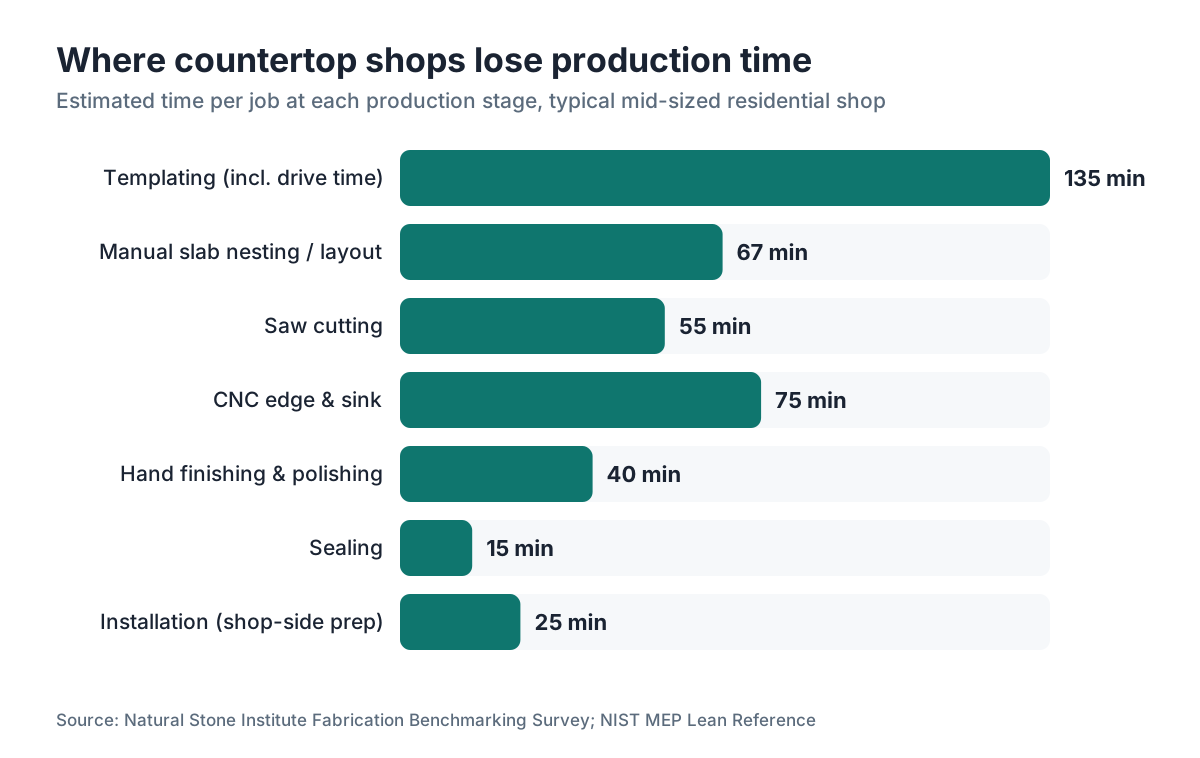
For most mid-sized shops (three to eight fabricators), here's what the time study usually reveals:
- Templating takes 90 to 180 minutes per job including drive time, which almost always limits how many jobs can start per day
- Manual slab layout and nesting takes 45 to 90 minutes per job; automated nesting can cut this to under 10 minutes [3]
- CNC setup and run time is highly variable but averages 60 to 90 minutes for a typical kitchen with an eased edge and one sink cutout
- Hand finishing adds 20 to 60 minutes depending on edge complexity
Once you have your takt time and your per-station times, the math points straight at where to act. Don't skip this step. Gut feeling is wrong about as often as it's right in production scheduling.
What's the fastest fix for a templating bottleneck?
Templating is a field activity, which makes it harder to speed up than a shop process. But the levers are real.
First, separate template scheduling from installation scheduling. Many shops schedule templates the same day as installs for other jobs, which compresses the week into a knot. Batch templates in the mornings Monday through Wednesday and installs Thursday through Saturday, and layout and cutting get a full two-day buffer. That alone can kill the Sunday-night fire drill.
Second, look at your templating technology. Laser templating systems (LT-55, Proliner, and similar tools) cut on-site time and nearly eliminate transcription errors compared to cardboard or stick templates. They also produce digital files that feed straight into layout software, dropping a manual digitizing step. A fabrication technology survey by industry software vendor Moraware found shops using digital templating reported roughly 30% fewer remakes from measurement error [4].
Third, ask whether a single templater is your single point of failure. Cross-train an installer to run templates on simpler jobs (straight kitchens, no curves) and you get flex capacity on heavy weeks without a new hire.
For kitchen countertops and other complex multi-piece jobs, a standard template checklist covering window and appliance clearances, sink cutout dimensions, and cooktop locations kills the back-and-forth phone calls that each add 20 to 40 minutes of dead time to a job.
How does poor slab nesting slow down the whole shop?
Nesting is where you decide which pieces cut from which slabs. Do it badly and you either waste stone or run extra saw passes. Either way, every downstream station pays for it.
Slab yield below 70% is a warning sign. Natural Stone Institute benchmarking puts optimal nesting at 78-85% yield for typical residential work [3]. The gap between 70% and 82% on a $300 slab is $36 of stone wasted per job. Across 200 jobs a year, that's $7,200 in material cost from nesting inefficiency alone, before you count the extra cutting time.
Manual nesting by an experienced programmer takes 45 to 90 minutes per job. Automated nesting in modern layout software takes under 10 minutes for the same job and routinely beats human nesting on yield, because it evaluates thousands of placement combinations faster than any person can [3]. This is one of the few places where software pays for itself quickly and you can measure it.
The saw bottleneck is often a nesting bottleneck in disguise. If the saw operator is waiting on cut files, or re-queuing slabs because the cut plan ignores slab orientation or vein matching, the saw looks busy without being productive. Clean, validated cut files delivered before the shift starts wipe out most of that wasted motion.
SlabWise's nesting module is built for exactly this. It takes the template file, optimizes placement against your available slab inventory, and outputs a cut file the saw operator runs without extra programming. That's the kind of specific workflow integration worth evaluating software for, if you're at that stage.
Is buying a new saw or CNC machine the answer?
Rarely, at least not first. New equipment is the right call only after you've confirmed the machine is the constraint and that better scheduling or layout can't fix it.
A bridge saw running one shift has theoretical throughput of 15 to 25 slabs per day, depending on piece complexity and blade condition. Most shops cut 6 to 12. The machine is almost never the limit. The limit is setup time, waiting for cut files, or the operator handling work a helper should do.
Before you buy, ask three questions:
- What percentage of saw time is actual cutting versus setup, blade changes, and waiting for instructions? Under 60% cutting time means you have a process problem, not a capacity problem.
- Is the CNC idle while the saw is slammed, or the reverse? If so, sequencing and scheduling are misaligned.
- What does a second shift cost versus a second machine? A second shift on existing equipment often runs $35,000 to $55,000 per year in labor; a new bridge saw runs $80,000 to $150,000 plus installation [5].
Capital equipment makes sense when you've done the scheduling work, tightened the nesting, and the machine still runs at 85%+ utilization across a full shift. That's the real threshold. Below it, you're buying capacity you don't need.
How does the quoting process create downstream production problems?
This connection is nearly invisible until you map it. Every day a quote sits unfinished is a day the customer hasn't signed, which means no template appointment, no layout, no saw slot. In a shop running 10 to 15 jobs per week, a 48-hour average quote delay pushes roughly one to two jobs per week to a later start than they should have.
Slow quotes also create compression. A customer who waits three days for a quote and then signs still wants installation in two weeks. A customer who gets a quote in two hours and signs the same day hands you a week of extra runway. That runway is what lets you batch templates cleanly, run the saw at a steady pace, and install without weekend overtime.
Quote accuracy matters just as much. A quote that undersells a job by $400 (a common outcome when edge pricing, sink cutouts, or material upcharges get done from memory) either eats your margin or forces an awkward conversation at install. Both burn time that could have been production time.
For granite countertops, marble countertops, and engineered stone, price per square foot swings enough by material grade, edge profile, and supplier that quoting from memory is genuinely risky. Structured quoting tools with material libraries and edge pricing tables cut quote time and error at the same time.
Here's a tell for homeowners comparing quotes: a fabricator who turns around a detailed written quote in under 24 hours is almost certainly running a tighter shop than one who takes four days. The correlation isn't perfect. It's real.
What scheduling changes reduce production bottlenecks without new equipment?
Scheduling is the highest-leverage, lowest-cost fix most shops have. A few structural changes move the needle hard.
Batch similar work. Group all waterfall edge jobs together, or all jobs with undermount sinks, and you slash CNC setup changes. Each setup change on a CNC typically costs 10 to 20 minutes. Five changes a day is 50 to 100 minutes of dead time. Batch the profiles and you get it back.
Buffer deliberately. Build a planned buffer of at least one full business day between templating completion and saw scheduling. It absorbs the inevitable template reschedule, the slow file from the programmer, or the morning the laser system needs calibration. Shops running zero buffer turn every small problem into a customer-facing delay.
Level-load the saw. Plenty of shops jam cutting into Monday and Tuesday to "get ahead," then scramble Thursday when a Tuesday install needs a redo. A level-loaded saw runs fewer pieces per day but steadier across the week, which flattens the overtime spikes that cost 1.5x labor.
Freeze the schedule 48 hours out. Changes inside 48 hours of production should need manager approval. Every last-minute swap reorders the queue, wrecks nesting efficiency, repositions slab inventory, and breeds errors. A 48-hour freeze feels uncomfortable at first and reads as measurably better within two months.
For countertop installation scheduling: confirm substrate readiness (level cabinet boxes, plumbing roughed in) before the install goes on the calendar. A failed install check wastes a truck, a crew half-day, and a slot another job needed.
How do you handle the hand-finishing and polishing bottleneck?
Hand finishing is invisible until it becomes the constraint, then it's glaring: a stack of CNC-machined pieces waits while one finisher grinds through them. The fix depends on what's actually slow.
If the queue is long because edge profiles are complex, trim your standard edge menu. Shops that offer four or five profiles instead of twelve finish noticeably faster and change fewer tools on the CNC. The revenue you lose by cutting from eight edges to five is usually smaller than the labor you save.
If finishing is slow because the polishing sequence isn't standardized, write it down and post it. Grit progression for a polished granite edge (typically 50, 100, 200, 400, 800, 1500, 3000, then buff) takes a fixed number of minutes when done right. Variation in technique, usually from newer employees, adds 20 to 40 percent to finishing time. A posted sequence kills most of that variation.
For materials like quartzite that need specific care during finishing, standardized procedures also cut the risk of surface damage. The same discipline shows up in the advice you'd give a homeowner: structured guidance for how to clean quartzite countertops or how to clean stone countertops reflects the same material-specific process thinking.
Sealer application creates its own queue. Run sealer as a dedicated batch at end of day, rather than piece by piece as finishing completes, and the finishing team stays in rhythm while the sealer station works steady.
How does job tracking visibility reduce wasted time?
In shops without visible job tracking, the floor manager answers the same question 15 to 20 times a day: where is this job? Each answer takes two to five minutes. That's 30 to 100 minutes a day of management time spent on status queries instead of solving problems [6].
A simple Kanban board with physical cards, one column per production stage, gives the whole shop real-time visibility with no software. Cards move when jobs move. The board is honest about where work sits. Bottlenecks become visible to everyone, more than the person standing at the backed-up station.
Digital job tracking adds automatic cycle time calculation over weeks and months, which is how you learn whether a scheduling change actually worked. If average cycle time from template to install ran 8.2 days before the 48-hour freeze policy and 6.7 days after, that's a measurement, not a feeling.
For shops shopping software, look specifically for cycle time reporting and queue visibility by stage. Those two features generate the data you need to keep improving. Everything else is secondary.
SlabWise tracks job status from quote through installation and shows queue depth at each production stage. If you want to see how that looks in a real shop workflow, the demo walks through it directly.
What role does material inventory management play in production flow?
Running out of a slab mid-job is a full stop. Running out of a matching lot is often worse: the job may need re-quoting with a different material, which triggers customer communication, a revised layout, and rescheduled production time.
Inventory bottlenecks usually show up as one of three patterns. First, popular materials in stock but wrong sizes: full slabs when the job needs a remnant, or only remnants when the job needs a full slab. Second, materials ordered job by job instead of in batches, so supplier lead time (often 3 to 7 business days for special orders) eats into production time [7]. Third, remnant inventory that isn't catalogued, so small jobs get cut from full slabs for no reason.
A remnant yard with accurate dimensions logged in a spreadsheet or inventory system cuts material cost and, more to the point, gives the nesting programmer a real option set. A remnant that covers a bathroom vanity keeps a full slab free for the next kitchen.
For materials like laminate countertops or Formica countertops, lead times and inventory work differently from stone, but the principle holds: know what you have before the job enters production, not after.
A minimum stock policy for your top five or six materials by volume (say, never let Colonial White or Calacatta Laza fall below two slabs) cuts emergency supplier runs without tying up cash in inventory.
How do rework and remakes create hidden bottlenecks?
A remake doesn't just cost the material. It costs a full production cycle: a new template (sometimes), a new layout, a new saw slot, new CNC time, new finishing time, a new install slot. On a job with a $1,200 material cost, the total remake cost including labor typically runs $1,800 to $2,500 once every stage is counted.
Remakes and rework average around 2-5% of jobs in a typical residential fabrication shop, though nobody has published rigorous industry-wide data on this. The closest reference point is general manufacturing, where the American Society for Quality treats rework rates of 2-4% as normal baseline and under 1% as excellent [8]. Stone fabrication sits broadly in that range based on what fabricators report.
Three causes drive most remakes: measurement error at templating, edge profile miscommunication between sales and production, and breakage during transport or installation. Each has a different fix.
Measurement error: digital templating and a mandatory field checklist. Edge miscommunication: a signed edge profile selection form attached to every job ticket, with a physical sample or photo confirmation. Transport breakage: padded A-frames, a maximum slab angle protocol, and a written loading sequence for each piece.
Cut remakes by even 1% of jobs in a shop doing 300 a year and you free up roughly three full production slots. That's real capacity.
What's a realistic timeline to see improvement after making workflow changes?
Scheduling changes (batching, the 48-hour freeze, buffer days) show measurable effect within two to four weeks. Cycle time drops and overtime hours drop first. Customer complaints about delays drop a few weeks after that.
Process standardization (polishing sequences, template checklists, loading procedures) takes four to eight weeks to become habit. Expect a short stretch where things feel slower while people adapt to the new standard.
Software timelines vary by tool. Basic job tracking on a physical Kanban board takes one day. Digital job tracking software typically takes two to six weeks to implement and start yielding meaningful data. Nesting software has a learning curve of roughly two to four weeks before operators hit the efficiency gains consistently.
Capital equipment, if it's genuinely warranted, takes longest: procurement, installation, and operator training on a new CNC or saw typically runs three to six months from decision to full production use.
The practical sequence for most shops: fix scheduling first (free, fast), then standardize processes (low cost, medium speed), then evaluate software (moderate cost, clear ROI in nesting and job tracking), then consider equipment (high cost, justified only by data). Skip steps in that order and it gets expensive.
Frequently asked questions
What is the most common bottleneck in a countertop fabrication shop?
Templating and digital layout are the most common bottlenecks in small to mid-sized shops. Templating limits how many jobs can start each day because it's a field activity with fixed travel time. Layout and nesting is the second most common, especially in shops still doing manual nesting, where one programmer becomes the gate for all downstream cutting and CNC work.
How do I calculate takt time for my countertop shop?
Divide your available daily production time (in minutes) by the number of jobs you need to complete that day. If you have 480 minutes of shop time and eight jobs, your takt time is 60 minutes per job. Any stage that takes longer than 60 minutes per job is a bottleneck. Any stage faster than 60 minutes has surplus capacity you can temporarily redirect to the constrained stage.
Will buying a new CNC machine fix my production bottleneck?
Usually not as the first move. Most CNC machines in small shops run well under 85% utilization when measured honestly. Before buying, measure actual cutting time versus setup and waiting time. If the machine is below 60% cutting time, the constraint is scheduling or file delivery, not machine capacity. New equipment is justified only after scheduling and process changes are exhausted.
How much does a production bottleneck actually cost a countertop shop?
The cost comes from several directions: overtime labor when jobs compress at week's end, customer-visible delays that hurt referrals, remakes caused by rushing, and material waste from poor nesting. A shop doing 300 jobs a year that loses 20% of productive capacity to bottlenecks runs at 240-job throughput. At $2,500 average job value, that gap is roughly $150,000 in unrealized annual revenue.
How does slow quoting affect production scheduling?
Every day a quote sits unsent delays the customer's decision, which delays the signed contract, which delays the template appointment, which shortens the production runway. Shops with 48-hour average quote times consistently report more end-of-week install compression and more overtime than shops quoting in under 4 hours. Faster quoting is one of the highest-leverage scheduling improvements available, and it costs nothing but process discipline.
What is a good slab yield percentage for countertop nesting?
Industry benchmarks put optimal nesting yield at 78-85% for typical residential work. Shops running below 70% lose significant material cost per job. At a $300 slab cost, the difference between 70% and 82% yield is $36 per job in wasted stone. Automated nesting software consistently beats manual nesting on yield because it evaluates more placement combinations in seconds than a programmer can in an hour.
How do I standardize the finishing process to avoid a polishing bottleneck?
Post the grit progression sequence at the finishing station and train every finisher to the same standard. For polished granite edges, the sequence typically runs 50, 100, 200, 400, 800, 1500, 3000, then buff. Variation from newer employees adds 20-40% to finishing time. Limiting your standard edge menu to four or five options also reduces CNC tool changes and finishing complexity without meaningfully affecting revenue.
How do remakes and rework affect throughput?
Each remake consumes a full production cycle: layout, saw time, CNC time, finishing, and an install slot. In a shop doing 300 jobs a year at a 3% remake rate, that's nine full production cycles lost annually. Total cost per remake in labor, material, and scheduling disruption typically runs $1,800 to $2,500. Cutting remakes by 1% frees roughly three job slots, which in most shops is a meaningful capacity gain.
What is a 48-hour schedule freeze and does it actually help?
A 48-hour schedule freeze means no job order changes inside two business days of its production slot without manager approval. It prevents last-minute queue reordering that disrupts nesting plans, misaligns slab inventory, and breeds errors under time pressure. Most shops that adopt it see measurable cycle time reduction within 6-8 weeks. It feels rigid at first. Your job tracking data will confirm whether it worked.
How does a physical Kanban board help a fabrication shop?
A Kanban board with one column per production stage (quote, template scheduled, template complete, layout, cutting, CNC, finishing, ready for install, installed) gives everyone on the floor real-time job status without asking the manager. It also makes bottlenecks visible: a column with ten cards backed up is the constraint. Setup costs nothing and takes one morning. It's the fastest way to get floor-wide visibility.
How should remnant inventory be managed to reduce production delays?
Catalogue every remnant with accurate length, width, thickness, and material name. A spreadsheet works. When a small job comes in, check the remnant log before pulling a full slab. This cuts material cost and keeps full slabs free for larger jobs. Shops running an uncatalogued remnant yard routinely cut full slabs for jobs a remnant would cover, wasting both material and nesting time.
What's the right sequence for fixing workflow problems in a countertop shop?
Fix scheduling first (batching, buffer days, 48-hour freeze): free and fast. Standardize processes second (checklists, grit sequences, loading procedures): low cost, takes 4-8 weeks. Evaluate layout and job tracking software third: moderate cost with measurable ROI in nesting yield and cycle time data. Consider new equipment last, only after data confirms the machine is the constraint and it's running above 85% utilization.
How can a homeowner tell if a fabricator has a well-run production workflow?
Ask how long from template to installation. A well-run shop typically quotes 7-10 business days. Ask whether they use digital templating. Ask for a written timeline with milestone dates. A fabricator who can give you specific dates for template, approval, and installation on the first call has a structured workflow. Vague answers like 'about two weeks' usually mean scheduling is reactive, not planned.
Does job tracking software really reduce bottlenecks or is it just overhead?
Job tracking software cuts the time managers spend answering status questions (estimated at 30-100 minutes per day in shops without visibility tools) and generates cycle time data that shows whether process changes worked. The overhead is real during implementation, typically 2-6 weeks. After that, the data value beats the entry cost for most shops doing more than 10 jobs per week. Smaller shops often do fine with a physical Kanban board.
Sources
- Goldratt, E.M. and Cox, J. 'The Goal: A Process of Ongoing Improvement' (1984), summarized in Theory of Constraints overview, APICS/ASCM: Every system has exactly one binding constraint at any moment; improving non-constraints first does not improve overall throughput
- National Institute of Standards and Technology (NIST), Manufacturing Extension Partnership: Lean Manufacturing Concepts: Takt time equals available production time divided by customer demand rate, the foundational calculation for identifying bottleneck stations
- Natural Stone Institute, 'Fabrication Benchmarking Survey Results', naturalstoneinstitute.org: Optimal slab nesting yield benchmarks of 78-85% for residential countertop work; automated nesting reduces layout time to under 10 minutes per job
- Moraware (countertop industry software), 'State of the Industry Survey: Fabrication Technology Adoption': Shops using digital laser templating reported approximately 30% fewer remakes attributable to measurement error compared to shops using analog templates
- Stone World Magazine, bridge saw and CNC equipment pricing reference: New bridge saw equipment costs range from $80,000 to $150,000 installed; second-shift labor costs typically run $35,000 to $55,000 per year
- NIST Manufacturing Extension Partnership, Lean Waste Identification Guide: Status-query time in shops without visible job tracking averages 30-100 minutes of management time per day, classified as motion and waiting waste under lean frameworks
- Natural Stone Institute (formerly Marble Institute of America), Stone Supplier Lead Time Guidelines: Special-order stone slabs from distributors typically carry 3-7 business day lead times, creating production delays when material is ordered job-by-job
- American Society for Quality (ASQ), 'Quality Costs and Rework Benchmarks in Manufacturing': Rework rates of 2-4% of jobs are considered normal baseline in general manufacturing; rates under 1% are considered excellent performance
- U.S. Bureau of Labor Statistics, Occupational Employment and Wage Statistics: Stone Cutters and Carvers: Labor cost benchmarks for stone fabrication workers, supporting overtime cost estimates for shops with compressed production schedules
- U.S. Small Business Administration (SBA), guidance on managing business operations: Operational scheduling improvements (batching, buffer time, freeze windows) are documented as high-ROI, low-capital interventions for small manufacturing businesses
Last updated 2026-07-11