TL;DR
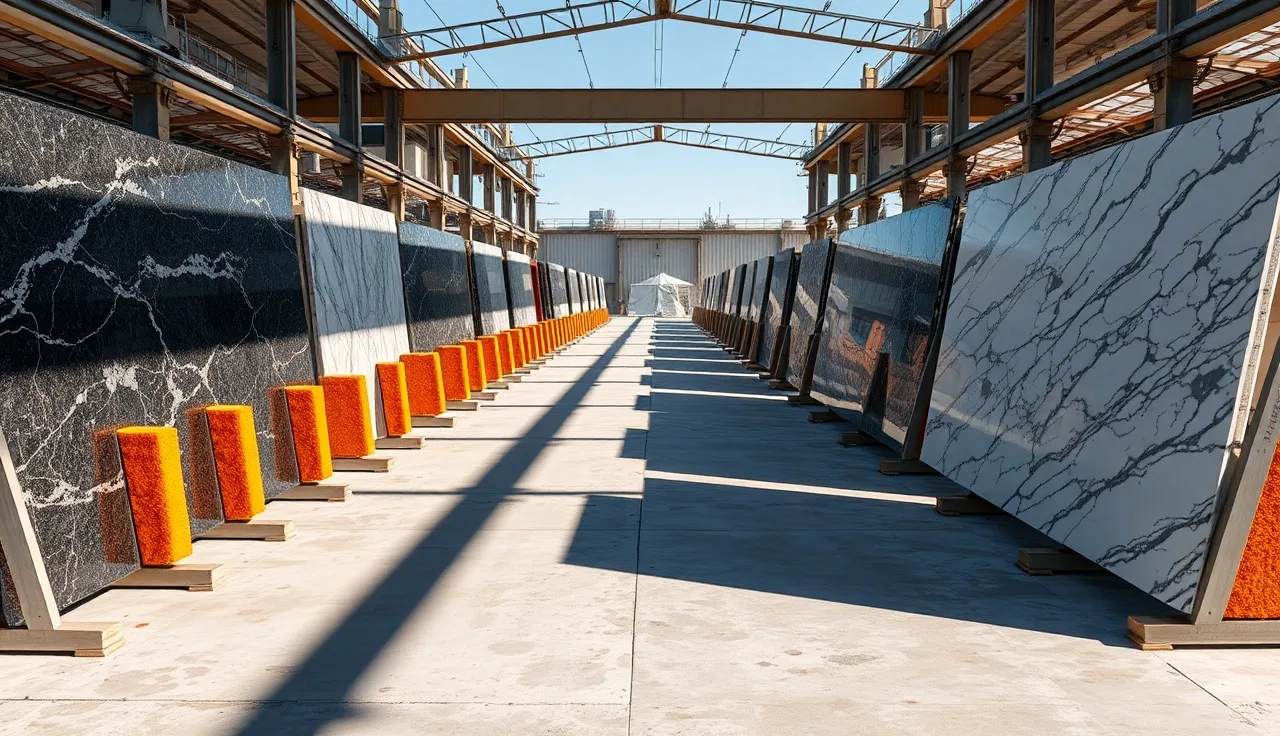
- Store slabs on A-frames at 5 to 15 degrees off vertical, never flat.
- Pad every contact point with foam or rubber.
- Keep bundles together as long as you can, and move thin or fragile material with suction cups and at least two people.
- Most yard breakage is preventable with gear that costs far less than one snapped slab.
Why does slab damage in the yard happen so often?
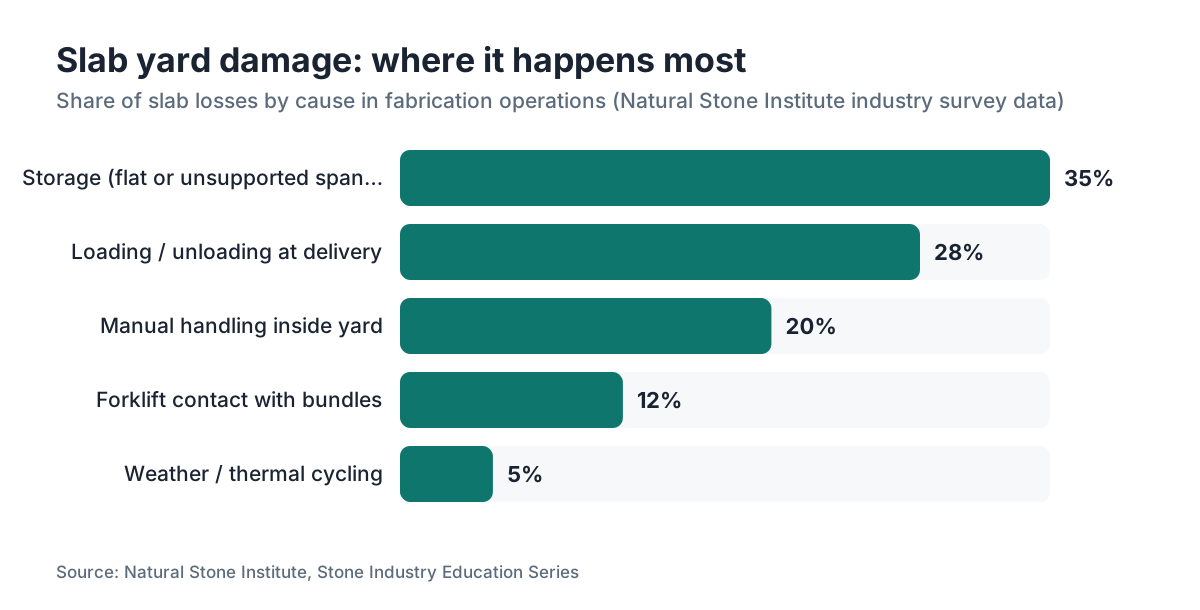
Stone is heavy and brittle at the same time, and that combination is what gets shops in trouble. A 3 cm granite slab measuring 60 x 110 inches weighs 700 to 900 lbs, yet one sharp edge impact or a few feet of unsupported span will snap it clean. Most breakage never happens on the saw or the CNC table. It happens in storage, during a short move across the yard, or while loading and unloading a truck.
The root causes repeat. Slabs stored flat, even for an afternoon, build stress across unsupported spans and crack under their own weight. Contact points without padding push all the force onto one edge or one spot on the face, seeding micro-fractures that open into full breaks the next time the slab moves. Then there's the human side: crowded yards, poor sight lines, and rushed handling, which is how forklifts clip bundles and workers carry stone at angles that load every bit of bending stress onto the thinnest point.
A single broken exotic marble or quartzite slab runs $500 to $3,000 or more in lost material, plus the labor already spent, plus the customer call nobody wants to make [1]. Prevention almost always wins the math.
What is the correct angle and position to store stone slabs?
Store slabs nearly vertical, leaning 5 to 15 degrees off true vertical. That lean sends the slab's weight straight down through its length instead of bending it across its width, which is where natural stone is weakest. Dead vertical is actually a touch worse than a small lean, because it dumps the whole balance job onto the bottom edge.
Never store slabs flat on the ground or on sawhorses without continuous, full-length support. A slab held up only at its ends sags under its own weight over hours or days, and stone doesn't spring back. The sag becomes a crack. The Natural Stone Institute's handling guidelines name horizontal storage on inadequate support as a leading cause of yard breakage [2].
Thick slabs (3 cm and up) tolerate a slightly wider range of angles. Thin slabs (1.2 cm, 2 cm, or any mesh-backed material) need to stay closer to vertical and need support across a wider base. If a bundle mixes thicknesses, let the thinnest slab in it govern how you store the whole thing.
Keep slabs in their original bundles as long as you can. The bundle reinforces itself. The moment you break it to pull one slab, the rest get less stable and need immediate restacking or fresh A-frame support.
What storage equipment do you actually need?
A-frames are the baseline. A good steel A-frame holds slabs at the right angle, has padded uprights, and won't tip under a full bundle. Cheap frames with flimsy welds are false economy. The frame should be heavy enough, anchored enough, that a forklift nudge can't tip it forward. Plenty of shops bolt their A-frames to concrete pads or weld them to heavy base plates.
Padding is not optional. Every point where stone meets metal, stone meets stone, or stone meets wood needs a cushion. Here's what shops actually use:
| Padding type | Best use | Approximate cost |
|---|---|---|
| Closed-cell foam strips | Slab-to-slab and edge contact | $0.10, $0.30 per linear foot |
| EPDM rubber strips | Bottom edge on steel A-frame | $0.20, $0.50 per linear foot |
| Rubber saddle pads | Forklift tine covers | $30, $80 per pair |
| Foam pipe insulation | Bundling odd-shaped remnants | $0.15, $0.25 per linear foot |
Rubber saddle pads on forklift tines are one of the highest-return items in any yard. They guard the stone face on every lift and cost less than the five minutes it takes to argue about who broke a slab.
Suction cup lifters earn their keep too. Mechanical or vacuum cups let two workers move a slab without their hands ever touching the face. On polished, porous surfaces, bare hands leave oils that can soak in, and the grip is unreliable anyway. A basic two-cup mechanical lifter runs $40 to $80. Vacuum systems with safety backup valves cost several hundred dollars and are the professional standard for heavy or large-format work [3].
How should you load and unload slabs from a delivery truck?
Loading and unloading are the riskiest moments for slab breakage, full stop. You're lifting heavy material between surfaces at different heights, usually with a driver tapping a foot to leave.
Use a forklift with the tines spread as wide as the bundle allows. Narrow tine spacing puts all the load on two close points and snaps a slab the way a flathead screwdriver splits a credit card. Spread the tines to cover as much of the bundle's width as you can, ideally within 6 inches of each edge.
Inspect the bundle before you commit to the lift. Check the strapping (steel or nylon banding) for corrosion, cuts, or slack. Look at the wood dunnage underneath. Wet or rotted wood collapses without warning. If the strapping looks compromised, re-strap before anything moves.
Never tilt the forks forward with a slab or bundle in the air. Forward tilt shifts the load toward the tips and sharply raises the odds of a slide. Keep the forks level or very slightly back-tilted while you move across the yard.
For individual slabs coming off a truck rather than bundles: two people minimum, suction cups on, walking in sync. One leads, one follows, both facing the stone. The follower watches the trailing edge for clearance. Call out every obstacle. It sounds like overkill until you've watched a slab hit a door jamb.
How do you protect slabs from weather and environmental damage?
Outdoor storage is common, and it adds real risk. The main weather threats are thermal cycling, standing water, and UV exposure, and which ones matter depends on the material.
Thermal cycling, repeated heating and cooling, stresses stone along its existing micro-fractures and grain boundaries. Dark stones absorb more heat and expand more than light ones. In climates with big day-night swings, covering bundles with tarps or shade cloth drops peak temperatures and slows the cycling [4].
Standing water under a bundle causes two problems. It softens the wood dunnage, which can collapse and drop the load. And for certain stones (some sandstones, certain marbles, green serpentinite), long exposure to moisture breaks down natural clay minerals in the stone. A concrete pad graded so water drains away from the base of your A-frames beats a gravel yard. Gravel beats dirt. Dirt is unacceptable.
UV exposure mostly hits resin-backed slabs and mesh-backed thin stone. The resin behind fragile or heavily veined slabs yellows and turns brittle after months in direct sun, weakening the bond that holds the slab together. Store resin-backed material outdoors and you need to cover it. That includes heavily veined marble countertops and quartzite that arrives with factory resin fill.
Freeze-thaw is the worst force for porous stone stored outdoors up north. Water in the micro-pores expands about 9 percent when it freezes [5], and each cycle drives the cracks deeper. Keep porous, unsealed stone under cover through winter.
What yard layout practices reduce slab damage risk?
Layout is a decision you make once that prevents accidents every day. The core idea: keep forklift traffic away from foot traffic and away from spots where slabs move by hand.
Mark forklift lanes with painted lines or physical barriers. When an operator clips a bundle that somebody left in an unmarked aisle, the operator isn't entirely at fault. The shop that never defined the aisle owns most of that liability. OSHA's Powered Industrial Trucks standard (29 CFR 1910.178) requires aisles and passageways to be kept clear and properly marked [6].
Store the heaviest, largest bundles lowest and toward the back. That keeps the center of gravity low across the whole yard and pushes the heaviest forklift work away from busy zones. Remnants and small pieces go on separate, lower racks where a worker can pull them by hand, no forklift needed.
Label every bundle clearly. When someone has to hunt for a slab by shoving others aside, that's exactly when stone gets leaned at a bad angle, set on the ground, or bumped. A clear label (bundle number, material, thickness, square footage) means the right slab turns up on the first try.
Keep a clear path from storage to fabrication wide enough for two workers carrying a slab on suction cups to pass another pair coming back. Six feet minimum. Eight feet if you handle any large-format material.
How do you handle remnants safely without breaking them?
Remnants break more than anything else in most shops. They don't fit neatly in bundles, they get stacked wherever there's room, and they get moved constantly by people thinking about the job they're quoting instead of the piece in their hands.
Use a dedicated remnant rack, separate from your full-slab A-frames, with padded upright dividers so each piece stands on its own. Leaning remnants against each other is how you get a cascade: one piece slides, drags two more down, and now you've got four broken pieces.
Label remnants the day they're cut. Put the material, the rough dimensions, and the date on the label. Skip that and you'll re-measure it later and probably confuse it with another piece.
Watch the weak spots. A long thin peninsula left over after a sink cutout needs foam blocks under the span before it goes into storage. A piece of leftover marble 4 inches wide and 24 inches long will break from its own weight if you store that 24-inch span horizontal and unsupported.
What personal protective equipment and safety training does OSHA require for stone yards?
OSHA has no stone-specific standard for fabrication yards, but several general industry standards apply directly.
Foot protection is required when heavy objects present a danger of foot injury (29 CFR 1910.136) [10]. Any shop that moves slabs meets that bar the moment the first slab moves. Steel-toed or composite-toed boots are not optional.
Eye protection is required when workers face flying particles (29 CFR 1910.133) [7]. If your yard does any cutting or grinding, safety glasses are required there too.
Forklift operators must be trained and certified under 29 CFR 1910.178(l). Certification means initial training, an evaluation, and recertification at least every three years, plus a fresh evaluation any time an operator is seen operating unsafely, after an accident or near-miss, or when an evaluation shows a problem [6].
Back injuries from manual slab handling are among the most common and most expensive injuries in this trade. OSHA's ergonomics guidance puts engineering controls first (suction cup lifters, mechanical assists), then administrative controls (training, job rotation), then PPE [11]. The takeaway is blunt: buy the tools. Training by itself does not prevent a herniated disc.
On dust, OSHA's Respirable Crystalline Silica standard for general industry (29 CFR 1910.1053) sets a permissible exposure limit of 50 micrograms per cubic meter of air, averaged over an 8-hour shift [8]. Dry-cutting stone in a yard with no dust suppression breaks this rule. If any cutting or grinding happens in your yard, wet methods or local exhaust ventilation are required.
How do you inspect slabs for existing damage before storing them?
Inspection on receipt is your one shot to document damage that happened before the slab reached your yard. Skip it and you own every crack and chip, whether you caused it or not.
Check each slab or bundle against the delivery paperwork before you sign. Note every chip, crack, broken corner, or delaminated resin backing on the delivery receipt itself, not on some separate form you'll file later. Photograph each defect with the delivery vehicle still in frame. That timestamp and the truck in the background make a much cleaner claim.
Run a flashlight across the face at a raking angle to catch hairline cracks that hide in flat light. Hairline cracks are future break lines. One in the field of a slab will almost certainly open into a full break during fabrication. Knowing it's there lets you plan the cut layout around it, or warn the customer before work starts.
For engineered stone like Cambria countertops and other quartz products, hunt for corner chips specifically. The resin-and-aggregate build is strong across the field but brittle at the corners, and a corner chip kills your ability to run a clean edge there.
Document every slab in your inventory system. Software that tracks slab condition, dimensions, and yard location, like the tools in SlabWise, can flag when a slab with a noted defect gets pulled for a job, so the estimator or fabricator knows before the saw turns on.
What are the biggest mistakes fabricators make with slab storage?
The most expensive mistake is also the most common: breaking bundles too early. The second you separate a bundle to pull one slab, every slab left behind needs new support. Set them back on the A-frame without checking that they're padded and seated, and you've built a chain reaction that's just waiting for a trigger.
Second mistake: mixing stone types and thicknesses on one A-frame without planning for the weakest piece. A 2 cm marble slab wedged between two 3 cm granite slabs is at risk, because the heavier slabs can slide inward and pinch the marble under load.
Third: ignoring the condition of the A-frames themselves. A frame that's spent five years in a rough outdoor yard may have corroded welds, bent uprights, or padding worn down to bare metal. Equipment inspection should be a scheduled task, not something you do after an accident.
Fourth, and it catches exposed yards: wind. A slab leaning at 10 degrees with a big face area acts like a sail. A-frames need to be heavy or anchored enough that a 40 mph gust can't tip them. In open yards, stake or bolt the frames to the concrete, especially for full-height slabs.
One note for homeowners trying to understand why fabricators charge what they charge for kitchen countertops: a shop that handles your stone carefully is spending real money on equipment, training, and time. That care is a sign of a good fabricator, not overhead to negotiate away.
How should you move slabs safely within the shop or yard?
Short moves inside the shop, storage to the saw table and back, are where a lot of injuries and breaks happen. The piece is off the A-frame, it's in motion, and there's no real process because it feels like a quick carry.
Set a rule and hold it: any slab over a certain size (many shops use 24 inches in any dimension) gets two people or a mechanical assist. No exceptions for the experienced hand who's carried bigger alone before. That exception becomes the culture, and eventually someone gets hurt.
Carry slabs on edge, not flat. Flat carry needs more people and loads more bending stress into the stone. On edge, one person on each end, suction cups applied, the stone's own stiffness does the work.
For overhead crane or gantry systems, use stone-specific lifting clamps with rubber-lined jaws, never generic steel. Steel jaws scratch polished faces and can pinch hard enough to chip edges. Keep the lifting point as close to the slab's center of gravity as you can.
Setting a slab down for a minute? Set it on foam blocks or a rubber mat, never straight on concrete. A concrete edge is sharp enough to chip a polished stone edge under nothing but the slab's own weight.
What does all this cost and is it worth it?
Put real numbers on it.
Four heavy-duty fabrication A-frames with padded uprights run $800 to $2,500 depending on size and steel gauge [9]. A pair of rubber forklift tine covers costs $30 to $80. Four mechanical suction cup lifters suitable for slabs cost $150 to $300. Foam and rubber padding for a yard with 20 A-frames runs maybe $200 to $400 installed. A decent remnant rack costs $400 to $1,200.
Total for a well-equipped small shop: roughly $2,000 to $5,000, installed.
One broken exotic slab, say a quartzite or a book-matched marble, costs $800 to $4,000 or more in material alone, plus the labor already logged, plus the reorder, plus the delay to the customer [1]. Shops that actually track their slab losses find that preventing even one or two breaks a year covers the entire equipment bill.
For shops running inventory and job-flow software, catching the gap between what's ordered, what's received, and what's actually usable is another layer of loss prevention. When the software flags that the slab pulled for Job #4472 has a noted defect in the upper-right quadrant, you re-nest before the saw runs, not after. Tools like SlabWise make that kind of defect-aware planning routine.
The return on yard safety and storage gear is not subtle. It's one of the clearest yes-spend calls in the fabrication business.
Frequently asked questions
Can you store stone slabs flat if you support them fully along the length?
Technically possible for very short stretches if the support is truly continuous (more than two end points), but it's not recommended. Full-length support is hard to pull off in a real yard, flat slabs are hard to lift safely, and any gap in support becomes a break line. Vertical storage on padded A-frames is safer, more space-efficient, and better for the stone.
How far apart should A-frames be spaced in a yard layout?
Leave enough room between frames for a forklift to approach head-on and for workers to pull slabs by hand without bumping the next frame. Four feet between frames works for most yards. If you load A-frames directly with a forklift, go 6 to 8 feet for tine clearance and sight lines.
What padding material is best for the bottom edge of slabs on an A-frame?
EPDM rubber strip, 1/4 to 3/8 inch thick, is the common pick. It handles oil, water, and UV better than foam alone, doesn't crush permanently under heavy loads, and gives enough to spread out edge contact stress. Replace it when it shows permanent deformation or surface cracking. Some shops run neoprene, which behaves about the same.
Do I need to secure slabs with straps once they're on A-frames?
For indoor storage in a stable environment, A-frame geometry usually gives enough stability on its own. In outdoor yards with wind, or if your frames aren't anchored, running nylon web straps across the bundle face as a backup restraint is a fair precaution. Never put steel banding directly against stone without padding between them.
How do you safely move a slab that's cracked but not fully broken?
Treat it as two pieces that happen to still be touching. Add extra suction cup points on each side of the crack before you lift. Move it to the fabrication table, not back to storage, if you can. Lay it down gently with support under both sections. Storing a partially cracked slab on an A-frame risks the crack finishing during the next move or from thermal cycling.
What's the safest way to store thin (2 cm or 1.2 cm) stone slabs?
Thin slabs need A-frame uprights spaced no more than 12 inches apart to keep them from bowing between contact points. Store them with the factory dunnage or add foam strips at every upright. Never pull a thin slab from one end. Support the whole face during extraction, with suction cups set at multiple points before the slab breaks contact with the frame.
How often should you inspect A-frames and storage equipment?
A quick visual check of each A-frame should happen weekly in an active yard: bent uprights, cracked welds, worn padding, any tilt. A thorough check with weight on each frame and a close look at the welds makes sense quarterly. Any A-frame involved in an incident gets pulled from service and inspected before it goes back.
Is silica dust a hazard in an outdoor slab storage yard, or only during fabrication?
The main silica hazard is cutting, grinding, or breaking. In a pure storage yard with no cutting, dust levels are generally low. If any dry cutting, trimming, or grinding happens in the yard, OSHA's 29 CFR 1910.1053 silica standard applies, requiring wet methods or local exhaust ventilation to hold exposure below 50 micrograms per cubic meter averaged over 8 hours.
Can stone slabs be stored outdoors in cold climates?
Yes, but porous stones need protection from freeze-thaw. Water that gets into micro-pores expands about 9 percent when it freezes, driving cracks deeper. Keep porous, unsealed material (certain marbles, sandstones, some limestones) covered through winter. Dense, low-porosity materials like granite and most quartzite handle outdoor winter storage far better. Keep every bundle elevated above standing water, season regardless.
What information should be on a slab storage label?
At minimum: material name, thickness (1.2 cm, 2 cm, 3 cm), rough dimensions, a unique bundle or slab ID that matches your inventory system, any noted defects and where they are, and the date received. If you run high volume, a QR code linking to the full inventory record saves real time and cuts down on mis-pulls.
How do you handle a slab that arrives damaged at delivery?
Document it before the driver leaves. Note every defect on the delivery receipt and have the driver acknowledge it. Take dated photos with the delivery vehicle visible in frame. Contact your supplier the same day with the photos and the annotated receipt. Most supplier damage claims have a short reporting window, often 24 to 72 hours after delivery, so waiting to document gets expensive.
What's the proper way to dispose of or recycle broken slab pieces?
Broken stone is typically inert solid waste. Many areas allow it in general construction and demolition waste streams. Check your local jurisdiction, since some counties cap disposal quantities or require a specific hauler for stone. Small pieces sometimes work for landscape projects or mosaics. Engineered quartz with resin binders may carry different disposal requirements than natural stone.
Sources
- Natural Stone Institute (formerly Marble Institute of America), Stone Industry Education Series: Slab breakage during storage and handling is identified as a primary source of material loss in fabrication shops, with replacement costs for exotic stone running several hundred to several thousand dollars per slab.
- Natural Stone Institute, Slab Safety and Handling Guidelines: Horizontal storage on inadequate support is identified as a leading cause of slab breakage in fabrication yards.
- Natural Stone Institute, Stone Industry Safety Resources: Suction cup lifters are recommended as the professional standard for moving polished stone slabs safely within fabrication environments.
- USGS, Thermal Properties of Rock and Stone, Professional Paper 1462: Thermal cycling causes stress along existing micro-fractures in natural stone; dark-colored stones absorb more heat and experience greater thermal expansion than light-colored stones.
- USGS, Water Science School: The Unique Properties of Water: Water expands approximately 9 percent in volume when it freezes, which propagates cracks in porous materials such as natural stone.
- OSHA, Powered Industrial Trucks Standard, 29 CFR 1910.178: OSHA 29 CFR 1910.178 requires that aisles and passageways be kept clear and properly marked, and that forklift operators be trained, evaluated, and recertified at least every three years.
- OSHA, Eye and Face Protection Standard, 29 CFR 1910.133: OSHA 29 CFR 1910.133 requires eye and face protection when workers are exposed to flying particles, such as during stone cutting or grinding.
- OSHA, Respirable Crystalline Silica Standard for General Industry, 29 CFR 1910.1053: OSHA 29 CFR 1910.1053 sets a permissible exposure limit of 50 micrograms per cubic meter of air for respirable crystalline silica, averaged over an 8-hour shift.
- Natural Stone Institute, Fabrication Best Practices Reference: Heavy-duty fabrication A-frames with padded uprights typically cost $800 to $2,500 per unit depending on size and steel gauge.
- OSHA, Personal Protective Equipment: Foot Protection, 29 CFR 1910.136: OSHA 29 CFR 1910.136 requires protective footwear when heavy objects present a danger of foot injury, which applies directly to stone fabrication yard workers.
- OSHA, Ergonomics: Solutions to Control Hazards: OSHA recommends engineering controls such as mechanical lifting aids as the primary intervention for preventing musculoskeletal injuries from manual material handling, ahead of administrative controls and PPE.
Last updated 2026-07-11