TL;DR
- A stone shop water recycling system collects slurry-laden coolant water from saws and CNC machines, settles the solids in a clarifier tank, and returns clean water to the tools.
- A basic gravity-fed system for a small shop costs $8,000, $20,000 installed.
- A full closed-loop system with a filter press runs $40,000, $80,000.
- Most jurisdictions require a permit before you discharge to sewer.
Why does a stone shop need a water recycling system?
Every wet-cutting stone shop runs water across the blade or wheel constantly, as coolant and dust control. Bridge saws, CNC routers, edge polishers, and hand tools all drink it. A single bridge saw can use 3 to 8 gallons per minute during a cut [1]. Over a busy production day, a shop might push 2,000 to 5,000 gallons through its equipment.
That water comes back loaded with stone slurry: fine silica dust, calcium carbonate, polymer binders from engineered stone, and whatever minerals the slab held. You cannot legally dump that down a floor drain in most states without treatment. The Clean Water Act prohibits discharging process wastewater with elevated total suspended solids (TSS) to a storm drain, and most municipal sewer authorities set TSS limits between 150 and 300 mg/L for industrial users [2]. Raw stone slurry routinely runs past 5,000 mg/L.
Fresh water costs money too. In drought-prone states like California, Arizona, and Texas, industrial water rates for fabricators run roughly $0.005 to $0.015 per gallon, and high-volume surcharges push that higher [3]. Recycle 70 to 80% of your process water and you cut that cost proportionally, plus you shrink your sewer discharge fees. Plenty of shops pay $300 to $800 a month in sewer surcharges before they build a system. After, they pay close to nothing, because there's almost nothing left to discharge.
There's a shop-floor reason too. Recycle your water and you deal with slurry on your schedule instead of chasing it across the floor. Slurry is slippery. It clogs drains. It dries into a concrete-gray crust on your machines. A good recirculation system keeps that mess contained and the floor safe.
What are the main components of a stone shop water recycling system?
A recycling system is a loop. Water goes out dirty, gets cleaned, and comes back. Every part has one job.
Collection trench or sump. The starting point. Water and slurry fall off your saw tables and polishing stations into floor drains that feed a central sump. The sump is usually a below-grade concrete pit, 200 to 500 gallons for a small shop, 1,000 to 3,000 for a larger one. It needs a pump and a grated cover to keep big debris out.
Transfer pump. A submersible slurry pump lifts water from the sump to the first settling stage. These pumps have to eat abrasive slurry without wearing out fast, so stainless steel or cast-iron impellers are worth the premium over a standard sump pump. A good submersible slurry pump costs $400 to $1,200 [4].
Primary clarifier tank. This is where most solids drop out. A clarifier is a large tank, usually 500 to 2,000 gallons, where the water slows down enough that gravity pulls heavy particles to the bottom. Residence time matters. Water needs to sit at least 20 to 40 minutes to settle well. Some shops run two or three tanks in series, which sharpens the clarity a lot.
Coagulant/flocculant dosing (optional but it works). Flocculants like polyacrylamide make fine particles clump together and drop faster. A basic dosing rig costs $800 to $2,500 and can cut clarifier residence time in half while pulling effluent from 500 mg/L TSS down under 100 [5]. For shops with tight discharge limits, this step is often the difference between passing and a violation.
Secondary filtration. After the clarifier, many systems push water through a sand filter, a bag filter, or a cartridge filter to catch the fines that never settled. A multi-media sand filter for industrial use runs $1,500 to $4,000. Cartridge filters are cheaper upfront but the media adds up over time.
Clean water storage tank. Filtered water waits here before it recirculates. This tank buffers the system so your saws never starve for water even when the clarifier is chewing through a surge. A 500 to 1,000 gallon poly tank does the job.
Return pump and distribution manifold. A clean-water pump pushes treated water back to each machine. Most saws and CNCs want 40 to 80 PSI. A centrifugal pump with a pressure tank handles it.
Filter press or dewatering system (for full closure). The sludge at the bottom of your clarifier is still mostly water. A filter press squeezes it into dry cakes, typically 60 to 75% solids, which cuts the volume you haul away as solid waste [6]. A small filter press costs $8,000 to $20,000. Without one, you're pumping wet slurry into drums and paying to haul heavy liquid off site.
What does it cost to build a stone shop water recycling system?
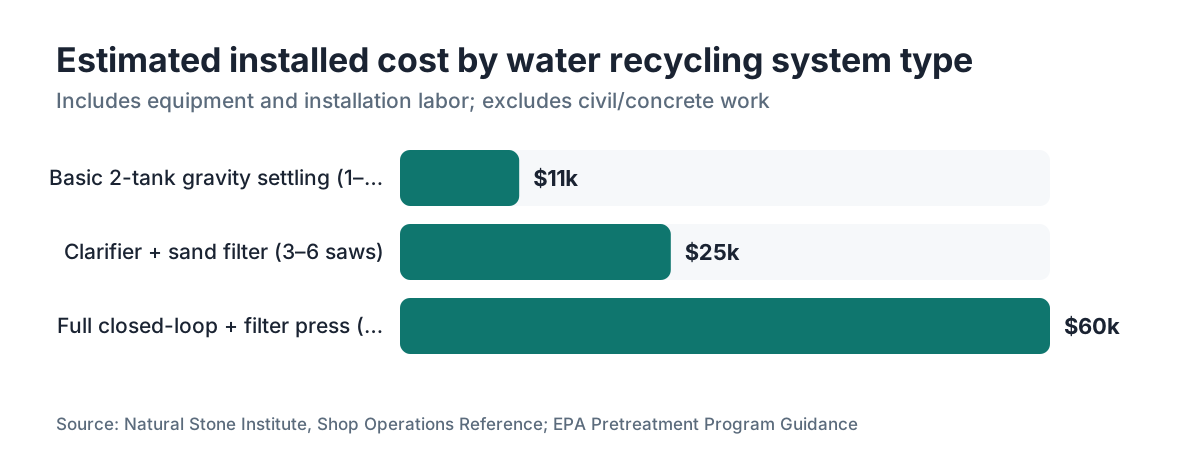
Cost swings hard on shop size, local labor rates, whether you need a filter press, and how tight your discharge permit is. The table gives honest ranges pulled from reported equipment prices and installer quotes in industry references.
| System Type | Shop Size | Equipment Cost | Install Labor | Total Installed |
|---|---|---|---|---|
| Basic gravity settling (2-tank) | 1 to 3 saws | $4,000, $8,000 | $3,000, $6,000 | $7,000, $14,000 |
| Clarifier + sand filter | 3 to 6 saws | $10,000, $22,000 | $6,000, $12,000 | $16,000, $34,000 |
| Full closed-loop + filter press | 6+ saws / CNC | $30,000, $55,000 | $10,000, $25,000 | $40,000, $80,000 |
Those numbers skip civil work. If your shop has no collection trench and sump, cutting concrete, installing drains, and waterproofing a sump pit adds $5,000 to $15,000, depending on slab thickness and local concrete prices [4].
Permitting fees usually run $500 to $2,000 for an industrial pretreatment permit, though some big municipalities charge more for the initial inspection and baseline sampling [2].
Payback on a water recycling system usually lands at 3 to 6 years once you count water savings, lower sewer surcharges, and reduced solid waste hauling. In high-water-cost regions it drops to 2 to 3 years. The math is plain. If you're paying $600 a month in sewer surcharges and $200 in excess water, a $20,000 system pays back in about 25 months.
What permits and regulations do you need to know before you build?
This is the piece most shops get wrong, and getting it wrong is expensive. Build first and permit later, and you may have to tear out gear that doesn't meet your city's specific rules.
The Clean Water Act, through the National Pollutant Discharge Elimination System (NPDES) program, sets the federal frame [2]. Enforcement lands at two levels. If you discharge to a municipal sewer, you fall under the local Pretreatment Program run by your publicly owned treatment works (POTW). If you discharge to surface water or groundwater (rare for indoor shops), you need a direct NPDES permit from your state environmental agency.
Most stone shops discharge to the municipal sewer. The POTW sets limits on TSS, pH, and sometimes specific metals or oils. EPA's general pretreatment standards say industrial users must not discharge pollutants that "pass through" or "interfere" with the treatment works [2]. In practice, TSS limits of 150 to 250 mg/L are common, and pH usually has to stay between 5.5 and 10.5.
Engineered stone (quartz composite) adds a wrinkle: crystalline silica. OSHA's respirable crystalline silica rule (29 CFR 1926.1153 for construction, 29 CFR 1910.1053 for general industry) governs airborne exposure, not waterborne discharge, but some state agencies have started asking fabricators about silica in wastewater too [7]. Ask your state environmental agency about silica limits before you design anything.
California shops face the toughest environment. The State Water Resources Control Board requires fabricators with process wastewater to hold a permit under the Industrial General Permit or a site-specific NPDES permit, and several Regional Water Quality Control Boards have gone after stone shops for unpermitted discharge [3]. Texas runs a parallel program under the Texas Pollutant Discharge Elimination System (TPDES), administered by TCEQ [8].
Do this: call your local POTW before you buy anything. Ask for their "significant industrial user" threshold (often 25,000 gallons per day, but some set it lower) and their specific discharge limits. Request a copy of the pretreatment ordinance. That document tells you exactly what you have to treat to. Then design to those numbers, not to a generic standard.
How do you size a clarifier for your shop's water volume?
Clarifier sizing comes down to two numbers: your peak flow rate and the settling velocity of your slurry particles.
Estimate peak flow by adding up the water demand of every tool that runs at once. A bridge saw uses roughly 3 to 5 GPM, a CNC router 4 to 8 GPM, an edge polisher 1 to 3 GPM, and hand tools 0.5 to 2 GPM each [1]. If your peak is two saws, one CNC, and two polishers all going, you're looking at roughly 15 to 25 GPM of incoming slurry water.
The sizing formula: clarifier surface area (sq ft) = flow rate (GPM) / surface overflow rate (GPM per sq ft). For stone slurry with flocculant, a surface overflow rate of 0.3 to 0.5 GPM per square foot is a reasonable target. Without flocculant, drop that to 0.15 to 0.25 GPM per sq ft to give particles more time to fall [5].
For a 20 GPM peak with flocculant: 20 / 0.4 = 50 square feet of surface area. A round clarifier 8 feet across has about 50 sq ft of surface, so it fits. For a 20 GPM system without flocculant, you'd want roughly 100 sq ft, which means a bigger single tank or two 1,000-gallon tanks in series.
Depth matters too. You want at least 4 to 6 feet of water depth to give particles a long fall path and to hold sludge at the bottom without incoming flow stirring it back up. A 2,000-gallon vertical poly tank (about 8 feet tall, 5 feet across) often works for a 2 to 3 saw shop.
Here's what many guides skip: inlet and outlet design matters as much as tank size. Kill the inlet velocity before water hits the settling zone. A baffle plate or a downward-facing inlet pipe slows the flow and stops it from churning up settled solids. The outlet should draw from near the surface, with a weir or tube settler to keep solids from being pulled over the top.
What's the difference between a settling tank, a clarifier, and a filter press?
Sales conversations swap these terms around, and they shouldn't, because each device does a different job at a different price.
A settling tank (or sedimentation tank) is just a container where gravity does the work. No moving parts, no chemicals. It drops the larger, heavier particles, typically anything above 50 to 100 microns. Fine silica flour, which runs 1 to 10 microns, barely settles in any reasonable time. A settling tank alone usually gets you to 500 to 1,500 mg/L TSS, depending on the slurry.
A clarifier is a settling tank with engineering added: baffles, tube settlers (bundles of inclined tubes that multiply the effective settling area), or lamella plates that make particles settle onto inclined surfaces and slide down instead of falling through the whole column. A lamella clarifier can process 3 to 5 times the flow of a plain tank of the same footprint. With flocculant, a clarifier can hit 50 to 150 mg/L TSS on stone slurry [5].
A filter press is not a settling device at all. It dewaters the sludge you've already collected. The press forces liquid through filter cloths under hydraulic pressure, typically 100 to 200 PSI, and packs the solids into rigid cakes. Those cakes run 65 to 80% solids by weight, against 5 to 15% solids in wet sludge. That volume drop cuts hauling costs directly. Dry stone cake is classified as non-hazardous solid waste in most states and can go to a regular construction-and-demolition landfill [6].
For most small shops (1 to 3 saws), a two-tank settling system with flocculant is the sweet spot: cheap, simple, good enough for typical pretreatment limits. For larger shops or very tight TSS limits, add a lamella clarifier. Only add a filter press once your sludge volume justifies the cost, which usually happens somewhere above 3 to 4 saws in full production.
How do you build a basic DIY water recycling system for a small shop?
A determined small-shop owner can build a working 2-tank gravity recirculation system for $6,000 to $12,000 in materials, handling the plumbing and electrical themselves. Here's how it goes.
Step 1: Map your drains. Every wet tool needs a floor drain that flows toward a central point. If your floor doesn't slope right or your drains don't connect, fix that first. Concrete work is the unglamorous prerequisite that decides whether anything downstream works.
Step 2: Install a collection sump. Dig and form a below-grade sump, 200 to 500 gallons, at the low point of your drainage. Waterproof it with hydraulic cement or an abrasion-rated pond liner. Set a submersible slurry pump with a float switch that kicks on when water reaches level.
Step 3: Pump to Tank 1 (primary settling). Run a 1.5-inch or 2-inch HDPE line from the sump pump to a 1,000 to 2,000 gallon poly tank set slightly higher than the sump (or at grade if the pump has enough head). This tank gets an inlet baffle and an overflow outlet near the top.
Step 4: Gravity-feed Tank 2 (secondary settling/storage). The overflow from Tank 1 feeds Tank 2, another 500 to 1,000 gallon poly tank. This is your clean water reservoir. Add a clean-water pump (a standard centrifugal, not a slurry pump) with a pressure switch and a 20-gallon pressure tank to hold your saws at steady pressure.
Step 5: Return line to tools. Run a 1-inch or 1.5-inch line back to a manifold near your saws. Put ball valves at each machine so you can isolate a tool for maintenance.
Step 6: Flocculant dosing (optional). A peristaltic dosing pump and a 5-gallon carboy of liquid polyacrylamide, injected into the inlet line of Tank 1, costs about $600 to $1,200 and sharply improves settling.
Step 7: Sludge cleanout. Plan how you'll pull settled sludge from Tank 1 before you pour concrete. A cleanout access port plus a wet-dry vacuum or a rented sludge pump keeps the monthly cleaning manageable. Shops that skip this end up with tanks they can't reach, filling with hardened slurry.
Electrical: the sump pump, transfer pump, and return pump each want a dedicated GFCI-protected circuit, because they run around water. If that work isn't in your wheelhouse, hire an electrician. It's a $500 to $1,500 job depending on circuit runs.
Have your POTW inspect the finished system before you discharge anything. Get it in writing that your effluent meets their limits. That paper protects you.
How do you manage and dispose of stone slurry waste?
The slurry you collect has to go somewhere. Most recycling discussions gloss right over that.
Wet slurry from a settling tank is typically 5 to 15% solids by weight. A busy four-saw shop might make 100 to 300 gallons of wet sludge a week. At a typical hauling rate of $0.25 to $0.50 per gallon, that's $25 to $150 a week, or $1,300 to $7,800 a year [4]. A filter press cuts the volume by roughly 80%, and the hauling cost drops with it.
In most U.S. states, dried or dewatered slurry from granite, marble, quartzite, or natural stone is non-hazardous solid waste and can go to a municipal or C&D landfill [6]. The exception is engineered stone slurry, which carries polymer resins and pigments. Check with your state environmental agency before you assume engineered stone sludge is non-hazardous. California's Department of Toxic Substances Control (DTSC) publishes guidance on industrial solid waste characterization [9].
Some shops find creative outlets. Stone sludge has real uses as a soil amendment (it raises pH in acidic soils, like agricultural lime), and some municipalities and farms will take it for free if you can document what's in it. The trick is a basic lab analysis, maybe $200 to $400 from an environmental lab, to confirm there are no heavy metals or other contaminants above threshold levels.
A few shops have hooked up with concrete product makers who use stone fines as aggregate filler. Whether that's practical depends entirely on your location and your volume.
What are common mistakes shops make when building a water recycling system?
The most expensive mistake is undersizing the collection sump. When a saw surge overwhelms it, water backs up onto the floor. Shops size the sump for average flow and get caught by peak flow during a full production run. Size for peak, not average.
The second most common mistake is skipping the inlet baffle on the clarifier. Without it, the incoming slurry jet shoots across the tank and keeps particles suspended. You end up with a very expensive mixing tank instead of a settling tank.
Planning cleanout after the fact is another repeat offender. Tanks fill with hardened slurry surprisingly fast, sometimes in 2 to 3 months for a busy shop. If you can't get a pump or vacuum into the tank, you'll be chiseling hardened cake out by hand. Design cleanout access from day one.
Another frequent error: a standard sump pump instead of a slurry-rated pump on the collection sump. Standard sump pumps have tight clearances built for clean water. Stone slurry clogs or grinds them out within weeks. A proper slurry pump with 0.5-inch or larger solids passage costs more and lasts.
And shops forget pH. Stone slurry, especially from limestone-based materials, can push water pH to 9.5 to 11.5 [5]. Many POTWs cap pH at 9.5 to 10.5. If your effluent runs above that, you need a neutralization step (a simple CO2 injection or citric acid dosing rig) before discharge. Test your effluent early and often.
How does a water recycling system affect your shop's OSHA silica compliance?
OSHA's respirable crystalline silica standard (29 CFR 1910.1053 for general industry) requires fabricators to keep worker exposure below 50 micrograms per cubic meter as an 8-hour time-weighted average [7]. That rule governs airborne dust, not water, but the two are linked in a recycling shop.
A closed-loop wet system is one of the engineering controls OSHA recognizes for silica. Run water continuously over a blade and recirculate it in a closed system, and you capture silica particles in the water before they go airborne. OSHA Table 1 for stone work lists "use water with handheld power saw" as an engineering control that satisfies the standard without individual air monitoring, as long as the water flow holds [7].
The risk point in a recycling system is the sludge. Dried stone cake and the mist off a filter press cycle both release fine silica. Workers who clean clarifier tanks, handle sludge, or run a filter press need respiratory protection (minimum N95, ideally a half-face respirator with P100 cartridges), and the area needs local exhaust ventilation. Plenty of shops are careful about wet-cutting exposure and then completely overlook the sludge step.
Keep your water recycling system logs as part of your OSHA exposure control plan. They document that you're maintaining wet methods, which backs up your compliance record if OSHA inspects.
How do shops track water usage and system performance over time?
A recycling system you don't watch drifts toward failure quietly. TSS creeps up, pH swings, pumps wear, and you don't know until a notice of violation lands from your POTW or your saws start running on cloudy, abrasive water that eats your tooling.
Minimum monitoring for a small shop: a pH meter or test strips on the clean water tank weekly, a turbidity check (a turbidity tube costs $20 to $30) on effluent before any discharge, and a monthly visual look at sludge depth in each settling tank.
Shops with a formal industrial pretreatment permit may owe quarterly or annual self-monitoring reports with lab-certified TSS results. Budget $150 to $300 per composite sample for a certified environmental lab [2].
A flow meter on your fresh water make-up line tells you exactly how much new water the system needs each day. When that number climbs, your recirculation rate is dropping, which usually means a pump issue, a filter that needs backwashing, or a clarifier that needs cleanout.
Shops that track this data closely can also tune chemical dosing. Flocculant use scales with incoming TSS load, and TSS load varies by material. Granite countertop fabrication makes different slurry than marble countertops: granite slurry is heavier and settles faster, marble slurry is finer and more alkaline. Knowing your typical material mix helps you calibrate dosing.
If you run quoting and job-tracking software like SlabWise, you can tie water usage to job records and see which materials or job types eat the most process water. That's useful when you price large commercial jobs, where water and waste disposal are real line items in your overhead.
What are the best system configurations for different shop sizes?
There's no single right answer, but each shop tier has a defensible default.
Solo operator or 1-saw shop. Your volume is low enough that a single 500-gallon settling tank fed by a floor drain sump, with a clean-water pump returning to the saw, often does the job. Total cost: $4,000 to $8,000. You still have to meet discharge rules, so test your effluent before you assume gravity settling alone gets you there.
Small production shop (2 to 4 saws, maybe a CNC). Here a two-tank system with flocculant dosing becomes standard. Tank 1 for primary settling with flocculant injection, Tank 2 for clean water storage. Add a lamella plate insert to Tank 1 if floor space is tight. Budget $15,000 to $30,000 installed. A filter press is worth evaluating once you're making more than 50 gallons of wet sludge a day.
Mid-size shop (4 to 8 saws, multiple CNCs, edge polishing line). You need a real engineered clarifier, likely lamella or tube-settler type, plus secondary filtration and a filter press. At this scale, an engineer who specializes in stone shop water treatment is worth the $2,000 to $5,000 consulting fee to get the design right. An undersized system at this production level generates compliance liability and tool damage that costs far more. Total system cost: $40,000 to $80,000.
Large fabricator or countertop installation operation. At 10+ saws or high-volume countertop installation throughput, you're looking at a fully engineered system with automated controls, pH and TSS telemetry, automated flocculant dosing, and maybe a belt press instead of a filter press for higher sludge throughput. These start around $80,000 and climb. At this level, the ROI math also counts the labor saved on manual sludge handling.
One note that applies at every scale: build in redundancy on your return pump. When the clean-water return pump dies and you have no spare, your saws go down. A backup pump on a quick-connect manifold costs $400 to $800 and kills that single point of failure.
Are there grant programs or tax incentives for building a water recycling system?
Real programs exist, though the funding is patchy and competitive. The honest answer is that most small stone shops never tap them, because the application takes time and the awards are modest against the system cost.
EPA's Small Business Environmental Assistance Program (SBEAP), run through state environmental agencies in all 50 states, offers free technical help for small manufacturers on pollution prevention and compliance. They won't cut you a check, but they can help you design a compliant system and sometimes point you to state-level grants [10].
USDA's Rural Energy for America Program (REAP) provides grants and loan guarantees for energy efficiency improvements to rural small businesses. Water recycling systems that cut pump energy or eliminate heated water use can qualify, but the energy efficiency angle has to be the main justification [11].
Several states run water conservation grant programs for industrial users. California's State Water Resources Control Board has administered grant and loan programs for industrial water conservation under various bond measures [3]. Texas, Arizona, and Colorado run their own water conservation programs for water-stressed regions.
Section 179 of the Internal Revenue Code lets you immediately expense qualified business equipment, which most water recycling components count as [12]. A $30,000 system could throw off a full $30,000 federal deduction in year one instead of depreciating over 7 years. Run that by your accountant before you build.
For fabricators tracking project costs, software like SlabWise can document the operational savings over time, which is exactly the data you need when applying for grants that require demonstrated ROI or when building the case to finance the system.
Frequently asked questions
How much water does a stone fabrication shop use per day?
A shop with two bridge saws, one CNC router, and an edge polisher running a full production day typically uses 2,000 to 5,000 gallons. Each bridge saw alone consumes 3 to 5 gallons per minute during cutting. A water recycling system can return 70 to 85% of that to the tools, dropping fresh water demand to 300 to 750 gallons per day for the same production.
Do I need a permit to run a water recycling system in my shop?
Yes, almost certainly. If any water from your system discharges to a municipal sewer, you likely need an industrial pretreatment permit from your local sewer authority (POTW). Even a fully closed-loop system with no discharge has to document how you dispose of sludge. Contact your POTW before building anything. Getting the requirements in advance saves you from redesigning a system that fails local TSS or pH limits.
Can I use a regular sump pump in a stone shop water recycling system?
No. Standard sump pumps are built for clean water with very low solids. Stone slurry is abrasive and can carry particles up to a centimeter across. A regular pump will clog or wear out its impeller within weeks. Use a submersible slurry pump rated for at least 0.5-inch solids passage, with a cast-iron or stainless steel impeller. Expect $400 to $1,200 for a proper unit.
How often do you need to clean out the settling tanks?
For a busy shop running 3 to 4 saws, plan on cleaning Tank 1 (primary settling) every 4 to 8 weeks. A solo operator or 1-saw shop might go 3 to 6 months between cleanouts. The practical indicator is sludge depth: once settled solids take up more than 25 to 30% of the tank volume, suction efficiency drops and effluent quality slides. A monthly visual check takes five minutes and tells you where you stand.
Is stone shop slurry considered hazardous waste?
In most states, slurry from natural stone (granite, marble, quartzite, limestone) is non-hazardous solid waste once dewatered, and dry cake can go to a C&D landfill. Engineered stone slurry is less clear because it contains polymer resins and pigments. California's DTSC and similar agencies elsewhere may require waste characterization testing before you classify it. Get a basic lab analysis before assuming a disposal method.
What TSS level does my effluent need to hit to discharge to the municipal sewer?
Most municipal pretreatment programs set TSS limits between 150 and 300 mg/L for industrial users. Raw stone slurry typically runs 3,000 to 10,000 mg/L, so treatment is always required. Your specific limit lives in your local POTW's pretreatment ordinance. Request that document before you design anything, because limits vary enough city to city that a system sized for one jurisdiction can fail the next.
What is a flocculant and do I really need one?
A flocculant is a chemical (commonly polyacrylamide) that makes fine suspended particles clump into larger aggregates that settle faster. You don't strictly need one if your tanks are big enough for gravity alone. But flocculant cuts settling time from 40 to 60 minutes down to 15 to 20, lets you use smaller tanks, and typically gets TSS to 50 to 150 mg/L versus 500 to 1,500 without it. For most shops with discharge limits, it's a good investment.
How does a filter press differ from a settling tank, and do I need one?
A filter press dewaters the sludge you've already settled, not the water itself. It squeezes wet sludge into dry cakes that are 65 to 80% solids, cutting hauling volume by 80% against wet sludge. You need one if your sludge volume makes hauling wet material expensive. For a 1 to 3 saw shop making modest sludge, a press is hard to justify at $8,000 to $20,000. For a larger shop, it pays for itself in 1 to 2 years.
Can a stone shop run a completely closed-loop water system with zero discharge?
Technically yes, but it takes a filter press to dewater the sludge (so only dry solid waste leaves the property, not liquid) plus careful management of evaporation losses. In practice, evaporation from open tanks in a hot shop naturally shrinks water volume over time. Some small shops in dry climates hit near-zero discharge without a press simply because enough water evaporates. You still have solid waste disposal to manage, and that needs its own documentation.
How does a water recycling system affect my OSHA silica compliance?
OSHA Table 1 under 29 CFR 1910.1053 lists continuous water delivery to wet-cutting tools as an engineering control that satisfies the silica exposure standard for stone work. A closed-loop recycling system supports compliance as long as water flow holds. The overlooked risk is sludge handling: dried stone sludge releases respirable silica, so workers cleaning tanks or running a filter press need P100 respiratory protection and good ventilation.
What pH does stone shop wastewater typically have, and is that a problem?
Stone slurry, especially from limestone, travertine, and marble, is highly alkaline. pH readings of 9.5 to 11.5 from settling tanks are common. Most municipal pretreatment programs cap discharge pH at 10.5, and some cap it at 9.5. If your effluent regularly exceeds the limit, a simple CO2 injection neutralizer or citric acid dosing rig brings pH into compliance for a few thousand dollars in equipment.
Are there tax incentives or grants for installing a water recycling system?
Section 179 of the IRS code lets you expense most water system equipment in the year of purchase instead of depreciating it over 7 years, which pulls the tax benefit forward. State water conservation grants exist in California, Texas, Arizona, and Colorado among others, though they're competitive. EPA's SBEAP program in every state offers free technical help to design a compliant, cost-effective system.
What happens if I don't treat my stone shop wastewater before discharge?
Unpermitted or non-compliant discharge to a municipal sewer violates the Clean Water Act's pretreatment requirements. Penalties range from warning letters and compliance schedules to fines that can reach $10,000 to $25,000 per day of violation for significant industrial users. Several California fabricators have received formal enforcement for unpermitted slurry discharge. Beyond the legal risk, untreated slurry hardens in sewer lines and can trigger costly remediation bills from the POTW.
Sources
- Stone World Magazine, Equipment & Technology (Stonexpo industry reference): Bridge saws consume approximately 3 to 8 gallons per minute during wet cutting operations
- U.S. EPA, National Pretreatment Program overview: Industrial users discharging to POTWs must meet local pretreatment standards; the Clean Water Act prohibits discharge of pollutants that pass through or interfere with municipal treatment works
- California State Water Resources Control Board: California requires fabricators with process wastewater to obtain NPDES permits; several Regional Water Quality Control Boards have initiated enforcement against stone shops for unpermitted discharge
- Natural Stone Institute (formerly MIA+BSI), Shop Operations Reference: Reported equipment and installation cost ranges for stone shop water treatment systems, including slurry pump pricing and civil work estimates
- U.S. EPA, NPDES Pretreatment Program (technical guidance section): Lamella clarifiers with flocculant can achieve TSS below 100 to 150 mg/L on stone slurry; surface overflow rate design targets of 0.3 to 0.5 GPM/sq ft apply with coagulant aid
- U.S. EPA, Resource Conservation and Recovery Act (RCRA) hazardous waste program: Dewatered stone sludge from natural stone processing is generally classified as non-hazardous solid waste; filter presses produce cakes of 60 to 80% solids by weight
- OSHA, Respirable Crystalline Silica Standard for General Industry, 29 CFR 1910.1053: OSHA Table 1 lists continuous water delivery to wet-cutting tools as an engineering control satisfying the silica standard; PEL is 50 micrograms per cubic meter as an 8-hour TWA
- Texas Commission on Environmental Quality (TCEQ), water permitting: Texas fabricators discharging process wastewater must obtain a TPDES permit administered by TCEQ under authority parallel to the federal NPDES framework
- California Department of Toxic Substances Control (DTSC): California DTSC requires characterization testing before industrial solid waste, including engineered stone sludge, can be classified as non-hazardous
- U.S. EPA, Small Business and Local Government Assistance: State Small Business Environmental Assistance Programs provide free technical assistance to small manufacturers on pollution prevention and compliance, including water treatment design
- USDA Rural Development, Rural Energy for America Program (REAP): REAP provides grants and guaranteed loans for energy efficiency improvements to rural small businesses; water recycling systems with demonstrable energy savings can qualify
- IRS, Small Businesses and Self-Employed: Section 179 allows businesses to immediately expense the full cost of qualifying equipment in the year of purchase, including water treatment system components, rather than depreciating over multiple years
Last updated 2026-07-11