TL;DR
- A stone fabrication shop needs general liability insurance to cover third-party bodily injury and property damage claims.
- Most shops pay $1,200 to $4,500 a year for a $1M/$2M policy.
- You buy it through a commercial broker who knows trade contractors, and the whole thing takes one to three business days once your revenue and payroll numbers are ready.
What does general liability insurance actually cover for a stone shop?
General liability (GL) insurance covers claims from third parties, meaning people who are not your employees. For a stone shop, three situations trigger most claims. A customer slips on dust or water in your showroom. A slab cracks and damages a homeowner's cabinet during installation. A finished countertop somehow causes property damage weeks after the job wraps.
What GL does not cover matters just as much. It skips your own equipment, your employees' injuries (that's workers' compensation), your shop building (that's commercial property insurance), and mistakes in your professional advice (that's errors and omissions). Plenty of shop owners treat GL like a general safety net. Then a tool theft claim gets rejected and they're stunned.
Most insurers write commercial general liability on the ISO CGL form. The Insurance Services Office publishes standard policy language that most U.S. insurers adopt, and that language defines the coverage trigger as an "occurrence," an unexpected event, rather than a claims-made trigger. For a fabricator, occurrence-based coverage is the one you want, because a silica-dust complaint can surface years after the work was done. [1]
One gap bites stone shops specifically. A lot of standard GL policies exclude "professional services." If a homeowner claims you measured wrong and the slab doesn't fit, that's arguably a professional error, not bodily injury or property damage in the classic sense. Some carriers carve it out. Ask before you bind.
What liability limits does a stone shop actually need?
The standard almost every general contractor requires is $1 million per occurrence and $2 million aggregate. The aggregate is the most the policy pays across all claims in a policy year. That's the number to start from.
Commercial work raises the bar. Hotels, restaurants, multi-unit residential: expect the GC to ask for $2M per occurrence and $4M or $5M aggregate. Some large developers want $5M/$5M. You can hit those numbers cheaply by stacking a commercial umbrella on top of your base GL instead of buying a fatter primary policy. A $1M/$2M primary plus a $1M umbrella usually costs less than a standalone $2M/$4M primary.
Here's a plain way to size the risk. If you drop and break a $15,000 slab of book-matched quartzite in a customer's kitchen, the claim is the slab plus maybe some cabinet repair, call it $20,000. A $1M per-occurrence limit swallows that without blinking. The claims that hurt are bodily injury. A helper breaks an ankle on a residential site and the homeowner files against you instead of your worker. Those reach six figures in medical costs and lost wages fast. $1M is tight but workable for residential. Go higher if you're in a commercial environment.
A handful of states set mandatory minimum liability limits for contractors. California requires licensed contractors to carry a $15,000 minimum liability limit under Contractors State License Board rules, but that number is so low it protects almost nothing. [2] Carry at least $1M no matter what your state mandates.
How much does general liability insurance cost for a stone fabrication shop?
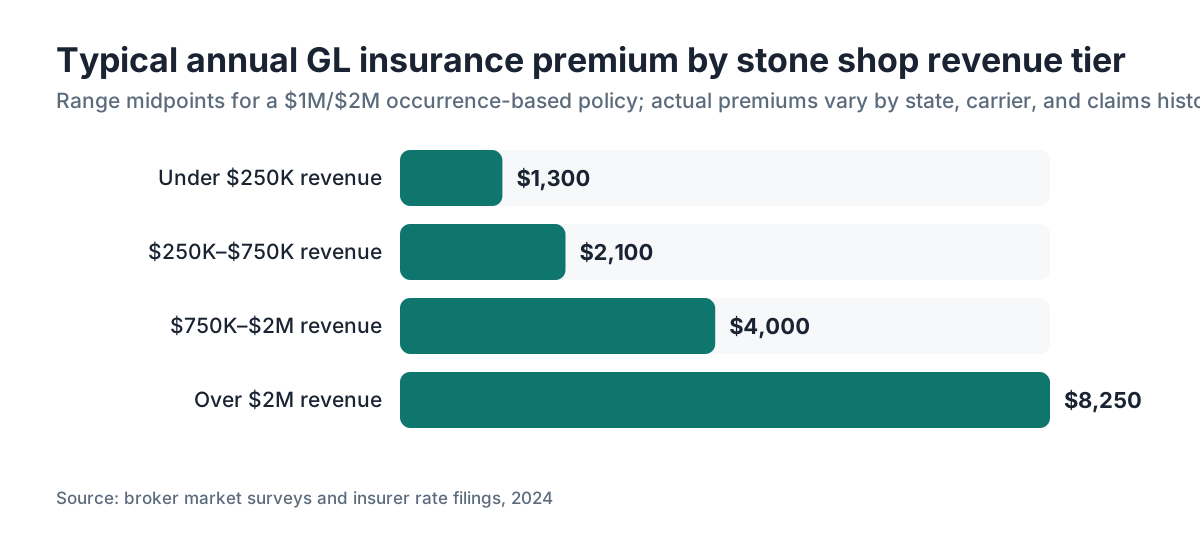
Premium rides on four variables: annual revenue, payroll, claims history, and location. The table below shows typical ranges across those tiers.
| Shop size (annual revenue) | Typical GL premium (annual) | Notes |
|---|---|---|
| Under $250K | $800 to $1,800 | Home-based or very small shop |
| $250K to $750K | $1,200 to $3,000 | 2 to 5 employees, showroom |
| $750K to $2M | $2,500 to $5,500 | Mid-size shop, some commercial work |
| Over $2M | $4,500 to $12,000+ | Multiple crews, large commercial exposure |
These ranges come from broker surveys and insurer filings. Actual premiums swing by state, carrier, and classification code. Shops that filed a GL claim in the last three years should expect to land toward the top of each band.
Here's what most shop owners miss. Insurers classify you using NCCI or ISO class codes, and the code they assign moves your rate a lot. A shop coded as "stone, marble or tile work" under a construction trade code gets a different base rate than one coded as retail. Make sure your broker uses the code for fabrication and installation rather than retail sales. Wrong classification can void coverage at claim time.
Silica exposure is becoming its own underwriting question at more carriers. If you cut dry or run without adequate dust suppression, some carriers exclude silica-related claims or tack on a surcharge. OSHA's silica standard for construction (29 CFR 1926.1153) sets a permissible exposure limit of 50 micrograms per cubic meter as an 8-hour time-weighted average. [3] Carriers are starting to ask about compliance before they bind.
Where do you actually buy GL insurance for a stone shop?
You have three realistic paths: a commercial independent broker who works with contractors, an online commercial insurance marketplace, or a trade association program. For most shops over $300K in revenue, the broker wins.
A good broker has access to multiple carriers, knows which ones go easy on stone fabrication class codes, and can bundle your GL, commercial property, and workers' comp with one carrier for a package discount. Look for brokers who mention contractor or artisan contractor programs in their book of business. The National Association of Professional Insurance Agents (PIA) runs a find-a-broker tool, and you can ask other fabricators in your area who they use. Word of mouth carries real weight here.
Online marketplaces like Next Insurance, CoverWallet (now part of Zurich), and Coterie can quote in under 10 minutes and bind same-day. The tradeoff is broader, less tailored policy language. They work fine for a very small shop or a sole operator who needs proof of insurance for one job fast. Read the exclusions before you click buy. Some of these policies explicitly exclude work on granite, stone, or tile, which is an obvious problem for you.
Trade associations sometimes negotiate group rates. The National Stone, Sand and Gravel Association (NSSGA) and the Natural Stone Institute (NSI) both run member benefit programs that include insurance options, though the actual products change by program year. [4][9] If you already pay dues, check what's on the table before buying separately.
For a shop doing real revenue, the right answer is almost always an independent broker with contractor experience, not the fastest click-to-bind option.
What information do you need to get a GL quote for a stone shop?
The quote moves fast if you walk in with the right documents. Carriers and brokers ask for all of the following, and a single missing item stalls the process.
Your current annual gross revenue (total business revenue, more than countertop sales). Your estimated payroll for the year, split if you can between office staff and field crew, because the field crew drives the premium. Your claims history for the past three to five years, meaning any GL or workers' comp claims you filed. A list of the work you do: residential countertops, commercial, restoration, outdoor, tile. The states where you install, because multi-state exposure pushes the premium up. Your current certificate of insurance if you're mid-term and shopping a better rate.
Some carriers also ask about dust control, specifically whether you wet-cut or run a water recirculation system. Have that answer ready. If you have OSHA training records showing your crew complies with 29 CFR 1926.1153, bring those too. They can genuinely lower your premium.
The quote process, from application to bindable quote, takes one business day with an online marketplace and one to three business days with a traditional broker. Don't wait until the day before a GC wants your certificate.
Do you need workers' compensation on top of general liability?
Yes, in nearly every state, once you have employees. Workers' comp is a separate policy that covers medical bills and lost wages for your own workers hurt on the job. GL covers claims from everyone else. The two do not overlap.
Every U.S. state except Texas requires employers to carry workers' compensation once they have at least one employee, though some states set the threshold at three or four employees. [5] Texas is the one state where workers' comp is technically optional for private employers, and even there, many GCs require it as a contract condition.
For a stone shop, workers' comp is no small line item. Fabrication and installation are physical trades with real injury rates. The Bureau of Labor Statistics reported that stone, clay, glass, and concrete products manufacturing ran a total recordable incidence rate of 4.7 cases per 100 full-time workers in recent years, above the all-industry average of about 2.7. [6] That rate feeds straight into your workers' comp premium.
Many insurers sell GL and workers' comp as a package, which makes certificate management easier. When a GC asks for both on one certificate, having a single carrier handle both keeps it simple.
What other insurance does a stone fabrication shop need beyond GL?
GL is the foundation. It also leaves several real gaps wide open.
Commercial property insurance covers your shop building (if you own it), your equipment, your slab inventory, and your finished goods. A CNC waterjet alone can cost $150,000 to $400,000 to replace, and a standard GL policy does nothing for it. If you rent, your landlord's property policy covers the building and nothing inside it.
Tools and equipment coverage (sometimes called inland marine or an installation floater) covers your gear while it's off-site, in transit, or at a job site. A trailer of diamond blades and clamps runs several thousand dollars. A regular commercial property policy may exclude off-premises losses.
Commercial auto insurance is required if you have vehicles titled to the business. A personal auto policy will not cover a work accident in a company vehicle.
An installation floater covers materials and finished work in transit or installed but not yet accepted by the customer. This one matters for a fabricator. If a slab cracks in the truck on the way to the job, who pays? Without an installation floater, you do.
A commercial umbrella is the cheapest way to push your limits higher. A $1M umbrella on top of a $1M GL primary usually costs $500 to $1,500 a year for a small-to-mid shop. Worth it.
How do you add a customer or GC as an additional insured on your policy?
When a general contractor or homebuilder hires you, they almost always require you to name them as an additional insured on your GL policy. Being an additional insured means they pick up coverage under your policy for claims that arise from your work. It's standard practice, not something to fight.
You request the additional insured endorsement from your broker or carrier, and they issue an updated certificate of insurance (COI) showing the other party's name and address. The certificate almost everyone uses is the ACORD 25, and it lists your policy limits, effective dates, and the additional insured's name. [7]
Two kinds of endorsements exist. A blanket additional insured endorsement covers anyone you're contractually required to add, automatically, no call to your broker per job. A scheduled additional insured endorsement makes your broker add each name by hand. Get the blanket version. It costs almost nothing extra and saves a phone call every time a new GC shows up.
One real annoyance: some carriers charge a $25 to $100 endorsement fee each time you add a named additional insured. If you run dozens of jobs a year with different GCs, that adds up quietly. Factor it into your comparison. Also confirm your policy gives ongoing operations coverage plus completed operations coverage for additional insureds, because a lot of claims land after the job is finished.
How does silica dust exposure affect your GL coverage?
This is where stone shop insurance is changing fastest, and most fabricators aren't paying enough attention. Ignore it and you can find yourself uninsured for the one claim that could close your business.
Crystalline silica lives in granite, engineered stone (quartz), and other natural stone. Dry cutting releases respirable silica particles that cause silicosis, a progressive and incurable lung disease. OSHA's silica rule for construction (29 CFR 1926.1153), finalized in 2016, set the permissible exposure limit at 50 micrograms per cubic meter as an 8-hour TWA, down from the old 250 microgram limit. [3][10]
Insurers treat silica the way they once treated asbestos: a long-tail occupational disease claim that can surface years or decades after exposure. Several carriers now exclude silica-related bodily injury claims from GL policies or apply a sublimit. Others just ask on the application whether you dry cut, and if you say yes, they either decline the risk or price it higher.
The move for your shop is simple. Document your wet-cutting practices, your water suppression equipment, and your respiratory protection program. Carriers who see evidence of OSHA-compliant dust control are far more willing to write you without a silica exclusion. The Natural Stone Institute publishes best-practice guides on silica compliance that some carriers look at favorably. [4]
If no carrier will write silica coverage without exclusions, ask about a standalone occupational disease policy or find a broker who handles industrial-hygiene risks. Don't accept the exclusion without asking whether it's negotiable.
How can fabrication software help with your insurance documentation?
Clean job records help your insurance in two ways: they let you fight inflated claims, and they let you report revenue and payroll accurately at renewal, which sets your premium directly.
Shops that quote on spreadsheets or paper often can't reconstruct job-by-job revenue at renewal, so they estimate, and estimates run low. That triggers an audit surcharge at year-end when the carrier finds the gap. If your actual revenue tops your estimate by 25 percent or more, many carriers charge the difference retroactively plus a penalty at audit.
A quoting and job management platform like SlabWise keeps a real-time revenue ledger that holds up at audit. When your broker asks for last year's gross revenue broken out by job type, you pull it in 30 seconds instead of guessing.
Good records also help at claim time. If a customer says a slab was already cracked at install and demands a replacement, a timestamped digital record of the slab condition at template and delivery can settle the argument before a claim ever gets filed.
How do you renew your GL policy and avoid common mistakes at renewal?
Most commercial GL policies renew annually. Sixty to ninety days out, your broker should send a renewal application asking you to update revenue, payroll, and any new operations. Don't ignore it.
The most common renewal mistake is under-reporting revenue. If your shop grew 30 percent last year and you report the same number as last year, you're underinsured, and your carrier can prorate your coverage at claim time. Report actual numbers.
The second mistake is not shopping the renewal. Carriers reprice their books constantly. A competing carrier might match or beat your limits for 15 to 20 percent less. Get at least two competing quotes every two to three years. Your broker should do this for you, but sometimes they don't, because a straight renewal is easier for them.
The third mistake is letting coverage lapse. A single day of lapsed coverage can drop you from a GC's approved vendor list, and reinstating a lapsed policy often means a fresh application with new underwriting, which eats time. Set a calendar reminder 75 days before expiration.
If your claims year was rough, talk to your broker before renewal instead of waiting for the carrier to non-renew you. Surplus lines carriers (non-admitted carriers) specialize in harder-to-place risks. They cost more. They beat no coverage at all.
How do you find a broker who actually understands stone fabrication?
The biggest decision in this whole process is picking a broker who has placed coverage for contractors or fabricators before, not one who mostly writes general small business or retail policies.
Ask any broker you're considering one question: "Have you placed GL for stone fabricators or tile contractors? Which carriers have you used?" If they name at least two carriers and one class code, they've done this. If they say "we handle all types of small business," move on.
Brokers who live in the construction trade know which carriers are currently friendly to stone shop risks, which ones added silica exclusions, and which aggregate class codes apply. That knowledge is worth real money to you.
You can find trade-experienced brokers through referrals from other fabricators, through the Natural Stone Institute or NSSGA member directories, or through the Independent Insurance Agents and Brokers of America (IIABA) database. [8] Local NARI (National Association of the Remodeling Industry) chapters often keep preferred vendor lists that include contractor insurance brokers their members actually use.
One practical test: ask a broker to explain the difference between a blanket additional insured endorsement and a scheduled one. If they answer it fluently, they know contractor insurance. If they have to look it up, find someone else.
Frequently asked questions
How much does general liability insurance cost for a stone countertop shop per year?
Most shops pay $1,200 to $4,500 per year for a $1M/$2M GL policy, depending on annual revenue, payroll, claims history, and location. Very small operations under $250K in revenue can sometimes find coverage starting around $800. Shops with prior claims or dry-cutting operations should expect to land toward the top of their revenue tier's range.
What GL limits should a stone fabricator carry?
The standard minimum most general contractors require is $1 million per occurrence and $2 million aggregate. Commercial work often demands $2M/$4M or higher. The cheapest way to reach higher limits is to buy a $1M base GL policy and stack a commercial umbrella on top rather than paying for a larger primary policy outright.
Is general liability insurance required by law for a stone shop?
No federal law mandates GL for fabricators. Some states require contractors to carry liability insurance as part of licensing. California requires licensed contractors to carry at least $15,000 in liability coverage under CSLB rules, but that threshold is so low it's essentially symbolic. You need GL to get on any GC's approved vendor list, which makes it a practical requirement even where it isn't a legal one.
Does GL insurance cover silica dust claims for stone fabricators?
It depends on the carrier and the policy form. Occurrence-based GL policies can cover silica-related bodily injury claims, but a growing number of carriers add silica exclusions or sublimits. Shops that document OSHA-compliant wet-cutting practices under 29 CFR 1926.1153 have better luck getting coverage without silica exclusions. Ask specifically about silica before you bind any policy.
Can I get GL insurance for a stone shop online without a broker?
Yes. Platforms like Next Insurance and Coterie can quote and bind a GL policy in under 15 minutes. For a very small shop or a sole operator who needs proof of insurance quickly, that can work. For shops over $300K in revenue doing installation work, use an independent broker who knows contractor class codes, because the online platforms use broader policy language and may include exclusions that surprise you at claim time.
What is a certificate of insurance (COI) and how do I get one for a stone shop?
A certificate of insurance is a one-page summary of your coverage, usually on an ACORD 25 form, that proves to a GC or homebuilder that you're insured. You request it from your broker or carrier by giving them the name and address of whoever needs to appear as the certificate holder. Most brokers email a COI within a few hours of the request.
What is the difference between GL insurance and workers' comp for a stone shop?
GL covers claims from third parties (customers, bystanders, GCs) for bodily injury or property damage. Workers' comp covers your own employees when they're hurt on the job. They are separate policies. Almost every state requires workers' comp once you have employees. A stone shop doing installation work needs both, full stop.
How do I add a general contractor as an additional insured on my policy?
Call or email your broker with the GC's full legal name and address. They add the GC to your policy via an endorsement and issue an updated ACORD 25 certificate. A blanket additional insured endorsement handles this automatically for all required parties without a separate call each time. Get the blanket version when you first buy your policy.
Does GL insurance cover damage to a customer's countertop during installation?
It depends on how the claim gets categorized. Damage to property you're working on is often excluded under the "your work" exclusion in standard CGL policies. The better coverage for in-transit and in-progress work is an installation floater or inland marine policy. GL fits damage to surrounding cabinets or flooring caused by your work, not the countertop itself.
What happens if my stone shop grows and I don't update my GL policy?
Your premium is based on the revenue and payroll you reported at binding or last renewal. If your actual revenue significantly tops that estimate, most carriers audit at renewal and charge the additional premium retroactively, sometimes plus a penalty. Report accurate numbers. Underreporting can also give the carrier grounds to prorate your coverage at claim time.
Do I need GL insurance if I only do fabrication in my shop and don't do installations?
Yes. Shop-only fabricators still have visitors (salespeople, customers picking up remnants), still ship products that can cause damage or injury downstream, and still face premises liability for anything that happens on their property. Products liability, which covers bodily injury or property damage caused by something you manufactured, is typically built into a standard GL policy. You need it.
How long does it take to get GL insurance for a stone fabrication shop?
Online platforms can bind same-day. A traditional broker working a complete application typically takes one to three business days to return a bindable quote. The process moves faster when you have your revenue figures, payroll, claims history, and list of operating states ready before the first conversation. Rushing it the day before a GC deadline is stressful and avoidable.
Sources
- Insurance Services Office (ISO), Commercial General Liability Coverage Form CG 00 01: Standard ISO CGL form uses an occurrence trigger, meaning coverage applies to unexpected events without requiring claims to be filed during the policy period
- California Contractors State License Board, License Requirements: California requires licensed contractors to carry a minimum of $15,000 in liability coverage under CSLB rules
- OSHA, Occupational Exposure to Respirable Crystalline Silica: Construction Standard 29 CFR 1926.1153: OSHA's silica construction standard sets a permissible exposure limit of 50 micrograms per cubic meter as an 8-hour time-weighted average, finalized in 2016
- Natural Stone Institute, Member Programs and Silica Safety Resources: NSI publishes best-practice guides on silica compliance and offers member benefit programs including insurance options
- U.S. Department of Labor, Workers' Compensation Overview: Every U.S. state except Texas requires private employers to carry workers' compensation insurance
- Bureau of Labor Statistics, Survey of Occupational Injuries and Illnesses, Stone, Clay, Glass, and Concrete Products Manufacturing: BLS reported that stone, clay, glass, and concrete products manufacturing had a total recordable incidence rate of approximately 4.7 cases per 100 full-time workers, above the all-industry average of about 2.7
- ACORD, Certificate of Liability Insurance Form 25: ACORD 25 is the standard certificate of insurance form used to document policy limits, effective dates, and additional insured status for contractors
- Independent Insurance Agents and Brokers of America (IIABA), Find an Agent: IIABA maintains a nationwide database to help businesses find independent insurance agents with commercial lines expertise
- National Stone, Sand and Gravel Association (NSSGA), Member Benefits: NSSGA offers member benefit programs including group insurance options for the stone industry
- OSHA, 29 CFR 1926.1153, Respirable Crystalline Silica Standard for Construction: The final silica rule reduced the permissible exposure limit for construction from 250 micrograms to 50 micrograms per cubic meter and took effect for most construction employers in 2017
Last updated 2026-07-11