TL;DR
- Vein-matched countertops usually add 20 to 50% to base fabrication cost over a standard layout.
- The premium comes from higher slab waste (often 40 to 60% loss vs 15 to 25% for standard), extra labor for book-matching or flow-matching, and buying multiple slabs from the same lot.
- The effect is sharpest on heavily veined marbles and quartzites.
What is vein-matching and how does it differ from a standard countertop layout?
A standard countertop layout treats each slab like a puzzle. The fabricator nests the cut pieces to waste as little as possible, with no requirement that veins line up across seams or across separate runs. You get an efficient job: low material cost, fast templating, and a simple CNC program.
Vein-matching is a different discipline. The goal is to make the stone read as one continuous sheet, so veins flow from one section to the next without an obvious break at every seam. Two main approaches do this. Book-matching opens two adjacent slabs like the pages of a book to create a mirrored vein pattern. Flow-matching (also called slip-matching or pattern-matching) cuts pieces in sequence from a single slab or adjacent slabs so the veins continue in the same direction rather than mirror.
Book-matching is the more dramatic effect. You need two consecutive slabs from the same quarry bundle, cut to the same thickness, and ideally from the same gang-saw pass so the pattern truly mirrors. Flow-matching is a little more forgiving, but it still demands that pieces get cut in a controlled sequence, which limits how freely the fabricator can optimize placement.
The visual payoff on a stone like Calacatta marble or Taj Mahal quartzite can stop you in your tracks. It also carries real costs that rarely get explained at the showroom stage.
Why does vein-matching cost more? The real drivers of the premium
Four separate cost drivers stack on top of each other.
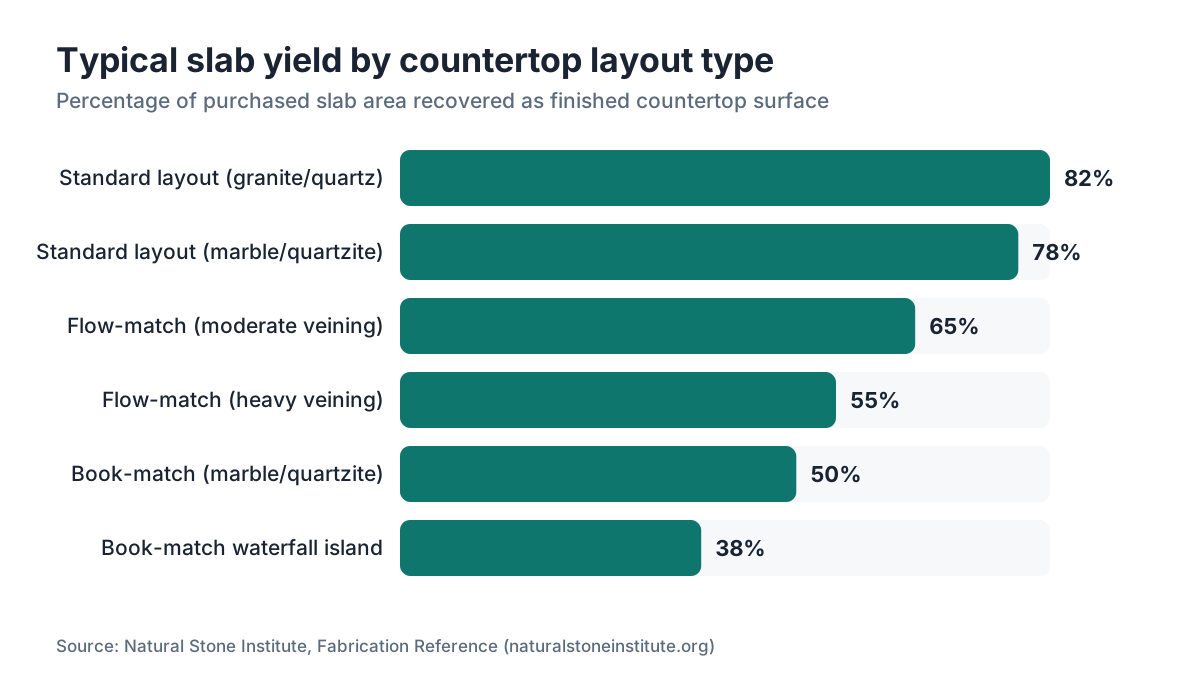
Material yield loss. In a standard nest, a skilled fabricator recovers 75 to 85% of a slab's usable area. In a vein-matched layout, pieces have to be cut at specific positions to preserve vein continuity. You cannot rotate a piece 180 degrees to tighten the nest if that rotation breaks the vein direction. Real yield on a vein-matched job can drop to 40 to 65% of the slab surface, depending on the stone's vein frequency and the kitchen layout [1]. You pay for stone you cannot use.
Multiple slabs from the same lot. A standard job for a medium kitchen might need 1.5 slabs. You buy 2 and keep a remnant worth something. A vein-matched job on the same kitchen might need 3 or 4 slabs, all from the same bundle, because the pattern has to carry across the whole room. Bundles from a single quarry block are finite. If your distributor does not have matching slabs in stock, you may be ordering special from the quarry, which adds lead time and freight.
Labor: templating and layout. The template takes longer. The fabricator photographs the slabs, overlays the template (digitally or physically on the slab floor), and confirms vein alignment before a single cut. Many shops charge a separate vein-match layout fee of $150 to $500 per project, on top of the square-footage charge [2].
Labor: cutting and fabrication. Cuts happen in sequence. A CNC bridge saw can be programmed for vein-matched sequencing, but setup runs longer and the program is more complex. On shops still using manual bridge saws, the time premium climbs higher. Expect 1.5 to 2.5 extra fabrication hours on a typical kitchen.
That is why the premium is not a clean percentage markup on material. It compounds across material, labor, and logistics.
How much more does vein-matching actually cost? Typical price ranges
Pricing shifts by region, stone, and shop, but the ranges below reflect what fabricators across the U.S. market are quoting as of mid-2025.
| Layout Type | Typical Installed Cost per Sq Ft | Waste Factor | Extra Labor |
|---|---|---|---|
| Standard layout, granite | $45 to $85 | 15 to 25% | Baseline |
| Standard layout, marble/quartzite | $75 to $140 | 15 to 25% | Baseline |
| Flow-matched, marble/quartzite | $100 to $175 | 25 to 40% | +$150 to $300 project |
| Book-matched, marble/quartzite | $130 to $220 | 35 to 60% | +$300 to $600 project |
| Waterfall island, book-matched | $200 to $350 | 50 to 70% | +$400 to $800 project |
Those ranges run wide because slab cost is the biggest variable. A Calacatta Gold marble slab runs $1,200 to $2,500 at the distributor level [3], while a domestic granite might be $250 to $500. The waste penalty on a $2,000 slab hurts far more than on a $300 slab.
Here is a concrete example. A 50-square-foot kitchen island in Taj Mahal quartzite, standard layout, might be quoted at $6,500 to $8,500 installed. The same island with a full book-match on the waterfall sides might be quoted at $11,000 to $16,000, because you need two or three matched slabs and waste can run 55 to 65% of purchased material.
Fabricators who do not price vein-match jobs often will underprice the first quote and then eat the loss. This is one of the more common margin killers in a countertop shop.
How do fabricators calculate the material cost for a vein-matched job?
The formula is simple. The inputs take judgment.
Start with the net square footage the homeowner actually needs, the countertop surface area from the template. Divide that by the expected yield percentage for the specific vein-match approach and stone type. That gives you the gross slab square footage to purchase. Multiply by the slab cost per square foot from your distributor. Add a small buffer (10 to 15%) for breakage and unanticipated vein interruptions, because natural stone is unpredictable.
Example: a kitchen needs 80 net square feet of flow-matched Statuario marble. You estimate 60% yield, a reasonable number for moderate veining with flow-match. 80 / 0.60 = 133 gross square feet needed. Statuario slabs at your distributor run $18 per square foot wholesale. 133 sq ft x $18 = $2,394, plus a 12% buffer = roughly $2,680 in material before fabrication labor or markup.
A standard layout on the same kitchen at 80% yield needs 100 gross square feet, costing $1,800 before buffer. The material difference is about $880 here, and that is before any labor premium or the reality that you may have to buy full slabs rather than partial ones.
For shops running quoting software, tools that model yield percentage by job type (like the nest optimizer in SlabWise) make this faster and easier to explain, because you can show the customer the slab map.
One honest caveat: yield estimates are exactly that, estimates. Vein frequency varies even within a single quarry block. Some fabricators refine their yield assumptions with historical job data by stone type. Others estimate conservatively and hand back the difference as a credit if they beat the yield. Both approaches are fine. Telling the customer up front is what matters.
What is the right way to price the labor premium for vein-matching?
Most fabricators price vein-match labor one of two ways: a flat project add-on, or a multiplied hourly rate on the extra time.
The flat-fee approach is common in shops that do a lot of high-end work. They know from experience that a typical vein-matched kitchen adds 3 to 5 hours of total labor (template planning, slab layout, sequenced cutting, dry-fit verification). At a shop rate of $85 to $120 per hour, that comes to $255 to $600 per project. Many shops round up to a clean number like $400 or $500 and present it as a line item labeled something like "vein-match layout and sequencing fee."
The hourly approach holds up better on unusual or very large projects, where labor time is genuinely hard to predict. If a client wants book-matched veining across a 12-foot island plus two full-height backsplash panels, time-and-materials that portion rather than guess at a flat fee.
Price the dry-fit explicitly. For a book-matched waterfall island, fabricators often do a full dry-fit in the shop before delivery to confirm alignment. That takes time, floor space, and sometimes a second person. If your shop does not charge for this step, you are giving away real money.
A practical benchmark: the Marble Institute of America's training materials (now under the Natural Stone Institute) recommend that fabricators apply at least a 1.5x labor multiplier on complex vein-matched jobs compared to standard production work [4].
How should a homeowner read a vein-match quote and know if it is fair?
A good vein-match quote itemizes at least three things: material cost (with the number of slabs and the yield assumption shown or available on request), fabrication labor, and the vein-match layout/sequencing fee as its own line. If a quote gives you a single price per square foot with no breakdown, ask for the slab count and yield assumption. You deserve to know how many slabs you are buying.
Red flags in a vein-match quote:
- Yield assumption above 75% for a flow-match or book-match job on heavily veined stone. That is optimistic to the point of misleading.
- No mention of slab bundle matching or lot continuity. If the fabricator is not asking about matching slabs, they are probably not planning to vein-match seriously.
- A price only 10 to 15% above the standard quote for the same stone. Real vein-matching costs more than that in almost every case.
Green flags:
- The fabricator walks you through the slab layout at the yard, or shows you a digital slab map.
- They discuss which seam locations will and will not show a perfect vein continuation. Some seams sit under appliances or at inside corners, and matching there is less critical.
- They mention the slab bundle number and confirm multiple matching slabs are in stock.
For marble countertops and granite countertops, this pre-job verification is what separates shops that do vein-matching well from shops that only say they do it.
Which stones benefit most from vein-matching and which ones do not?
Not every stone earns the vein-match premium. Here is how to sort them.
High benefit: Stones with dramatic, large-scale veining that runs diagonally across the slab. Calacatta and Statuario marbles, Taj Mahal and Sea Pearl quartzites, and some book-matched granites like Van Gogh or Blue Eyes. On these materials, visible seams with misaligned veins look bad. The premium is worth it when the stone is the design centerpiece.
Moderate benefit: Stones with moderate veining that stays consistent in scale and direction. White Zeus or Bianco Drift quartzite, for example. Flow-matching adds some value, but the gap between a well-done standard layout and a flow-matched one is small. Many fabricators use a careful standard layout, place seams in low-visibility spots, and land close enough that the premium is hard to justify.
Low or no benefit: Heavily speckled granites with no directional movement, solid-color quartz (vein-matching is irrelevant since the pattern is uniform), leathered or honed black granites with minimal veining, and engineered stones like Cambria countertops where the pattern repeats mechanically. For those, a standard layout is the right call, and you should push back if a shop tries to upsell vein-matching.
Laminate and solid surface: Vein-matching does not apply the same way to laminate countertops or Corian countertops, since seams can be nearly invisible and the pattern either repeats uniformly or does not matter.
How does slab selection at the yard affect the vein-match price?
This step matters more than most homeowners realize, and skipping it is a common mistake.
If you are buying a single slab for a flow-match job, see the actual slab, not a sample tile. The slab online or in a showroom sample may not match the material in stock. Drive to the slab yard, stand the slab up (most yards have A-frame lifters), and look at it in daylight.
For a book-match, you need two consecutively numbered slabs from the same bundle. Quarry bundles are numbered in sequence, and the slabs inside a bundle come from the same block. Ask the yard for the bundle number and confirm both slabs are from the same lot. If they cannot confirm this, you cannot guarantee a true book-match, and any premium you are paying is not fully earned.
Some distributors charge to hold matching slabs during the project timeline, typically $100 to $300 per slab per month [3]. That is a real cost that belongs in your budget if there is a gap between your slab purchase date and the fabrication date.
If a fabricator buys direct from the distributor on your behalf, ask them to confirm the bundle numbers in writing before the deposit is paid. Shops that handle high-end natural stone regularly do this as a matter of course.
Can you vein-match across multiple countertop surfaces in one kitchen?
Yes, and this is where cost escalates fast.
A kitchen with a perimeter countertop plus an island plus a backsplash in the same stone has three separate surfaces, some horizontal, some vertical. Vein-matching all three means the stone needs to read as continuous from countertop to backsplash and from island face to waterfall edge. That demands careful planning of which direction the slab's primary vein runs relative to each surface.
Here is the practical reality. True full-room vein-matching across countertop, backsplash, and island is very hard and sometimes impossible, depending on the kitchen layout. The veins in a slab run at an angle. Matching a horizontal countertop to a vertical backsplash means either cutting book-matched pieces specifically for that transition or accepting a vein direction change at the transition point.
Most fabricators doing high-end work focus vein-matching on the highest-visibility surfaces: the perimeter countertop's main run and the island top. They treat the backsplash as a complementary piece, not a precisely matched one, unless the client asks for and budgets full-room matching.
Full-room vein-matching on a medium kitchen (80 to 120 sq ft of countertop plus backsplash) can require 6 to 8 slabs from the same bundle and a material cost 2 to 3x a standard layout. That is not an exaggeration. It is the waste math when you have to honor vein direction on every surface at once.
What do fabricators get wrong when pricing vein-matched jobs?
A handful of mistakes come up over and over in fabrication shop discussions.
Underestimating yield loss. Shops that mostly do standard layouts often use their standard waste factor (15 to 25%) when pricing a vein-match job. The job comes in, and actual waste is 45 to 55%. The shop eats the difference. This is the most common and most costly pricing error.
Not charging for the dry-fit. A dry-fit is not optional on a complex book-matched piece. It is quality control. Shops that fold it into the standard job rather than a line item are giving away two to four hours of shop time.
Quoting before slab selection is complete. The yield calculation depends on the actual slab dimensions and the vein pattern on those specific slabs. Quoting a vein-match job from a sample tile and a stock photo is guessing. The quote should either treat the vein-match layout fee as a deposit-and-verify item, or note that material pricing is subject to confirmation after slab selection.
Ignoring slab hold costs. If slabs sit at the distributor for three months while the client finishes construction, hold fees pile up. Some fabricators absorb this. They should not.
For shops running quoting software, a separate vein-match line in the quote template forces the estimator to think through each of these items instead of slapping on a round-number markup. That structured quoting is where tools like SlabWise's job-costing module earn their keep on premium stone work.
Is vein-matching worth the extra cost? An honest take
For most kitchens, the honest answer depends on the stone and the seam locations.
If you have a single-run countertop with one seam that falls somewhere quiet (under the microwave, inside a corner, behind the faucet), a well-done standard layout on even a heavily veined stone can look great. Seam placement matters as much as vein-matching for the final look.
If you have a large island with no appliances breaking it up, or a waterfall edge that reads as a focal point, or a conspicuous seam in the middle of a straight run you can see from the living room, vein-matching is worth it. The eye catches a jarring vein interruption at a prominent seam on a dramatic stone. That is where the premium pays off.
For kitchen countertops in materials like Cambria countertops or engineered quartz with a repeat pattern, the vein-match conversation is mostly irrelevant. Save your money.
For natural stone where beauty is the point, the best middle ground is usually this: ask your fabricator to show you the proposed slab layout before cutting. Look at where the seams fall. If you can live with the standard layout seam placement, take it. If a seam lands somewhere you will look at every day and the vein break will bother you, pay for the match. That is a call only you can make, and it gets easier once you can see the layout on the actual slab before anyone picks up a saw.
Frequently asked questions
How much more does vein-matched marble cost compared to standard layout?
Vein-matched marble usually costs 20 to 50% more than a standard layout on the same stone. For book-matched marble with a waterfall edge, the premium can reach 60 to 100% because of the slab waste involved. The biggest driver is material: yield on a vein-matched job can drop to 40 to 65% vs 75 to 85% for standard, so you buy significantly more stone to cover the same surface.
What is the difference between book-matching and flow-matching countertops?
Book-matching opens two consecutive slabs like pages of a book, creating a mirrored vein pattern across a seam. It requires two slabs from the same quarry bundle. Flow-matching (also called slip-matching) cuts pieces in sequence so veins continue directionally without mirroring. Flow-matching is less dramatic but more achievable with a single slab. Book-matching costs more because it demands matched-bundle slab pairs and produces higher waste.
Do fabricators charge a separate fee for vein-match layout?
Many do. A vein-match layout fee covering the extra templating time, digital slab overlay, and sequenced cutting setup typically runs $150 to $500 per project depending on the shop and complexity. Some shops fold it into their per-square-foot price for high-end stone instead. Either way, it should be visible in your quote. If you do not see it as a line item, ask how vein-match labor is accounted for.
What waste percentage should I expect from a vein-matched countertop job?
For flow-matching on moderately veined stone, expect 25 to 40% waste. For book-matching on heavily veined marble or quartzite, waste commonly runs 35 to 60% of purchased slab area. A fully book-matched waterfall island can push 65 to 70% in extreme layouts. These numbers are why vein-matched jobs cost significantly more in material even before any labor premium.
Can you vein-match quartz or engineered stone countertops?
Engineered quartz and similar materials (Cambria, Silestone, Caesarstone) have mechanically repeated or uniform patterns. True vein-matching in the natural stone sense does not apply because the pattern either repeats predictably or has no directionality. Some engineered lines do have large-format vein designs that can be flow-matched to reduce visible pattern breaks at seams, but the premium and complexity are much lower than natural stone work.
How do I know if my stone will look bad without vein-matching?
It depends on the stone's vein scale and the seam location. Heavily veined marbles like Calacatta or dramatic quartzites like Taj Mahal show seam mismatches clearly, especially on long uninterrupted runs or waterfall edges. Speckled granites, leathered stones with subtle movement, or any material with a fine consistent pattern are far more forgiving. Ask your fabricator to show you the proposed slab layout and seam placement before cutting. That view beats any general rule.
How many slabs do I need for a vein-matched kitchen?
More than a standard layout. A medium kitchen (60 to 80 sq ft) on a standard layout might need 1.5 to 2 slabs. The same kitchen with flow-matching typically needs 2 to 3 slabs from the same lot. A full book-matched kitchen with a waterfall island often needs 3 to 5 slabs from the same quarry bundle. The exact count depends on slab size (a typical full slab is 55 to 65 sq ft), kitchen geometry, and the yield you can hit on your specific stone.
Should the seam location affect whether I pay for vein-matching?
Yes, and this is an underused decision point. If all your seams fall under appliances, in inside corners, or at backsplash transitions where the eye does not linger, a well-done standard layout with good seam placement can look nearly as good as a matched layout on most stones. Reserve the vein-match premium for seams on prominent, uninterrupted surfaces: a long island top, a straight perimeter run visible from multiple angles, or a waterfall face.
What is a slab bundle and why does it matter for vein-matching?
A slab bundle is a set of slabs cut in sequence from the same quarry block and shipped together. Slabs within the same bundle share the same mineral composition and vein pattern in sequence, which is what makes book-matching possible. When your fabricator says they need matching slabs from the same bundle, they mean consecutively numbered slabs from the same lot. If the distributor cannot confirm the bundle number, true book-matching is not guaranteed.
What questions should I ask a fabricator before agreeing to a vein-match job?
Ask: How many slabs are you buying and from what bundle? What yield percentage are you assuming, and how did you get there? Is the vein-match layout fee included or separate? Will you show me a digital or physical slab layout before cutting? Will there be a dry-fit in the shop before delivery? What happens if the yield is worse than expected? A fabricator who answers these clearly has actually done this work before.
Does vein-matching add to countertop installation time or complexity?
It adds fabrication time more than installation time. Shop work takes longer because of layout planning, sequenced cutting, and dry-fitting. On install day, vein-matched pieces are pre-labeled and pre-sequenced, so a good crew sets them without major extra time. Things go wrong when pieces were not dry-fit in the shop and a vein-match problem shows up at the job site, which is much harder to fix there.
Is there a price difference between flow-matching and book-matching?
Yes. Flow-matching is cheaper because it can often use one slab or two same-lot slabs and has lower waste than book-matching. Book-matching requires consecutively bundled slabs, has higher yield loss (35 to 60% vs 25 to 40% for flow-match), and usually needs more fabrication time for precise alignment and dry-fit verification. The gap between the two approaches in total project cost is typically $500 to $2,500 depending on stone price and project size.
Can vein-matching be done on a budget or is it always a luxury option?
It is almost always a premium cost item, but the size of the premium varies. On lower-cost stones like domestic marbles or budget quartzites in the $8 to $12 per sq ft wholesale range, the extra material from vein-matching is manageable, maybe $400 to $900 on a typical kitchen. On high-end imported marbles at $18 to $30 per sq ft wholesale, the same waste penalty becomes $1,500 to $4,000 in extra material alone. Vein-matching on budget stone is far more achievable than on luxury stone.
Sources
- Natural Stone Institute, Technical Bulletins and Fabrication Reference: Vein-matched slab yield can drop to 40 to 65% of purchased slab area compared to 75 to 85% for standard layouts depending on veining pattern and kitchen geometry.
- Natural Stone Institute, Fabrication and Installation Standards: Fabricators commonly charge $150 to $500 as a vein-match layout and sequencing fee on top of standard job pricing.
- Marble and Granite Supply of Illinois, Slab Pricing Reference: Premium imported marble slabs (Calacatta Gold) retail at the distributor level in the range of $1,200 to $2,500 per slab; slab hold fees at distributors commonly run $100 to $300 per slab per month.
- Natural Stone Institute, Professional Certification Training Materials: Industry training recommends at least a 1.5x labor multiplier on complex vein-matched jobs compared to standard production work.
- Occupational Safety and Health Administration (OSHA), Respirable Crystalline Silica standard 29 CFR 1926.1153: Stone fabrication shops are subject to federal silica dust exposure limits; wet cutting and ventilation requirements apply to all countertop cutting operations including vein-matched sequencing work.
- U.S. Geological Survey, National Minerals Information Center (Dimension Stone): U.S. dimension stone production statistics and import data used as reference for natural stone market context.
- Home Innovation Research Labs, National Housing Survey on Countertop Choices: Natural stone (granite and marble) countertops represent approximately 30 to 35% of new home countertop installations in the U.S., providing context for volume of vein-matched work in the market.
- National Kitchen and Bath Association (NKBA), Design and Cost Trends Report: Premium countertop materials (natural marble, quartzite) are specified in 18 to 22% of major kitchen remodels, the segment most likely to request vein-matching.
- Tile Council of North America, ANSI A108 Natural Stone Installation Standards: ANSI standards for natural stone installation reference slab selection, lot matching, and sequencing requirements relevant to vein-matched countertop work.
- U.S. Census Bureau, American Housing Survey: Kitchen remodel expenditure data showing countertop replacement as one of the top kitchen upgrade categories, providing scale context for premium material decisions.
Last updated 2026-07-11