TL;DR
- Polishing marble means removing etches and restoring gloss with progressively finer abrasives, then finishing with a marble polishing powder or cream.
- A light dull spot takes 20 minutes with polishing powder and a soft cloth.
- Deep scratches or widespread etching need a wet diamond pad sequence (200 to 3000 grit) or a professional re-polish at $3 to $8 per square foot.
What actually makes marble lose its shine?
Marble is calcium carbonate, and acids attack it chemically, not mechanically. Lemon juice, vinegar, wine, or even plain water carrying dissolved CO2 will dissolve a thin layer of the calcium carbonate and leave a dull, slightly rough patch called an etch. An etch is not a stain. Wiping harder does nothing, because the damage is already in the stone.
That confusion costs people a lot of wasted effort. They scrub, try every cleaner in the cabinet, and the dull spot stays put. Cleaning removes stuff sitting on top of the stone. Polishing removes (or re-crystallizes) the damaged layer itself.
Scratches are a separate problem. Floors get scratched by foot traffic constantly, but countertops mostly get scratched by utensils, appliances dragged across the surface, and coarse cleaners. Fine scratches scatter light and make the stone look hazy even with no chemical etching at all.
Sealers wear out too. Marble is porous, and most fabricators apply an impregnating sealer that sits below the surface and slows liquid absorption. The sealer does not add gloss, but a worn one lets liquids reach the stone faster and speeds up etching. Re-sealing after polishing is not optional.
What supplies do you need to polish marble countertops at home?
It depends on how bad the damage is. Here's the honest breakdown.
For light etches and general dullness (DIY-friendly):
- Marble polishing powder (tin oxide is the traditional formula; products like Miracle Sealants or StoneTech are easy to find)
- Soft cotton cloths or a felt buffing pad
- Clean water
- Painter's tape to protect adjoining surfaces
- pH-neutral stone cleaner for prep
For moderate etches and fine scratches:
- Wet/dry diamond polishing pads (400, 800, 1500, 3000 grit minimum)
- A variable-speed angle grinder or polisher (4-inch or 5-inch, 600 to 1500 RPM range)
- A water source or spray bottle for wet grinding
- Shop vacuum with water pickup or absorbent towels
- Marble polishing powder for the finishing step
For deep scratches or widespread etching: A rental or DIY job at this level risks making things worse. You'd need 50 to 200 grit diamond pads to remove enough stone to level the surface, and going that aggressive without practice on marble (which is soft, 3 on the Mohs scale) creates uneven flat spots. At that point the labor cost of a pro re-polish is cheaper than the risk of ruining the slab.
The Natural Stone Institute recommends that homeowners keep to abrasives no coarser than 220 grit for countertop work without professional guidance. That's a useful line in the sand.
| Damage Level | Method | Typical Cost (DIY supplies) | Time |
|---|---|---|---|
| Light etch (small, recent) | Polishing powder + cloth | $10 to $25 | 20 to 30 min |
| Moderate etch or haze | Wet pads 400 to 3000 grit | $40 to $80 | 1 to 3 hours |
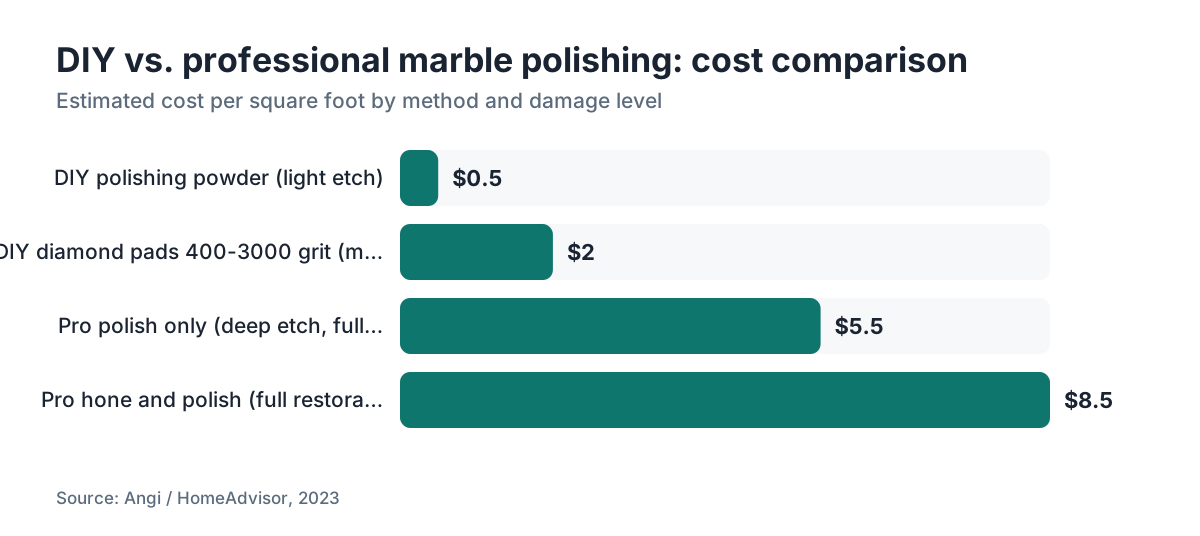
| Deep scratch or widespread dullness | Pro re-polish | $3 to $8/sq ft | Same day |
| Full countertop re-hone + polish | Pro | $5 to $12/sq ft | 1 to 2 days |
How do you polish marble countertops step by step?
This walkthrough covers the most common homeowner job: a countertop with a few etch marks and general dullness, using polishing powder and, if needed, a 1500 to 3000 grit finishing pad.
Step 1: Clean the surface completely. Use a pH-neutral stone cleaner and a soft cloth. Remove all grease, food residue, and soap film. Any grit caught under a polishing pad becomes a scratch. Let the stone dry fully.
Step 2: Tape off edges. Polishing powder and water make a slurry that stains grout, discolors wood, and coats undermount sink clips. Two minutes of taping saves an hour of cleanup.
Step 3: Wet the etch mark. Apply a little water directly to the etched area. Marble compounds work as a mild abrasive suspended in liquid. The water controls heat and keeps the abrasive moving freely.
Step 4: Apply polishing powder. Sprinkle a small amount (roughly a teaspoon for a 6-inch area) onto the wet surface. Use a damp felt pad, a power buffer, or a folded cotton cloth. Work small circles with moderate pressure. A white or gray paste forms. That's normal.
Step 5: Keep the surface wet. Add water as needed to hold a paste consistency. Letting it dry out drags the abrasive particles and can cut new fine scratches. Work each small etch for 2 to 4 minutes.
Step 6: Wipe and inspect. Wipe the slurry away with a damp cloth. Look at the spot from several angles under raking light. A phone flashlight held almost parallel to the surface is the best way to catch leftover dullness.
Step 7: Repeat if needed. Fresh, shallow etches often clear in one pass. Older or deeper ones may take 3 to 5.
Step 8: Final buff. Once the etch is gone, buff the whole section (more than the spot) with a clean dry cloth to even the gloss. If you leave a bright patch surrounded by a duller ring, you spot-polished too hard. Feather the polish out a few inches on all sides to blend it.
Step 9: Apply sealer. After polishing, the stone is open and clean. This is the best moment to apply an impregnating sealer. Follow the manufacturer's dwell time, usually 5 to 30 minutes, then wipe off every bit of excess. Never let sealer dry on the surface.
Step 10: Cure time. Most sealers need 24 to 72 hours to fully protect the stone. Keep water off during that window.
How do you use diamond polishing pads on marble?
Diamond pads are for moderate to heavy surface work. The idea matches sandpaper: start coarser to strip the damaged layer, then refine with finer grits until the surface reflects light evenly.
On a countertop (not a floor), don't start below 200 to 400 grit unless there's a scratch your fingernail catches. For most etching jobs, 400 up to 3000 is plenty.
The sequence:
- 400 grit: removes the etch, leaves a matte surface
- 800 grit: clears the 400-grit scratch pattern, adds a low sheen
- 1500 grit: surface starts to look semi-polished
- 3000 grit: close to a polished finish
- Polishing powder (tin oxide or aluminum oxide): final gloss step
Always run pads wet. Dry grinding marble builds heat that can cause thermal stress cracks in thinner slabs (3/4 inch or 20mm material is especially at risk). Keep the grinder moving. Dwelling in one spot cuts a dip.
Speed matters. Stay between 900 and 1500 RPM for most 4-inch pads on marble. Fast speeds build heat quicker than water can carry it away. Slow speeds cut less efficiently but stay safer for a first-timer.
Wet grinding does double duty: the water also holds down silica dust. OSHA treats water as a primary engineering control for stone grinding, so wet work keeps your lungs and your slab happy at once.
Wipe the surface after each grit change and look again in raking light before you move on. Jump to a finer grit before the last scratch pattern is gone and you'll just chase the coarse scratches with a pad too fine to touch them.
Can you use a drill instead of an angle grinder for polishing marble?
Yes, with a flexible backer pad that accepts 4-inch or 5-inch diamond pads. A standard drill handles small etch repairs, but it has two limits: most drills top out at 1500 to 2000 RPM with no low-range speed control, and holding a drill flat on a horizontal surface for long stretches gets tiring fast.
A random orbital polisher built for automotive or stone work is the better DIY tool. It makes less heat than an angle grinder, the random orbit pattern avoids swirl marks, and most run at 1000 to 1800 OPM out of the box. Makita, Rupes, and Porter-Cable all make models stone shops actually use.
For a single etch spot on one countertop, hand polishing with compound is still my first call. Reach for the drill or grinder when you have 40 square feet to re-gloss or a scratch a cloth genuinely won't touch.
What's the difference between honing and polishing marble?
Honing leaves a matte or satin surface (think 200 to 400 grit finish). Polishing leaves a mirror gloss (think 1500 grit through compound). Some people prefer honed marble for countertops because etch marks nearly vanish on an already-matte surface. That's a real design choice, not a compromise.
Over-work one etch on a polished top with a 400-grit pad and stop before finishing up to 3000 and compound, and you'll leave a honed patch inside a polished field. You can see it from across the room. That's the single most common DIY mistake.
Taking a polished surface down to honed on purpose is a one-way street, and it's a fabricator's job with the right gear. Going honed back to polished across a whole top is also professional work. Spot polishing you can do yourself. Full surface refinishing is a different category of job.
For how marble compares to other stone surfaces and how to care for them, see how to clean stone countertops and marble countertops.
How do you fix deep scratches in marble countertops?
A scratch your fingernail catches is at least 50 to 100 microns deep. Polishing powder alone won't touch it. You need material removal, which means diamond abrasives starting at 200 grit or coarser.
The process mirrors the pad sequence above, but you start coarser. The rule: work an area at least 6 to 8 inches around the scratch so you don't leave a visible low spot. Marble is soft enough that one pass with a 200-grit pad over a 4-inch area shaves a few microns uniformly, but a scratch in the middle of that path takes several passes to disappear.
Deep scratches crossing a polished surface, especially on Calacatta or Statuario with heavy white or gray veining, are very hard to make invisible without re-polishing a large section. Even after the scratch depth is gone, the direction of your grinding can leave a linear sheen difference against the vein pattern.
This is exactly where I'd call a stone restoration contractor instead of spending on rental gear and gambling with an expensive slab. The Natural Stone Institute keeps a member directory of accredited stone restoration contractors. Most countertop fabricators offer restoration work too.
How often should you polish and reseal marble countertops?
There's no universal number, but the water test is the honest standard: drop a tablespoon of water on the surface and wait 10 minutes. If it beads and wipes away clean, the sealer is working. If it darkens the stone (it absorbed), reseal.
Most impregnating sealers for marble are rated for 1 to 5 years depending on the product, the stone's porosity, and how hard you use it. A kitchen counter used daily burns through sealer faster than a bathroom vanity. Some dense marbles, like Nero Marquina, barely need sealing at all.
Polishing is demand-driven, not calendar-driven. If the surface looks uniformly excellent, leave it alone. Polishing removes stone. Quarterly polishing over years will measurably change the profile of the surface, especially on thinner slabs or near edges.
A practical schedule for most kitchen marble:
- Daily: wipe with a damp cloth, pH-neutral cleaner for spills
- Monthly: inspect for etches in raking light, treat new ones while they're still shallow
- Annually (or per water test): re-apply impregnating sealer
- As needed: spot polish etches
- Every 5 to 10 years (if ever): professional re-polish for a full refresh
For how maintenance differs across stone types, the guide on how to clean quartzite countertops reads well alongside this one.
What household products should you avoid when polishing marble?
Plenty of popular DIY tips online will wreck your marble. The worst offenders:
Vinegar or lemon juice: The most common suggestion in general cleaning circles. Both are acids that etch on contact. Never use them on marble, even diluted.
Baking soda paste: Mildly abrasive and alkaline. Some sources push it for stains. It won't etch marble (it's a base), but it's coarse enough to scratch a polished surface over time.
Bleach: High-pH cleaners like bleach can dull calcium carbonate and strip impregnating sealers faster. The Natural Stone Institute advises against bleach and ammonia-based cleaners for marble.
Generic bathroom tile cleaners: Most carry acids (phosphoric, citric, or hydrochloric) built to dissolve calcium-based scale, which is the same chemistry as your marble. Read every label before it touches the stone.
Steel wool or green Scotch-Brite pads: Mechanical abrasion at a grit coarser than most finishing pads. They strip gloss fast and leave swirl scratches.
Bar Keepers Friend: Contains oxalic acid. Great on stainless steel and porcelain. Etches marble.
For safe daily cleaning, the how to clean stone countertops guide covers the routine in more detail.
When does polishing marble countertops require a professional?
Short version: when the damage runs deeper than 100 microns, when it covers more than a few square feet, or when the marble is rare, expensive, or already thin.
Stone restoration pros run floor-mounted or hand-held machines with a full progression of diamond tooling from 50 grit to 3000 grit, then finish with crystallization or resin polishing compounds. Crystallization (a fluorosilicate compound applied with heat and abrasion) actually reacts with the calcium carbonate to form a harder surface layer that resists etching better than the original stone. You don't replicate that with a felt pad and a bag of tin oxide.
Typical professional re-polish pricing runs $3 to $8 per square foot for countertops, and $5 to $12 per square foot for a full hone-and-polish that starts from scratch. A standard 40-square-foot kitchen counter might run $120 to $480 for a polish-only restoration. Get multiple quotes; the range is wide by region and by the contractor's specialty.
Fabricators pricing restoration into a quote can add custom line items in SlabWise for restoration and sealing so those services aren't left out of the final number. A project view that tracks material and labor separately makes restoration jobs easier to quote accurately.
One scenario always needs a pro: any marble with epoxy fills, resin repairs, or veining a fabricator previously filled. Grinding over those without knowing what's underneath can expose or tear up the fills.
Does polishing marble remove stains, or just etches?
Polishing removes etches. It does not reliably remove stains, and it can make some stains worse by opening the surface before you've treated them.
Stains are materials soaked into the pores of the stone: oil, coffee, red wine, rust, organic matter. They need a poultice to pull the material back out. A typical poultice is an absorbent powder (diatomaceous earth, kaolin clay, or even plain flour) mixed with a chemical matched to the stain type, spread over the mark, covered with plastic wrap, and left 24 to 48 hours.
For oil stains: poultice with hydrogen peroxide (12 to 20 volume) for light organic stains, or acetone for oil-based ones. For rust stains: a commercial iron-removing poultice; rust is stubborn and may need several applications. For organic stains (coffee, wine, tea): hydrogen peroxide at 12% mixed to a paste.
The Natural Stone Institute (formerly the Marble Institute of America) publishes specific poultice formulas for each stain type in its stain removal guide. That's the reference I'd check before trying anything.
Sequence matters: pull the stain first, then polish, then seal. Polish over a stain and you may grind the staining material deeper or smear it across a wider area.
How is polishing marble different from polishing granite or quartz?
Marble is much softer than granite (3 versus 6 to 7 on the Mohs scale) and it's acid-sensitive. Granite shrugs off mild acids and takes a different finishing chemistry. The resin-bonded diamond tooling is the same type for both, but the final-step compounds differ.
Engineered quartz isn't polishable by a homeowner the same way. Quartz countertops aren't stone in the traditional sense. They're a polymer and quartz-particle composite. Etching is less of a worry, but the surface can dull from fine abrasion and certain cleaners. The manufacturer usually dictates how the surface gets restored, and scratches in engineered quartz often mean panel replacement rather than spot polishing.
Quartzite sits close to granite in hardness (around 7 on Mohs) and needs its own polishing approach and compound despite the similar name. Don't put marble polishing powder on quartzite and expect the same result.
For granite specifically, the granite countertops guide covers material differences in detail, and the kitchen countertops overview compares maintenance across all the major materials.
Frequently asked questions
Can I use car polish or automotive wax on marble countertops?
No. Car polish compounds are made for clear-coat paint and carry chemicals that can react poorly with calcium carbonate or leave a film that grabs dirt. Automotive paste wax can mask dullness for a while but won't remove an etch, and it has to be stripped before any real polishing. Use marble-specific polishing powders or stone restoration compounds labeled for calcium-based stone.
How long does it take to polish a marble countertop?
A single light etch treated with polishing powder takes 20 to 30 minutes including prep and cleanup. A full countertop polish with diamond pads (400 through 3000 grit) on a 40-square-foot kitchen counter takes 3 to 5 hours for an experienced DIYer, longer if the damage is uneven. Professional re-polishing of the same counter usually runs 2 to 4 hours on-site.
Will polishing marble countertops make them more slippery?
A polished surface is smoother than a honed one, but for a horizontal countertop that's not a real safety concern. It matters on marble floors, where high-gloss finishes can raise slip risk when wet. On countertops, the practical difference is that a polished surface shows fingerprints, water spots, and new etches more clearly than a honed finish does.
Can you polish marble countertops without a machine?
Yes, for light etches and general dullness. Marble polishing powder applied with a damp cloth and firm circular pressure clears shallow etches on Carrara and similar soft marbles. Harder or denser marbles may need more mechanical help. For anything you'd call a scratch (fingernail catches it), hand polishing takes a very long time and may not fully remove the damage without a machine.
What grit should I start with to polish an etched marble countertop?
For a visible but shallow etch (dull, slightly rough, no depth you can feel), start at a 400-grit wet diamond pad and work through 800, 1500, and 3000 before finishing with polishing powder. If the etch is very light and recent, you may start at 800 or skip the pads and use powder alone. Start finer than you think you need; you can always go coarser.
How do I know if my marble countertop needs honing or polishing?
Look at the surface in raking light (phone flashlight held almost parallel to the counter). If the dull areas feel rough and chalky, that's etching and needs polishing. If the whole surface has a consistent low sheen with no localized rough patches, it was probably honed on purpose. Honing leaves a matte finish by design; polishing restores mirror gloss. Polishing a honed surface won't hurt it, but you'd have to run the full grit sequence to reach gloss.
Is marble polishing powder the same as marble polishing compound?
Roughly, yes. 'Polishing powder' usually means a dry tin oxide or aluminum oxide abrasive you mix with water on the surface. 'Polishing compound' often means a pre-mixed cream or paste of the same chemistry. Both work by fine abrasion that strips the dull etch layer and leaves a smoother, more reflective surface. The powder gives you more control over consistency; the compound is faster to apply. Both work for light to moderate jobs.
Can polishing marble remove water rings and hard water stains?
Water rings from glasses are usually etches, not stains, because mineral-laden or slightly acidic water chemically attacks the surface. Polishing powder removes those. Hard water deposits (white mineral buildup, calcium scale) sitting on top of the stone are a different problem. Those need a stone-safe hard water remover or a neutral-pH mineral cleaner applied carefully before polishing. Never use vinegar or acidic lime-scale removers on marble.
How much does professional marble countertop polishing cost?
Professional re-polishing runs $3 to $8 per square foot for polishing only, and $5 to $12 per square foot for a full hone-and-polish restoration. A standard 40-square-foot kitchen counter costs roughly $120 to $480 for a polish-only job. Pricing varies by region, severity of damage, marble type, and whether edge profiles need hand work. Get at least two quotes from stone restoration contractors.
Does polishing marble make it more resistant to etching afterward?
Standard polishing with tin oxide or diamond pads does not improve etch resistance. The surface is cleaner and smoother, but calcium carbonate is calcium carbonate. Professional crystallization treatments (fluorosilicate-based compounds applied with heat) do form a harder surface layer that resists mild acids better, though it isn't permanent. A quality impregnating sealer after polishing slows liquid contact but won't stop etching from prolonged acid exposure.
Can I polish marble countertops with olive oil or baby oil?
No. Oils don't polish marble. They make the surface look shinier for a while by filling micro-texture, but they absorb into the stone, attract bacteria and dirt, and cause an oil stain that's hard to remove. You'd have to poultice the oil back out before doing any real polishing. This is a persistent home remedy that creates more work than it saves.
What's the best marble polishing powder for home use?
Tin oxide-based powders are the traditional standard and work well on Carrara, Calacatta, and most white or light marbles. Common options include Miracle Sealants Marble Polishing Powder and StoneTech Marble Polishing Compound. For darker marbles, some fabricators prefer aluminum oxide compounds that don't leave a white residue. No single brand dominates; read reviews specific to your marble type before buying.
How soon after polishing can I use my marble countertop?
The polished surface itself is ready right after the final buff and cleanup. If you re-applied a sealer (you should), wait the manufacturer's cure time before exposing it to water. Most penetrating sealers specify 24 to 72 hours before full water exposure, though light use is often fine after a few hours. Check the specific product label.
Sources
- USGS Mineral Resources Program, Marble and Limestone information: Marble is a metamorphic rock composed primarily of calcium carbonate, which reacts readily with acidic solutions; marble rates about 3 on the Mohs hardness scale
- Natural Stone Institute (formerly Marble Institute of America), Care and Cleaning Guidelines: Homeowners should use abrasives no coarser than 220 grit for countertop polishing without professional guidance; bleach and ammonia-based cleaners are not recommended for marble
- Angi, Marble Polishing Cost Guide: Professional marble countertop polishing costs $3 to $8 per square foot; full hone-and-polish runs $5 to $12 per square foot
- Natural Stone Institute, Sealer Application Guidelines: Most impregnating sealers for marble are rated for 1 to 5 years depending on product and use level; sealer must be wiped off before drying on the surface
- Stone World, Crystallization of Marble Surfaces: Crystallization applies a fluorosilicate compound with heat and abrasion to react with calcium carbonate and form a harder, more etch-resistant surface layer
- Natural Stone Institute, Stain Removal and Poultice Guide: A poultice of absorbent powder and appropriate chemical left on the stain for 24 to 48 hours under plastic wrap draws staining material out of stone pores
- Penn State Extension: Calcium carbonate is chemically attacked by acids including acetic acid (vinegar) and citric acid, dissolving the surface layer
- National Institute of Standards and Technology (NIST): Surface roughness correlates directly with light scattering; finer abrasives produce lower Ra values and higher gloss readings
- Occupational Safety and Health Administration (OSHA), Respirable Crystalline Silica in Stone Fabrication: Wet grinding of stone suppresses silica dust; OSHA requires engineering controls for stone grinding operations
- Indiana Geological and Water Survey: Carbonate rock porosity varies by type; denser varieties absorb less sealer and require less frequent resealing
- Minerals Education Coalition, Mohs Hardness Scale: Marble (calcite) rates about 3 on the Mohs scale, quartz rates 7, making marble far softer and more scratch-prone than quartz-based stone
Last updated 2026-07-09