TL;DR
- To compare countertop quotes fairly, every bid has to specify the same material grade, edge profile, thickness, sink cutout count, and whether templating and installation are included.
- Price per square foot alone lies.
- Get at least three quotes, strip out the line items that differ, then check each shop's warranty, turnaround, and seam placement policy before you sign.
Why are countertop quotes so hard to compare?
Three bids come back with three totals that don't line up, and the instinct is to assume the cheapest shop cuts corners or the priciest one pads the margin. Sometimes that's right. More often the quotes are measuring completely different things.
One fabricator quotes slab material at a wholesale grade. Another quotes retail slab cost already marked up. One folds edge profiling into the square-foot price. Another lists it as a separate line. One charges for templating; another hides that fee inside installation. One assumes a standard undermount single-bowl cutout; another sees your double-bowl farmhouse sink and prices it accordingly.
Angi's 2024 remodeling cost data put a typical kitchen countertop project between roughly $1,700 and $4,200, but that spread reflects different scopes and materials far more than fabricator markup [1]. You're almost never comparing the same scope unless you forced every shop to quote the same spec sheet.
The fix is simple to describe. Standardize what you ask for before you ask for it.
What should every countertop quote include before you compare them?
Write a one-page spec sheet and hand it to every fabricator before you get a single number. Here's what belongs on it.
Material. Name the exact material category and, if you can, the specific slab or product line. "White quartz" is not a spec. One shop's entry-level white quartz costs $55 per square foot installed; another's is $90. Give the brand and collection if you've picked one, or ask each fabricator to quote a comparable tier (entry, mid, premium) and label it.
Thickness. Slabs come in 2 cm (about 3/4 inch) and 3 cm (about 1-1/4 inch). Most shops default to 3 cm for kitchens because it skips the plywood substrate, but some quote 2 cm with laminated edges to fake 3 cm bulk. Different product, different price. Specify 3 cm unless you have a reason not to.
Square footage. Measure it yourself before you call anyone. Length times depth for each run, then add them. Don't deduct the sink opening unless a shop explicitly offers it, because most don't. Your own number lets you catch a quote that's using inflated square footage.
Edge profile. An eased edge (slightly rounded) usually comes free. An ogee, waterfall, or mitered edge can add $10 to $30 per linear foot, sometimes more. Put the profile on the spec sheet so every bid prices the same one [2].
Cutouts. List them all: sink type (undermount, drop-in, farmhouse), faucet holes, soap dispenser, hot water dispenser. Each cutout runs somewhere between $75 and $200 depending on complexity and the shop [2]. A double-bowl undermount does not cost what a single-bowl costs.
Backsplash. Want a 4-inch stone backsplash from the same material? Include that linear footage. Doing tile and only want the counter? Say so, so nobody assumes.
Templating fee. Some shops charge $100 to $250 for a digital template visit; others fold it into the project. Ask for it as its own line.
Delivery and installation. Same deal. A few quotes are material only, with you arranging install. Most kitchen quotes are supply-and-install. Get the scope in writing.
Seam location. If a long run needs a seam, ask each shop to note where it goes. Seam placement affects how the counter looks and what it costs. It also tells you fast how well a shop reads a layout.
How do you calculate cost per square foot from a countertop quote?
Once your bids cover the same scope, cost per installed square foot is the cleanest way to normalize them. Divide the total project price by the square footage of countertop surface. That's it.
Say Fabricator A quotes $3,200 for 45 square feet all-in. That's $71 per square foot. Fabricator B quotes $2,800 but leaves out templating ($150) and the farmhouse sink cutout ($175), so the real number is $3,125, or $69 per square foot. The "cheaper" quote just collapsed into a near tie, and you haven't even looked at turnaround or warranty yet.
Keep a simple comparison table. Here's a format that works:
| Line Item | Fabricator A | Fabricator B | Fabricator C |
|---|---|---|---|
| Material (sq ft rate) | $38/sf | $34/sf | $41/sf |
| Edge profile | Included | +$12/lf | Included |
| Template fee | $150 | Included | $0 |
| Sink cutout (1 undermount) | $125 | $150 | $100 |
| Installation | Included | Included | Included |
| Total (45 sf, 22 lf edge) | $3,188 | $3,214 | $3,145 |
| Effective $/sf | $70.84 | $71.42 | $69.89 |
A table like this often shows that the quote that looked $400 cheaper is really $26 cheaper, or that the "expensive" shop is competitive once the line items line up.
What is a fair price range for countertop installation in 2024?
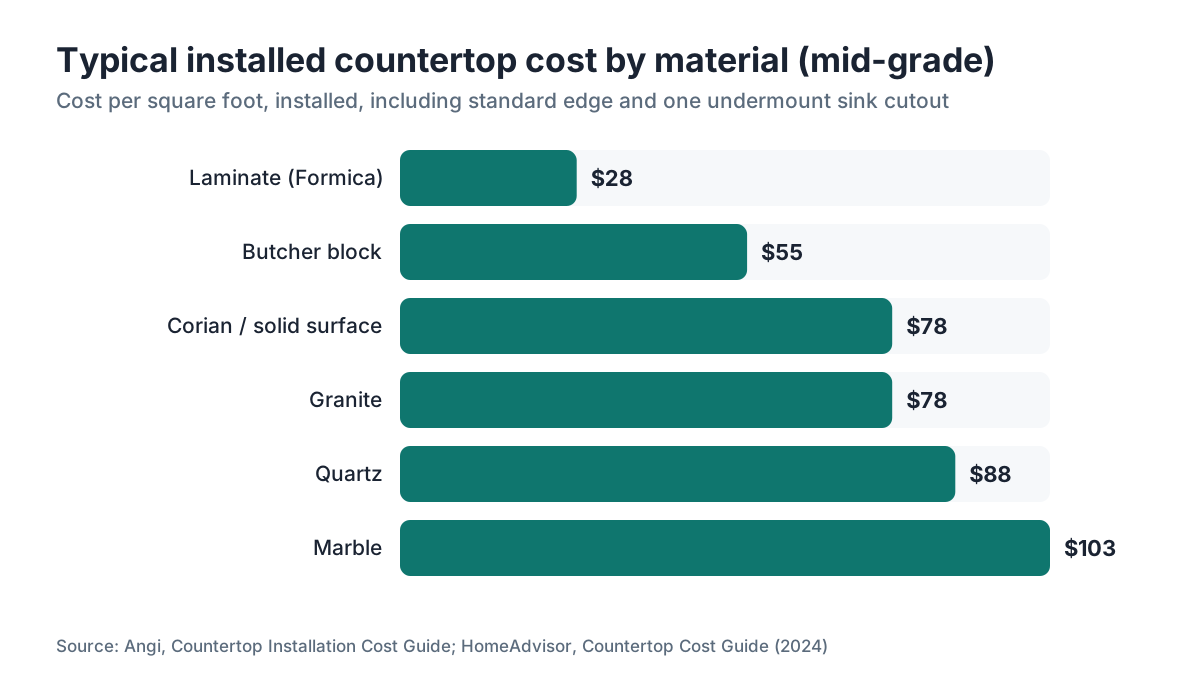
Material drives most of the spread. Here are honest installed price ranges for common materials, pulled from aggregated contractor pricing at Angi and HomeAdvisor as of 2024 [1][3]. These are installed costs per square foot, including a standard edge, one sink cutout, and installation, but not backsplash.
| Material | Low (entry grade) | Mid | High (premium) |
|---|---|---|---|
| Laminate (e.g., Formica) | $10, $20/sf | $20, $35/sf | $35, $50/sf (custom post-form) |
| Butcher block | $25, $45/sf | $45, $65/sf | $65, $100/sf |
| Quartz (e.g., Cambria) | $55, $75/sf | $75, $100/sf | $100, $150/sf |
| Granite | $45, $65/sf | $65, $90/sf | $90, $175/sf |
| Marble | $60, $85/sf | $85, $120/sf | $120, $200/sf |
| Corian / solid surface | $45, $65/sf | $65, $90/sf | $90, $130/sf |
A quote that lands 25% or more below this range for your chosen material deserves a hard look. Either the material grade is different, the scope is narrower than you think, or the shop has a quality problem.
Region matters too. Urban markets in the Northeast and on the West Coast tend to run 15 to 25% above the national midpoint. Rural Midwest markets run lower. Treat these ranges as a sanity check, not a ceiling.
What questions should you ask each fabricator before accepting a quote?
The quote document tells you the price. The conversation tells you whether that price holds.
Ask these of every shop you're seriously considering.
Who does the installation? Some fabricators run their own crew; others subcontract. Subcontracting isn't automatically bad, but when something goes wrong, knowing who owns the problem matters. Get it in writing.
What's the lead time from template to install? The industry standard is roughly 1 to 2 weeks after templating for most quartz and granite. Busy seasons (spring remodels, fall kitchen jobs) can stretch that to 3 to 4 weeks. If you're on a contractor's schedule, a 3-week slip gets expensive.
How do you handle waste and remnants? Fabricators cut slabs to your layout, and the leftover pieces are remnants. Some shops keep them all. Others sell them to you at a discount or throw small pieces (good for a windowsill or a bath vanity) into the price. Ask.
What's your workmanship warranty? Labor warranties in this trade are not standardized. Some shops offer 1 year; a few offer lifetime on seams. Material warranties come from the manufacturer, not the shop. Cambria carries a limited lifetime warranty, for example, but it covers manufacturing defects, not a chip from a dropped pan [4].
Can I see your seam drawing before you template? Any solid shop will produce a layout drawing showing where seams fall. If they refuse or say they'll sort it out on install day, that's a red flag.
Digital or physical templating? Digital templating (laser or photogrammetry) is more accurate and faster. Physical templating (cardboard or thin strips) works fine but leaves more room for error on complex layouts. This matters more for a busy kitchen than for a single straight run.
Shops that run quoting and shop management software, like SlabWise, tend to produce a detailed itemized quote automatically, which makes your comparison easier because every line is spelled out.
How do you spot a low-ball quote that will cost you more later?
Low-ball quotes follow a handful of recognizable patterns.
The quote drops line items instead of listing them at zero. You find out the sink cutout costs extra when the invoice shows up.
The square footage is lower than your measurement. Some shops undercount on purpose to win the bid, then charge for "additional material" after they template and you're locked in.
The material is described vaguely. "Granite, tan tones" is not a spec. If a shop won't name the slab or the supplier, you can't verify the grade.
The workmanship warranty is verbal. Get any warranty commitment onto the written quote or a separate signed document.
The payment terms front-load the money. A 50% deposit is standard. A shop you've never used asking for 75% or 100% upfront is a risk.
Change order language is missing. Ask how the shop handles changes between quote and install, and what it charges. Shops that skip this in the contract tend to charge whatever they feel like when something shifts.
Does the fabricator's shop quality actually show up in the quote?
Not directly. No quote says "we run dull blades" or "our polisher is from 2003." But shop quality shows up in a few indirect signals.
Ask to visit the shop, or ask for photos of finished jobs if a visit isn't practical. Seam quality is visible in close-up photos. A polished edge should match the sheen of the slab face. Uneven polish or micro-chipping along the edge points to worn tooling or thin skill.
Read Google reviews for the specifics: seams, chip repairs, install damage. A pattern of "the seam was very visible" or "they cracked a tile during install" tells you more than the star average.
Ask how long the shop has been in business. Countertop fabrication has bigger barriers to quality than to entry. A shop that's run 5-plus years in one market has a reputation to protect that a brand-new operation doesn't.
Ask for the equipment list if they'll share it. CNC-routed cutouts come out cleaner than hand-cut ones. Bridge saws with digital stops beat manual saws on accuracy. Equipment doesn't guarantee quality, but it's a fair proxy.
See our broader guide on countertop installation for what to inspect on install day.
Should you negotiate countertop quotes, and how?
Yes. Most fabricators have room in the margin, especially on material markup. Here's what actually works.
Bundle the project. Kitchen counters plus a bath vanity top? Quote them together. The setup costs for templating and install are largely fixed, so adding square footage to one visit is efficient for the shop, and you can push for a better rate on the extra surface.
Ask about remnant pricing. For a small bath or a laundry room, a shop sitting on a remnant in your preferred material can often price the job well below standard. Remnant jobs skip the slab purchase and cut the handling.
Ask about scheduling flexibility. Shops have slow stretches, usually January through February and sometimes late summer. Book your template and install into a slow window and some shops will discount to fill the calendar.
Put the competing numbers on the table. "Fabricator B quoted me $3,100 for the same scope. Can you match or beat that?" works more often than people expect. Don't invent a quote you don't have. That's bad faith, and experienced fabricators know the market well enough to catch it.
Don't negotiate edge or cutout quality downward. Those details are where cutting price means cutting process time, and it shows in the finished piece. Push on material markup and scheduling. Leave the craft alone.
How do warranties and payment terms affect which quote you should choose?
Two quotes at the same total can carry very different risk depending on their terms.
On payment terms: 50% deposit at signing and 50% at completion is the standard structure in most residential countertop projects [2]. Some shops want 100% upfront, which is a real risk if the shop stumbles on the job. Some national retailers structure payment differently, sometimes through a parent company's financing. Know what you're signing.
On workmanship warranty: ask exactly what's covered and for how long. A cracked seam six months after install should be the shop's problem. Warranty language that excludes "normal settling" or "homeowner handling" can deny almost any claim. A short, clear warranty often beats a long one stuffed with exclusions.
On material warranty: this sits between you and the manufacturer, not the fabricator. Caesarstone and Silestone offer limited lifetime warranties on their products, but they usually require installation by an authorized or certified fabricator [5][6]. Confirm your shop qualifies before you assume it does.
On lien protection: in most states, a contractor who supplies materials or labor to your property can file a mechanic's lien against it if they aren't paid, even after you've paid the general contractor who hired them [7]. If your fabricator is a subcontractor to your GC, confirm the payment flow is clean. Not countertop-specific, but it matters when things go sideways.
How many quotes should you get, and when does getting more stop helping?
Three quotes is the practical minimum for a kitchen job. Below three, you don't have enough data to know whether you're in the right range at all.
Past five quotes, the returns drop off fast. Extra quotes rarely tell you anything new once you've spread across shop types: a local independent fabricator, a big-box countertop program (Home Depot's or Lowe's install service), and a mid-sized regional shop. Those three carry meaningfully different cost structures, lead times, and service models.
Home Depot and Lowe's countertop programs use third-party fabricators in each market and put a brand guarantee behind the work [8][9]. Their pricing is competitive in the entry-to-mid range, but they usually flex less on edge profiles, seam placement, and complex layouts than an independent shop does.
Independent local shops tend to offer the most flexibility and the most variance in quality. They're where both the best and the worst experiences cluster.
If your project is complex (multiple levels, a waterfall edge, lots of cutouts, unusual stone), lean toward shops that specialize in that work and skip the big-box route. The margin for error on complex fabrication is too thin for a generalist.
Still in the research stage? The kitchen countertops guide covers material options before you start collecting bids.
What does a well-structured countertop quote actually look like?
A quote from a well-run shop spells out all of the following. If anything's missing, ask for it before you sign.
- Customer name, address, and project description (e.g., "kitchen countertops, master bath vanity")
- Material name, brand if applicable, finish, thickness, and grade/tier
- Total square footage being quoted and how it was calculated
- Edge profile, named (eased, beveled, ogee) and priced per linear foot or marked included
- Number and type of cutouts, each priced individually or marked included
- Backsplash scope if any
- Templating: date, method (digital or physical), and fee
- Fabrication lead time (business days after template)
- Installation: included or subcontracted, labor cost broken out
- Payment schedule (deposit amount, balance due timing)
- Workmanship warranty (duration, what's covered)
- Signature lines for both parties and a date
Shops running modern management tools, like SlabWise, generate quotes at this level of detail automatically, which makes your comparison job much easier. A napkin number or a one-line email is itself information about how the shop runs.
A clean quote also tells you what you're authorizing. Sign one that says "quartz countertop approx 45 sf" with nothing else, and you have almost no recourse if the edge, the seam placement, or the material grade misses your expectations.
Are there red flags in a countertop quote that should make you walk away?
A few things should genuinely make you reconsider.
No written quote at all. If a shop gives you only a verbal price and wants a verbal commitment, walk. Legitimate businesses don't operate that way at this price point.
The quote says "plus material cost" without naming the material. That open end means the final price is whatever they decide to charge for the slab.
The deposit demand is a full 100% upfront, especially from a shop you found through an ad rather than a referral. This pattern shows up in contractor fraud cases. The Federal Trade Commission's guidance on hiring a contractor flags large upfront payment demands as a common warning sign [10].
No install date or timeline commitment. "We'll get to it" is not a schedule.
The quote explicitly excludes cleanup. Some shops leave stone dust, cut caulk, and packaging for you. Standard professional installation includes cleaning the work area.
No physical address, or a residential one. Fabrication takes serious equipment. A shop working out of a garage can do good work, but it earns extra scrutiny on insurance and licensing.
Frequently asked questions
Is it rude to tell a fabricator you're getting other quotes?
No. Every reputable fabricator expects it. Just say you're comparing a few shops before you decide. Most will appreciate knowing so they can give you their best price upfront. What's actually rude (and counterproductive) is inventing a fake competing quote to pressure a shop, because experienced fabricators know their local market and can usually tell.
Should the cheapest countertop quote ever win?
Sometimes, yes, if the cheapest quote is also complete, specific, and from a shop with good references. Price alone doesn't disqualify anyone. But if it's cheap because it drops line items, uses vague material descriptions, or comes from a shop with a pattern of poor reviews on seams or install damage, the apparent savings vanish. Normalize the quotes first, then compare price.
Can I supply my own slab and just pay a fabricator for cutting and installation?
Yes, some fabricators offer fabrication-only pricing if you buy a slab directly from a stone yard. It can save money on material markup, which runs 15 to 40% at some shops. The tradeoff: the fabricator may not warranty the material, and you take on the risk of slab defects. Not every shop accepts customer-supplied material, so ask upfront.
What is the standard deposit for countertop fabrication?
Fifty percent at signing and fifty percent on completion is the most common structure in residential countertop projects. Some shops want more (60 to 70%) when they have to order a specific slab that can't be returned. One hundred percent upfront from a shop you've never used is a risk worth taking seriously before you agree.
How much does an extra sink cutout add to a countertop quote?
A standard undermount single-bowl cutout typically runs $75 to $150. A double-bowl or farmhouse apron cutout can run $150 to $250 or more, depending on the material and the shop. Faucet holes are usually $15 to $40 each. These numbers vary by region and shop, so ask for each cutout to be broken out as its own line rather than bundled or left unstated.
How do I compare laminate countertop quotes to stone quotes?
They're structurally different products, so compare within each category first. Laminate, like Formica, installs at $10 to $50 per square foot depending on grade and edge treatment, against $45 to $175 per square foot for stone. If you're deciding between material types, the honest comparison is total installed cost plus expected lifespan and maintenance, more than the square-foot rate alone.
What lead time should I expect from quote to installed countertops?
For most quartz and granite jobs, expect one to two weeks from the template visit to install. Busy seasons in spring and fall can push that to three to four weeks at well-regarded shops. Very complex jobs or special-order slabs take longer. Always get the fabrication lead time in writing, especially if you're on a contractor schedule where the counters gate other trades.
Do big-box store countertop programs (Home Depot, Lowe's) compete with local fabricators on price?
At the entry-to-mid range, yes, they're often competitive. Home Depot and Lowe's countertop programs use vetted local subcontractors and back the work with a large retailer's guarantee. They usually cost more than an independent shop at the high end and flex less on complex layouts, custom edges, and seam placement. For a straightforward kitchen, get a big-box quote as one of your three.
What should I inspect when the countertops are installed before I pay the balance?
Check seam visibility and alignment: seams should be tight and color-matched. Run your finger along every edge and look for chips, uneven polish, or rough spots. Verify every cutout is clean and the right size for your fixture. Check that the counter is level and flush on the cabinets. Look for caulk at the wall joint and around the sink. Don't release final payment until any defects are documented and a repair date is set.
Does countertop square footage include the sink area?
Most fabricators quote the gross square footage of the surface and do not deduct for the sink opening, because they still cut and handle that material during fabrication. A few shops do deduct it. Ask each shop how they calculate square footage so you're comparing the same measurement. Your own measurement should include the full slab footprint, sink opening and all.
Can I get a countertop quote without a home visit?
Yes, many fabricators will give a ballpark quote over the phone or by email if you supply your measurements and material. That quote is an estimate until they template. The binding price usually comes after a template visit confirms the exact square footage, layout complexity, and site conditions like out-of-square walls or uneven cabinet heights that affect the job.
How do I know if a fabricator is licensed and insured?
Ask directly and request a certificate of insurance (COI) showing general liability and workers' compensation. Licensing rules vary by state: some require a general contractor license for countertop installation, others have no specific requirement. Check your state's contractor licensing board online. A fabricator who can't or won't provide a COI on request is a meaningful risk if a worker gets hurt on your property.
What is a seam allowance and why does it appear on some quotes?
A seam allowance is the extra material a fabricator accounts for at each seam to get a clean joint. Some shops fold it into the square-footage calculation; others list it separately. It's not a scam, it's a real material cost. The bigger thing to ask about is seam placement: where will the seam be visible, and can you approve the location before templating is finalized?
What happens if the countertop cracks after installation?
If it cracks within the warranty period and the cause is a fabrication defect (improper seam support, inadequate substrate, a bad cut near a cutout), the fabricator should repair or replace it at no charge. If the cause is homeowner impact or thermal shock, that's typically excluded from workmanship warranties and falls under the manufacturer's material warranty, which also often excludes impact damage. Document the crack with photos and contact the fabricator in writing right away.
Sources
- Angi, Countertop Installation Cost Guide: National average countertop installation projects range from roughly $1,700 to $4,200 for a typical kitchen, depending on material and scope
- HomeAdvisor, Countertop Cost Guide: Edge profile upgrades can add $10 to $30 per linear foot; cutouts typically run $75 to $200 each depending on complexity
- U.S. Bureau of Labor Statistics, Producer Price Index program: Stone product manufacturing costs have risen measurably since 2020, contributing to installed price increases for natural stone countertops
- Cambria, Warranty Information: Cambria offers a limited lifetime warranty covering manufacturing defects but not damage from homeowner handling or impact
- Caesarstone, Warranty Policy: Caesarstone's limited lifetime warranty requires that installation be performed by a certified fabricator
- Silestone by Cosentino, Warranty: Silestone's 25-year warranty requires professional installation by an authorized Cosentino fabricator
- Legal Information Institute, Cornell Law School, Mechanic's Lien: In most U.S. states, a subcontractor who provides materials or labor to a property can file a mechanic's lien against the property if not paid, regardless of payment to the general contractor
- Home Depot, Countertop Installation Services: Home Depot's countertop program uses vetted local installers and offers a one-year labor warranty on its countertop installation service
- Lowe's, Countertop Installation: Lowe's countertop installation service uses professional installers and provides a one-year installation warranty
- Federal Trade Commission, Hiring a Contractor guidance: The FTC identifies large upfront payment demands as a common warning sign in contractor fraud
- U.S. Consumer Financial Protection Bureau: CFPB guidance on home improvement payments advises consumers to use written contracts and staged payment schedules to protect against non-performance
Last updated 2026-07-11