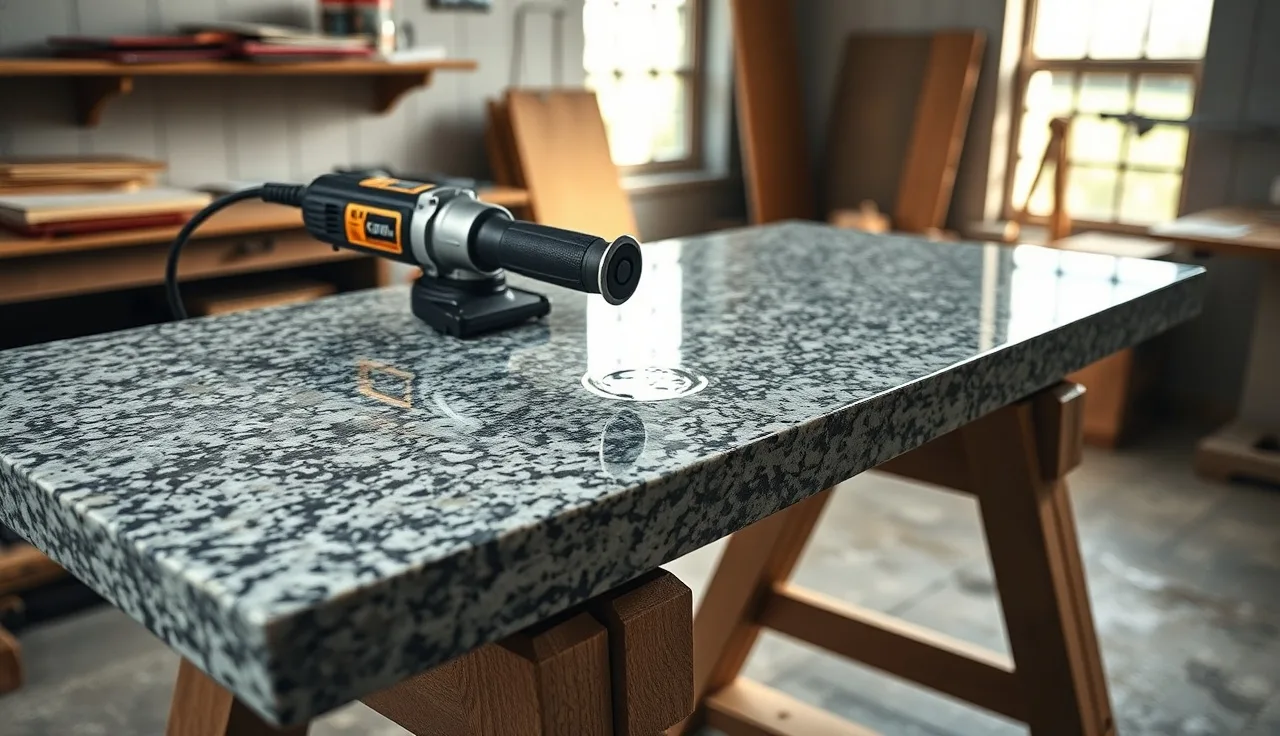
TL;DR
- Cutting granite needs a diamond-tipped blade, constant water cooling, and a clamped guide line.
- An angle grinder handles curves and cutouts.
- A wet tile saw or circular saw handles straight cuts.
- Budget $40 to $200 for tools or a rental.
- Mistakes crack slabs for good, so measure twice, practice on scrap, and wear a P100 respirator to block silica dust.
Why cutting granite is different from cutting other countertop materials
Granite sits at 6 to 7 on the Mohs hardness scale, which puts it above steel files and most carbide blades. That hardness is why granite counters last decades. It's also why a regular saw blade won't touch it. A wood-cutting blade burns up in seconds and leaves a jagged, chipped mess.
Heat is the second problem. Cutting stone makes friction, and friction makes heat fast enough to crack a slab if the blade isn't cooled the whole time. Pro fabricators run wet saws that flood the blade with water from the first second to the last. If you're on an angle grinder, you either use a dry-cutting diamond blade rated for short bursts or keep water running along the cut line.
Then there's the dust. The Occupational Safety and Health Administration treats respirable crystalline silica as a serious occupational hazard, and granite dust is full of it. OSHA's construction silica rule (29 CFR 1926.1153) requires engineering controls and respiratory protection when you cut stone dry. Even for a one-off homeowner cut, a fitted N95 is the floor. A half-face respirator with P100 filters is what I'd actually wear.
Stack granite up against the other counters people cut at home and the gap is obvious. Laminate countertops score and snap or cut with a fine-tooth blade. Butcher block countertops cut like the hardwood they are. Even engineered quartz, harder than most natural stone, is mixed to cut more predictably. Granite is the toughest DIY cut of any common counter surface, full stop.
What tools do you actually need to cut granite at home?
The list is short. Every item on it matters.
The blade is everything. You want a continuous-rim diamond blade rated for stone or granite. Continuous-rim gives you smoother edges and less chipping. Segmented-rim cuts faster but leaves a rough edge. For a countertop edge anyone will see, use continuous-rim. Match the diameter to your saw: 4.5 inch for an angle grinder, 7 inch for most circular saws, or the size the maker specs for a wet tile saw.
Blade prices swing hard. A cheap diamond blade at a home center runs $15 to $25 and may not survive one full countertop cut. A pro-grade continuous-rim blade runs $60 to $150 and stays sharp for many cuts. Spend the money here. A blade that dies mid-cut can grab, kick back, or leave a fracture line clean across your slab.
Wet tile saw (best for straight cuts). A 10-inch wet tile saw with a diamond blade gives the cleanest straight cuts and straight-sided sink cutouts. The water reservoir keeps the blade cool and knocks down most of the airborne dust. Rent one from most home improvement stores for $40 to $80 per day.
Angle grinder (best for curves and cutouts). A 4.5-inch angle grinder with a continuous-rim diamond blade handles sink cutouts, curves, and radius work. It's cheap ($30 to $80 new) and moves where a tile saw can't. The cost is more vibration, more dust, and a rougher edge you'll need to grind smooth.
Circular saw. A standard 7-1/4 inch circular saw with a diamond blade makes straight cuts on a slab laid flat on sawhorses. Run it against a clamped straight-edge guide. Keep water on the blade the whole time. This is the most reachable method for anyone who already owns the saw.
Gear you can't skip:
- N95 or P100 respirator (not a paper dust mask)
- Safety glasses or a full face shield
- Ear protection (wet saws and grinders top 90 dB)
- Nitrile or leather gloves
- Clamps and a non-slip pad to hold the slab
- Painter's tape along the cut line (cuts down surface chipping)
- A straightedge guide or fence to clamp to the slab
- Water source (hose or spray bottle for grinder work)
- Diamond polishing pads for edge finishing if the cut will show
What type of diamond blade should you use for granite?
Not every diamond blade cuts granite the same. The grit and the bond hardness are matched to specific materials, so the wrong one wastes money or wrecks the slab.
For granite, buy a blade marked for "hard stone" or "granite/marble." These use a softer bond that lets worn diamonds shed off and expose fresh ones as you cut. Grab a blade made for concrete or masonry by mistake and it can glaze over on granite, because granite isn't abrasive enough to wear the hard bond away and expose new diamonds.
| Blade type | Best for | Edge quality | Cost range |
|---|---|---|---|
| Continuous rim, wet | Straight cuts, sink cutouts | Smooth, low chip | $40-$150 |
| Turbo rim, wet/dry | General cuts, faster removal | Moderate chip | $20-$80 |
| Segmented rim | Rough cuts, demo work | Rough, high chip | $15-$50 |
| Core drill bit | Round sink cutout corners | Clean bore | $20-$60 per bit |
For a kitchen cutout where the edge shows a little, like a drop-in sink, use a continuous-rim wet blade for the straight runs and a small core drill bit to bore out the corners first. Boring corners before you cut the straight sides keeps the saw from binding and cracking the slab at the corners.
One thing people skip: blade diameter and arbor size have to match your tool exactly. Read the packaging. A 7-inch blade with a 5/8-inch arbor will not fit a saw built for a 7/8-inch arbor without an adapter.
How do you mark and prepare the cut line on granite?
Good layout before the saw touches stone prevents nearly every common mistake. Measure twice. Then measure again.
Granite doesn't forgive. You can't glue back a piece you cut off 1/4 inch short. For a sink cutout, use the template that came with the sink, or trace the sink rim onto the stone and draw your cut line 1/8 to 1/4 inch inside that trace so the sink lip covers the cut edge.
Run two layers of painter's tape along the whole cut line before you mark it. The tape earns its keep twice: your pencil or marker line shows clean on it, and it holds down surface chipping as the blade enters from above. Mark the line on the tape with a fine-tip marker, not a grease pencil.
Clamp a steel straightedge or a strip of 3/4-inch plywood as a fence, parallel to your cut line, offset by the exact distance from the blade to the edge of your tool's base plate. This offset (sometimes called the kerf offset) is different on every tool, so measure it on scrap before you clamp to the slab. A fence-guided cut is measurably straighter than freehand with any saw.
Support the slab right. Granite runs about 18 to 20 pounds per square foot at 3/4-inch thickness and 25 to 30 pounds per square foot at 1.25-inch, per the Natural Stone Institute. A 30-inch by 96-inch section weighs 300 to 400 pounds. Set it on padded sawhorses or foam underlayment over a solid table. The offcut needs support too, or it sags, binds the blade, and cracks along the kerf as it separates.
Step-by-step: how to make a straight cut in a granite countertop
These steps work for a circular saw or a wet tile saw with a fence. Read all of it before you start.
Step 1: Set up the work area. Lay the slab face-up on padded sawhorses. Keep the cut line clear of any sawhorse so the slab can flex a hair as the cut finishes. Set up water. Wet tile saw, fill the reservoir. Circular saw, have a helper trickle water from a hose right onto the blade while you cut.
Step 2: Tape and mark. Two layers of painter's tape over the whole cut path. Mark the line on the tape with a fine-tip marker.
Step 3: Clamp the fence. Measure the blade-to-base-plate offset on scrap, then clamp your straightedge at that distance from the cut line.
Step 4: Put on all your PPE. Respirator, eye protection, ear protection, gloves. No shortcuts.
Step 5: Score the surface. Make a shallow first pass at about 1/4 inch depth, moving at slow walking speed. This scores the top and gives the blade a track to follow on the deep pass.
Step 6: Full-depth cut. Set blade depth to slab thickness plus about 1/8 inch. Make the cut in one smooth, steady pass. Don't stop. A pause builds heat at that spot and invites a thermal crack. Feed rate matters both ways: too fast chips and damages the blade, too slow overheats. Let the blade do the work.
Step 7: Support the waste piece. Have a helper hold the offcut, or clamp it, so it doesn't drop and crack as the cut frees it.
Step 8: Peel the tape and inspect. Pull the tape slowly at a 45-degree angle. Check the edge. A little micro-chipping on the cut face is normal. The top surface should be clean if you used a continuous-rim blade at the right speed.
Step 9: Dress the edge. A fresh cut on granite is sharp and raw. For any edge that shows, grind it with a diamond hand pad or a polishing pad set on the grinder, working from 60 grit up to 400 or higher. A polished or eased edge takes 10 to 30 minutes of hand work.
How do you cut a sink cutout in a granite countertop?
A sink cutout is the hardest cut in the job. You're making a closed interior cut, and the corners are stress points that crack easily.
Start with a pilot hole in each corner of the cutout rectangle. Use a 3/8-inch or 1/2-inch diamond core bit, run it wet, and drill all the way through at every corner. Those round corners are where cracks want to start. Let a saw blade stop dead at a sharp 90-degree corner and the stone will eventually crack there. A pre-drilled round corner soaks up that stress.
For the straight sides, use an angle grinder with a continuous-rim blade or a diamond jigsaw blade (they exist and work fine on granite up to about 1 inch thick). Cut from corner hole to corner hole on each side. Go slow. Keep water on the blade.
That cutout piece is heavy. A 20-inch by 30-inch drop from 1.25-inch granite runs roughly 38 to 45 pounds. Tape it or have someone hold it from underneath before the last side frees it.
Once all four sides are cut, the piece should drop out. If it binds, don't pry it. Cut a small relief slot instead. Levering a bound granite piece cracks it, and the crack travels well past the cutout.
For an undermount sink, the cut edge shows below the rim, so it gets polished. Plan 20 to 40 minutes of hand polishing per linear foot of exposed edge.
Can you cut granite with an angle grinder?
Yes, and for curves, notches, and tight spots the grinder is the better tool. A wet tile saw only cuts straight. An angle grinder with the right blade handles curves, L-shaped cuts around a cabinet filler, and radius corners at a cooktop opening.
Use a 4.5-inch or 5-inch continuous-rim diamond blade rated for dry or wet stone cutting. Bring the grinder to full speed before it touches the stone, and keep it moving. Sit in one spot and the heat builds enough to micro-crack the granite under the blade.
The downsides for countertop work: more vibration, harder to hold a line without a fence, more dust than a wet saw. Build a plywood fence and clamp it for any straight cut over 6 inches. For curves, a steady hand and a slow feed rate get you there.
For a one-time homeowner cut, buying a $40 to $60 grinder and a $50 diamond blade often beats renting a full wet tile saw setup for a small notch or a single trim.
How much does it cost to have a fabricator cut granite instead of DIY?
Before you commit to DIY, get a real quote for the pro version. A fabricator can add a straight cut, trim a counter to a shorter length, or cut a sink opening for less than you'd guess.
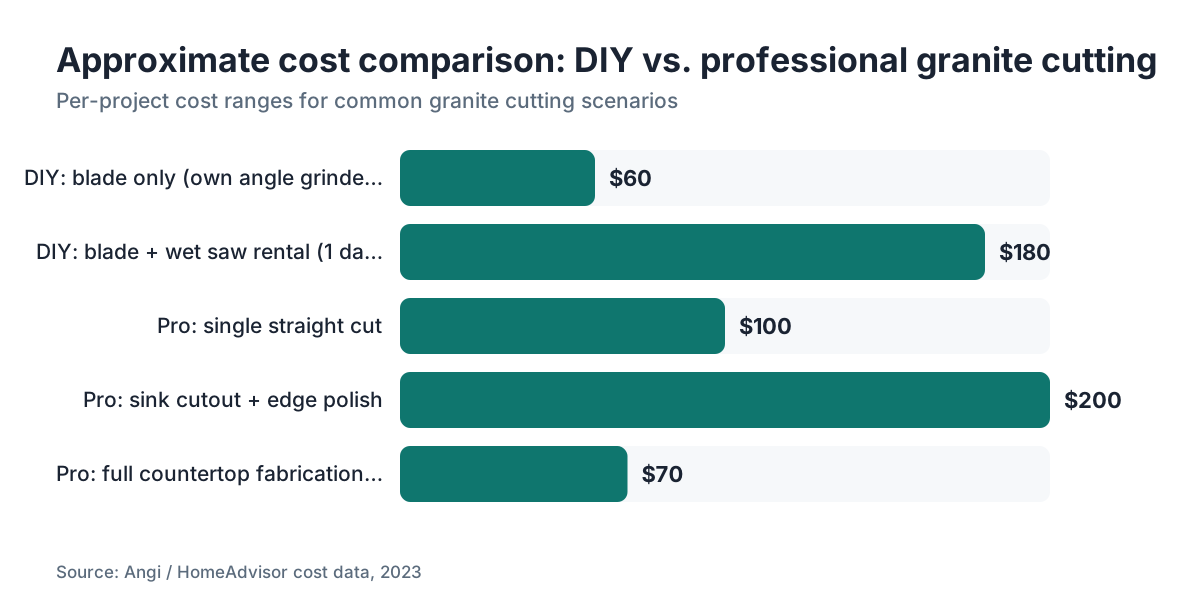
A single straight cut at a shop runs roughly $50 to $150 depending on slab thickness and your local market. A sink cutout with the exposed edge polished runs $100 to $300 at most shops. Some fabricators won't cut slabs you bring in, especially stone that's already been installed and pulled out, because the odds of a hidden micro-crack breaking on them go up.
For a full replacement with templating, cutting, and install, countertop installation runs $40 to $100 per square foot for granite material and labor combined, and edge profile complexity and region move that number a lot.
DIY tools plus a rental saw for a single cut land at $80 to $200. Already own an angle grinder? Add just the blade: $40 to $80. The math favors DIY for a simple trim on an existing counter. It favors a fabricator for a whole kitchen's worth of cuts, where one mistake costs $500 to $2,000 in material alone.
Running a shop that prices complex cuts and curve work? Software like SlabWise helps you quote and nest cuts so waste doesn't eat your margin.
What are the most common mistakes that crack granite during cutting?
Cracking is almost always preventable once you know what causes it.
Stopping mid-cut. This is the number one cause of thermal cracks. Heat piles up at the blade contact point the instant the saw stops moving. Finish every cut in one pass.
Unsupported offcut. Leave the piece being cut off with nothing under it and gravity pulls it down the moment the kerf nearly finishes. The slab bends, and granite has very low tensile strength. It cracks clean across. Support the offcut.
Wrong or glazed blade. A glazed blade (diamonds buried under bond) stops cutting, so the operator pushes harder, makes more heat, and the slab cracks. If the blade is smoking or not cutting free, stop. Dress it on a cinder block or buy a new one.
Cutting corners without a pilot hole. Saw blades cut in straight lines. Stop a blade at a sharp corner and that corner becomes the stress point where granite fails. Pre-drill round corners on any enclosed cutout, every time.
Cutting a slab that's already installed. Glued to the cabinets and siliconed to the wall, the whole slab shakes when the saw vibrates, and you have no room to work safely. Cut before install whenever you can. If you have to cut in place, use an angle grinder at very low feed rates, work wet, and accept that the crack risk is meaningfully higher.
How do you clean up and care for the cut edge and your work area?
Dust control comes first after the cut. Granite cutting dust holds crystalline silica. OSHA standard 29 CFR 1926.1153 sets the permissible exposure limit for respirable crystalline silica at 50 micrograms per cubic meter of air as an 8-hour time-weighted average. Wet cutting catches most of the dust at the source, but you still have slurry to deal with. Don't sweep dry granite slurry. Wet-mop it, or vacuum with a HEPA-filter shop vac.
Clean the cut surface with warm water and mild dish soap. For ongoing care of your granite countertops, the standard advice is a penetrating stone sealer every one to three years and quick cleanup of spills, especially acidic ones. The edge you just cut is raw stone with no sealer, so seal it the same day if it'll see moisture or food.
For cleaning granite after install or after any work that leaves stone dust behind: warm soapy water daily, a dedicated stone cleaner for deeper jobs, and never vinegar, bleach, or ammonia. Those break down the sealer and etch the surface. Our guide on how to clean stone countertops covers the rest.
Save your offcuts. Even a 6-inch strip is worth keeping as a repair patch if the counter ever chips, or as a test piece before your next cut.
When should you call a professional fabricator instead of cutting yourself?
There's no shame in calling a fabricator. This is their day job, and their tools (CNC routers, bridge saws with water-cooled diamond blades, laser templating) produce results a homeowner can't match by hand.
Call a pro if the cut is a mitered edge join, the slab is thicker than 1.25 inches (3 cm material is much harder to control), the piece will be a focal point like a waterfall edge, or you're working an exotic or expensive stone where the material cost dwarfs any labor you'd save.
For a shop, the choice is easy: use the bridge saw or CNC router, run it wet, and follow OSHA's silica controls. If you're building out a shop or tightening how you quote complex cuts, the nesting and layout tools in SlabWise are worth a look for cutting offcut waste and sharpening your job costing.
For a homeowner making one trim cut or a sink cutout in a slab you already own and paid for, DIY is reasonable with the right tools, the right blade, and the safety steps taken seriously. Go slow, keep the blade cool, and support every piece before the cut finishes.
Frequently asked questions
Can I cut granite countertop with a regular circular saw?
Yes, but only after you swap the blade for a continuous-rim diamond blade rated for hard stone. A standard wood or masonry blade fails immediately. You also need water running onto the blade the whole time to prevent thermal cracking. Set a blade-depth guide, clamp a straightedge fence, and make the cut in one steady pass.
How do you cut a granite countertop without chipping it?
Apply two layers of painter's tape over the cut line before you mark it. Use a continuous-rim (not segmented) diamond blade. Cut at a steady feed rate without stopping. Score a shallow first pass before the full-depth pass. Peel the tape at a 45-degree angle after cutting. Chipping usually comes from a dull or wrong blade, or a feed rate that's too fast.
What blade do I need to cut granite?
A continuous-rim diamond blade rated specifically for granite or hard stone. Match the diameter to your tool (4.5 inch for angle grinders, 7 inch for most circular saws). Skip blades marketed for concrete or masonry, since their harder bond glazes over on granite. Budget $40 to $150 for a good one. Cheap blades under $25 often don't survive a full countertop cut.
Is cutting granite dangerous?
The main hazards are silica dust, blade kickback, and heavy slab weight. Granite dust holds respirable crystalline silica, which OSHA treats as a serious respiratory hazard under 29 CFR 1926.1153. Wear at least an N95 respirator, ideally a P100 half-face. Add safety glasses, hearing protection, and gloves. Wet cutting cuts airborne dust a lot.
Can I cut granite countertop that is already installed?
Technically yes, but it's harder and riskier. Saw vibration travels through the whole installed slab, and you have little room to maneuver or support the offcut. Use an angle grinder rather than a circular saw, cut wet, go slow, and accept a higher chance of cracking. Cut before installation whenever you can.
How do I cut a hole in granite for a sink?
Mark the cutout with the sink maker's template. Drill a round pilot hole at each corner using a diamond core bit run wet. Then cut between the corner holes with an angle grinder and continuous-rim blade, or a diamond jigsaw blade. Support the cutout piece from below before the final cut so it doesn't drop and crack. Polish the exposed edge if it will show.
How long does it take to cut granite countertop?
A single straight cut on a standard 1.25-inch slab takes 5 to 15 minutes of actual cutting once the saw and workpiece are set. Marking, clamping, and setup add another 20 to 30 minutes. A full sink cutout with corner drilling and edge polishing takes 1 to 3 hours for a careful DIYer. Pros on a bridge saw cut faster, roughly 2 to 5 minutes per linear foot.
Can I rent a wet tile saw to cut granite?
Yes. Most major home improvement stores and rental companies rent 10-inch wet tile saws for $40 to $80 per day. The rental usually comes with a general-purpose diamond blade, so ask whether it's rated for hard stone like granite. If not, buy a granite-rated continuous-rim blade and swap it in before your rental period starts.
How do I cut granite countertop for a cooktop?
A cooktop cutout is an enclosed rectangular cut, same method as a sink cutout. Use the cooktop's template to mark the line, drill round corner pilot holes with a diamond core bit, then cut the straight sides with an angle grinder or diamond jigsaw blade. Keep all four sides supported before the final cut frees the piece. A drop-in cooktop's trim ring usually hides the edge, so polishing it is optional.
How do I clean granite countertops after cutting?
Wet-mop or HEPA-vacuum the slurry right away. Never sweep dry granite dust. Clean the stone surface with warm water and mild dish soap. Apply a penetrating stone sealer to any newly cut or raw edges the same day if they'll see moisture. Avoid vinegar, bleach, or ammonia cleaners, which break down sealer and can etch the surface.
What is the best tool for cutting granite countertop at home?
For straight cuts, a 10-inch wet tile saw with a continuous-rim diamond blade wins: coolest cut, least dust, cleanest edge. For curves, notches, and sink cutouts, a 4.5-inch angle grinder with a diamond blade moves better. Most homeowner projects want both, since a full sink install involves both kinds of cut.
How much does it cost to have granite cut by a professional?
A single straight cut at a fabricator shop runs roughly $50 to $150. A sink cutout with edge polishing runs $100 to $300. Full fabrication and installation runs $40 to $100 per square foot for granite including labor and material, depending on edge profiles and local rates. For a simple trim cut, DIY with rented tools often costs less than the pro.
Do I need to seal granite after cutting it?
Yes. Any cut edge or newly exposed surface is raw, unsealed stone. Apply a penetrating granite sealer to those surfaces before they contact moisture or food. Most fabricators also re-seal the whole counter after major cutting or repair, since the process can disturb or strip sealer near the cut zone.
Can an angle grinder cut granite countertop in a straight line?
It can, with a clamped fence. Cut freehand and you'll drift. Clamp a steel straightedge or a strip of 3/4-inch plywood as a fence at the right offset from your cut line, press the grinder's base plate against it as you cut, and the result comes out straight. For cuts over about 12 inches, a wet tile saw with a rip fence is easier to control.
Sources
- U.S. Geological Survey, Mohs Hardness Scale reference: Granite has a Mohs hardness of approximately 6 to 7, harder than steel files and most carbide tooling.
- OSHA, 29 CFR 1926.1153 Respirable Crystalline Silica Standard for Construction: OSHA's silica rule for construction requires engineering controls and respiratory protection when cutting stone dry; the permissible exposure limit is 50 micrograms per cubic meter as an 8-hour TWA.
- HomeAdvisor / Angi, Countertop Cutting and Fabrication Cost Data: Wet tile saw rental runs $40 to $80 per day; professional straight cuts run $50 to $150; quality diamond blades run $40 to $150.
- Natural Stone Institute, Stone Weight Reference: Granite countertop material weighs approximately 18 to 20 pounds per square foot at 3/4-inch thickness and 25 to 30 pounds per square foot at 1.25-inch thickness.
- National Kitchen & Bath Association, Cost vs. Value and Installation Benchmarks: Full granite countertop fabrication and installation costs run approximately $40 to $100 per square foot including material and labor, varying by edge profile and region.
- OSHA, Silica Crystalline Safety and Health Topics page: OSHA classifies respirable crystalline silica as a known human carcinogen and significant occupational health hazard in stone cutting operations.
- CDC/NIOSH, Silica Dust Control in Stone Countertop Fabrication: Wet cutting methods reduce airborne crystalline silica concentrations significantly compared to dry cutting in stone fabrication environments.
- Natural Stone Institute, Fabrication and Installation Standards: Industry standards recommend sealing cut edges and raw stone surfaces immediately after fabrication to prevent moisture infiltration and staining.
- OSHA, Respiratory Protection Standard 29 CFR 1910.134: OSHA respiratory protection standards specify minimum N95 protection for nuisance dusts with P100 recommended for silica-generating operations.
Last updated 2026-07-09