TL;DR
- Hotel stone fabrication means cutting, finishing, and installing stone across dozens or hundreds of matching rooms under hard construction deadlines.
- Projects run 5,000 to 50,000-plus square feet, require stamped shop drawings, and demand batch production with staged deliveries.
- Lead times, tolerance specs, bonding, and contract terms differ sharply from residential work, and the deadline is never negotiable.
What makes hotel stone fabrication different from residential work?
Volume is the first thing. A single hotel might call for 200 identical bathroom vanity tops, 80 lobby pieces, and miles of base and wall cladding, all cut from slabs that match closely enough to satisfy a general contractor and a brand standards document. A residential kitchen uses 3 to 5 slabs. A mid-size hotel burns through 300 to 600 slabs before the ribbon is cut.
The second difference is the chain of approval. You are not working with a homeowner who changes her mind at the template. You are working with a general contractor, an interior designer, an architect, a purchasing agent, and sometimes a hotel brand's own construction standards team. Every material choice flows through a submittal process. Shop drawings get stamped. Samples get signed. Deviations turn into RFIs (requests for information) and can stall your entire production schedule.
Third, the deadline is fixed in a way a kitchen remodel deadline never is. A hotel opening ties to financing, brand agreements, and pre-sold bookings. Miss it, and you are not inconveniencing a homeowner. You are potentially triggering liquidated damages clauses in a multi-million dollar construction contract. Those clauses commonly run $5,000 to $25,000 per day or more, scaled to project size [1].
Fourth, tolerances tighten. Brand standards, especially for upscale and luxury flags, often specify maximum warpage, thickness tolerances (commonly plus or minus 1/16 inch on calibrated material), and surface finish standards that go well past what any residential client would notice.
What stone materials do hotels actually specify and why?
Marble is the prestige choice for lobbies, reception desks, and spa areas. It photographs beautifully, signals luxury, and carries centuries of association with grand public spaces. The tradeoff is old news: marble etches from acidic cleaners and food, scratches more readily than granite, and needs periodic sealing in high-traffic spots. Operators who put marble on vanity tops in full-service hotels accept that the stone will show wear and budget for honing or eventual replacement. Our guide to marble countertops covers the maintenance reality in full.
Granite is the workhorse. It shrugs off acids and scratches far better than marble, holds a polish through years of commercial housekeeping chemicals, and comes in enough colors to satisfy most design programs. Budget hotels and select-service brands reach for granite first. Grades and pricing are in our granite countertops guide.
Quartzite (natural stone, not the same thing as engineered quartz) has grown popular in upscale hotels as a marble-look material with better acid resistance. The catch is that true quartzite quality varies enormously by source, and some material sold as quartzite is really a soft marble that etches just as badly. Acid-test before you specify. That step is not optional.
Engineered quartz (Cambria, Silestone, Caesarstone) dominates mid-scale and upper-midscale vanity tops and kitchenette counters. It needs no sealing, holds up to housekeeping chemicals, and delivers tight color consistency across hundreds of pieces, which matters a lot when you need 200 matching tops. Cambria countertops show up often on branded chains because Cambria supplies commercial warranty documentation that passes brand standards review.
Porcelain slabs have pushed into the hotel market hard over the last five years, especially for wall cladding, shower surrounds, and pool decks. A 3mm porcelain panel can cover a 60-square-foot shower wall in one piece. That kills the grout lines that harbor bacteria and drive housekeeping crazy.
Here is how material selection typically breaks down by segment:
| Hotel Segment | Lobby/Public | Vanity Tops | Shower Walls |
|---|---|---|---|
| Economy/Budget | Engineered quartz or laminate | Laminate or cultured marble | Fiberglass/acrylic |
| Midscale | Granite or eng. quartz | Engineered quartz | Porcelain tile |
| Upper Midscale | Granite or quartzite | Engineered quartz or granite | Porcelain slab or tile |
| Upscale | Marble, quartzite, or granite | Granite or engineered quartz | Porcelain slab |
| Luxury/Lifestyle | Marble, book-matched stone | Marble or quartzite | Book-matched marble or quartzite |
How do fabricators price and bid a hotel stone project?
Hotel bidding is a formal process, almost every time. The general contractor issues a bid package with architectural drawings, finish schedules, and specification sections (usually Division 04 for masonry and Division 09 for finishes). Your bid has to hit a deadline, match the specified scope exactly, and include unit pricing so the GC can price alternates and change orders later.
The core formula matches residential: material cost plus fabrication labor plus overhead plus margin. The variables shift, though. At hotel volume you can sometimes negotiate better slab pricing from distributors, which compresses your material cost per square foot. On the other hand, you may need to rent temporary storage or stage delivery in several drops, which adds logistics cost. You will almost certainly need certified shop drawings, which adds drafting time and sometimes engineering review.
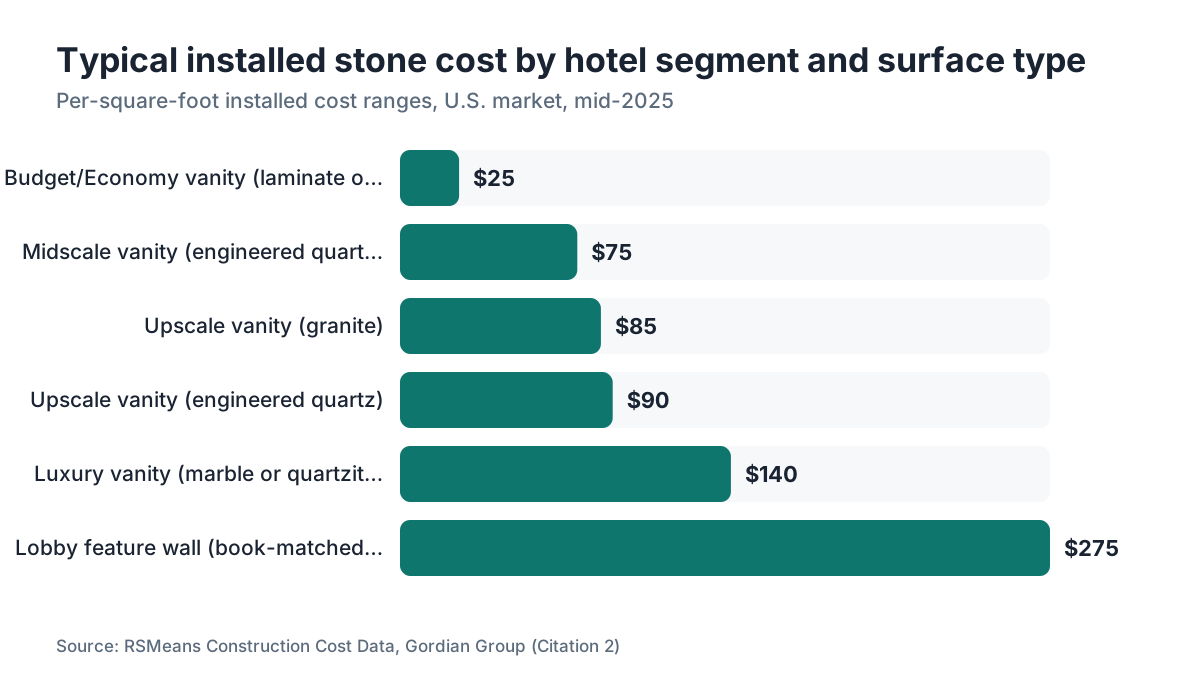
Unit pricing for hotel work, as of mid-2025 in the U.S. market, typically runs:
- Standard granite vanity tops, edge and cutout included: $55 to $95 per square foot installed, by region and stone grade
- Engineered quartz vanity tops: $65 to $110 per square foot installed
- Marble lobby flooring, supplied and installed: $20 to $60 per square foot by thickness and finish (flooring fabrication is a different animal from countertop fab)
- Lobby reception desk or feature wall in book-matched marble: almost always custom, but $150 to $400-plus per square foot supplied and installed is realistic for premium material and complex layouts [2]
These ranges are wide because regional labor markets, freight, and material grades all move the number. A shop in Dallas prices differently than one in New York City. Do not treat any published number as your number.
One thing that catches shops new to hospitality: hotel GCs often require a bid bond (typically 5 to 10 percent of the bid amount) and a performance and payment bond once you win the contract. If you have never set up bonding with a surety, start early. It can take weeks and requires financial statements [3].
For shops juggling complex hotel bids with dozens of line items and multiple slab layouts, software that handles nesting and job costing in one workflow saves hours per bid. SlabWise was built for exactly that multi-job complexity, and the demo is worth a look before your next large commercial bid.
What does the templating and shop drawing process look like at hotel scale?
On a residential job, templating means one visit, one kitchen, maybe 45 minutes. On a hotel job, it means coordinating with the GC's schedule to reach dozens or hundreds of rooms in a set sequence, often while other trades are still working next door. Rooms get templated after the cabinetry or vanity bases are set and plumbed, but before finish trades need the space back. That window can be as short as a few days per floor.
Serious hotel fabricators use digital templating (laser templating) instead of cardboard or luan. The data drops straight into CNC programming, which kills the transcription errors that would be catastrophic at scale. An error on one residential top is an inconvenience. The same error repeated across 200 vanity tops ends projects.
Shop drawings are a formal submittal. They show every piece in plan view with dimensions, edge profiles, cutout locations, seam locations, and material call-outs. The architect approves, approves with comments, or rejects. Rejected submittals cycle back through review. Build that time into your schedule. Two to three weeks per submittal round is common on larger projects [11].
Batch fabrication follows approved submittals. The smartest shops cut and finish all pieces for a given room type at once, tag every piece with a room number, and palletize by floor and wing so the install crew pulls exactly what it needs without sorting on-site. Sounds obvious. It takes real project management and labeling discipline to actually pull off.
How do staged deliveries and install sequencing work on hotel projects?
A 300-room hotel does not go up all at once. Construction flows floor by floor or wing by wing, and stone installation follows that sequence. You deliver many times across weeks or months. There is no one big truck and done.
Each delivery has to match the GC's schedule exactly. Show up a week early and you need somewhere to store finished stone, which may not exist on a dense urban jobsite. Show up late and the GC's finishing crew sits idle, and that cost lands on you if your contract has liquidated damages language.
Storage and staging deserve their own plan. On-site stone storage means protecting finished pieces from jobsite damage (other trades dropping tools, forklifts, drywall mud), from theft, and from the weather. Polished surfaces scratch easily. Most experienced hotel fabricators wrap every finished piece and require it stay wrapped until the install crew pulls it.
Install crew coordination is its own discipline. Hotel stone installers work in active construction zones with OSHA requirements, site safety orientations, and often union labor agreements depending on location. If you are a residential shop bidding your first hotel job, confirm whether the project is a union jobsite before you price labor. The gap between prevailing-wage union installation and residential-rate labor is substantial, sometimes 40 to 80 percent higher per hour [4].
What are the biggest contract and legal risks for fabricators on hotel jobs?
The contract itself is the first risk. Hotel GCs use subcontract agreements their attorneys wrote, and those agreements are not balanced. Watch for broad indemnification clauses (you indemnify the GC for losses even partly caused by others), "pay-when-paid" or "pay-if-paid" clauses that tie your payment to the GC getting paid by the owner, and waiver of lien rights in exchange for a spot on the bid list.
Mechanics lien rights are your main protection on any construction project. In most states, a material supplier or subcontractor who is not paid can file a lien against the property, giving a secured claim against the real estate. Hotel projects often involve lenders with anti-lien provisions in their financing, which pressures the GC to collect lien waivers from every sub. Know your state's lien law, know the notice deadlines (preliminary notice can be as short as 20 days from first furnishing material [5]), and do not waive lien rights unconditionally before you are paid.
Retainage is standard on commercial construction. Expect the GC to hold back 5 to 10 percent of each payment until substantial completion, sometimes until final completion. On a $500,000 hotel stone contract, that is $25,000 to $50,000 sitting with the GC for six to twelve months.
Change orders are the other money issue. Hotel projects change. The designer swaps the specified marble after you have already ordered slabs. The GC asks for a feature wall that was never in scope. Get every change in writing before you touch the work. Verbal approvals on hotel projects have a way of vanishing the moment the invoice shows up.
How do hotel brand standards affect stone specifications?
The major brands (Marriott, Hilton, Hyatt, IHG, and others) publish property improvement plan (PIP) documents and brand standards manuals that spell out acceptable materials, finishes, and installation methods for every surface in a guestroom and public area. These documents exist so a Marriott in Phoenix looks and performs like a Marriott in Boston.
Stone standards usually specify approved material categories (not specific slabs, but categories like "polished natural granite" or "engineered quartz"), minimum thickness (3/4 inch for countertops is nearly universal in commercial specs), acceptable edge profiles (often a short list like eased, beveled, or bullnose to keep brand consistency), and sometimes approved supplier lists.
For a franchise property (a private owner operating under a brand flag), the brand standards manual is legally binding under the franchise agreement. The owner cannot swap in a cheaper material without brand approval. That gives the fabricator a defined scope, but it also means every change needs brand sign-off, which takes time.
Brand standards reach into maintenance and cleaning too. Brands specify approved housekeeping chemicals, and some stone materials fight those chemicals. Marble etches badly with common acid-based bathroom cleaners. If you are specifying stone for a hotel, check the brand's approved chemical list before you finalize the spec. See how to clean stone countertops for the chemistry, which holds in commercial settings just as it does at home.
What shop capacity and equipment do you need to handle hotel volume?
A two-CNC-bridge shop with two skilled fabricators handles plenty of residential volume. Hotel work at scale asks for more. The bottleneck is rarely cutting speed. It is throughput in polishing, handling, and quality control.
For a 200-vanity-top project, you need a workflow that produces finished, tagged, quality-checked pieces steadily and fast enough to meet the delivery schedule. Typical hotel vanity tops are simple shapes with one sink cutout and a standard edge, so the fabrication itself is not complex. The challenge is volume plus zero-defect consistency. One bad seam or wrong-size cutout repeated 200 times is a disaster.
Equipment minimums most shops running hotel work keep on the floor:
- At least one CNC bridge saw with DXF import so digital templates translate straight to cut files without manual re-entry
- An edge machine or CNC router that runs consistent profiles at speed
- At least one full-time QC check at the finished-piece stage before palletizing
- Enough yard or warehouse space to stage completed pieces by room or floor, more than by job
If your shop runs software for nesting and job management, hotel projects expose every inefficiency in that workflow. Manual spreadsheets that handle 10 jobs a week collapse under a 200-piece hotel with multiple stone types, changing room configs, and a delivery schedule that updates weekly. This is exactly the operation where fabrication management software earns its cost. The SlabWise demo shows how job-level nesting and batch production tracking work in practice.
Staffing is the other constraint. Hotel installation often needs workers with OSHA 10 or OSHA 30 cards, site safety orientations, and real experience in active multi-trade environments [6].
How long does a typical hotel stone project take from award to final install?
Timeline swings hard with project size and complexity, but the phases stay consistent. Total elapsed time from contract award to final punch list clearance runs 6 to 18 months on most hotel projects. New-build full-service hotels sit at the high end. Renovation projects land at the low end.
Submittal and approval: 2 to 6 weeks. Shop drawings go in, the architect reviews, comments come back, revisions go in. On complex projects this can cycle twice.
Material procurement: 4 to 16 weeks, depending on whether the specified stone is in stock domestically or has to be imported. Book-matched marble for a feature wall, cut from specific blocks, can take 12 to 20 weeks from quarry to shop [12]. This is the phase most fabricators underestimate. If you are bidding a luxury hotel with imported stone, your procurement lead time may run longer than an entire residential project cycle.
Fabrication: 4 to 12 weeks for a typical mid-scale hotel with 150 to 250 pieces. It depends heavily on shop capacity and whether the pieces are simple (standard vanity tops) or complex (curved reception desk, book-matched panels).
Staged installation: 6 to 20 weeks, running concurrently with or slightly behind the overall construction schedule.
The most common schedule failure point is material procurement. Fabricators who treat procurement as an after-the-submittal task often end up compressing fabrication and install to make up lost time. That is where quality problems and accidents happen.
What are realistic profit margins on hotel stone work?
Hotel stone fabrication is not automatically more profitable than residential on a per-square-foot basis. Sometimes it is less profitable, thanks to the extra overhead: bonding, certified submittals, OSHA compliance, staged logistics, and retainage sitting with the GC.
Gross margins (revenue minus direct material and direct labor) for commercial stone fabrication typically run 35 to 50 percent for established shops with good volume buying, versus 45 to 60 percent for residential work where markups run higher [7]. Hotel projects deliver that thinner margin on much larger revenue, so absolute profit dollars still come out higher even when the percentage is lower.
The real profitability driver in hotel work is repeatability. A 200-top project is essentially the same top fabricated 200 times. Once your CNC program and QC checklist are dialed in, per-unit cost drops as the job runs. The first 20 tops cost more than the last 20.
Shops that lose money on hotel work usually make one of three mistakes. They underbid to win (competitive pressure in commercial bidding is real). They miss the indirect costs (bonds, submittals, logistics, the carrying cost of retainage). Or they treat change orders casually and eat costs they should have billed.
What certifications and insurance do hotel projects require from fabricators?
Commercial general liability at hotel scale typically has to hit at least $2 million per occurrence and $4 million aggregate. Some GCs require $5 million or more on larger projects. Workers' compensation is mandatory. You will provide certificates of insurance naming the GC and the property owner as additional insureds before you can even mobilize [8].
Bonding runs on two tracks. Bid bonds are common (5 to 10 percent of the bid), and performance and payment bonds are required on most projects over a threshold (many GCs require them for subs over $100,000 in scope). A surety sets your bonding capacity based on your financials. Small shops without established bonding relationships often find they cannot bond a large hotel project without a few years of financial history behind them.
Site-specific rules often include OSHA 10 cards for workers and OSHA 30 for supervisors. OSHA itself does not require a specific card for general construction work, but it does require adequate safety training [6]. Many hotel GCs mandate the cards as a project rule anyway.
Some jurisdictions require contractor licensing for commercial stone installation above certain thresholds. California, Florida, and Texas all have licensing requirements that reach commercial stone work, though the license category and thresholds vary by state [9]. Check your state contractor licensing board before bidding in an unfamiliar jurisdiction.
For projects chasing LEED certification (plenty of hotel brands pursue LEED for the marketing and operational payoff), the stone specs may need to meet regional material sourcing rules or low-VOC sealer requirements. LEED v4.1 for interior design and construction addresses material transparency and regional material credits that can shape stone selection [10].
Frequently asked questions
How much does hotel stone fabrication cost per square foot?
Installed costs run roughly $55 to $95 per square foot for standard granite vanity tops and $65 to $110 for engineered quartz tops at hotel scale, as of mid-2025. Lobby marble feature work or book-matched panels can reach $150 to $400 per square foot or more. Regional labor markets, stone grade, and logistics all move these numbers. Always get at least three competitive bids on any hotel project.
What stone is most commonly specified for hotel bathroom vanity tops?
Engineered quartz is the most common spec for vanity tops in midscale through upper-upscale hotels because it needs no sealing, resists housekeeping chemicals, and delivers tight color consistency across hundreds of identical pieces. Granite is common in budget and midscale properties. Marble appears in luxury and lifestyle hotels where the look justifies the higher maintenance cost and eventual refinishing.
Do hotel stone fabricators need to be bonded?
Yes, on most hotel projects over roughly $100,000 in scope. GCs typically require a bid bond (5 to 10 percent of the bid amount) when bidding and a performance and payment bond on contract award. A surety company sets bonding capacity based on your shop's financial statements and track record. Shops without established bonding relationships should start that process well before pursuing large hotel work.
How do I template a hotel project with hundreds of identical rooms?
Digital laser templating is standard for hotel volume. Data feeds directly into CNC programming, killing the manual transcription errors that would replicate across hundreds of pieces. Rooms get templated after cabinet bases are set but before other finish trades need the space, so coordinate closely with the GC's schedule. Template a representative sample of each room type first, since even supposedly identical rooms carry small variations.
What are liquidated damages and how do they affect hotel stone fabricators?
Liquidated damages are a pre-agreed daily penalty written into construction contracts when a delay harms the project owner financially. On hotel projects they commonly run $5,000 to $25,000 per day. If your stone installation causes a delay, the GC can pass those costs to you through your subcontract. Read the clause carefully before signing, and make sure your schedule commitments are genuinely achievable.
What insurance coverage does a hotel GC typically require from a stone fabricator?
Most hotel GCs require at least $2 million per occurrence and $4 million aggregate in commercial general liability, plus workers' compensation. Larger projects may require $5 million or more. You must provide a certificate of insurance naming the GC and property owner as additional insureds. Umbrella or excess liability policies are commonly needed to reach required limits if your base GL policy falls short.
How does the hotel brand standards approval process work for stone?
Major hotel brands publish property improvement plan documents specifying acceptable materials, finishes, thicknesses, and edge profiles. For franchise properties, these standards are legally binding. Material substitutions require brand approval, which can take weeks. The fabricator usually does not talk to the brand directly. Submittals and approvals flow through the architect and GC. Build brand review time into your schedule from the start.
Can a small residential shop take on hotel fabrication work?
Yes, but the gaps are real. Hotel projects require bonding capacity, higher insurance limits, OSHA-trained staff, digital templating, and project management for staged deliveries that most small residential shops lack. A practical path: start with a smaller renovation hotel rather than a new-build, partner with a larger commercial GC who will walk you through their process, and build the administrative infrastructure before you bid.
What is a shop drawing submittal and why does it matter for hotel stone?
A shop drawing is a detailed plan showing every fabricated piece with dimensions, edge profiles, cutout locations, seam locations, and material call-outs. The architect reviews and stamps it approved, approved with comments, or rejected. Nothing goes into fabrication until submittals are approved. Errors caught at the submittal stage cost nothing. The same error caught after 200 pieces are cut costs everything.
How does retainage work on a hotel stone contract?
Retainage is a percentage of each payment (typically 5 to 10 percent) held back by the GC until substantial or final completion. On a $500,000 hotel stone contract, you might have $25,000 to $50,000 held for six to twelve months. Factor the carrying cost of that money into your bid. Some states limit retainage on public projects, but private hotel projects are generally governed only by the contract terms.
What LEED requirements might affect hotel stone specifications?
LEED v4.1 for interior design and construction includes credits for regional material sourcing (materials extracted and manufactured within 100 miles can contribute to regional materials credits) and material transparency requirements. Low-VOC sealers may be required if interior sealers are applied on-site. If a hotel is pursuing LEED certification, the architect or LEED AP on the project team should provide specific guidance on which credits the stone scope can support.
What is the difference between pay-when-paid and pay-if-paid clauses?
Pay-when-paid means your payment from the GC is due within a reasonable time after the GC gets paid by the owner, with a fallback right to payment eventually. Pay-if-paid means you get paid only if and when the GC gets paid, and if the owner never pays, neither do you. Pay-if-paid is enforceable in many states and represents a serious risk for fabricators. Some states have begun limiting or banning pay-if-paid clauses, so know your state's law before signing.
What thickness of stone do hotel specs typically require for vanity tops?
Three-quarter inch (2cm) is the minimum for most commercial countertop specifications, and many upscale and luxury hotel specs require 1-1/4 inch (3cm) material for vanity tops. Thicker material is heavier and costs more, but it flexes and cracks less during transport and installation across hundreds of rooms. Check the project specification section and brand standards document for the required thickness before ordering material.
Sources
- American Institute of Architects, AIA A201 General Conditions of the Contract for Construction: Liquidated damages clauses are standard in commercial construction contracts and can impose per-day penalties on subcontractors causing delay
- RSMeans Construction Cost Data, Gordian Group: Installed stone countertop and cladding cost ranges for commercial hospitality applications
- U.S. Small Business Administration, Surety Bonds: Contract surety bonding requires financial documentation and an underwriting process that can take time to establish for newer businesses
- U.S. Department of Labor, Bureau of Labor Statistics, Occupational Employment and Wage Statistics: Union prevailing wage rates for construction trades substantially exceed non-union rates in many U.S. markets
- California Department of Consumer Affairs, Contractors State License Board, Mechanics Lien Information: California requires preliminary notice within 20 days of first furnishing labor or materials to preserve mechanics lien rights on private projects
- U.S. Occupational Safety and Health Administration, Construction Industry Standards 29 CFR 1926: OSHA construction standards require adequate safety training for workers; OSHA 10 and 30 cards are industry conventions, not OSHA mandates, but many GCs require them
- Natural Stone Institute: Gross margin benchmarks for stone fabrication shops in commercial versus residential segments
- Insurance Information Institute, Commercial General Liability Insurance: Commercial construction subcontractors commonly required to carry $2 million per occurrence and $4 million aggregate CGL coverage as a minimum
- Florida Department of Business and Professional Regulation, Contractor Licensing: Florida requires contractor licensing for commercial stone and tile installation above certain contract thresholds
- U.S. Green Building Council, LEED v4.1 Interior Design and Construction Rating System: LEED v4.1 ID+C includes regional material sourcing credits and material transparency requirements that can affect commercial stone specification
- American Institute of Architects: Standard shop drawing submittal and review process for commercial construction subcontractors
- National Stone, Sand and Gravel Association: Stone material import and procurement lead times for commercial projects
Last updated 2026-07-09