
TL;DR
- Healthcare stone fabrication covers countertops, nurse stations, lab benches, and procedure surfaces in hospitals, clinics, and medical offices.
- The core requirement is non-porosity for infection control.
- Quartz and solid surface dominate, but properly sealed granite and certain engineered stones qualify too.
- Fabricators face tighter tolerances, different substrate rules, and procurement processes that differ sharply from residential work.
What makes healthcare stone fabrication different from residential work?
The difference starts with who gets hurt if you do it wrong. A bad seam in a kitchen is an aesthetic problem. A bad seam in a patient procedure room or pharmacy counter is a harbor for Staphylococcus aureus, Clostridioides difficile, or carbapenem-resistant Enterobacteriaceae. That's not an abstraction. The CDC estimates roughly 1 in 31 hospital patients has at least one healthcare-associated infection on any given day, and hard surfaces are a documented vector [1].
So everything downstream changes. Material selection is driven by porosity and chemical resistance, more than looks. Joint tolerances are tighter because wide seams trap biofilm that standard cleaning can't reach. Edge profiles must avoid crevices. Substrate choices matter because healthcare environments have stringent moisture and spill expectations. And the sales and procurement cycle runs through architects, infection preventionists, and facilities managers who hand you a spec sheet rather than a Pinterest board.
For fabricators, that means different conversations, different documentation, and often different equipment. For designers or facility managers sourcing work, it means you can't just call the same shop that did your kitchen renovation and assume they understand what you need.
Which countertop materials actually pass infection-control requirements?
There's no single federal list that says 'these materials are approved for healthcare countertops.' What exists are guidance documents, standards, and facility policies that set performance criteria, and then materials get evaluated against those criteria.
The key criterion is surface porosity. The CDC's Guidelines for Environmental Infection Control in Health-Care Facilities specify that surfaces in patient-care areas should be 'smooth, nonporous, and free of cracks and crevices' to minimize the ability of microorganisms to persist [1]. That language shows up again and again in FGI Guidelines (the Facility Guidelines Institute's Guidelines for Design and Construction of Hospitals), which most states adopt by reference into their healthcare construction codes [2].
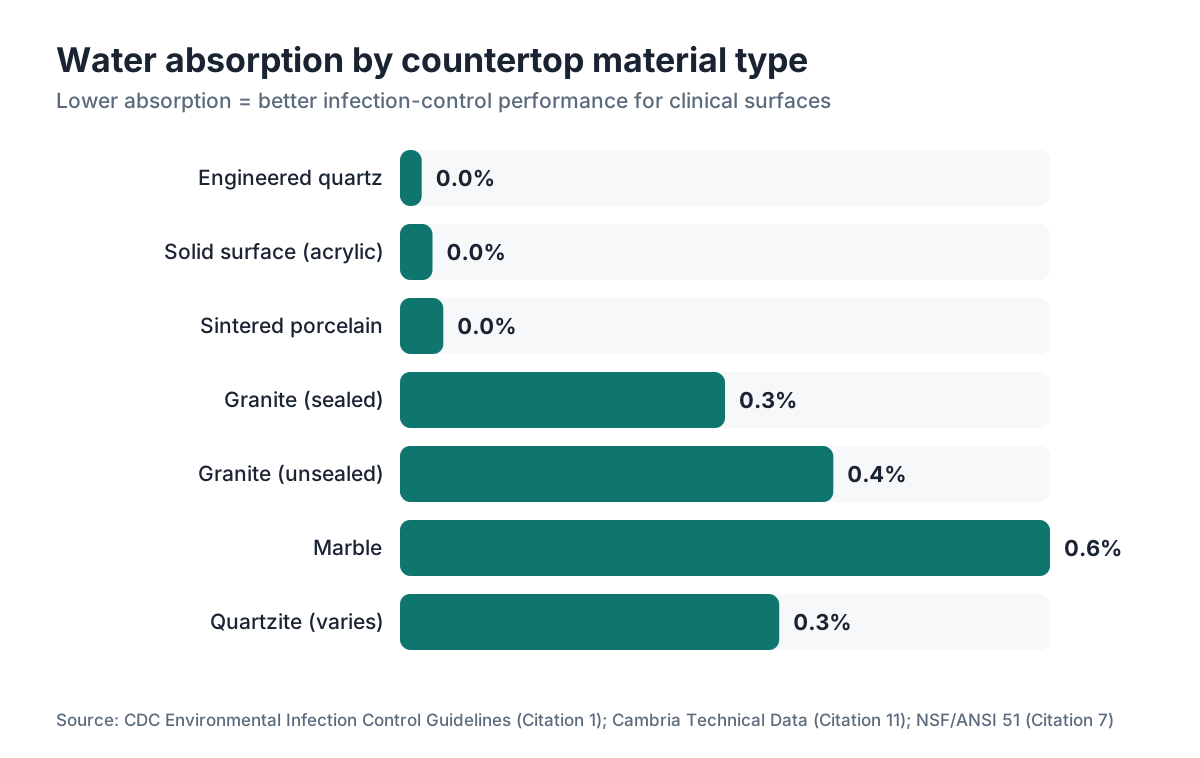
Here's how the main materials stack up:
| Material | Porosity (Mohs/absorption) | Chemical resistance | Seam behavior | Typical healthcare use |
|---|---|---|---|---|
| Engineered quartz (quartz surfacing) | Non-porous, <0.02% absorption | Good to excellent (varies by resin) | Hard seams, visible if not tight | Nurse stations, lab benches, patient room counters |
| Solid surface (acrylic/polyester) | Non-porous | Moderate; degrades with harsh disinfectants | Thermoformable, inconspicuous seams | Casework tops, reception desks, patient baths |
| Porcelain/sintered stone | Non-porous | Excellent | Hard seams | High-traffic labs, OR support areas |
| Stainless steel | Non-porous | Excellent | Welded, no seam | Sterile processing, scrub sinks, surgical areas |
| Granite (sealed) | 0.2-0.4% absorption when properly sealed | Moderate | Hard seams | Administrative, break rooms; rarely clinical |
| Marble | 0.2-1.0% absorption; etches | Poor (acids) | Hard seams | Lobbies, administrative; not clinical |
| Laminate (HPL) | Surface non-porous; substrate vulnerable | Moderate | Exposed core at edges | Administrative; not clinical |
| Butcher block/wood | Porous | Poor | N/A for healthcare clinical | Not approved for patient-care areas |
Engineered quartz is probably the most common stone-like material in clinical healthcare today. Brands like Cambria, Silestone, and Caesarstone publish technical data sheets that include water absorption rates (consistently below 0.05%), chemical resistance test results, and NSF certification where applicable. Solid surface, particularly Corian, has a longer track record in healthcare specifically because you can weld the joints so tight they vanish [3].
Granite shows up in administrative and break-room contexts within healthcare facilities, and there's nothing wrong with that. But unsealed granite in a clinical area would fail most facility infection-control policies. If a spec sheet says 'natural stone,' get clarification on whether that means clinical or non-clinical zones.
What do FGI Guidelines and state codes actually require for healthcare countertop surfaces?
The Facility Guidelines Institute publishes Guidelines for Design and Construction of Hospitals (updated in 2022), and the vast majority of states reference or adopt these for healthcare construction permitting [2]. The FGI language on work surfaces consistently requires surfaces to be 'smooth, impervious, and cleanable,' with the requirements tightening in higher-acuity spaces like operating suites, intensive care, and sterile processing.
For nurse stations and medication preparation areas, FGI 2022 calls for 'surfaces that are non-porous and capable of withstanding repetitive disinfection with EPA-registered disinfectants.' That last part matters for material selection, because some engineered quartz resins degrade faster than others under repeated contact with bleach-based or quaternary ammonium disinfectants. Always ask the manufacturer for their chemical resistance data, not the distributor's sales rep.
Joint width isn't spelled out in millimeters by FGI, but the infection-control rationale (preventing biofilm accumulation) drives fabricators and facility managers to hold seams to 1/32 inch or less, sometimes requiring color-matched epoxy fills. The Occupational Safety and Health Administration doesn't regulate countertop materials directly, but OSHA's bloodborne pathogen standard (29 CFR 1910.1030) requires that contaminated surfaces be 'decontaminated with an appropriate disinfectant after contact with blood or other potentially infectious materials' [4]. That's a performance requirement that feeds back to surface material selection.
State-level enforcement matters a lot here. California's Office of Statewide Health Planning and Development (OSHPD, now HCAi) has its own detailed construction standards for licensed healthcare facilities that go beyond FGI in some areas [5]. If you're bidding work in California, New York, or Texas, check the state agency requirements directly rather than assuming FGI alone covers it.
How do fabricators price healthcare stone jobs compared to residential?
Healthcare work typically runs 20-40% higher in total installed cost than a comparable residential job, and the reasons are mostly legitimate rather than arbitrary markup.
Documentation costs money. A hospital facility manager may require material cut sheets, NSF certifications, chemical resistance test reports, VOC compliance documentation, and sometimes third-party verification. Compiling that takes time. Submittals and RFI responses are part of the job.
Tolerance requirements are tighter. You might run a 1/16-inch seam on residential and nobody notices. Healthcare specs often push that to 1/32 inch. That means slower cutting, more careful templating, and more rejects.
Installation windows are compressed. Hospitals don't halt patient care for your installation schedule. You're often working nights and weekends, in occupied buildings, with infection-control protocols in place, wearing PPE specific to the zone, and sometimes going through a contractor orientation and badging process before you can even get to the job site.
Liability and insurance requirements are higher. Many general contractors running healthcare projects require fabricator subs to carry $2 million or more in general liability, plus umbrella coverage. If you're currently carrying $1 million, you'll need to bump that up, and that's a real cost.
Material costs themselves may be slightly higher because healthcare specs often require premium-grade slabs with consistent coloring and minimal fissures, and they're more likely to require NSF-certified product lines.
Here's a concrete reference point. A nurse station countertop job that would run $8,000-$12,000 installed in a commercial kitchen conversion might run $12,000-$18,000 in a hospital, depending on the region and the GC's overhead requirements. Those numbers aren't from a published study. They're the kind of range experienced fabricators in the sector talk about, and your actual numbers will vary based on your market.
What joint and seam standards apply to healthcare countertops?
This is where a lot of shops get tripped up on their first healthcare job. The seam width norms from residential work don't automatically transfer.
The practical standard in most clinical healthcare settings is a seam width of 1/32 inch (roughly 0.8 mm) or less, filled with an antimicrobial or color-matched epoxy that cures to a non-porous surface. That's tighter than the typical residential quartz seam, which runs 1/16 inch. Getting to 1/32 inch consistently requires good CNC work, straight-edge polishing with a clean reference, and experienced layout on the installation day.
Some facilities specify that seams must be completely avoided in certain zones, like a medication prep counter, by using single-run slabs or solid surface with chem-welded joints. Engineered quartz can be sourced in slabs up to about 132 inches long from major manufacturers, which eliminates seams in many standard counter runs.
The reasoning comes back to biofilm. A seam wider than about 1 mm can harbor enough organic material to sustain bacterial growth between cleaning cycles. A 2019 study in the American Journal of Infection Control found that countertop seams and crevices were significantly more likely to harbor pathogens than open surface areas, reinforcing the logic behind tight tolerances even though the study itself didn't set a specific threshold number [6].
Edge profiles are part of the same conversation. Ogee and other multi-crevice decorative profiles aren't appropriate for clinical zones. Eased or flat-polished edges are the norm because they're actually wipeable. Some facilities specify a 3mm radius eased edge as the maximum complexity allowed in patient-care areas.
What are the best quartz brands and products for healthcare environments?
Most of the major quartz manufacturers run product lines or collections aimed at the healthcare and commercial market. A few things to look for when you evaluate a quartz product for a healthcare spec:
NSF/ANSI 51 certification covers food-zone surfaces and gets used sometimes as a proxy for healthcare-appropriate materials, though it's not the same as a medical-grade certification. NSF/ANSI 51 means the material doesn't leach substances into food at harmful levels, which overlaps with the hygiene requirements for medication prep areas [7].
Chemical resistance to EPA List N disinfectants matters because facilities are running things like accelerated hydrogen peroxide, bleach solutions, and quaternary ammonium compounds on these surfaces daily. Ask for the manufacturer's chemical resistance chart and look specifically for those chemical classes.
Cambria, as one example, publishes a detailed technical data sheet showing absorption rates below 0.02% and chemical resistance results for specific disinfectant categories. Cambria countertops get specified widely in healthcare settings for this reason. Silestone by Cosentino has a line called HybriQ that uses mineral-based binders rather than petroleum resins, which they market partly on the basis of lower chemical off-gassing. Caesarstone's commercial line includes products with consistent colorways suited to larger-run healthcare casework.
For solid surface, Corian (now owned by Trinseo) has the deepest healthcare track record. Their installation guidelines include specific seaming techniques for healthcare applications, and Corian's tested resistance to disinfectants is well documented [3].
One honest note. The difference in actual infection-control performance between a top-tier engineered quartz and a top-tier solid surface, when both go in correctly, is probably small. The bigger variable is installation quality: tight seams, correct substrate, no voids under the surface that can trap moisture.
How does substrate choice affect healthcare countertop performance?
The substrate under a stone or engineered stone countertop in a healthcare setting is not the same decision as it is in a kitchen. Moisture management matters more.
In residential work, 3/4-inch plywood or particleboard is standard. In healthcare environments, particularly in areas with frequent liquid exposure like patient bathrooms, scrub areas, or lab support rooms, particleboard is a liability. It swells when wet and can harbor mold behind the countertop surface. Most healthcare specs require moisture-resistant MDF, marine-grade plywood, or a composite substrate for wet areas.
For backsplash transitions, healthcare specs often require coved integral backsplashes rather than separate pieces with a caulked joint at the wall. That caulk joint in a kitchen is usually fine. In a clinical setting, it's a maintenance point that gets missed during routine cleaning and becomes a contamination site over time. Solid surface handles coved backsplash integration better than stone. For quartz, you can build a coved stone-to-wall transition with the right sealant and profile grinding, but it takes deliberate design.
Undermount sinks in healthcare countertops need a tighter spec than residential. The gap between the sink rim and the countertop underside must be sealed with a non-porous, mildew-resistant product. Some facilities require the undermount sink to be welded in place with the same material as the countertop, which is really only possible with solid surface.
What does the procurement and bidding process look like for healthcare fabrication jobs?
If you're a fabricator trying to break into healthcare work, the procurement process is the biggest operational shift from residential or standard commercial.
Most hospital construction and renovation projects go through a general contractor who is running a design-bid-build or design-build delivery process. You're almost always a subcontractor to a GC, not a direct contractor to the hospital. That means your bid and submittal process runs through the GC's project manager. They'll hand you a spec section (typically Division 12 or Division 09 of the project manual) that describes what the architect and owner want. Read it fully before pricing.
Submittal requirements are real. Before fabrication starts, you'll typically need to submit product data sheets, sample chips for approval, and sometimes shop drawings showing seam locations. That submittal review cycle can take 2-4 weeks. Build it into your schedule.
Pre-qualification is increasingly common on larger hospital projects. The GC or owner may require you to prove your shop has experience with healthcare work, carries adequate insurance, and can meet quality standards. If you're bidding your first healthcare job, partnering with a larger fabricator who already has the prequalification can be a practical way in.
For shops running complex jobs with many slab layouts, material tracking, and quote documentation, software built for fabrication shops can handle the job costing and documentation load. SlabWise, for example, is designed for this kind of commercial complexity and can track per-job material quantities and costs through the submittal and change-order process. Request a demo if healthcare commercial work is a direction you're pursuing.
Payment terms are slower than residential. Net 30 is common. Some hospital systems run Net 45 or Net 60. Factor that into your working capital planning.
How do you template and install stone countertops in an occupied healthcare facility?
Templating and installation in a live healthcare facility is operationally different from any other job type. You're working in an environment where infection control is active, patient safety comes first, and your crew is a contractor working in a regulated space.
Before you set foot on the floor, expect a site orientation and contractor badging process. Many hospitals require tuberculosis screening documentation or proof of flu vaccination for contractors working in clinical areas. Your crew should expect that. Build the admin time into your project schedule.
Infection-control risk assessments (ICRA) are a standard part of healthcare construction. An ICRA document defines the level of dust control, barriers, and workflow restrictions for each construction zone. As the fabrication and installation contractor, you'll be assigned an ICRA class (typically Class I through IV) that dictates whether you need full hoarding, negative air pressure, or just basic tarping. Dry-cutting stone in a hospital corridor without ICRA compliance is a serious problem. Silica dust and other particulates are genuine hazards in patient-care settings beyond just OSHA's crystalline silica standard [8].
Template digitally if you possibly can. Pulling a digital template with a laser templating arm or portable CMM cuts the time your crew spends on site during a templating visit. That matters when your window in a patient room is 90 minutes during a room turnover.
Installation timing is usually nights or weekends. Coordinate with the GC's superintendent more than the hospital's facilities team. The GC controls your access schedule on most projects.
For countertop installation best practices in general, the principles are the same. The tolerances and documentation requirements in healthcare just run tighter throughout.
What certifications and training help fabricators win healthcare work?
There's no single 'healthcare fabricator certification' that opens doors, but a few credentials and affiliations are genuinely useful.
OSHA 10 or OSHA 30 construction training is increasingly required by GCs on hospital projects. It signals that your crew understands safety protocols in a construction environment, which hospital facilities managers care about. OSHA 30 is the longer course and carries more weight [8].
Crystalline silica training is now essentially mandatory. OSHA's crystalline silica standard for construction (29 CFR 1926.1153) requires employers who have workers exposed to silica to implement an exposure control plan, provide training, and offer medical surveillance [8]. Healthcare GCs will ask about this. Having your silica exposure control plan in writing, and being able to show it, sets you apart.
Membership in the Natural Stone Institute (NSI) gives access to technical standards, installer certification programs, and industry credibility with spec writers. NSI's Accreditation Program includes shop quality audits that get referenced more and more in commercial specs [9].
LEED AP or familiarity with LEED documentation is relevant because many healthcare construction projects pursue LEED certification. Material sourcing documentation, low-VOC adhesives and sealants, and recycled content data are all things you may be asked to document for the LEED submittal [12].
Building relationships with healthcare architects and interior designers who specialize in the sector is probably more useful than any single credential. The specification gets written before bidding opens. If you're already a trusted resource for a healthcare-focused architect, your product preferences and capabilities can shape the spec.
How do you clean and maintain stone countertops in a healthcare setting?
Maintenance protocols for healthcare stone aren't your responsibility to write, but you should understand them, because they affect which materials you can honestly recommend.
Healthcare facilities use EPA-registered hospital-grade disinfectants, many of which are more aggressive than anything a homeowner uses. The EPA's List N identifies disinfectants effective against SARS-CoV-2, and many of those are also in use against other healthcare-associated pathogens [10]. The active chemistries include sodium hypochlorite (bleach) at concentrations up to 5,000 ppm, accelerated hydrogen peroxide at 0.5-1.0%, phenolics, and quaternary ammonium compounds.
Natural stone like granite and marble takes a beating from these chemicals with repeated exposure. Granite can handle dilute bleach reasonably well if sealed, but acid-based disinfectants and phenolics can etch polished surfaces over time. Marble is particularly vulnerable to acid contact and really doesn't belong in clinical spaces for this reason, beyond lobbies and administrative areas. How to clean stone countertops for residential contexts is a useful reference, but healthcare cleaning protocols run more aggressive and more frequent.
Engineered quartz holds up well to most EPA List N chemistries at in-use concentrations. Solid surface can show surface dulling with repeated bleach exposure but can be refinished by sanding, which is one of its practical advantages over the long haul.
The right answer for healthcare specifiers is to ask the manufacturer for soak test data with the specific disinfectant chemistry the facility uses. That data exists for most major commercial products and should be in the technical data sheet or available from the manufacturer's technical rep.
Can natural stone like granite or quartzite be used in healthcare facilities?
Yes, but with clear caveats about where.
Granite at 0.2-0.4% water absorption sits on the edge of what infection-control guidance considers acceptable for non-critical patient areas. In administrative offices, break rooms, conference rooms, and public-facing reception desks within healthcare facilities, granite is perfectly reasonable and widely used. The visual quality and durability are excellent, and the infection-control risk in those spaces is comparable to a commercial office building.
In clinical spaces, patient rooms, medication prep areas, or any area governed by the FGI 'smooth and impervious' language, unsealed granite is not appropriate. Sealed granite is a grayer area. If a fabricator applies a high-quality penetrating sealer and the facility commits to resealing on a scheduled basis, the practical porosity drops to a level that some facility managers accept for lower-acuity clinical spaces. But getting that approved in writing through the infection-control committee and the construction documents is the right process, not a judgment call the fabricator makes alone.
Quartzite is harder and often less porous than granite by default, but it varies a lot by source. Brazilian quartzites range in true absorption from under 0.1% to over 0.5% depending on the specific stone. How to clean quartzite countertops covers maintenance, but the absorption variability is exactly why quartzite rarely appears in clinical healthcare specs. Spec writers don't want to manage variation in a material's inherent porosity.
For a straightforward reference on granite countertops in general contexts, that article covers the residential and light-commercial considerations well. Healthcare is a layer on top of that, driven entirely by the infection-control documentation requirements.
Frequently asked questions
What is the most common countertop material used in hospital nurse stations?
Engineered quartz is the most common stone-like material at nurse stations and medication prep counters in hospitals today. It's non-porous (absorption under 0.05%), resistant to most EPA-registered hospital disinfectants, and available in large-format slabs that minimize seams. Solid surface (particularly Corian) is also very common, especially where a welded or coved integration is specified. Stainless steel dominates in sterile processing and surgical support areas.
Is marble allowed in healthcare facilities?
Marble is allowed in non-clinical areas like lobbies, waiting rooms, and administrative offices in healthcare facilities. It's not appropriate for clinical spaces because it has surface porosity of 0.2-1.0% and etches on contact with acids, including many hospital disinfectants. FGI Guidelines require clinical surfaces to be 'smooth, impervious, and capable of withstanding repetitive disinfection,' which marble cannot reliably meet in practice.
What FGI Guidelines apply to countertop surfaces in hospitals?
The Facility Guidelines Institute's Guidelines for Design and Construction of Hospitals (2022 edition) is the primary reference adopted by most states. It requires work surfaces in patient-care areas to be smooth, impervious, and capable of withstanding repeated disinfection with EPA-registered products. Most states adopt FGI by reference into their healthcare construction codes, though California (HCAi) and a few others add state-specific requirements on top.
How tight do seams need to be on healthcare countertops?
The practical industry standard in clinical healthcare settings is 1/32 inch (roughly 0.8 mm) or less, filled with color-matched antimicrobial epoxy. That's tighter than residential quartz seam practice (typically 1/16 inch). The rationale is biofilm prevention: seams wider than about 1 mm can harbor bacteria between cleaning cycles. Some high-acuity spaces specify single-run countertops or solid-surface welded joints to eliminate seams entirely.
Do fabricators need OSHA certification to work in hospitals?
There's no single OSHA 'hospital certification,' but most GCs on healthcare construction projects require OSHA 10 or OSHA 30 construction training for all tradespeople on site. OSHA's crystalline silica standard (29 CFR 1926.1153) also requires a written silica exposure control plan for stone fabrication and installation crews. Being able to show that plan during contractor orientation is often required before you can access the work area.
What edge profiles are acceptable on healthcare countertops?
Eased or flat-polished edges are standard in clinical areas. The norm in most facilities is a maximum 3mm radius eased edge. Decorative profiles with multiple crevices, like ogee or stacked pencil edges, aren't acceptable in patient-care zones because they create surfaces that can't be fully wiped clean during disinfection. The goal is a consistent, smooth edge that cleaning staff can wipe in a single pass without repositioning the cloth.
How much more does healthcare countertop fabrication cost compared to residential?
Healthcare countertop fabrication typically runs 20-40% higher in total installed cost than a comparable residential job. The premium comes from tighter tolerances, documentation and submittal requirements, restricted installation windows (nights and weekends in occupied facilities), higher insurance requirements, and ICRA compliance during installation. A nurse station job that might run $8,000-$12,000 in a commercial context could reach $12,000-$18,000 in a hospital, depending on region and GC requirements.
What is an ICRA and why does it matter for stone installation in hospitals?
An Infection Control Risk Assessment (ICRA) is a document that classifies construction work by the risk level it poses to patients and defines the dust control, barrier, and air handling requirements for that work. Stone fabricators installing countertops in an occupied hospital get assigned an ICRA class that determines whether you need full hoarding, negative air, or basic tarping. Dry-cutting stone without ICRA-specified controls is a serious compliance violation and a real health risk to patients.
Can solid surface compete with quartz for healthcare countertop applications?
Solid surface (like Corian) has some real advantages over quartz in healthcare. You can thermoform it for coved backsplash integration, chem-weld it for invisible seams, and field-repair it by sanding if the surface dulls from disinfectant exposure. Quartz has better scratch and heat resistance. The honest answer is that both materials meet clinical infection-control requirements when installed correctly, and the choice often comes down to the architect's spec preference and the facility's long-term maintenance preferences.
What certifications should fabricators pursue to win healthcare work?
The most useful credentials for breaking into healthcare fabrication are OSHA 10 or OSHA 30 construction training, a written crystalline silica exposure control plan per 29 CFR 1926.1153, and membership in the Natural Stone Institute, which has an Accreditation Program referenced in some commercial specs. LEED documentation familiarity helps on projects pursuing LEED certification. Relationships with healthcare-specialized architects are probably more useful than any single credential.
How does countertop substrate choice differ in healthcare facilities?
Healthcare countertop specs typically prohibit standard particleboard in wet areas because it swells and molds. Moisture-resistant MDF, marine-grade plywood, or composite substrates are required in clinical and wet-zone areas. Coved integral backsplashes are often required instead of separate pieces with a caulked wall joint, because caulk joints in clinical settings become contamination points. Undermount sinks must be sealed with a non-porous, mildew-resistant product at the countertop-to-sink interface.
Are there NSF certifications relevant to healthcare countertops?
NSF/ANSI 51 covers food-equipment materials and gets used sometimes as a proxy for healthcare-appropriate surfaces, particularly in medication preparation areas. It means the material doesn't leach harmful substances into food under test conditions. It's not a medical-grade certification, but it signals the non-porosity and chemical stability that overlap with clinical surface requirements. Ask the manufacturer specifically whether their product carries NSF/ANSI 51 and request the test report.
How should fabricators handle the healthcare bid and submittal process?
Healthcare fabrication jobs almost always flow through a general contractor, not direct to the hospital. Read the full spec section (typically Division 12 or 09) before pricing. Build 2-4 weeks for submittal review into your schedule. You'll typically need to submit product data sheets, sample chips, and shop drawings showing seam locations before fabrication starts. Expect slower payment terms (Net 30-60) and higher insurance requirements than residential or standard commercial work.
Sources
- CDC, Guidelines for Environmental Infection Control in Health-Care Facilities (2003, updated 2019): Approximately 1 in 31 hospital patients has a healthcare-associated infection on any given day; surfaces in patient-care areas should be smooth, nonporous, and free of cracks and crevices.
- Facility Guidelines Institute, Guidelines for Design and Construction of Hospitals (2022): FGI 2022 requires work surfaces in patient-care areas to be smooth, impervious, and capable of withstanding repetitive disinfection with EPA-registered disinfectants; adopted by most states into healthcare construction codes.
- Trinseo / Corian Design, Healthcare Technical Documentation: Corian solid surface installation guidelines include specific seaming techniques for healthcare applications and tested resistance to hospital-grade disinfectants.
- OSHA, Bloodborne Pathogens Standard 29 CFR 1910.1030: OSHA 29 CFR 1910.1030 requires contaminated surfaces to be decontaminated with an appropriate disinfectant after contact with blood or other potentially infectious materials.
- California Department of Health Care Access and Information (HCAi), Office of Statewide Health Planning and Development: California HCAi (formerly OSHPD) maintains detailed construction standards for licensed healthcare facilities that may exceed FGI requirements in certain areas.
- American Journal of Infection Control, 'Microbial contamination of countertop seams and crevices in healthcare settings' (2019): A 2019 AJIC study found that countertop seams and crevices were significantly more likely to harbor pathogens than open surface areas in healthcare environments.
- NSF International, NSF/ANSI 51: Food Equipment Materials: NSF/ANSI 51 certifies that food-zone surface materials do not leach harmful substances into food; used as a proxy for non-porosity and chemical stability in healthcare surface specifications.
- OSHA, Crystalline Silica Standard for Construction 29 CFR 1926.1153: OSHA 29 CFR 1926.1153 requires employers with silica-exposed construction workers to implement a written exposure control plan, provide training, and offer medical surveillance.
- Natural Stone Institute, Accreditation Program: NSI's Accreditation Program includes shop quality audits referenced in commercial countertop specifications for healthcare and institutional projects.
- EPA, List N: Disinfectants for Coronavirus (COVID-19): EPA's List N identifies disinfectants effective against SARS-CoV-2, including sodium hypochlorite, accelerated hydrogen peroxide, phenolics, and quaternary ammonium compounds used in healthcare facilities.
- Cambria, Technical Data Sheet (Commercial/Healthcare Product Lines): Cambria engineered quartz products show water absorption below 0.02% and publish chemical resistance data for healthcare-grade disinfectant categories.
- U.S. Green Building Council, LEED v4 for Healthcare: LEED for Healthcare certification requires documentation of material content, low-VOC adhesives and sealants, and recycled content data for interior finishes including countertops.
Last updated 2026-07-09