TL;DR
- Houston has one of the densest clusters of granite slab distributors in the country, thanks to port access and a huge fabrication industry.
- Homeowners can buy slabs direct starting around $10, $40 per square foot for raw stone, while full installed costs run $40, $200 per square foot depending on material and edge work.
- This guide covers how distributors operate, where to find them, and how to avoid overpaying.
Why does Houston have so many granite slab distributors?
Houston sits at a geographic sweet spot. The Port of Houston is one of the busiest in the country by tonnage, and a large share of imported natural stone, including granite, quartzite, and marble, enters the U.S. through Texas ports [1]. That proximity cuts shipping cost hard compared to markets deep in the interior, which is why the metro has grown a dense cluster of stone distributors, importers, and fabricators along corridors like the Beltway 8 industrial zone and northwest Houston.
The region also builds a lot of houses. The Greater Houston area issued over 50,000 new single-family building permits in 2023, ranking it consistently among the top metros in the country for new home construction [2]. That volume creates steady demand for countertop stone, which keeps distributors competitive and inventories deep.
So if you're a homeowner chasing a good deal, or a fabricator sourcing material, you're in one of the best markets in the country for it. Competition here is real, and it works in your favor.
What is a granite slab distributor and how are they different from a retailer or fabricator?
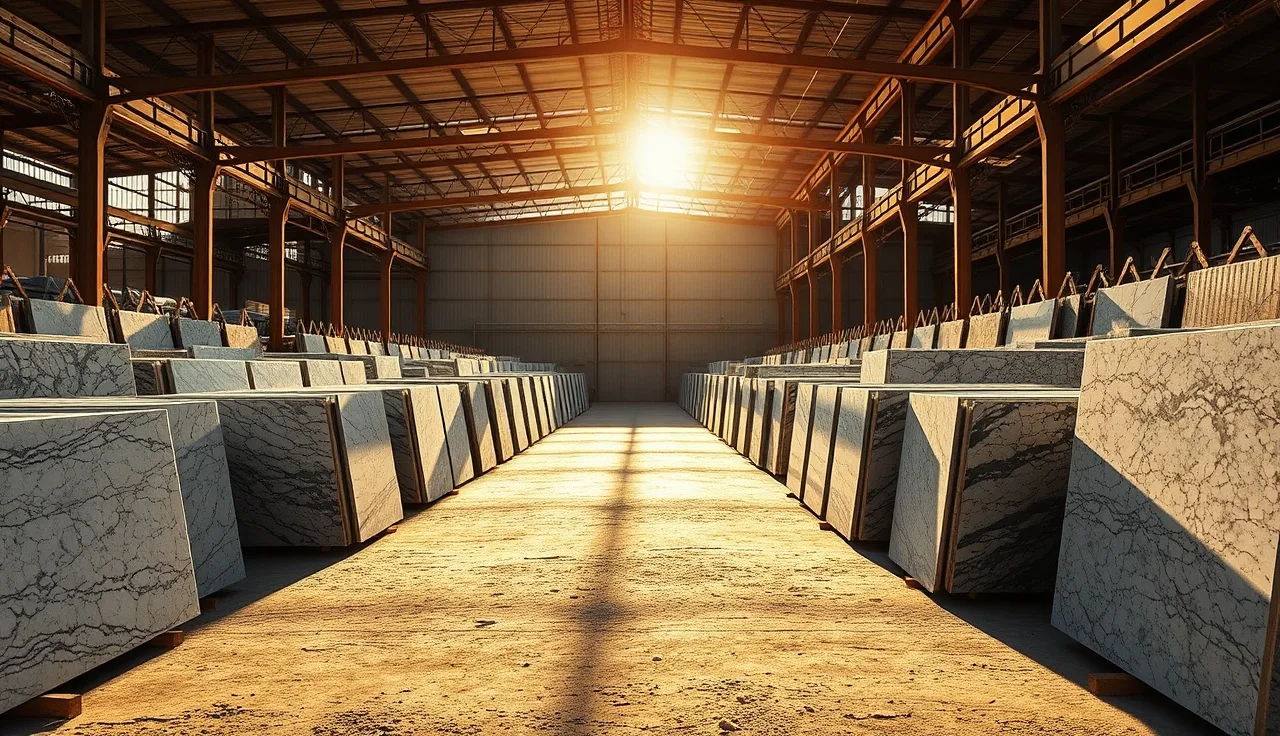
A distributor buys stone in bulk from quarries or importers, usually in container loads, and sells slabs wholesale to fabricators and sometimes straight to the public. They don't cut the stone. They store it in a large warehouse or yard, often called a slab yard, and you walk through to pick the exact slab you want.
A retailer, by contrast, carries finished or semi-finished product and marks it up. A fabricator cuts, edges, and installs the countertops but often sources slabs from a distributor rather than importing stone.
The chain matters because it decides who adds margin at each step. Buy from a distributor directly, then bring your own fabricator, and you can sometimes save money. You also take on the coordination burden. Most homeowners skip this route because it's more work, but it's good to know the option exists. Many Houston distributors sell to the public as long as you're buying a full slab, and some sell remnants too.
What does granite cost at a Houston distributor versus a big-box store?
Raw slab pricing at a Houston distributor runs $10, $40 per square foot for standard granite (think mid-tier colors like Giallo Ornamental or Uba Tuba), and climbs to $80, $150 per square foot for exotic granites or rare quartzites [3]. Those numbers are for the stone alone, unmachined.
Big-box stores like Home Depot or Lowes quote installed prices for their countertop programs, which bundle measurement, fabrication, and basic installation. Advertised starting prices often begin around $35, $45 per square foot installed, but the stone selection is narrow and comes from contracted fabricators who limit your slab choices to their catalog.
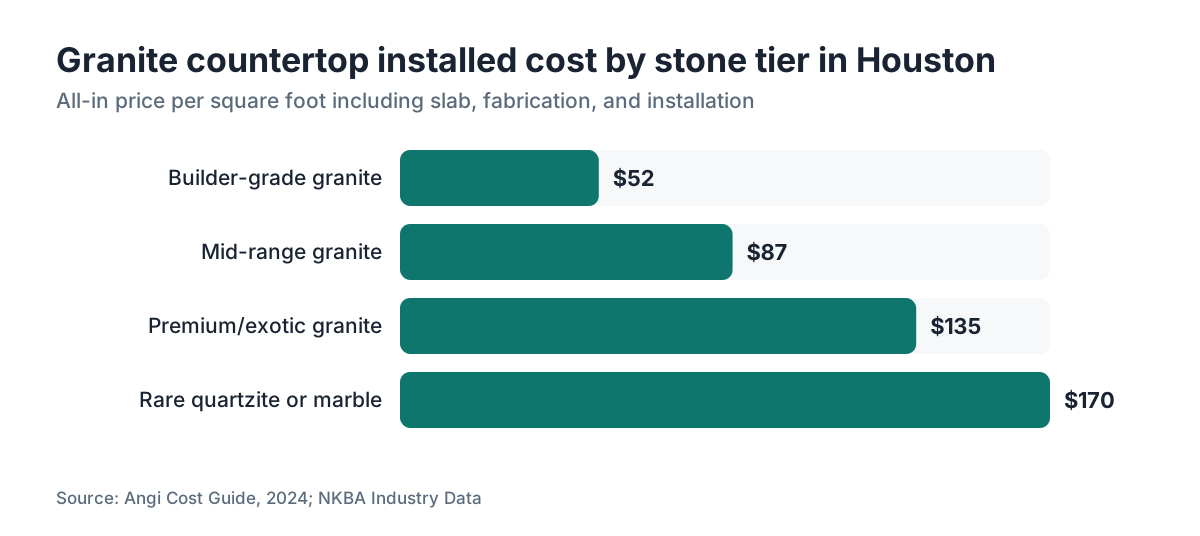
Add a local fabricator working with Houston distributor stone and full installed costs spread out. The table below shows realistic all-in estimates by stone tier.
| Stone tier | Slab cost (raw, per sq ft) | Installed total (per sq ft, est.) |
|---|---|---|
| Builder-grade granite | $10, $18 | $40, $65 |
| Mid-range granite | $18, $35 | $65, $110 |
| Premium/exotic granite | $35, $80 | $110, $160 |
| Rare quartzite or marble | $60, $150+ | $140, $200+ |
These ranges come from industry pricing surveys and fabricator cost reports [3][4]. Your real number depends on edge profile, cutouts (sinks, cooktops), overhang depth, and whether the job needs seaming.
One thing Houston homeowners should know: the slab yard price is negotiable more often than people expect, especially at the end of a quarter or when a slab has sat in inventory a long time. Ask. The worst they say is no.
How do you find and vet a granite slab distributor in Houston?
Start with Google Maps searches for "stone slab yard Houston" or "granite distributor Houston TX" and look for locations along Highway 290, FM 1960, and the northwest industrial corridors where most stone businesses cluster. Yelp and the Better Business Bureau [5] help with complaints, but the best vetting is showing up in person.
When you walk a slab yard, look for a few things. First, is the inventory labeled clearly with origin, finish type (polished, honed, leathered), and price per square foot? Any distributor serious about the business labels slabs properly. Second, how do they store the stone? Slabs should stand vertically in A-frame racks, not lay flat where they can crack under their own weight. Third, ask for references from local fabricators who buy from them. A good distributor has relationships with fabricators who will vouch for them.
For fabricators sourcing stone, the relationship goes beyond price. A distributor who holds a slab for you two to three weeks while you confirm a job, pull your template, and schedule the cut is worth more than one who is $2 per square foot cheaper but sells to whoever walks in first.
Check that any distributor you work with has a valid Texas sales tax permit if you're claiming a resale exemption. The Texas Comptroller's office lets fabricators buy materials for resale without paying sales tax, but you need the Form 01-339 resale certificate in place [6].
Can homeowners buy directly from a granite distributor in Houston?
Yes, many can and do. Most Houston stone distributors sell slabs to the public, especially if you're buying at least one full slab. Some set minimum purchase requirements or charge a higher per-square-foot price for retail customers than for trade accounts, but the markup is usually modest.
The catch is that you still need a fabricator to cut, finish, and install the stone. Buying the slab yourself and bringing it to a fabricator is called a "customer-supplied material" job, and not every fabricator will take it. Those who do may charge a higher fabrication rate because they don't capture margin on the material. Some won't warrant the finished countertop as fully as they would if they sourced the stone themselves.
Still, if you have a specific exotic slab in mind, something you saw at a yard and fell for, buying it yourself and then finding a fabricator willing to work with it can get you that exact stone. Just be ready to manage the logistics.
Remnants are another route. Distributors and fabricators both pile up offcut pieces from larger slabs. A remnant 30 by 60 inches covers a bathroom vanity, a laundry room folding counter, or a small island. Remnant pricing at Houston yards often runs $50, $200 for a piece, flat, not per square foot, which makes them a steal [4].
What granite colors and origins are most common at Houston distributors?
Brazil supplies the largest share of granite to the Houston market. Brazilian granites like Bianco Antico, Venetian Gold, and Absolute Black dominate mid-range and commercial work because Brazilian quarries are prolific and have long export relationships with Texas importers [1].
India is the second major source, especially for uniform-grained blacks and greens. Absolute Black from India (also called Jet Black or Galaxy Black depending on the quarry) is one of the most commonly stocked slabs in any Houston yard and runs on the lower end of the price range.
Norway exports Blue Pearl, a labradorite-rich granite with a silver-blue shimmer that stays popular in Houston kitchen remodels. China supplies various granites for commercial and builder-grade work.
For granite countertops in general, origin matters because it affects mineral density, porosity, and how the stone handles fabrication. A high-mica Brazilian granite like Giallo Ornamental is softer than an Indian black, which changes how long saw blades and polishing wheels last and, indirectly, what a fabricator charges to cut it.
You'll also find quartzite slabs at most Houston granite distributors, sometimes labeled and sometimes not. Ask specifically what you're looking at, because quartzite, marble, and some engineered stone get mixed together in yards and the care requirements are very different. See the guide on how to clean stone countertops if you're sorting out maintenance for different stone types.
How does the quoting and ordering process work with a Houston distributor?
The process has a few steps that catch people off guard the first time.
First, you or your fabricator visits the yard and picks the specific slab (or slabs, if seaming is needed). The slab gets tagged with your name and a hold period starts. Most Houston distributors hold slabs 5 to 14 days before releasing them back to general inventory, though trade accounts often get longer holds.
Second, your fabricator takes a template of the countertop space, either with a physical template kit or, more commonly now, with a digital laser templating device. The template determines exactly how the slab gets cut.
Third, the fabricator gives you a quote for fabrication and installation. This quote should itemize the slab cost (if they're sourcing it), the per-linear-foot or per-job fabrication charge, edge profile cost, sink cutout charges, and installation labor. If you supply the slab yourself, the quote covers fabrication and install only.
Fabricators who want to speed this up use quoting software like SlabWise to connect slab inventory to job quotes, so you're not manually recalculating material cost every time stone prices shift. That matters in a market like Houston where slab cost moves month to month with import volumes.
Fourth, once the job is confirmed, the distributor delivers the slab to the fabricator's shop, or the fabricator picks it up. The fabricator cuts, polishes edges, and installs. Most Houston residential jobs run 2 to 4 weeks from contract to installation, though high-demand periods (spring renovation season) stretch that to 6 weeks or more.
What should homeowners watch out for when buying granite in Houston?
The biggest issue in any slab market is bait-and-switch on stone grade. A yard shows you a gorgeous A-grade slab in the showroom, quotes a price, and then the slab that shows up at the fabricator is a B-grade piece with more movement, color variation, or veining than what you picked. This happens more with high-volume distributors running thin margins.
The fix is simple: mark your slab yourself. Use a felt-tip wax marker (soapstone markers work) to write your name, date, and a check mark on a corner when you select it. Take photos with a tape measure visible. Some buyers go further and watch the loading at the yard.
Second issue is seam placement. If your countertop needs a seam (most runs over about 9 to 10 feet do, since standard slabs max out around 10.5 feet long), your fabricator should show you on the layout exactly where the seam falls. A seam in the middle of a primary workspace is bad. A seam near a sink or behind an appliance is fine.
Third, Texas has no mandatory licensing for granite fabricators or countertop installers [7]. Anyone can hang a sign. Verify the fabricator carries general liability insurance (ask for a certificate of insurance naming you as certificate holder on the job) and check that they pull a permit if the job involves any plumbing disconnection, which the Houston city code may require depending on scope [8].
Finally, watch for "installed price" quotes that leave out removal of old countertops or haul-away. That's a common add-on that shows up after you've committed.
Are there differences between buying from a distributor, an importer, and a stone broker in Houston?
Yes, and the differences matter for both price and risk.
A distributor holds physical inventory in Houston. You can walk the yard, see and touch the slabs, and buy knowing the stone exists and is in the condition you see. The price covers their cost to import, store, and sell, plus margin.
An importer sits further upstream. They bring stone in from quarries directly, usually in container quantities, and either sell to distributors or sell direct in pallet and container minimums. If you're a fabricator buying at that volume (think 20+ slabs of a single material at a time), going direct to an importer cuts cost a lot. Most homeowners can't buy this way.
A stone broker holds no inventory. They connect buyers to suppliers and earn a commission or markup on the transaction. Brokers can find stone that isn't stocked locally, but you're buying without seeing the exact material, which carries risk. If you go this route, insist on a sample and get the quarry lot number written into the contract so the material you receive matches what was quoted.
For most Houston homeowners, a reputable local distributor is the right call. For fabricators running high volume, a relationship with both a distributor for standard stock and an importer for project-specific material gives you the best of both worlds.
How does Houston compare to other Texas cities for granite pricing and availability?
Houston generally has better pricing and deeper inventory than Dallas, San Antonio, or Austin, mostly because of port access [1]. Dallas distributors have to truck stone from Houston or import through other ports, which adds freight cost. That freight difference can run $3, $8 per square foot on heavier slabs.
Austin's market is smaller with fewer distributors, so there's less competition and higher retail prices for the same material. San Antonio sits between the two on geography and pricing.
For a fabricator in Austin or San Antonio buying serious volume, it can pay to drive to Houston, pick stone in person at a yard, and pay freight back, still coming out ahead. Several Austin fabricators do exactly this for premium or hard-to-source material.
For homeowners in the greater Houston metro (including Sugar Land, The Woodlands, Katy, Pearland, and Pasadena), you're in the best geographic spot in the state. Drive time to major slab yards is manageable from almost anywhere in the metro, and the competition keeps prices honest.
What questions should you ask a Houston granite distributor before buying?
Walk in with these questions ready.
One: Is this slab in stock and available now, or on order? Some yards display samples of stone that isn't physically on-site.
Two: What are the slab dimensions and square footage? You need this to know if one slab covers your job or if you'll need a second slab (and whether the second slab will match closely enough).
Three: What country and region did this granite come from, and what quarry lot? Lot matters for color consistency across slabs.
Four: Is this stone finished (polished, honed, or leathered), and can it be refinished to a different surface if I want?
Five: What is the hold policy? How long will you hold my slab after I commit, and what do I need to put down to hold it?
Six: Do you sell to the public, or must I have a fabricator account? If the latter, who are some fabricators you work with that I could contact?
Seven: Is there any cracking, pitting, or fill on this slab? Turn the slab edge toward a light source and look for epoxy fills or hairline cracks, which are common and not necessarily disqualifying but should be disclosed.
For countertop installation logistics, also ask whether the distributor delivers to fabricator shops or if the fabricator must pick up, since that affects scheduling and cost.
For fabricators: how do you build a strong distributor relationship in Houston?
Pay on time, always. Distributors track payment history closely, and a fabricator with a clean record gets first call when a rare slab comes in, gets longer holds, and sometimes gets pricing breaks on volume orders.
Open a trade account with two or three distributors, more than one. Having multiple sources means you can fill a job when your primary yard is out of the material you need, and it gives you room to negotiate.
Tell them what's coming. If you know you'll need six slabs of Calacatta quartzite for a project in eight weeks, say so now so they can source it. Distributors who know your pipeline plan inventory around you, which helps both sides.
Some Houston fabricators have moved to digital quoting tools that connect slab inventory to project quotes in real time. When a distributor updates pricing or restocks a material, the fabricator sees it immediately and quotes more accurately. SlabWise is one platform built for this workflow, letting fabricators manage quotes, nesting, and material cost without spreadsheets. If you're running more than a handful of jobs a month, the time savings are real.
For kitchen countertops projects specifically, consider building a showroom relationship with two or three of your best distributors so clients can visit their yards with your recommendation. When clients pick their own slab in person, they're happier with the final product and you have fewer scope disputes.
Frequently asked questions
Where are granite slab distributors located in Houston?
Most Houston granite distributors cluster in the northwest industrial corridors, particularly around Highway 290 and Beltway 8, and in the northwest quadrant near FM 1960. A Google Maps search for "stone slab yard Houston" or "granite distributor Houston TX" shows current locations with reviews. Visiting in person is the best way to vet a yard before committing to a purchase.
Can I go directly to a distributor to pick my own granite slab?
Yes. Most Houston distributors sell to the public, especially for full-slab purchases. Some charge a slightly higher per-square-foot price to retail customers than to trade accounts. You'll still need a fabricator to cut and install the stone, and not all fabricators accept customer-supplied material, so confirm that arrangement before buying the slab.
What is the average cost of granite countertops in Houston?
Raw slab pricing at Houston distributors runs roughly $10, $40 per square foot for standard granite and $35, $150 per square foot for premium or exotic material. All-in installed costs (stone, fabrication, and installation) typically fall between $40 and $200 per square foot depending on stone tier, edge complexity, and number of cutouts. Builder-grade granite jobs often land closer to $40, $65 per square foot installed.
Is it cheaper to buy granite in Houston than other Texas cities?
Generally yes. Houston's port access reduces freight cost compared to landlocked markets like Dallas or Austin, where stone must be trucked inland. That logistics advantage typically translates to $3, $8 per square foot lower raw slab prices. Houston also has more competing distributors, which keeps pricing sharper across the board.
What is the difference between granite and quartzite, and does it matter at a Houston slab yard?
Granite is an igneous rock with interlocking mineral crystals; quartzite is a metamorphic rock, typically harder and often with flowing veining similar to marble. Both sell at Houston slab yards, sometimes mislabeled. Quartzite is usually harder and less porous than many granites. Ask specifically what you're looking at and request the material name and origin country so you can verify independently.
Do Houston granite distributors sell remnants?
Many do. Remnants are offcuts from larger slabs, typically pieces from about 12 by 24 inches up to 36 by 72 inches. They're priced as flat amounts rather than per square foot, often running $50, $200 per piece. Remnants are excellent for bathroom vanities, laundry rooms, or small kitchen sections, and they're one of the best ways to get premium stone at a fraction of the full slab cost.
How long does it take to get granite countertops installed in Houston?
From contract signing to installation, most Houston residential granite jobs take 2 to 4 weeks. That covers slab hold and confirmation, template measurement (usually scheduled 1 to 3 days after contract), fabrication (typically 3 to 7 business days in shop), and installation scheduling. During high-demand periods like spring renovation season, timelines can stretch to 5 to 6 weeks. Ask your fabricator for a written timeline before signing.
Do I need a permit to replace countertops in Houston?
A countertop swap that doesn't move any plumbing or structural elements generally doesn't require a permit under the City of Houston's building code. However, if the project involves disconnecting or relocating plumbing connections (like moving a sink location), a permit and licensed plumber may be required. When in doubt, check with the City of Houston's permitting department directly, since requirements can change.
Are granite fabricators in Houston licensed by the state?
Texas has no mandatory state license specifically for stone fabricators or countertop installers. Anyone can legally operate as a fabricator in Texas. That makes insurance verification more important: always ask for a certificate of general liability insurance from any fabricator before signing a contract, and check reviews and references carefully.
How can fabricators get a resale exemption when buying granite from a Houston distributor?
Texas allows fabricators to purchase materials for resale without paying sales tax. You provide the distributor with a completed Texas Sales and Use Tax Resale Certificate (Form 01-339) at the time of purchase. The exemption applies when the stone will be incorporated into a finished product sold to the end customer. The Texas Comptroller's office publishes the form and guidance at its official site.
What edge profiles are most popular for granite countertops in Houston, and do they cost extra?
Eased (slightly softened square) and beveled edges are the most common for mid-range jobs because they're included in most fabricators' base pricing. Bullnose, ogee, and waterfall edges add cost, typically $10, $20 per linear foot above the base fabrication price for standard profiles, and more for complex compound profiles. Ask your fabricator to show you physical edge samples, more than photos, before deciding.
What is the best way to compare granite distributor prices in Houston?
Visit at least three yards in person and compare slabs of similar origin, thickness (2cm vs. 3cm), and finish for the same price point. Ask each yard for pricing on a specific named material (for example, "3cm Bianco Antico polished") so you're comparing apples to apples. Get quotes in writing. Online price lists exist but are often outdated; distributor pricing moves with import costs and inventory levels.
How thick should granite countertops be?
Residential countertops are most commonly 3cm (about 1.25 inches) thick. This thickness doesn't need a plywood substrate and handles typical kitchen loading without cracking. Older homes sometimes have 2cm stone, which needs full plywood underlayment support. The 3cm premium over 2cm is usually $5, $15 per square foot for the slab itself. Most Houston distributors stock primarily 3cm for residential material.
Sources
- Port of Houston Authority, official homepage: Port of Houston is one of the busiest U.S. ports by tonnage and a major entry point for imported natural stone including granite from Brazil and India
- U.S. Census Bureau, New Residential Construction (Building Permits): Greater Houston area issued over 50,000 new single-family building permits in 2023, consistently ranking among top U.S. metros for new home construction
- HomeAdvisor (Angi), Granite Countertop Cost Guide: Granite countertop installed costs nationally range from roughly $40 to $200 per square foot depending on stone grade; raw slab pricing ranges from $10 to $150+ per square foot
- National Kitchen and Bath Association (NKBA), Cost vs. Value and Industry Data: Remnant slab pricing and fabrication cost benchmarks for residential countertop projects in U.S. metro markets
- Better Business Bureau, Houston and South Texas: BBB complaint history for local stone distributors and fabricators available for public review
- Texas Comptroller of Public Accounts, Sales and Use Tax Forms: Texas Form 01-339 Sales and Use Tax Resale Certificate allows fabricators to purchase stone materials for resale exempt from sales tax
- Texas Department of Licensing and Regulation: Texas does not require a mandatory state license specifically for granite fabricators or countertop installers; licensing requirements that exist are trade-specific (electrician, plumber, HVAC)
- City of Houston, Development Services / Permitting: Houston building permit requirements for residential remodels; plumbing permit required when moving or relocating plumbing connections
- Marble Institute of America (now Marble, Granite, and Quartz Industry / MGQI): Industry standards for slab storage (vertical A-frame racks), thickness specifications (2cm and 3cm), and fabrication best practices
Last updated 2026-07-09