TL;DR
- Entry-level quartz countertops run $50 to $75 per square foot installed for basic colors from brands like Silestone, MSI, or IKEA's Kasker line.
- That price climbs to $150 or more for premium patterns.
- The cheapest options are solid whites, grays, or blacks with simple edges and few cutouts.
- A standard 30-square-foot kitchen costs $1,500 to $2,250 at the low end.
What do the cheapest quartz countertops actually cost?
Entry-level quartz runs $50 to $75 per square foot fully installed. That price covers the slab material, fabrication, edge profile, and basic installation. Material alone, before any shop touches it, runs roughly $20 to $40 per square foot for budget-tier product. The rest goes to cutting, polishing, and labor.
A typical kitchen with 30 square feet of counter lands at $1,500 to $2,250 on the low end. Bathrooms with small vanities can come in under $500 if the slab piece is under 10 square feet, though most fabricators charge a minimum job fee, often $300 to $500, no matter how small the job is.
Those numbers assume a simple layout: a few straight runs, one sink cutout, and a standard eased or beveled edge. Add a waterfall edge, an L-shaped peninsula, a cooktop cutout, or a radius corner and the price jumps. Fabricators charge those extras separately, usually $50 to $200 per linear foot for specialty edges and $100 to $300 per cutout depending on complexity.
Home improvement data from Angi (formerly Angie's List) puts the national average for quartz installation at roughly $55 to $145 per square foot across all tiers [1]. That matches what fabricators in the Midwest and South quote. Coastal markets run 20 to 40 percent higher because labor and overhead cost more there.
Which quartz brands have the lowest prices?
Brand drives a lot of the price, and the pecking order is clear. MSI Quartz is the cheapest widely available brand you can trust.
MSI Quartz (often sold as MSI Q, alongside Vicostone through distributors) is consistently the most affordable brand you'll find in most markets. Its entry-line solid colors wholesale around $12 to $18 per square foot, and fabricators pass that low material cost through. You'll see MSI product at Dal-Tile, Floor & Decor, and regional stone distributors nationwide.
IKEA's Kasker quartz line is another genuinely cheap option if you can live with IKEA's measurement and installation system. IKEA quotes custom Kasker pieces by the running foot, and simple layouts can land under $60 per square foot installed through their network [2]. Lead times are long and the edge selection is thin.
Silestone, owned by Cosentino, markets itself as premium but keeps a budget tier and entry-level color groups that wholesalers move at lower margins. A high-volume dealer can sometimes get you Silestone at near-MSI prices.
Hanstone and Caesarstone both offer entry-level collections in the $25 to $35 per square foot material range. Cambria sits at the far end. It's made in the USA and priced accordingly, with material alone starting around $40 to $60 per square foot. If price is your main driver, Cambria countertops are not where you start.
Chinese-made quartz sold under house brands at floor covering chains can go lower still, sometimes $15 to $20 per square foot in material. Quality control is inconsistent and warranty support is limited. That's a real trade-off, not a hidden gem.
| Brand | Approx. material cost/sq ft | Budget tier available? |
|---|---|---|
| MSI Quartz | $12, $22 | Yes |
| IKEA Kasker | ~$15, $25 | Yes |
| Hanstone | $20, $35 | Yes |
| Silestone | $25, $45 | Yes (entry lines) |
| Caesarstone | $25, $45 | Yes (entry lines) |
| Cambria | $40, $65 | No |
| House-brand Chinese quartz | $12, $20 | Yes (warranty risk) |
What colors and styles are cheapest in quartz?
Color is one of the biggest levers on price, and the logic is simple. The plainer the color, the cheaper it is to make.
Solid whites, bright whites, and light grays are almost always the cheapest options in any brand's lineup. They use the fewest pigments and the simplest particle mixing. Carrara-style whites with light gray veining, like MSI's Calacatta Laza or Silestone's Blanco Zeus, sit one step up but still land in the entry tier for most brands.
Solid blacks and dark charcoals cost about the same to produce. They're underrated on value. They look high-end in a kitchen but price like a base color.
What costs more: anything mimicking Calacatta Gold or Statuario marble with heavy gold or warm beige veining, bold patterns with thick veins, colors with metallic flecks or mirror chips, and anything that needs a brand's proprietary printing or layering technology. Cambria and Caesarstone charge a real premium for their most convincing stone-look patterns.
Edge profiles are another hidden cost driver. A standard eased edge (a subtle 1/8-inch bevel along the top) is usually baked into base pricing. An ogee, a dupont, a full bullnose, or a mitered waterfall can add $15 to $50 per linear foot. Pick the eased or straight-polished edge and you save real money across a 20-foot perimeter.
Thickness matters too. Standard quartz comes in 3/4-inch (2cm) and 1.25-inch (3cm) slabs. The 3cm is stiffer, installs without plywood backing, and has become the default for kitchen counters. Some fabricators price 2cm lower because the material costs less, but they often laminate the edge to fake a thicker look, which eats the savings. Stick with 3cm unless a specific situation says otherwise.
How does quartz price compare to other countertop materials?
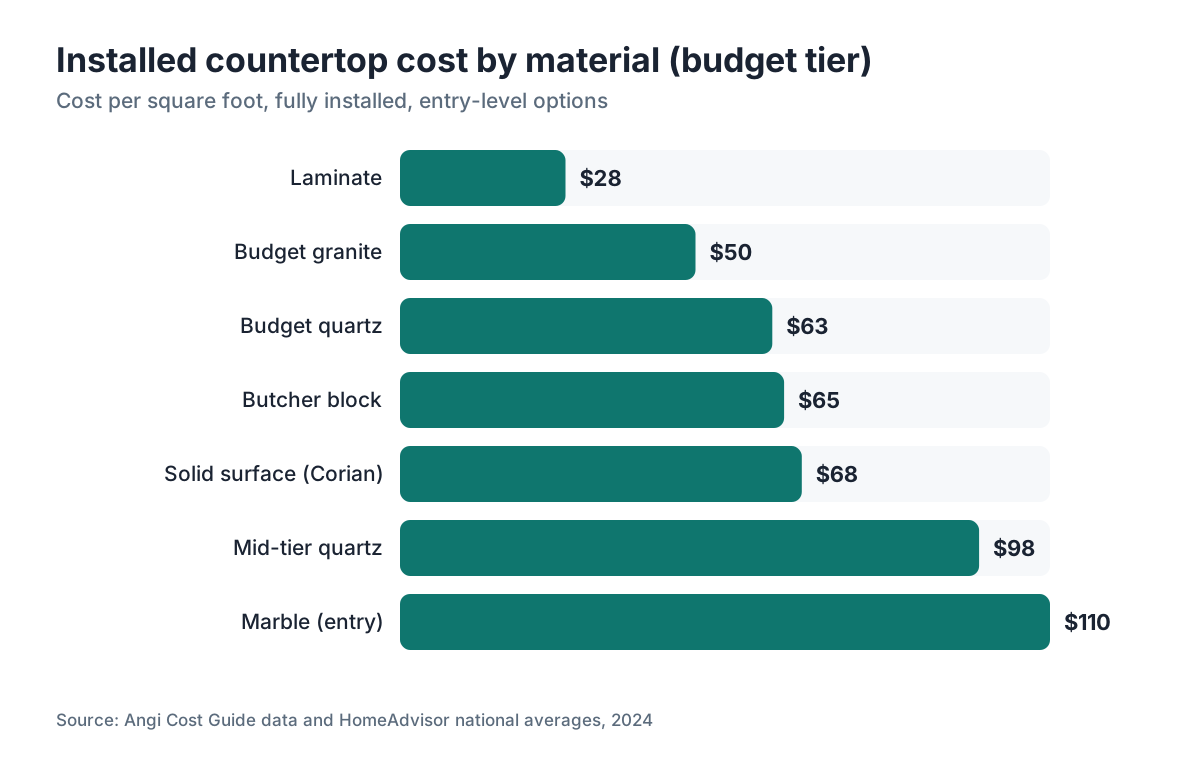
Budget quartz sits right in the middle of the pack. This comparison uses installed cost, because that's the number you actually write a check for.
Laminate countertops (and its branded cousin Formica countertops) are the cheapest in absolute terms, running $15 to $40 per square foot installed. Laminate has no porosity, resists staining well, and looks genuinely good with modern designs. The knock is that it chips and peels at the edges over time and can't be refinished.
Butcher block countertops run $40 to $100 per square foot installed, overlapping with budget quartz. Wood needs oiling and takes water damage near sinks, but it's warm, repairable, and hard to beat in the right kitchen.
Granite countertops start around $40 to $60 per square foot installed for builder-grade material, close to cheap quartz. Premium granite with rare patterns can hit $200 or more. Unlike quartz, granite needs periodic sealing.
Corian and other solid-surface materials (see Corian countertops) run $45 to $90 installed. You can sand out scratches, which is a real advantage, but they scratch more easily than quartz to begin with.
Here's quartz's edge over almost everything at the same price. It needs zero sealing. It's non-porous, so bacteria can't work into the surface the way they can with under-sealed stone. And it's dimensionally consistent, so fabrication is predictable. For a homeowner who wants a stone look with low upkeep, the budget quartz tier is a strong buy.
| Material | Installed cost range/sq ft | Sealing required? | Repair possible? |
|---|---|---|---|
| Laminate | $15, $40 | No | Limited |
| Butcher block | $40, $100 | Yes (oil) | Yes |
| Budget quartz | $50, $75 | No | No |
| Budget granite | $40, $60 | Yes | No |
| Solid surface (Corian) | $45, $90 | No | Yes |
| Mid-tier quartz | $75, $120 | No | No |
| Marble | $75, $150+ | Yes | Limited |
Where should you buy cheap quartz to get the best deal?
The channel you buy through matters as much as the brand you pick. Remnants are the single most underused way to save on a small job.
Big-box stores (Home Depot, Lowe's) sell quartz through countertop programs that use contracted local fabricators. Their purchasing volume sometimes makes the material competitive, but fabricator markups and thin color selection can wipe that out. You also get less room to move on edge choices and turnaround than you would with an independent shop.
Floor & Decor sells quartz slabs to the public at prices close to what distributors pay [10]. You walk in, buy a slab, and hire your own fabricator. That split can save money if you find a fabricator with fair labor rates. It also lets you shop remnants.
Remnants win for small jobs. A remnant is a leftover slab piece from a bigger job that's already sitting in a fabricator's yard. For a small bathroom vanity or a laundry counter, you can grab one for $100 to $400 plus fabrication. Many shops price remnants 30 to 60 percent below slab cost. Call shops directly and ask what they have in white or gray.
Buying direct from a high-volume fabricator is the next best move for a full kitchen. High-volume shops buy more material and pull better wholesale pricing. A fabricator doing 40 to 80 jobs a month has more negotiating power with distributors than one doing 8. Ask a shop what its monthly volume is. It's a fair question and it tells you a lot.
A note for the fabricators reading this. The spread between your material cost and your installed price is your gross margin, and tracking it accurately across job types takes real data. SlabWise is quoting and nesting software built for countertop shops, and the instant quote tool on the homeowner side helps clients understand realistic pricing before they walk in your door.
What are the real hidden costs in a quartz countertop job?
The quoted price per square foot rarely tells the whole story. A few line items can quietly double your bill, so pin them down before you sign.
Demolition and disposal. If you have old countertops to pull out, most fabricators either charge separately ($100 to $300) or won't touch it, leaving you to arrange it. Confirm this upfront.
Plumbing disconnect and reconnect. The fabricator won't hook your sink plumbing back up. That's a plumber's job. Budget $100 to $250 for a plumber before and after installation.
Minimum job charges. A shop quoting $60 per square foot might have a $600 minimum [11]. A 6-square-foot bathroom vanity suddenly costs $100 per effective square foot.
Travel and delivery fees. Shops far from your address sometimes tack on fuel or mileage charges. These rarely show up in the first quote.
Backsplash cuts. If you want your quartz to run up the wall as a backsplash, even 4 inches, those pieces get priced separately and count toward your square footage. Easy to underestimate.
Template fees. Some shops charge a separate fee ($100 to $200) for the templating visit, though most fold it into the job price. Ask.
The Federal Trade Commission's guidance on home improvement contracts stresses getting a written contract with a clear scope of work, and several states require specific disclosures. California's Home Improvement Contract law under Business and Professions Code 7159 is the most detailed example [3]. Get everything in writing, including the exact square footage being billed and what the per-square-foot price actually covers.
Does cheap quartz have worse quality or durability?
Sometimes, but rarely in ways that matter for a normal kitchen. That's the honest answer.
All engineered quartz is made by roughly the same process. Ground quartz aggregate (typically 90 to 95 percent by weight) gets bound with polymer resins (usually polyester or epoxy), pressed under vacuum and vibration, then cured and polished [9]. NSF International's standard NSF/ANSI 51 covers food-contact surfaces, and most reputable quartz products meet it [4].
Here's where budget and premium quartz actually diverge.
Consistency of veining. Budget quartz with a veining pattern is printed or mixed less precisely, so the pattern may repeat visibly or read as slightly fake. Solid colors don't have this problem at all.
Warranty length. Caesarstone and Cambria offer lifetime limited warranties. Some budget brands offer 10 or 15 years, and house-brand product from smaller importers may offer less. Read the warranty document, not the marketing.
Surface hardness. Higher-end makers use more consistent aggregate sizing and better-calibrated pressing, which gives more uniform hardness across the slab. Budget slabs occasionally have soft spots or small voids. This rarely causes real problems, but it can show up as uneven wear after 10 to 15 years of heavy use.
Resale value. If you're renovating to sell, budget quartz in a good color reads the same as mid-tier quartz to most buyers. Nobody sees the brand stamped on the underside. The surface is what sells.
For an average kitchen remodel, budget quartz from a reputable brand does the job. For a busy commercial kitchen or a luxury renovation, step up.
How do you measure quartz countertops to get an accurate quote?
Fabricators measure in square feet, and how they count changes your bill. Most shops measure the full bounding rectangle of each counter section, not the usable surface. A 96-inch run that's 26 inches deep is 96 x 26 = 2,496 square inches, divided by 144 = 17.3 square feet. You pay for all 17.3 even though the sink cutout removes some of it. That's standard. The removed material still gets cut and wasted from the slab.
To estimate your own square footage before you get quotes:
- Measure each counter section in inches (length x depth).
- Multiply length x depth for each section.
- Add all sections together.
- Divide the total by 144 to get square feet.
- Add 10 to 15 percent for waste, especially with corners or diagonal cuts.
Take an L-shaped kitchen with a 120-inch run and a 72-inch run, both 25.5 inches deep. You get (120 x 25.5) + (72 x 25.5) = 3,060 + 1,836 = 4,896 square inches, divided by 144 = 34 square feet before waste. Add 10 percent and you're quoting around 37 to 38 square feet.
The actual templating visit uses a digital or physical template to nail down exact measurements, including cutouts, radius corners, and wall irregularities. Don't skip it. A template error that drops a seam in the wrong place or misses a wall angle gets expensive fast.
For a full walkthrough of the install itself, see the countertop installation guide.
What are the best low-cost quartz colors to pick for a kitchen?
Solid white and bright white are the clear winners. They're cheapest to make, they go with almost any cabinet color, and they read clean and current. The catch is they show coffee and red wine if you don't wipe up quickly, though quartz's non-porous surface keeps those stains sitting on top instead of soaking in.
Light grays and greiges (gray-beige blends) are the next most affordable tier and honestly more forgiving day to day. A light gray with subtle movement looks like stone, photographs beautifully, and hides water spots from a wet glass better than stark white.
Vein-cut white-and-gray patterns in the Carrara style, like MSI's Calacatta Laza, cost a bit more than solids but still land in the budget tier for most brands. If you want the marble look without marble maintenance, this is the sweet spot.
Charcoal and anthracite blacks are underused in budget kitchens. They look expensive, hide most food stains, and cost the same as white.
What to skip if you're watching money: anything with warm amber or gold veining (Calacatta Gold lookalikes), anything branded as a "statement" or "designer" color, and any pattern with thick blue or green veining. Those are premium-tier at every brand.
If you're weighing quartz against natural stone for looks on a budget, the marble countertops and kitchen countertops articles break down the aesthetics in more detail.
How can fabricators price budget quartz jobs more competitively?
This one's for shop owners. Homeowners, the earlier sections already cover your ground.
Margin on budget quartz is thin. Material for a low-end MSI product might run $15 per square foot, and the homeowner expects to pay $55 to $65 all-in. After labor, overhead, and delivery, you might net $8 to $12 per square foot on a clean job. Efficiency is the whole game.
Nesting matters more on budget work than anywhere else. Pull from a full slab for a 30-square-foot job with poor layout and you waste material you've already paid for. Shops using manual layout leave an average of 15 to 25 percent of the slab as scrap. Optimized digital nesting usually gets that under 10 percent. On a $300 slab, that's $30 to $45 saved per job, which is real money when your total margin is $250 to $350.
Accurate quoting heads off the two margin-killers on budget jobs: underquoting from a measurement error, and over-ordering because the estimator padded the waste buffer. Both come from the same root, imprecise job data at the quote stage.
For a shop running more than 20 jobs a month, quoting software usually pays for itself inside 90 days. SlabWise was built for exactly this: accurate estimates tied straight to nesting, so the material you quote matches what you cut.
In a competitive market, generating an accurate quote in minutes instead of days also closes jobs faster. That matters when a homeowner is sitting on three bids.
Is cheap quartz safe and food-contact approved?
Yes. Quartz is non-porous, which is why it doesn't need sealing and doesn't harbor bacteria in the surface the way under-sealed granite or marble can. The material is at least 90 percent ground quartz bound in resin, which leaves essentially no open porosity [9].
NSF International's standard NSF/ANSI 51, "Food Equipment Materials," covers surfaces meant for food-prep contact [4]. Most major quartz brands test to it and list compliance in their technical documentation. If food safety is a specific worry, ask for the brand's NSF certification before you buy.
One health issue has gotten more attention lately: silica dust during fabrication. Engineered stone carries higher crystalline silica content than natural granite, and both the California Department of Public Health and federal OSHA have flagged elevated silica dust as a serious occupational hazard for countertop fabricators [5]. This is a shop-floor problem, not a homeowner problem. Finished, polished quartz in your kitchen poses no silica inhalation risk.
OSHA's permissible exposure limit for respirable crystalline silica is 50 micrograms per cubic meter of air as an 8-hour time-weighted average, set under the 2016 silica rule [5]. Shops that wet-cut and ventilate properly meet that standard. Worth knowing when you're sizing up a fabricator, since a shop that ignores silica controls tends to cut corners elsewhere too.
For keeping any stone or engineered surface clean once it's in, the how to clean stone countertops guide covers the basics that apply to quartz.
Frequently asked questions
What is the cheapest quartz countertop brand?
MSI Quartz and IKEA's Kasker line are consistently the most affordable widely available options, with MSI material wholesaling at $12 to $22 per square foot. House-brand Chinese quartz sold through floor covering chains can be cheaper in material cost but carries warranty and quality-control risk. For most homeowners who want a reliable budget option, MSI through a local fabricator or Floor & Decor is the practical answer.
Can I get quartz countertops for under $1,000?
Yes, but only for small jobs. A bathroom vanity or laundry room with 10 to 12 square feet can come in under $1,000 installed if you find a fabricator without a high minimum charge and pick a basic color. Most shops have a $300 to $500 minimum job fee, so very small vanities often cost more per square foot than full kitchens. A remnant slab from a shop's yard is the best path to sub-$1,000 for a small space.
How much does a 10-foot quartz countertop cost?
A 10-foot run at standard 25.5-inch depth is roughly 17.7 square feet. At $50 to $75 per square foot installed for budget quartz, that's $885 to $1,328 for the section alone. Add a sink cutout ($100 to $200) and most fabricators' minimum job fees, and a realistic all-in price for a single 10-foot section is $1,000 to $1,500 depending on market and edge choice.
Does quartz price vary by region?
Yes, a lot. Labor and overhead push coastal markets like the San Francisco Bay Area, New York metro, and Seattle 20 to 40 percent higher than the Midwest or Southeast [12]. The same job that costs $1,800 installed in Nashville might run $2,800 in Los Angeles. Material costs stay closer together because slab distributors operate nationally, but fabrication labor is entirely local.
Is budget quartz durable enough for a kitchen?
Yes for nearly every kitchen. All engineered quartz is rated for kitchen use. The gap between budget and premium shows up mostly in pattern realism, warranty length, and surface consistency over many years. For normal cooking and cleanup, a budget MSI or Hanstone product performs the same as Caesarstone for the first decade. The difference opens up only in very high-use or high-heat situations.
What is the cheapest quartz color?
Solid whites, solid light grays, and solid blacks are the cheapest colors at virtually every quartz brand. They use fewer pigments and simpler mixing. Veined patterns that mimic Calacatta Gold, Statuario, or exotic marbles cost more because they need extra layering or printing steps. If budget is the priority, stick to solid or lightly textured white and gray options in the brand's base collection.
Should I buy quartz remnants to save money?
Remnants are one of the best savings moves for a small project. A remnant is a leftover piece from a previous job, already sitting at the fabricator's shop. They typically sell 30 to 60 percent below slab cost. Call fabricators directly and ask what they have in white or gray. For vanities, laundry rooms, or bar tops under 15 square feet, a remnant plus standard fabrication fees can cut total cost 25 to 40 percent versus cutting a new slab.
How much does quartz countertop installation cost separate from material?
Installation labor, including the template visit and the install day, typically runs $20 to $35 per square foot for straightforward jobs. Complex layouts with multiple cutouts, specialty edges, or difficult access push that higher. Some fabricators quote one combined number and won't split it. Ask explicitly for the breakdown if you want to compare shops on labor rates versus material markup.
Is quartz cheaper than granite?
At the entry level they're neck and neck. Budget granite starts around $40 to $60 per square foot installed; budget quartz starts around $50 to $75. Mid-range granite with interesting patterns can beat mid-range quartz. Exotic granite with rare coloring can top the highest quartz prices. Quartz never needs sealing, which lowers lifetime cost even when the upfront number is similar.
What is the minimum thickness for quartz countertops?
The two standard thicknesses are 2cm (about 3/4 inch) and 3cm (about 1.25 inches). Most fabricators default to 3cm for kitchens because it skips the plywood substrate and feels more substantial. The 2cm material is thinner and cheaper in raw cost but often needs edge lamination to look standard, which trims the savings. For cheap countertops, 3cm in a base color is usually the most cost-effective pick.
Can quartz countertops be installed as a DIY project to save money?
Technically yes, practically it's very hard. A full slab of 3cm quartz weighs 15 to 18 pounds per square foot, so a 30-square-foot kitchen section can top 400 pounds. Moving, aligning, and adhering slabs takes multiple people and specific equipment. Errors in seam placement or leveling cost real money to fix. The DIY savings rarely justify the risk. Compete on material choice and shop selection instead of skipping professional installation.
How long does quartz countertop installation take from order to finish?
The typical timeline is 1 to 3 weeks from signed contract to finished install. The steps: template visit (about 1 hour on site), fabrication in the shop (2 to 5 business days for in-stock budget material), then install day (2 to 6 hours for a standard kitchen). Delays happen when material has to be ordered from a distributor who's out of stock, which adds 1 to 2 weeks. An in-stock color at a high-volume shop shortens it a lot.
Does the big-box store quartz program (Home Depot, Lowe's) actually save money?
Sometimes, not always. Big-box countertop programs use contracted local fabricators and can offer competitive material pricing thanks to purchasing scale. The trade-off is fewer colors, fewer edge options, and sometimes longer lead times than an independent shop. Get a direct quote from an independent fabricator alongside the big-box quote before you decide. The difference often runs $5 to $15 per square foot, which adds up on a 40-square-foot kitchen.
How does cheap quartz hold up near sinks and stoves?
Quartz is non-porous, so water near sinks won't penetrate or stain it. It holds up extremely well in wet areas. Near stoves the concern is heat: quartz resins can discolor or crack under sustained direct heat above roughly 150 degrees Celsius. A hot pan straight from the burner onto quartz without a trivet is a real risk, even with budget brands, and premium quartz is no different. Use trivets and the counter lasts decades near both a sink and a stove.
Sources
- Angi (formerly Angie's List), Quartz Countertop Cost Guide: National average for quartz countertop installation ranges from approximately $55 to $145 per square foot across all tiers
- IKEA, Kasker Custom Countertops product page: IKEA's Kasker line offers custom quartz countertop pricing by the running foot through their measurement and installation network
- California Legislative Information, Business and Professions Code Section 7159: California Business and Professions Code 7159 requires specific written contract disclosures for home improvement contracts
- NSF International, NSF/ANSI 51 Food Equipment Materials standard: NSF/ANSI 51 covers food-contact surface materials; most major quartz brands test to this standard
- U.S. Occupational Safety and Health Administration, Respirable Crystalline Silica Standard: OSHA's PEL for respirable crystalline silica is 50 micrograms per cubic meter as an 8-hour TWA, established in the 2016 silica rule; engineered stone fabrication is a flagged high-exposure occupation
- National Kitchen and Bath Association, Cost vs. Value and material pricing research: NKBA industry data on countertop material pricing tiers and fabrication cost benchmarks
- Natural Stone Institute (formerly Marble Institute of America), Engineered Stone Overview: Engineered quartz is composed of approximately 90 to 95 percent ground quartz aggregate bound with polymer resins
- Floor & Decor Holdings, Quartz countertop slab retail pricing: Floor & Decor sells quartz slabs directly to consumers at distributor-adjacent prices, enabling separation of material purchase from fabrication
- HomeAdvisor (Angi Brands), Countertop installation cost data: Fabricator minimum job charges typically run $300 to $500 for countertop installation regardless of square footage
- U.S. Bureau of Labor Statistics, Construction labor cost data: Regional labor cost variation means coastal markets run 20 to 40 percent higher for skilled trades including countertop installation
Last updated 2026-07-10