What Is Abrasive Waterjet? Definition & Guide
Quick Definition
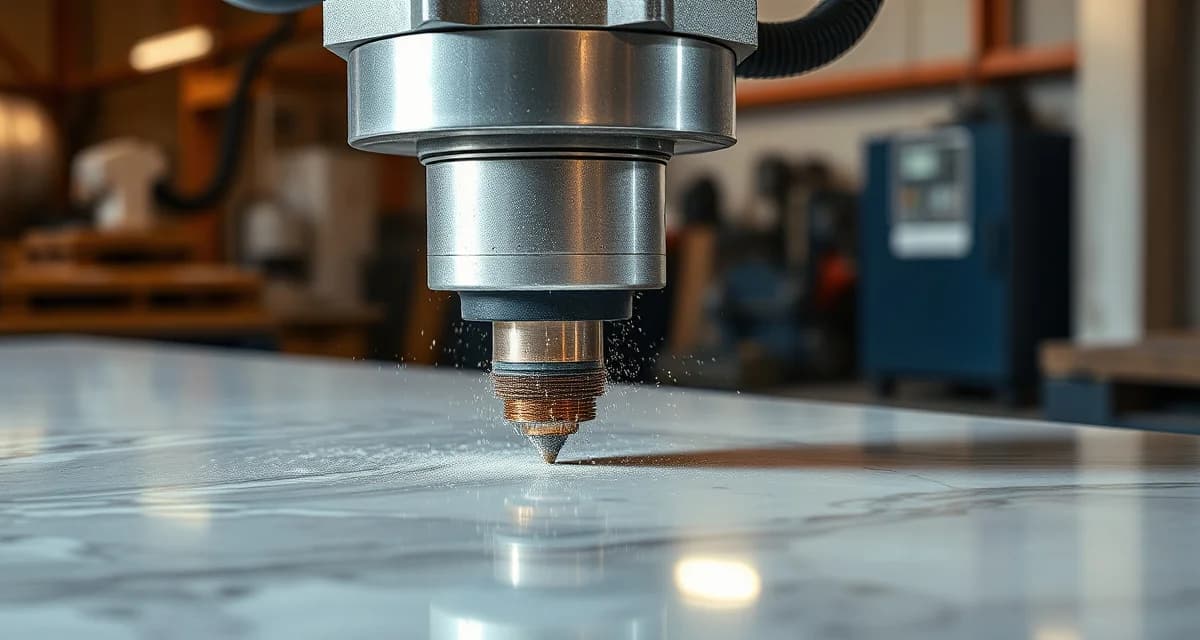
An abrasive waterjet is a cutting machine that uses a high-pressure stream of water (40,000-90,000 PSI) mixed with a fine abrasive material (typically garnet) to cut through stone, metal, glass, and other hard materials. In countertop fabrication, abrasive waterjets are used primarily for sink cutouts, cooktop openings, curved cuts, and detailed shapes that would be difficult or risky to achieve with a diamond blade. The process generates virtually no dust, making it one of the safest cutting methods for silica-containing materials.
TL;DR
- Abrasive waterjet cuts stone using ultra-high-pressure water mixed with garnet abrasive
- Operates at 40,000-90,000 PSI water pressure
- Ideal for sink cutouts, cooktop openings, curves, and complex shapes
- Produces virtually zero airborne silica dust (inherently wet process)
- Cuts any countertop material: granite, quartz, porcelain, sintered stone, marble
- No heat-affected zone - won't discolor or structurally weaken the stone
- Slower than bridge saws for straight cuts but superior for complex geometry
- Machine cost: $50,000-$300,000+; garnet abrasive is an ongoing operating expense
How Abrasive Waterjet Cutting Works
The Cutting Process
- High-pressure pump pressurizes water to 40,000-90,000 PSI through an intensifier pump
- Orifice: The pressurized water passes through a tiny jewel orifice (sapphire or diamond, 0.010"-0.015" diameter), creating a coherent water stream
- Mixing chamber: The water stream enters a mixing chamber where garnet abrasive particles are drawn in by the Venturi effect
- Focusing tube: The water-abrasive mixture accelerates through a carbide focusing tube (0.030"-0.040" diameter)
- Cutting: The focused stream exits at supersonic speed, eroding through the stone
- Catch tank: A water-filled tank beneath the workpiece absorbs the remaining energy
The garnet particles, not the water, do the actual cutting. Water is the carrier that accelerates the abrasive to cutting speed.
Calculate your material waste savings
See exactly how much slab material and money you could save with optimized cutting layouts.
Try the free Waste CalculatorWaterjet Applications in Countertop Fabrication
Sink Cutouts
The most common waterjet application. Undermount sink openings require precise, curved cuts with radiused corners. Waterjets produce smooth, accurate cutouts without the vibration risk that can crack brittle materials.
Cooktop Openings
Similar to sink cutouts but typically rectangular with rounded corners. Waterjets handle the corners without stress concentration - a common crack point with blade cutting.
Curved and Custom Shapes
Waterfall edges, curved bar tops, radius corners, and decorative elements are all better suited to waterjet cutting than blade cutting.
Porcelain and Sintered Stone Cutouts
These brittle materials crack easily when cut with vibrating blades. Waterjets apply force gradually and without vibration, significantly reducing breakage risk.
Inlays and Detailed Work
High-end inlay work (contrasting stone pieces fitted together) requires the sub-millimeter precision that waterjets provide.
Abrasive Waterjet vs. Diamond Blade Cutting
| Factor | Abrasive Waterjet | Diamond Blade (Bridge Saw) |
|---|---|---|
| Cut speed (straight) | Slow (6-20 in/min depending on material/thickness) | Fast (60-120+ in/min) |
| Cut speed (curves) | Good | Poor (requires multiple straight cuts or hand finishing) |
| Precision | ±0.003"-0.005" | ±0.030"-0.060" |
| Dust generation | Near zero | Moderate (with wet cutting) |
| Heat generation | None | Moderate to high |
| Material stress | Minimal | Vibration and mechanical stress |
| Kerf width | 0.035"-0.050" | 0.100"-0.140" |
| Material waste (kerf) | Less | More |
| Machine cost | $50,000-$300,000+ | $15,000-$100,000 |
| Operating cost | Higher (garnet, pump maintenance) | Lower (blade replacement) |
| Best for | Cutouts, curves, brittle materials | Straight cuts, high volume |
When to Use Each
Most fabrication shops use both technologies:
- Bridge saw for primary slab cuts (straight lines, sizing)
- Waterjet for cutouts, curves, and precision work
Shops without a waterjet often outsource complex cutouts to a shop that has one, or use CNC routers as an alternative.
Operating Costs
Abrasive waterjet operation involves several ongoing costs beyond the initial machine purchase:
Garnet Abrasive
The largest operating expense. Garnet consumption ranges from 0.5-1.5 lbs per minute of cutting, depending on pressure and cut speed. Garnet costs $0.15-$0.40 per pound in bulk.
Monthly garnet cost for a typical fab shop: $300-$1,500
Pump Maintenance
High-pressure pumps require regular maintenance:
- Seal kits ($200-$500, replaced every 500-1,000 hours)
- Check valves ($150-$300 per set)
- High-pressure tubing replacement
- Intensifier cylinder rebuilds
Annual pump maintenance: $3,000-$8,000
Consumables
- Mixing tubes (nozzles): $100-$300, replaced every 40-100 hours of cutting
- Orifices: $50-$200, replaced every 40-100 hours
- Abrasive delivery tubing
- Water filtration components
Water and Disposal
The catch tank water becomes contaminated with garnet and stone particles. It must be filtered or disposed of properly. Some shops recycle garnet from the catch tank, reducing abrasive costs by 30-50%.
Safety Advantages
Silica Dust
Waterjet cutting produces virtually zero airborne dust because the entire process occurs in water. This makes it the safest cutting method for silica-containing materials like engineered quartz and quartzite.
No Heat Damage
The water stream keeps the cutting zone cool. There's no heat-affected zone, so the stone doesn't discolor, crack from thermal stress, or suffer resin damage (important for quartz countertops).
Operator Safety
Modern waterjets are enclosed machines with safety interlocks. The operator loads the material, programs the cut path, and the machine runs automatically. This keeps workers away from the cutting zone.
CNC Integration
Most modern abrasive waterjets are CNC-controlled, meaning they accept digital cutting programs directly from fabrication software. The workflow:
- Template is digitized (laser templater or other measurement system)
- Cutting program is generated in CAD/CAM software
- Program is sent to the waterjet controller
- Operator loads the slab and starts the program
- Machine cuts autonomously
This integration means waterjet cutouts can be planned and optimized as part of the overall slab nesting process. SlabWise's nesting engine can generate cutting layouts that account for both bridge saw and waterjet operations.
What is an abrasive waterjet?
A cutting machine that uses ultra-high-pressure water (40,000-90,000 PSI) mixed with garnet abrasive to cut through stone and other hard materials.
What is the abrasive material used in waterjet cutting?
Garnet - a naturally occurring mineral that's hard enough to cut stone but won't damage the waterjet's internal components.
Why use a waterjet instead of a saw for countertop cutouts?
Waterjets produce precise cuts with no vibration (reducing crack risk), no heat (preventing damage), and virtually no dust (protecting workers).
Can a waterjet cut any countertop material?
Yes. Granite, quartz, marble, quartzite, porcelain, sintered stone - waterjets cut them all with equal precision.
How accurate is waterjet cutting?
Typical precision is ±0.003"-0.005", significantly tighter than bridge saw cutting (±0.030"-0.060").
Is waterjet cutting slow?
For straight cuts, yes - much slower than a bridge saw. For complex shapes and cutouts, it's often faster because it doesn't require multiple straight cuts and hand finishing.
How much does an abrasive waterjet cost?
Entry-level machines start around $50,000. Full-featured production waterjets run $100,000-$300,000+.
Does waterjet cutting produce silica dust?
Virtually none. The cutting occurs underwater, making it one of the safest methods for silica-containing materials.
What are the ongoing costs of running a waterjet?
Garnet abrasive ($300-$1,500/month), pump maintenance ($3,000-$8,000/year), and consumables (nozzles, orifices) are the main ongoing costs.
Can waterjet cutouts be integrated into CNC nesting software?
Yes. Modern waterjets accept digital cutting programs and can be integrated into the overall fabrication workflow, including slab nesting optimization.
Do you need both a waterjet and a bridge saw?
For most shops, yes. The bridge saw handles fast straight cuts and slab sizing. The waterjet handles cutouts, curves, and precision work. Together they cover all cutting needs.
Can you cut thick stone with a waterjet?
Yes, though cutting speed decreases as thickness increases. 3cm stone is well within standard waterjet capabilities.
Optimize Every Cut in Your Shop
Whether you're programming waterjet cutouts or planning bridge saw layouts, SlabWise helps fabricators minimize waste and maximize throughput. From slab nesting to template verification, every cut starts with a better plan.
Start your 14-day free trial →
Try These Free Tools
- Nesting Optimizer -- AI-powered slab layout that maximizes yield considering vein direction and defects.
- Defect Mapping -- Upload a slab photo and AI maps every fissure, pit, and color issue.
- Value Engineering -- Find dollar-quantified suggestions to save material without cutting margin.
Sources & Further Reading
- Natural Stone Institute - Fabrication Guidelines and Best Practices
- International Surface Fabricators Association - Waterjet Cutting Technology Standards
- ASTM International - Standard Guide for Abrasive Waterjet Machining
- OSHA - Safety Guidelines for Waterjet Operations