What Is Porcelain Slab? Definition & Guide
Quick Definition
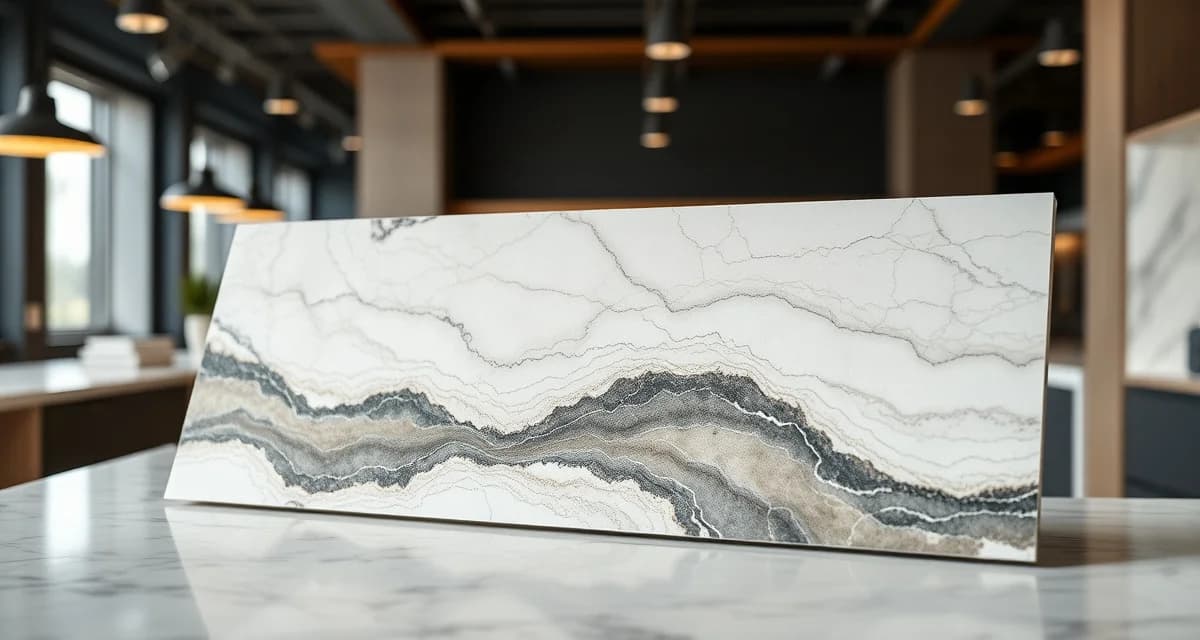
A porcelain slab is a large-format ceramic surface made from refined clay, feldspar, and mineral oxides fired at extremely high temperatures (1200-1400°C). Porcelain slabs used in countertop fabrication are typically 12mm (1/2") or 20mm (3/4") thick and mimic the look of natural stone, marble, concrete, or wood. They are lightweight, UV-stable, heat-resistant, and stain-resistant - but also more brittle than granite or quartz, requiring specialized handling and always needing a substrate for countertop applications.
TL;DR
- Porcelain slabs are large-format ceramic surfaces fired at 1200-1400°C
- Available in 6mm, 12mm, and 20mm thicknesses for countertops
- Lightweight (about half the weight of granite at the same size)
- Heat, UV, and stain-resistant; non-porous without sealing
- More brittle than quartz or granite - prone to cracking if unsupported
- Always requires a plywood or MDF substrate beneath the slab
- Fabrication requires specialized tools, slower cutting speeds, and extra care
- Growing in popularity for both indoor and outdoor applications
How Porcelain Slabs Are Made
Porcelain manufacturing follows a centuries-old process, scaled up to produce countertop-sized slabs.
Calculate your material waste savings
See exactly how much slab material and money you could save with optimized cutting layouts.
Try the free Waste Calculator- Raw material preparation: Clay, feldspar, quartz sand, and mineral pigments are ground into fine powder
- Pressing: The powder is pressed into slab forms under high pressure (up to 15,000 tons for large-format slabs)
- Decoration: Surface patterns are applied using high-resolution digital printing technology - this is how marble, granite, and wood appearances are created
- Firing: Slabs are kiln-fired at 1,200-1,400°C for several hours, vitrifying the material
- Finishing: Surface treatments create polished, honed, matte, or textured finishes
- Quality control: Each slab is inspected for flatness, color consistency, and structural integrity
The high firing temperature creates a vitrified body with near-zero water absorption (<0.5%), making porcelain naturally non-porous.
Porcelain Slab Specifications
| Property | Value |
|---|---|
| Composition | Clay, feldspar, quartz, mineral oxides |
| Firing temperature | 1,200-1,400°C |
| Water absorption | <0.5% |
| Available thicknesses | 6mm, 12mm, 20mm |
| Common slab sizes | Up to 126" × 63" |
| Weight (12mm) | ~6.5 lbs/sq ft |
| Weight (20mm) | ~11 lbs/sq ft |
| Scratch resistance | Mohs 5-6 |
| Heat resistance | Excellent (no resin) |
| UV resistance | Excellent (color-stable) |
Weight Comparison
| Material (3cm equivalent) | Weight per sq ft |
|---|---|
| Granite (3cm) | ~18 lbs |
| Quartz (3cm) | ~16 lbs |
| Porcelain (12mm + substrate) | ~10 lbs |
| Porcelain (20mm + substrate) | ~14 lbs |
Fabrication Challenges
Porcelain slab fabrication is significantly different from stone or quartz fabrication. Many shops that are experienced with granite and quartz struggle initially with porcelain.
Brittleness
Porcelain's primary fabrication challenge is its brittleness. The material:
- Cracks easily if subjected to point loads or uneven support
- Can fracture during cutting if the blade vibrates or the slab flexes
- Is vulnerable to edge chipping during handling and transport
- Cannot tolerate any unsupported spans without substrate
Specialized Cutting
- Diamond blades must be specifically designed for porcelain - blades meant for granite will chip and crack the material
- Cutting speed must be slower and more controlled
- Water flow must be consistent to prevent overheating
- Waterjet cutting is preferred for cutouts (sinks, cooktops) because it eliminates vibration-induced cracking
- CNC routing requires specific bit types and very shallow pass depths
Substrate Requirement
Porcelain slabs for countertops always require a substrate (plywood or MDF panel) for structural support. The slab is adhered to the substrate with flexible adhesive, and the combined assembly is installed as a unit.
Edge Treatment
Because porcelain slabs are thin, the raw edge reveals the body color beneath the printed surface. To create the appearance of a thicker countertop:
- Laminated edges: Strips of matching porcelain are adhered to the front edge, creating a mitered or layered look
- Waterfall edges: The slab wraps down the side of the cabinet
- Metal edge profiles: Aluminum or stainless steel channels cap the edge
Porcelain Slab vs. Other Countertop Materials
| Factor | Porcelain | Quartz | Granite | Sintered Stone |
|---|---|---|---|---|
| Weight | Light | Heavy | Heavy | Moderate |
| Heat resistance | Excellent | Poor | Excellent | Excellent |
| UV resistance | Excellent | Poor | Good | Excellent |
| Brittleness | High | Low | Moderate | Moderate-High |
| Substrate needed | Always | Rarely | Rarely | Sometimes |
| Fabrication difficulty | High | Moderate | Moderate | High |
| Pattern variety | Very high (digitally printed) | High | Limited to nature | High |
| Price range | $40-$120/sq ft | $50-$150/sq ft | $40-$200/sq ft | $75-$200/sq ft |
Best Applications for Porcelain Slabs
Outdoor Kitchens and Countertops
Porcelain's UV stability and weather resistance make it ideal for outdoor installations where quartz would fade and some natural stones would degrade.
Wall Cladding and Backsplashes
Large-format porcelain slabs create dramatic wall surfaces with minimal grout lines. The lightweight nature of thin porcelain (6mm) makes it practical for vertical applications.
Bathroom Vanities and Shower Walls
Porcelain's water impermeability and stain resistance suit wet environments perfectly. Large slabs reduce grout lines, simplifying cleaning.
Commercial Surfaces
Restaurants, retail spaces, and offices use porcelain for its durability, easy maintenance, and the ability to create large, continuous surfaces.
Nesting and Layout Planning for Porcelain
Porcelain's printed patterns present unique nesting challenges:
- Pattern repeat: Digital printing means patterns can repeat, but the repeat isn't always aligned with the slab edges
- Directional patterns: Marble-look porcelain has directional veining that must be oriented consistently across seams
- Color batch matching: Like tile, porcelain slabs should come from the same production lot for consistent color
- Breakage allowance: Shops should order 10-15% more porcelain than calculated because fabrication breakage rates are higher than with stone
SlabWise's nesting tools account for porcelain's thinner profiles and pattern characteristics when generating optimized cutting layouts.
What is a porcelain slab?
A porcelain slab is a large-format ceramic surface made from refined clay and minerals, fired at extreme temperatures (1200-1400°C) to create a dense, non-porous material suitable for countertops, wall cladding, and flooring.
Is porcelain good for kitchen countertops?
Yes, with proper substrate support. Porcelain resists heat, stains, UV light, and scratches. It's lightweight and available in many designs. The main drawback is brittleness during fabrication and installation.
How thick are porcelain countertop slabs?
Common thicknesses are 12mm (1/2") and 20mm (3/4"). Edge treatments are used to create the appearance of a thicker surface.
Does porcelain need a substrate?
Always for countertop applications. Porcelain is too thin and brittle to span between cabinets without continuous plywood or MDF support beneath it.
Is porcelain harder to fabricate than granite?
Yes. Porcelain requires specialized blades, slower cutting speeds, careful handling, and waterjet cutting for complex cutouts. Breakage rates are higher during fabrication.
Can porcelain slabs be used outdoors?
Absolutely. UV stability, freeze-thaw resistance, and weather durability make porcelain one of the best outdoor countertop options.
How do you create thick edges on porcelain countertops?
By laminating matching porcelain strips to the slab edge with adhesive, creating a mitered joint that looks like a thicker slab from the front.
Does porcelain countertop need sealing?
No. The vitrified body has near-zero water absorption, making sealing unnecessary.
What patterns are available in porcelain slabs?
Nearly anything - marble, granite, concrete, wood, solid colors, and abstract designs. Patterns are created with high-resolution digital printing technology.
How does porcelain compare to quartz for countertops?
Porcelain is lighter, more heat-resistant, and UV-stable, but it's more brittle and harder to fabricate. Quartz is more durable during handling and fabrication but can't handle heat or outdoor exposure.
What happens if porcelain cracks during fabrication?
The piece is typically ruined. Porcelain cracks propagate quickly and can't be repaired like epoxy-filled granite fissures. This is why breakage allowances (10-15% extra material) are standard.
Are porcelain slabs expensive?
Mid-range pricing: $40-$120 per square foot installed. The material itself is often less expensive than quartz, but higher fabrication costs offset some savings.
Nest Porcelain Slabs With Confidence
Porcelain fabrication leaves little room for error. SlabWise's nesting and template verification tools help shops plan porcelain layouts precisely - accounting for substrate, edge treatments, and material characteristics before the first cut.
Start your 14-day free trial →
Try These Free Tools
- Nesting Optimizer -- AI-powered slab layout that maximizes yield considering vein direction and defects.
- Defect Mapping -- Upload a slab photo and AI maps every fissure, pit, and color issue.
- Value Engineering -- Find dollar-quantified suggestions to save material without cutting margin.
Sources & Further Reading
- Natural Stone Institute - Fabrication Guidelines and Best Practices
- International Surface Fabricators Association - Waterjet Cutting Technology Standards
- ASTM International - Standard Guide for Abrasive Waterjet Machining
- OSHA - Safety Guidelines for Waterjet Operations