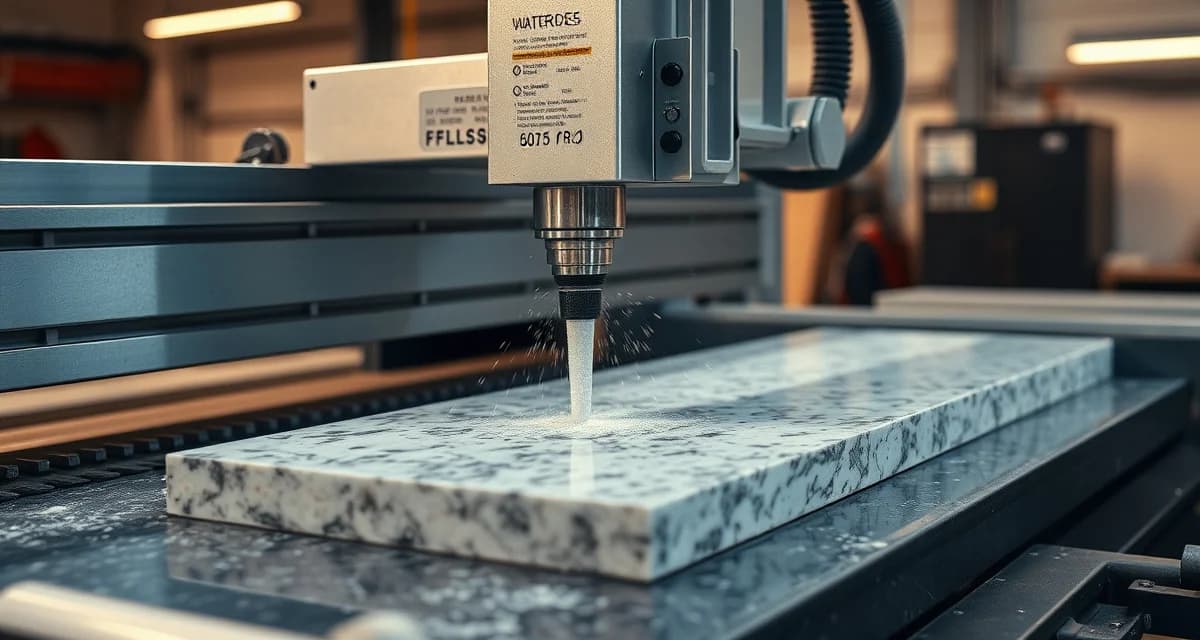
Waterjet Cutting Guide
What Is Waterjet Cutting?
Waterjet cutting uses a high-pressure stream of water mixed with abrasive garnet particles to slice through stone, quartz, porcelain, and other countertop materials. Operating at pressures between 50,000 and 90,000 PSI, waterjet systems can cut virtually any material without generating heat, making them ideal for intricate countertop work.
TL;DR
- Waterjet cutting operates at 50,000-90,000 PSI using water and abrasive garnet
- No heat-affected zones means zero risk of thermal cracking on natural stone
- Capable of cutting curves, sink cutouts, and decorative inlays with ±0.005" accuracy
- Operating costs range from $15-$30 per hour for abrasive and water
- Typical ROI for countertop shops is 12-18 months on a new machine
- Pairs well with CNC routers for a complete fabrication workflow
- Modern 5-axis machines handle bevel cuts and 3D profiling
How Waterjet Cutting Works
The Basic Process
A waterjet machine forces water through a tiny orifice (typically 0.010"-0.015" in diameter) at extreme pressure. In abrasive waterjet cutting - the type used for stone fabrication - garnet particles are injected into the water stream inside a mixing tube. This abrasive-laden jet does the actual cutting.
Calculate your material waste savings
See exactly how much slab material and money you could save with optimized cutting layouts.
Try the free Waste CalculatorThe process breaks down into these stages:
- Pressurization: A hydraulic intensifier pump or direct-drive pump pressurizes water to 50,000-90,000 PSI
- Orifice acceleration: Water passes through a jewel orifice (sapphire, ruby, or diamond), accelerating to roughly 2,500 mph
- Abrasive mixing: Garnet abrasive (typically 80-mesh) is pulled into a mixing chamber by the Venturi effect
- Cutting: The combined water-abrasive stream exits through a focusing tube and cuts the material
- Catching: A catch tank below the cutting table collects spent water and abrasive
Key Components
| Component | Function | Typical Lifespan |
|---|---|---|
| Intensifier pump | Generates high pressure | 500-1,000 hours between rebuilds |
| Jewel orifice | Creates initial water stream | 40-100 cutting hours |
| Mixing tube | Combines water and abrasive | 60-120 cutting hours |
| Abrasive hopper | Stores and feeds garnet | N/A (refillable) |
| XY gantry | Moves cutting head | 10+ years with maintenance |
| Catch tank | Captures waste water and garnet | Cleaned regularly |
Why Countertop Fabricators Use Waterjet
No Heat-Affected Zone
Unlike laser or plasma cutting, waterjet is a cold-cutting process. This matters enormously for countertop fabrication because:
- Natural stone won't develop micro-fractures from thermal stress
- Quartz composites (which contain resin binders) won't discolor or warp
- Porcelain slabs maintain their structural integrity near the cut edge
- No tempering or annealing is needed after cutting
Material Versatility
A single waterjet can cut:
- Granite (including hard varieties like Black Galaxy)
- Marble and travertine
- Engineered quartz (Cambria, Silestone, Caesarstone)
- Quartzite
- Porcelain slabs (Dekton, Neolith)
- Sintered stone
- Soapstone
- Concrete countertops
- Recycled glass surfaces
You won't need different blades or tooling for different materials - just adjust the feed rate and abrasive flow.
Precision and Complexity
Modern CNC waterjet tables achieve ±0.005" accuracy on countertop cuts. This opens up work that's difficult or impossible with a bridge saw:
- Sink cutouts with tight inside radii
- Curved edges and freeform shapes
- Decorative inlays using multiple stone types
- Medallions and logos for commercial projects
- Backsplash patterns with intricate designs
Reduced Material Waste
The waterjet kerf (cut width) is typically 0.030"-0.050", compared to 0.125"-0.150" for a bridge saw blade. On a standard kitchen countertop project using a 130" × 78" slab, the thinner kerf can save 2-4 square feet of material. Over a year, that adds up to significant savings on expensive stone.
Waterjet vs. Bridge Saw vs. CNC Router
| Feature | Waterjet | Bridge Saw | CNC Router |
|---|---|---|---|
| Cut type | Through-cut any shape | Straight and curved cuts | Profiling, drilling, through-cuts |
| Kerf width | 0.030"-0.050" | 0.125"-0.150" | Varies by bit (0.25"-0.5") |
| Speed (granite) | 3-10 in/min | 30-60 in/min for straight | 20-40 in/min |
| Heat generated | None | Moderate (water-cooled) | Low to moderate |
| Inside corners | Sharp (0.015" radius) | Limited by blade radius | Limited by bit radius |
| Initial cost | $80K-$300K+ | $40K-$150K | $60K-$200K+ |
| Operating cost/hr | $15-$30 | $5-$15 | $8-$20 |
| Best for | Cutouts, inlays, curves | Straight cuts, miters | Edge profiling, drilling |
Most productive countertop shops use a combination. The bridge saw handles the initial straight cuts, the waterjet does sink cutouts and complex shapes, and the CNC router handles edge profiling and drilling.
Choosing a Waterjet for Your Shop
Pump Size and Type
For countertop fabrication, you'll typically want:
- 30-50 HP pump for general countertop work
- 60-100 HP pump for higher production volumes or faster cutting of thick materials
- Intensifier pumps deliver higher pressures (up to 90,000 PSI) but require more maintenance
- Direct-drive pumps are more energy-efficient and have lower maintenance costs but typically max out around 60,000 PSI
Table Size
Standard table sizes for countertop work:
- 5' × 10': Handles most residential slab sizes
- 6' × 12': Accommodates jumbo slabs and gives more nesting room
- 6' × 13' or larger: For high-volume shops working with full-size imported slabs
3-Axis vs. 5-Axis
- 3-axis: Cuts perpendicular to the slab surface. Sufficient for most countertop work including sink cutouts and straight through-cuts.
- 5-axis: Tilts the cutting head to compensate for taper and create angled cuts. Useful for miter joints, bevel edges, and minimizing taper on thick materials.
A 5-axis head adds $30,000-$80,000 to the price but eliminates the natural taper that 3-axis waterjets produce (typically 0.005"-0.010" per inch of material thickness).
Operating Costs Breakdown
Here's what a typical countertop shop spends running a waterjet:
| Cost Category | Estimated Cost |
|---|---|
| Abrasive (garnet, 80 mesh) | $0.25-$0.35/lb ($8-$12/hr at 1.5 lb/min) |
| Water | $1-$3/hr |
| Electricity | $3-$8/hr (depending on pump size) |
| Orifice replacement | $15-$50 each, every 40-100 hrs |
| Mixing tube replacement | $100-$300 each, every 60-120 hrs |
| Pump maintenance | $2,000-$5,000 per rebuild |
| Total hourly operating cost | $15-$30/hr |
Reducing Operating Costs
- Recycle garnet: Garnet recycling systems can reclaim 50-70% of spent abrasive, cutting your largest single expense roughly in half
- Optimize cut paths: Efficient nesting and toolpath programming reduce cutting time per piece
- Match pressure to material: You don't need 90,000 PSI for marble - lower pressure extends component life
- Preventive maintenance: Replace seals and check valves on schedule to avoid costly pump failures
Setting Up Your Waterjet
Facility Requirements
- Floor: Reinforced concrete, level within 0.125" across the table footprint
- Electrical: 3-phase power, typically 60-100 amps depending on pump size
- Water supply: 1-2 GPM of clean water (municipal or filtered well water)
- Drain: Floor drain or waste water system for catch tank overflow
- Space: Allow 3-4 feet of clearance on all sides for maintenance access
- Ventilation: While waterjet cutting is relatively clean, some mist management may be needed
Water Treatment
Incoming water should be filtered to at least 1 micron and softened if your supply exceeds 5 grains of hardness. Hard water accelerates wear on the orifice and pump seals. Many shops install a small reverse-osmosis system dedicated to the waterjet.
Outgoing water from the catch tank contains fine stone particles and spent garnet. Most municipalities require this water to pass through a settling tank before discharge. Check your local regulations - some areas require a closed-loop system.
Waterjet Safety
Waterjet cutting carries real risks that demand respect:
- Never put any body part near the cutting stream - it will cut through flesh and bone instantly
- Keep the catch tank water level above the focusing tube tip to reduce noise and splash
- Wear hearing protection (waterjet operation generates 85-100 dB)
- Use eye protection when near the machine
- Follow lockout/tagout procedures during maintenance - stored pressure in the system can be lethal
- Ensure the emergency stop is accessible and tested regularly
- Train all operators on the specific machine, not just general waterjet knowledge
Integrating Waterjet with Digital Fabrication
Modern countertop fabrication is moving toward fully digital workflows. Here's how a waterjet fits in:
- Template the job site (laser or digital templating)
- Import the template file into CAD/CAM software
- Nest parts on the slab to minimize waste
- Cut straight lines and large pieces on the bridge saw
- Waterjet sink cutouts, curves, and complex shapes
- CNC route edge profiles and drill holes
- Polish and finish edges
Software that coordinates across multiple machines - managing slab inventory, nesting parts, and tracking production - is where the biggest efficiency gains are found. Fabrication platforms like SlabWise help shops optimize slab nesting to reduce waste by 10-15%, which directly impacts how much value you extract from every slab that hits the waterjet table.
Common Waterjet Problems and Fixes
| Problem | Likely Cause | Fix |
|---|---|---|
| Rough cut quality | Cutting too fast, worn mixing tube | Slow down feed rate, replace mixing tube |
| Excessive taper | Wrong standoff distance, worn orifice | Adjust standoff, replace orifice, use 5-axis taper compensation |
| Abrasive clog | Wet garnet, kinked feed line | Dry storage, straighten lines, check flow sensor |
| Inconsistent pressure | Worn pump seals, air in system | Rebuild pump, bleed air from lines |
| Orifice cracking | Contaminated water, over-tightening | Improve filtration, follow torque specs |
| Cutting stops mid-job | Emergency stop triggered, software fault | Check e-stops, restart controller software |
How thick of stone can a waterjet cut?
Most countertop waterjets can cut natural stone up to 6" thick, though cutting speed drops significantly above 3". For standard 2cm and 3cm countertop slabs, cutting is straightforward.
How much does a waterjet machine cost?
Entry-level countertop waterjets start around $80,000-$120,000. Mid-range 5-axis machines run $150,000-$250,000. Top-tier systems with large tables and high-horsepower pumps can exceed $300,000.
Can a waterjet replace my bridge saw?
Not entirely. A bridge saw cuts straight lines 5-10x faster than a waterjet. The two machines complement each other - use the saw for straight cuts and the waterjet for everything else.
How long does it take to learn waterjet operation?
Basic operation can be learned in 1-2 weeks. Becoming proficient with CAM programming, material-specific parameters, and troubleshooting typically takes 3-6 months.
What kind of maintenance does a waterjet need?
Daily: Check water level, inspect orifice, verify abrasive flow. Weekly: Inspect mixing tube, check pump pressure. Monthly: Grease linear bearings, check alignment. Annually: Full pump rebuild, calibrate gantry.
Is waterjet cutting loud?
Yes. Operating noise ranges from 85-100 dB depending on the material and whether the cut is submerged. Hearing protection is mandatory. Submerging the cutting area underwater reduces noise by 15-20 dB.
How much garnet does a waterjet use?
Typical consumption is 0.75-1.5 pounds per minute, depending on pump pressure and orifice size. A busy countertop shop might use 1,000-3,000 pounds of garnet per month.
Can I cut porcelain slabs with a waterjet?
Yes. Waterjet is actually the preferred method for cutting porcelain slabs like Dekton and Neolith, since the cold-cutting process avoids the chipping that can occur with traditional saw blades.
What's the difference between pure waterjet and abrasive waterjet?
Pure waterjet uses only water and cuts soft materials (rubber, foam, gaskets). Abrasive waterjet adds garnet particles and is required for cutting stone, quartz, and porcelain. Countertop fabrication always uses abrasive waterjet.
How do I dispose of waterjet waste?
Spent garnet and stone particles settle in the catch tank. This sludge is typically non-hazardous and can be disposed of in a landfill, but check your local regulations. The water is usually recyclable after settling.
Does waterjet cutting create dust?
Very little. Since the process uses water, airborne dust is minimal compared to dry cutting methods. This improves air quality in your shop and reduces the need for dust collection systems.
How does waterjet cutting affect slab yield?
The thin kerf (0.030"-0.050") wastes less material per cut than a bridge saw. When combined with optimized nesting software, waterjet cutting can help maximize usable material from each slab.
Get More from Every Slab
A waterjet is a major investment, and its value depends on how efficiently you use it. Optimized nesting and production planning can mean the difference between a 12-month ROI and a 24-month one.
SlabWise's slab nesting tools help fabricators reduce material waste by 10-15%, turning more of every slab into finished countertops instead of remnants. Combined with digital templating integration and production tracking, you can keep your waterjet running at peak efficiency.
Start your 14-day free trial and see how much material you could save.
Try These Free Tools
- Photo to Template -- Snap a photo of an existing countertop and get an AI-generated DXF template.
- Template Compare -- Upload two templates and see every dimension change highlighted instantly.
- AI Template Verification -- Cross-check your template against manufacturer specs before cutting.
Sources & Further Reading
-
Natural Stone Institute - ADA Compliance Guidelines for Natural Stone Installations
-
National Kitchen & Bath Association - Universal Design and ADA Standards for Kitchen Countertops
-
ASTM International - Standard Practice for Accessible Counter and Work Surface Design