What Is A Frame? Definition & Guide
Quick Definition
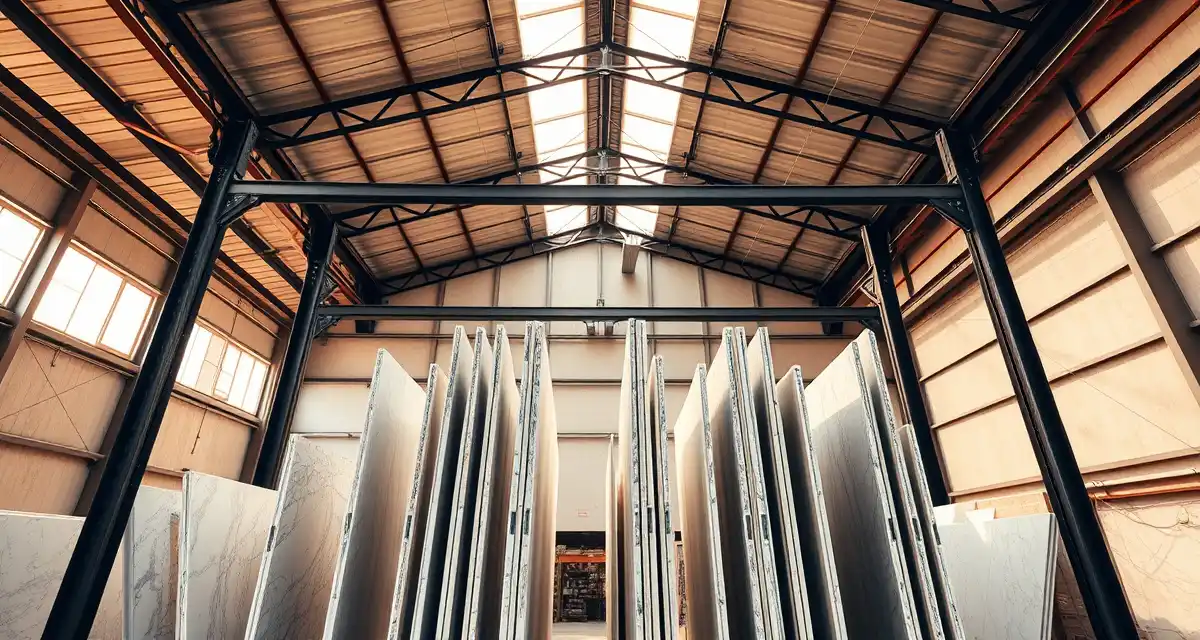
An A-frame (also called an A-frame rack or slab rack) is a steel storage structure shaped like the letter "A" used by countertop fabrication shops and stone distributors to store stone slabs vertically. Slabs lean against the angled sides of the frame, held upright by gravity and the frame's design. A-frames are the standard method for storing granite, quartz, marble, quartzite, and porcelain slabs in fabrication facilities, distributor warehouses, and during transport.
TL;DR
- A-frames are steel racks used to store stone slabs vertically in fabrication shops
- Standard A-frames hold 8-15 slabs per side, depending on slab thickness
- Typical dimensions: 8-10 feet long, 5-6 feet tall, with 80-90 degree lean angle
- Cost: $500-$2,500 per rack depending on size and capacity
- Proper spacing and loading prevents slab breakage (which costs $500-$5,000+ per slab)
- Most fabrication shops need 4-12 A-frames depending on inventory volume
- A-frames are also used on trucks for slab transport
A-Frames: The Foundation of Slab Storage
Why Slabs Are Stored Vertically
Stone slabs are heavy - a 3cm granite slab measuring 120" x 72" weighs approximately 800-1,000 pounds. Storing slabs flat (horizontal) would require enormous floor space and specialized lifting equipment to access individual slabs. It would also put tremendous weight on the bottom slab in a stack, risking cracks.
Calculate your material waste savings
See exactly how much slab material and money you could save with optimized cutting layouts.
Try the free Waste CalculatorVertical storage on A-frames solves these problems:
- Space efficient - 10 slabs stored vertically take up roughly 30 square feet of floor space vs. 500+ square feet if laid flat
- Individual access - You can pull any slab without moving the others (though they need to be separated with spacers)
- Weight distribution - Each slab bears its own weight against the frame's support rails
- Visibility - Staff can see slab colors and patterns for selection and inventory purposes
A-Frame Construction and Specifications
| Component | Typical Specification |
|---|---|
| Frame material | Steel (powder-coated or galvanized) |
| Length | 8-10 feet |
| Height | 5-6 feet |
| Lean angle | 80-85 degrees from horizontal |
| Capacity per side | 8-15 slabs (depending on thickness) |
| Total capacity | 16-30 slabs (both sides) |
| Weight capacity | 10,000-20,000 lbs per rack |
| Floor protection | Rubber or polyurethane base pads |
| Slab contact surfaces | Rubber-coated rails to prevent chipping |
Types of A-Frames
Standard Shop A-Frames
Fixed-position racks that sit on the shop floor. These are the most common type and are available from fabrication supply companies in various sizes. Many shops weld their own from steel stock, saving 30-50% vs. commercial options.
Bundle A-Frames
Larger, heavier-duty frames designed to hold full slab bundles (5-10 slabs banded together) as received from the distributor. Bundle racks sit in the receiving area and hold material before it's broken out into individual slabs and moved to shop A-frames.
Transport A-Frames
Smaller, lighter frames designed to fit in truck beds for delivering finished countertops to job sites. Transport A-frames typically hold 2-6 finished pieces and include tie-down points and rubber padding to prevent damage during transit.
Rolling A-Frames
A-frames mounted on heavy-duty casters for mobility within the shop. These allow fabricators to move slab inventory near the saw or CNC machine as needed, reducing overhead crane use.
A-Frame Safety and Best Practices
Improperly loaded A-frames are one of the top safety hazards in fabrication shops. A falling stone slab can cause severe injury or death.
Critical safety rules:
- Never overload one side. Loading all slabs on one side of the A-frame creates an unbalanced load that can tip the entire rack. Distribute weight roughly equally between both sides.
- Use slab separators. Place rubber or foam separators between slabs to prevent surface damage and allow individual slabs to be pulled without disturbing neighbors.
- Inspect welds regularly. A-frame weld joints fatigue over time, especially in shops where forklifts bump the racks. Inspect monthly and repair immediately if you see cracks.
- Bolt to the floor. Fixed A-frames should be bolted to the concrete floor to prevent tipping. This is especially important in areas with seismic activity.
- Train every employee. Anyone who loads or unloads slabs needs training on safe A-frame procedures. This includes forklift operators, shop floor workers, and delivery drivers.
A-Frame Inventory Management
Here's where many fabrication shops lose money: they know what's on their A-frames in general terms, but they can't tell you specifically which slabs are where without walking the shop floor.
The typical scenario:
- A customer selects a marble slab during a showroom visit
- The salesperson writes the slab identifier on the work order
- Three weeks later, the production crew goes to pull the slab and discovers it was used on another job, or it's on the wrong A-frame, or the identifier was written incorrectly
This confusion leads to:
- Production delays - 30-60 minutes spent hunting for slabs
- Wrong material used - A similar-looking slab gets cut instead, and the customer rejects it at installation ($1,500-$4,000 remake)
- Inventory errors - Remnants aren't tracked, leading to wasted material
Digital inventory tracking eliminates these problems. SlabWise assigns each slab a digital identity the moment it arrives at your shop. Slab location (which A-frame, which position), allocation status (available, reserved for job, remnant), and dimensions are all tracked digitally. When production needs slab #47 for the Johnson kitchen, they know exactly where it is - no hunting required.
How Many A-Frames Does Your Shop Need?
A simple formula:
| Shop Size | Monthly Jobs | Typical Slab Inventory | A-Frames Needed |
|---|---|---|---|
| Small (1-2 person) | 5-10 | 15-30 slabs | 2-4 |
| Mid-size | 15-30 | 40-80 slabs | 4-8 |
| Large | 30-60+ | 80-200+ slabs | 8-15+ |
Add extra capacity for remnant storage. Most shops keep remnants on dedicated A-frames, and remnant inventory grows quickly if not managed actively.
A-Frame Costs
| Type | Price Range |
|---|---|
| Standard shop A-frame (commercial) | $800-$2,500 |
| DIY welded A-frame | $300-$800 (materials) |
| Bundle A-frame (heavy-duty) | $1,500-$4,000 |
| Transport A-frame | $500-$1,500 |
| Rolling A-frame | $1,200-$3,000 |
What is an A-frame used for in stone fabrication?
An A-frame is a steel storage rack used to hold stone slabs vertically. It's the standard storage method in countertop fabrication shops and stone distributor warehouses.
How many slabs can an A-frame hold?
A standard A-frame holds 8-15 slabs per side (16-30 total), depending on slab thickness and frame size.
How much does an A-frame cost?
Commercial A-frames range from $800-$2,500. DIY welded frames can be built for $300-$800 in materials. Transport and specialty frames have different price ranges.
Are A-frames safe?
A-frames are safe when properly loaded, balanced, bolted to the floor, and regularly inspected. Improperly loaded or damaged A-frames are a serious safety hazard.
Should A-frames be bolted to the floor?
Yes. Fixed A-frames should be bolted to the concrete shop floor to prevent tipping, especially when slabs are being loaded or removed.
How far apart should A-frames be spaced?
Allow at least 4-6 feet between A-frame rows for forklift access. Some shops use 8-foot spacing for easier navigation and safety.
Can I build my own A-frames?
Many fabrication shops weld their own A-frames from steel stock. Ensure proper engineering for weight capacity, use rubber-coated contact rails, and bolt to the floor.
What goes between slabs on an A-frame?
Use rubber separators, foam strips, or plywood shims between slabs to prevent surface scratching and chipping.
How do I track which slabs are on which A-frame?
Many shops use chalk markings or paper tags. Digital inventory systems like SlabWise track slab locations automatically, eliminating the hunting and errors that come with manual methods.
Do I need different A-frames for quartz vs. granite?
The same A-frames work for all slab materials. However, some shops dedicate specific A-frames to different material types for easier organization and selection.
Track Every Slab on Every A-Frame with SlabWise
Stop hunting for slabs across your shop floor. SlabWise tracks every slab from the moment it arrives - which A-frame, which position, which job it's reserved for. Your production crew pulls the right slab, first try, every time.
Start your 14-day free trial at SlabWise.com
Try These Free Tools
- Cost Calculator -- Get instant countertop cost estimates by material, edge profile, and square footage.
- Compare Materials -- Side-by-side material comparison with pricing, durability, and maintenance ratings.
- Edge Profile Selector -- Browse edge profiles with cost impact and visual previews.
Sources & Further Reading
- National Kitchen & Bath Association - Cabinet Frame Construction Standards
- International Surface Fabricators Association - Support Frame Requirements for Stone Installation
- Natural Stone Institute - Structural Framing Guidelines for Natural Stone Applications
- ASTM International - ASTM C1242 Standard Guide for Selection, Design, and Installation of Dimension Stone Attachment Systems