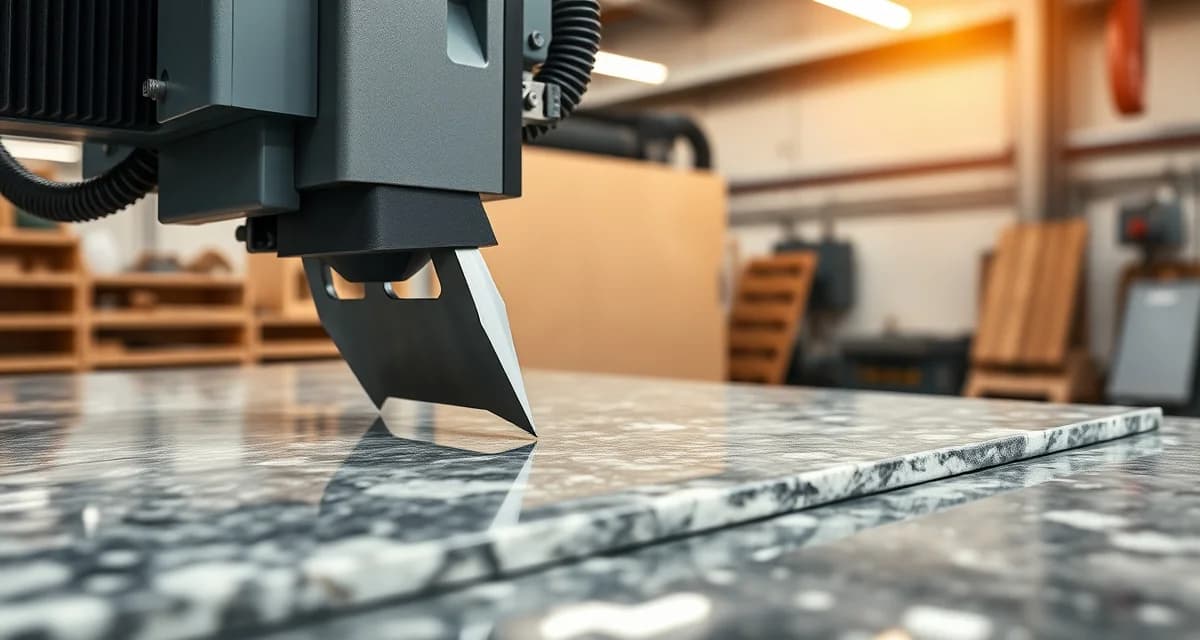
What Is Five Axis Saw? Definition & Guide
Quick Definition
A five axis saw (5-axis saw) is an advanced CNC-controlled bridge saw that can move and tilt its blade along five independent axes of motion, allowing it to make straight cuts, angled cuts, miter cuts, and complex profiles without repositioning the stone slab. In countertop fabrication, five axis saws combine the functions of a traditional bridge saw, a miter saw, and some CNC router operations into a single machine - dramatically reducing handling time and increasing precision on complex jobs like waterfall edges and mitered joints.
TL;DR
- A five axis saw moves its blade along 5 independent axes (X, Y, Z, plus tilt and rotation)
- Combines bridge saw, miter saw, and some router functions in one machine
- Can make straight cuts, 45° miter cuts, and angled profiles without moving the slab
- Essential for waterfall edge fabrication, mitered edges, and laminated profiles
- Reduces material handling and setup time by 30-50% on complex jobs
- Machine cost: $80,000-$350,000+ depending on features and brand
- Requires skilled operators and CNC programming knowledge
- Increasingly common in mid-to-large fabrication shops
The Five Axes Explained
A traditional bridge saw moves along three axes:
Calculate your material waste savings
See exactly how much slab material and money you could save with optimized cutting layouts.
Try the free Waste Calculator- X-axis: Left and right (along the length of the slab)
- Y-axis: Forward and back (across the width of the slab)
- Z-axis: Up and down (depth of cut)
A five axis saw adds two more:
- A-axis (tilt): The blade tilts from vertical to angled positions (0°-90°), allowing miter cuts and angled edges
- C-axis (rotation): The blade head rotates around the vertical axis, allowing cuts at any horizontal angle without moving the slab
These additional axes mean the saw can approach the stone from virtually any angle, making cuts that would require multiple machine setups on a traditional saw.
What a Five Axis Saw Can Do
Standard Straight Cuts
Everything a traditional bridge saw does - sizing slabs, making parallel cuts, cutting template pieces - a five axis saw does too. For shops replacing a bridge saw, the 5-axis machine handles all existing work plus the advanced capabilities.
Miter Cuts (45°)
Tilting the blade to 45° cuts a miter joint - the angled edge used for waterfall countertops and laminated edges. On a traditional saw, mitering requires a separate miter saw or a manual setup that's time-consuming and less precise.
Waterfall Edge Preparation
Waterfall edges (where the countertop wraps down the side of a cabinet) require precise 45° miter cuts on both the horizontal and vertical pieces. A five axis saw makes both cuts in sequence without moving the slab.
Edge Lamination Cuts
To make thin porcelain or 2cm stone look like a thicker slab, fabricators laminate strips to the edge. The 5-axis saw cuts the lamination strips at exact angles for tight, invisible joints.
Profile Cuts
With appropriate tooling, some 5-axis saws can cut basic edge profiles (bullnose, bevel) by tilting the blade. This reduces the need for separate CNC profiling on simpler edges.
Compound Angle Cuts
Architectural applications sometimes require cuts at compound angles (tilted in two dimensions simultaneously). Five axis saws handle these without custom jigs or fixtures.
Five Axis Saw vs. Traditional Bridge Saw
| Capability | Traditional Bridge Saw | Five Axis Saw |
|---|---|---|
| Straight cuts | Yes | Yes |
| Miter cuts (45°) | No (separate machine needed) | Yes |
| Angle cuts (any degree) | No | Yes |
| Blade rotation | No | Yes |
| Waterfall edge prep | Manual/separate machine | Integrated |
| Setup time per job | Multiple setups for complex jobs | Single setup |
| CNC programming | Basic or manual | Full CNC with 5-axis toolpaths |
| Price range | $15,000-$100,000 | $80,000-$350,000+ |
The Productivity Argument
The real value of a five axis saw isn't that it makes cuts a three-axis saw can't - in most cases, the cuts can be done with other equipment. The value is speed and precision:
- No slab repositioning between different cut types
- Automated angle settings (no manual protractor measurements)
- Consistent miter angles across all pieces in a job
- Fewer handling operations reduce breakage risk
- Faster throughput on complex jobs
Shops that do high volumes of waterfall edges, mitered installations, or laminated edge work see the fastest ROI on a 5-axis investment.
Who Needs a Five Axis Saw?
Shops That Benefit Most
- High-volume fabricators processing 20+ jobs per week with regular waterfall and miter work
- Premium-focused shops where architectural and designer projects demand precision angles
- Porcelain/sintered stone specialists where laminated edges are standard on every job
- Growing shops replacing an aging bridge saw and wanting future-proof capability
Shops That May Not Need One (Yet)
- Small shops processing under 10 standard jobs per week with minimal miter work
- Budget-constrained operations where a traditional bridge saw meets current needs
- Predominantly simple work (standard granite, basic edges, no waterfall)
Machine Considerations
Floor Space
Five axis saws typically require a similar footprint to a standard bridge saw - roughly 20' × 12' for the machine plus material handling space. Some models are larger; check specifications before purchasing.
Water and Power
Like all bridge saws, five axis saws use water for cooling and dust suppression. High-performance models may require higher water flow rates and electrical service (three-phase power, 30-60 amp circuits).
Operator Training
A five axis saw is more complex to program and operate than a traditional bridge saw. Operators need training on:
- CNC programming for 5-axis toolpaths
- Material setup and clamping for angled cuts
- Tool selection for different operations
- Safety procedures specific to tilting-blade operations
Software Integration
Five axis saws accept cutting programs from CAD/CAM software. Integration with your fabrication workflow - from template to cutting program to nesting - maximizes the machine's efficiency.
What is a five axis saw?
A CNC-controlled bridge saw that moves its blade along five independent axes, allowing straight, angled, and mitered cuts without repositioning the stone slab.
What are the five axes on a 5-axis saw?
X (left-right), Y (forward-back), Z (up-down), A (blade tilt angle), and C (blade rotation). The A and C axes add angled and rotational cutting capability.
Why is a five axis saw better for waterfall edges?
It cuts precise 45° miters on both the horizontal countertop and vertical waterfall piece in sequence, without moving the slab - producing consistent, tight-fitting joints.
How much does a five axis saw cost?
$80,000-$350,000+ depending on the brand, size, features, and level of CNC automation.
Can a five axis saw replace a bridge saw?
Yes. A 5-axis saw does everything a traditional bridge saw does, plus miter and angle cuts. Many shops use it as their primary (or only) saw.
Does a five axis saw require special training?
Yes. Operators need training on CNC programming, 5-axis toolpath setup, and material handling for angled cuts. Most manufacturers include training with the purchase.
What materials can a five axis saw cut?
All countertop materials: granite, quartz, marble, quartzite, porcelain, sintered stone. The blade selection changes, but the machine handles all of them.
Is a five axis saw worth the investment?
For shops doing regular waterfall, miter, or laminated edge work, the time savings and precision improvements typically deliver ROI within 12-24 months.
Can a five axis saw do edge profiling?
Basic profiles (bevels, chamfers) can be cut by tilting the blade. Complex profiles (ogee, bullnose) still require a CNC router or dedicated profiling equipment.
How fast is a five axis saw compared to a standard bridge saw?
For straight cuts, speed is similar. The time savings come from eliminating slab repositioning and separate machine setups for miter and angle work - reducing total job time 30-50%.
Do I need both a five axis saw and a CNC router?
For most shops, yes. The 5-axis saw handles cutting and mitering; the CNC router handles edge profiling, detailed shaping, and sink cutout finishing.
What brands make five axis saws for stone fabrication?
Major manufacturers include Breton, Intermac (Biesse), Park Industries, BACA Systems, and Northwood.
Get More From Every Machine in Your Shop
Whether you're running a 5-axis saw or a standard bridge saw, the quality of your cutting plan determines your material yield and job throughput. SlabWise's nesting engine optimizes cutting layouts for any equipment configuration.
Start your 14-day free trial →
Try These Free Tools
- Photo to Template -- Snap a photo of an existing countertop and get an AI-generated DXF template.
- Template Compare -- Upload two templates and see every dimension change highlighted instantly.
- AI Template Verification -- Cross-check your template against manufacturer specs before cutting.
Sources & Further Reading
- National Kitchen & Bath Association - Kitchen Sink Selection Guide
- International Surface Fabricators Association - Sink Cutout and Installation Standards
- Natural Stone Institute - Countertop Sink Integration Best Practices
- Remodeling Magazine - Apron Front Sinks: Design and Installation Considerations