What Is Crystalline Silica? Definition & Guide
Quick Definition
Crystalline silica is a naturally occurring mineral found in most rocks, sand, and soil - and it's the primary component of many countertop materials used in fabrication. In its natural form, crystalline silica is harmless. But when stone is cut, ground, or polished, it generates fine respirable dust particles that can cause serious lung damage (silicosis) and other health effects when inhaled. Understanding crystalline silica content in countertop materials is essential for fabrication shop safety compliance and worker protection.
TL;DR
- Crystalline silica (SiO2) is a mineral found in quartz, granite, sandstone, and many countertop materials
- Harmless in solid form - dangerous only as fine airborne dust (<10 micrometers)
- Engineered quartz contains 90%+ crystalline silica; granite 20-45%; marble <5%
- OSHA PEL: 50 μg/m³ over 8-hour TWA
- Respirable silica dust causes silicosis, lung cancer, and kidney disease
- Wet cutting reduces airborne silica by 80-95%
- Every fabrication shop must have a written silica exposure control plan
- Air monitoring determines actual exposure levels in your specific shop environment
What Makes Crystalline Silica Dangerous
Crystalline silica in its solid state - as part of a granite slab or quartz countertop - poses no health risk. You can touch it, stand on it, and eat off it safely.
Calculate your material waste savings
See exactly how much slab material and money you could save with optimized cutting layouts.
Try the free Waste CalculatorThe danger arises when fabrication processes break the material into microscopic dust particles. Particles smaller than 10 micrometers (one-seventh the width of a human hair) are called respirable - small enough to bypass the nose and throat and reach deep into the lungs.
Once in the lungs, these silica particles trigger a chronic inflammatory response. The body can't dissolve or expel them. Over time, this leads to:
- Fibrosis (scarring) of lung tissue
- Reduced lung capacity
- Progressive respiratory failure
The latency period can range from a few years (high exposure, engineered quartz) to decades (moderate exposure, granite).
Crystalline Silica Content in Countertop Materials
Not all countertop materials carry the same risk. Silica content varies dramatically:
| Material | Crystalline Silica Content | Dust Risk Level |
|---|---|---|
| Engineered quartz | 90-94% | Very high |
| Quartzite (natural) | 90%+ | Very high |
| Granite | 20-45% | High |
| Sandstone | 60-95% | Very high |
| Slate | 20-40% | Moderate-high |
| Porcelain | 10-30% | Moderate |
| Marble | <5% | Lower |
| Soapstone | <2% | Low |
| Limestone | <5% | Low |
The critical insight: engineered quartz - the most popular countertop material in the US - has the highest silica content of any commonly fabricated material. A shop that does 50% quartz work is exposing its workers to significantly more silica than a shop doing primarily marble.
How Silica Dust Is Generated in Fabrication
Every major fabrication process generates silica-containing dust:
Cutting (Bridge Saw, CNC)
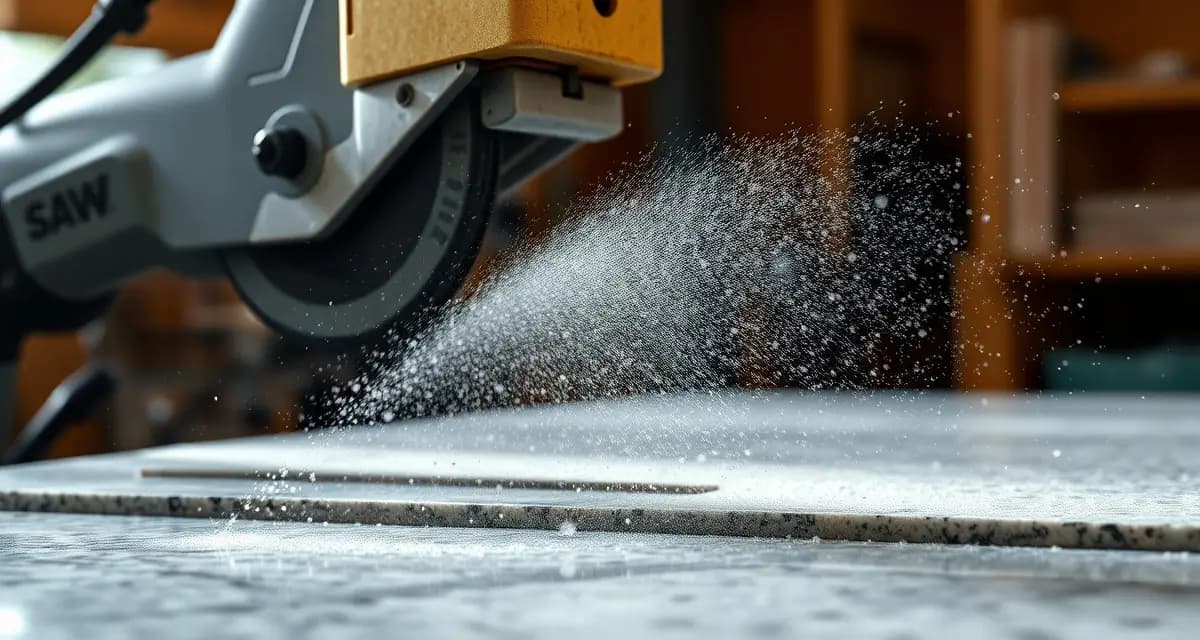
The primary cutting operation breaks stone into smaller pieces, generating both coarse chips and fine dust. Without water suppression, a single dry cut on quartz can produce silica concentrations hundreds of times above OSHA limits.
Grinding and Shaping
Edge profiling, sink cutout finishing, and radius grinding create fine particles as the diamond tools abrade the stone surface.
Polishing
Although polishing uses finer abrasives and often involves water, it still generates respirable dust - especially during hand polishing or touch-up work.
Handling and Cleanup
Moving cut pieces, dry sweeping the shop floor, and using compressed air to clean workspaces can re-aerosolize settled silica dust, creating secondary exposure.
OSHA Silica Regulations for Fabrication Shops
Key Requirements
| Requirement | Details |
|---|---|
| Permissible Exposure Limit (PEL) | 50 μg/m³ TWA over 8 hours |
| Action Level | 25 μg/m³ - triggers monitoring and medical surveillance |
| Exposure Assessment | Initial monitoring required; periodic monitoring if above action level |
| Engineering Controls | Wet methods, ventilation, dust collection |
| Respiratory Protection | When engineering controls alone don't achieve PEL |
| Medical Surveillance | For workers exposed above action level: chest X-ray and spirometry every 3 years |
| Written Control Plan | Documenting all exposure controls and procedures |
| Worker Training | On hazards, controls, respirator use, and medical program |
| Housekeeping | No dry sweeping; use wet methods or HEPA vacuums |
Enforcement Reality
OSHA has increased enforcement in the stone fabrication industry. Inspectors visit shops with and without complaints. Penalties for violations can exceed $16,000 per serious violation and $160,000+ for willful violations.
Controlling Silica Exposure in Your Shop
Tier 1: Engineering Controls (Most Effective)
- Wet cutting on all saws and CNC machines - maintains water flow at the cutting point
- Enclosed CNC with integrated dust/water collection - contains particles at the source
- Downdraft tables for hand polishing and grinding
- Local exhaust ventilation (LEV) positioned at dust-generating points
- General shop ventilation for overall air exchange
Tier 2: Work Practice Controls
- Never dry cut any silica-containing material
- Use HEPA-filtered vacuums (not brooms or compressed air) for cleanup
- Maintain water suppression systems - check nozzles, flow rates, and pump function daily
- Segregate dusty operations from other work areas when possible
- Provide clean changing areas so contaminated clothing doesn't go home with workers
Tier 3: Personal Protective Equipment (PPE)
- N95 respirators (minimum) for tasks where engineering controls are insufficient
- P100 or half-face respirators for higher-exposure tasks
- Supplied-air respirators for extremely dusty operations
- Fit testing annually or whenever respirator model changes
- PPE supplements engineering controls - it doesn't replace them
Air Monitoring: Know Your Actual Exposure
The only way to know if your controls are working is to measure airborne silica levels in your shop. Air monitoring involves:
- Personal sampling - a pump worn by the worker collects air from the breathing zone during a full shift
- Laboratory analysis - the sample is analyzed for respirable crystalline silica concentration
- Comparison to PEL - results are compared against the 50 μg/m³ standard
- Adjustment - if levels exceed limits, additional controls are implemented and re-monitoring confirms effectiveness
Initial monitoring is required. If results are above the action level (25 μg/m³), periodic monitoring must continue.
What is crystalline silica?
Crystalline silica (SiO2) is a naturally occurring mineral found in most rocks, sand, and soil. It's the primary component of quartz and is present in many countertop materials.
Why is crystalline silica dangerous in fabrication?
When stone is cut or ground, it creates fine dust particles small enough to inhale deep into the lungs. These particles cause permanent scarring (silicosis) and increase the risk of lung cancer.
Which countertop materials contain the most silica?
Engineered quartz (90-94%), quartzite (90%+), and granite (20-45%) have the highest crystalline silica content among common countertop materials.
What is OSHA's permissible exposure limit for silica?
50 micrograms per cubic meter of air, averaged over an 8-hour work shift (TWA).
Does wet cutting eliminate silica dust completely?
No, but it reduces airborne silica by 80-95%. Combined with ventilation and dust collection, wet cutting brings exposure to safe levels in most operations.
How do I know if my shop's silica levels are safe?
Through air monitoring. Personal air sampling during typical work activities, analyzed by an accredited laboratory, determines your actual exposure levels.
Is marble safer to fabricate than quartz regarding silica?
Yes. Marble contains less than 5% crystalline silica compared to engineered quartz at 90%+. However, proper dust controls should be used with all stone materials.
What happens if my shop doesn't comply with silica standards?
OSHA can issue citations with penalties of $16,000+ per serious violation. More importantly, your workers can develop silicosis - a preventable but incurable disease.
How often should air monitoring be done?
Initial monitoring is required. If results exceed the action level (25 μg/m³), periodic monitoring continues until levels are consistently below the action level.
Can silica exposure cause cancer?
Yes. OSHA and the International Agency for Research on Cancer (IARC) classify respirable crystalline silica as a known human carcinogen for lung cancer.
Do fabrication workers need medical exams for silica exposure?
If exposed above the action level (25 μg/m³), OSHA requires medical surveillance including chest X-rays and spirometry (lung function tests) every 3 years.
Is a dust mask enough protection against silica?
A standard dust mask is not sufficient. Workers need at minimum a properly fitted N95 respirator, and P100 or supplied-air respirators for higher exposures. Respirators must supplement engineering controls, not replace them.
Run a Safer, More Efficient Shop
Protecting workers from silica exposure requires investment in proper controls. SlabWise helps fabrication shops operate more profitably - reducing material waste and administrative burden - so you can direct resources toward the safety infrastructure your team deserves.
Start your 14-day free trial →
Try These Free Tools
- Cost Calculator -- Get instant countertop cost estimates by material and square footage.
- Kitchen Visualizer -- Upload a kitchen photo and preview different materials in place.
- Template Compare -- Upload two templates and see every dimension change highlighted.
Sources & Further Reading
- OSHA - Crystalline Silica Construction Standard
- Natural Stone Institute - Silica Safety Guidelines
- International Surface Fabricators Association - Crystalline Silica Exposure Prevention
- U.S. Geological Survey - Silica Mineral Commodity Summary